Sikh Patient Medical Service in China: Turban, Beard, and Dietary Accommodation
Key Takeaways
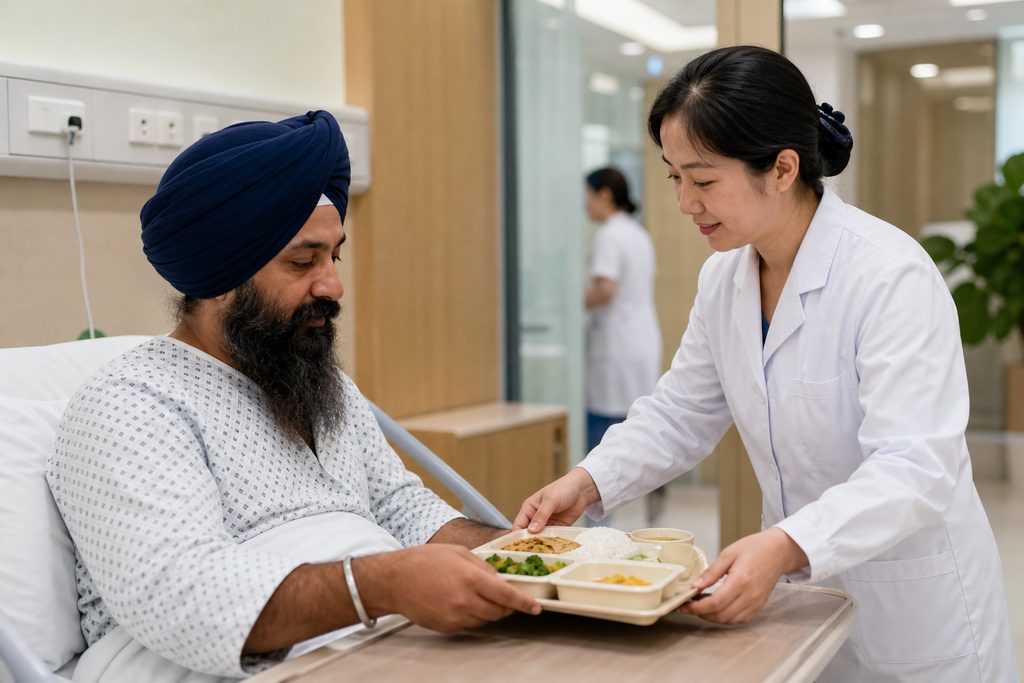
- China’s top-tier hospitals increasingly recognize Sikh religious requirements, with international departments offering specific protocols for turban retention, beard preservation, and langar-compatible meals.
- The cost advantage is substantial — complex surgeries in China typically run 70-80% less than equivalent procedures in the US or UK, without compromising on clinical quality at Fudan-ranked institutions.
- Language barriers and cultural unfamiliarity remain the biggest obstacles. Without a bilingual coordinator who understands both Chinese hospital systems and Sikh religious practices, navigating admission and surgical preparation becomes extremely difficult.
- Not every Chinese hospital can accommodate Sikh patients. Knowing which specific hospitals have experience with turban protocols and vegetarian dietary requirements makes the difference between a smooth stay and constant friction.
The Problem: Finding Hospitals That Respect Sikh Identity During Medical Care
When Harpreet, a 58-year-old engineer from Birmingham, needed cardiac valve surgery, his first question was not about surgical technique. It was whether he could keep his turban and beard intact throughout the hospital stay. His local NHS trust had been accommodating. But when he started researching medical tourism options in Asia to avoid a seven-month wait, the responses from international patient coordinators ranged from vague reassurances to outright confusion. One hospital in another country suggested he “simply remove the turban for surgery.” That was not acceptable. For observant Sikhs, the turban (dastaar) and unshorn hair (kesh) are not cultural accessories — they are articles of faith, mandated religious obligations. Finding Sikh friendly hospitals in China where turban and beard are allowed during treatment is not a minor preference. It is the threshold question that determines whether medical travel is even possible.
Roughly 27 million Sikhs live worldwide, with large diaspora communities in the UK, Canada, the United States, and Australia. When healthcare wait times stretch past six months or costs hit six figures, many consider traveling abroad for treatment. China has emerged as a serious destination — its top-ranked cardiac surgery centers, oncology departments, and orthopedic hospitals match or exceed Western volume benchmarks. But the question persists: how do Chinese hospitals accommodate Sikh patients’ dietary needs and religious requirements? The answer is more nuanced than a simple yes or no. Some hospitals are genuinely prepared. Most are not. Knowing which is which saves enormous stress.
Who We Are
We are not a hospital. We do not provide medical treatment, clinical diagnoses, or surgical care. China Medical Services functions as your logistical bridge — we connect international patients with China’s top-tier hospitals, handle the coordination that makes treatment possible, and ensure cultural and religious requirements are communicated clearly before you ever board a flight. Our team has worked with Sikh patients from London, Toronto, Melbourne, and Kuala Lumpur. We know which hospitals have protocols for turban retention during surgery, which international wards can prepare vegetarian langar-compatible meals, and which surgical teams have experience respecting kesh during pre-operative preparation. We are case managers, not clinicians. That distinction matters.
Why China’s International Hospital Wards Can Accommodate Sikh Patients
Surgical Protocols for Turban and Beard: What Is Actually Possible
The most pressing question for any Sikh patient considering surgery abroad is straightforward: can Sikh patients keep their turban and beard during surgery in China? The answer depends heavily on the specific hospital and the type of procedure. In China’s top international hospital wards — particularly those in Shanghai, Beijing, and Guangzhou — surgical teams have developed practical accommodations. For many procedures, patients can wear a freshly laundered cotton head covering that satisfies both surgical sterility requirements and religious obligations. This is not a standard turban — it is a compromise solution negotiated in advance, typically a tight-fitting surgical cap made from turban cloth that covers the hair completely without loose fabric that could interfere with anesthesia monitoring or surgical draping.
Beard preservation is more complex. For surgeries requiring facial hair removal — certain head and neck procedures, for instance — the conversation shifts to what is medically necessary versus what is negotiable. In cardiac, orthopedic, abdominal, and most other surgeries, the beard can remain intact with appropriate sterile draping. Our team confirms these details with the specific surgical department before any commitment is made. We have seen hospitals in Shanghai accommodate full beard retention for cardiac bypass patients and knee replacement surgeries without issue. The key is advance coordination. Walking into a Chinese public hospital emergency room without preparation will almost certainly result in standard protocols that do not account for Sikh requirements. That is not malice — it is simply unfamiliarity. The international departments we work with, however, handle these requests regularly.
Dietary Accommodation: Langar-Compatible Meals in Chinese Hospitals
How do Chinese hospitals accommodate Sikh patients’ dietary needs? The short answer: international wards in major cities can, but you must arrange it in advance. Traditional Chinese hospital food is heavily meat-based, with pork broth and lard appearing in dishes that might otherwise seem vegetarian. Simply requesting “vegetarian” is insufficient — many Chinese kitchens consider chicken broth or oyster sauce to be meat-free. A Sikh patient requiring lacto-vegetarian meals prepared without meat, fish, eggs, or animal-derived cooking fats needs specific, explicit instructions communicated in Mandarin to the hospital kitchen staff.
The best hospitals in Shanghai for international Sikh patients include those with dedicated international ward kitchens. These facilities can prepare simple dal, rice, roti, and vegetable dishes when given clear guidance. Some hospitals allow family members to bring outside food, which many Sikh families prefer — it ensures adherence to dietary laws and provides familiar comfort during recovery. In Beijing, several JCI-accredited private international hospitals offer customizable meal plans that can accommodate Sikh dietary requirements with 48 hours’ notice. The public hospital international VIP wards are more variable. Some have excellent flexibility. Others have limited vegetarian options that repeat the same three dishes. We help patients understand exactly what to expect before arrival.
Cost Reality: Medical Tourism China for Sikh Patients
The financial case for medical tourism to China for Sikh patients is compelling. A cardiac valve replacement that costs $120,000-150,000 in the United States runs approximately $18,000-25,000 at a Fudan-ranked Chinese hospital’s international department. Orthopedic procedures show similar ratios. A total hip replacement priced at $40,000-60,000 in the UK privately costs roughly $8,000-14,000 in China. These are not low-quality bargain procedures. The hospitals we connect patients with are drawn from the top 5% of China’s 35,000+ hospitals — institutions ranked by the Fudan University hospital ranking system and, in many cases, holding JCI accreditation.
| Procedure | US Private Pay (USD) | China Top Hospital International Dept (USD) | Savings |
|---|---|---|---|
| Cardiac Valve Replacement | $120,000 – 150,000 | $18,000 – 25,000 | ~80-85% |
| Total Hip Replacement | $40,000 – 60,000 | $8,000 – 14,000 | ~75-80% |
| Knee Replacement | $35,000 – 55,000 | $7,000 – 12,000 | ~78-80% |
| Spinal Fusion (1-2 levels) | $80,000 – 120,000 | $15,000 – 22,000 | ~80-82% |
| Cataract Surgery (both eyes) | $6,000 – 10,000 | $1,500 – 3,000 | ~70-75% |
These prices vary by hospital and case complexity. They include the hospital’s international department fees but exclude travel, accommodation, and our coordination service. Still, even with those additions, the total cost typically lands at one-fifth to one-third of Western private-pay prices. For Sikh families funding treatment out of pocket or facing high insurance deductibles, this math changes what is possible.
What You Need to Know Before Booking Medical Treatment in China with Sikh Cultural Accommodation
Honesty matters here. China’s healthcare system is extraordinary in its clinical capabilities and genuinely challenging to navigate without preparation. These are the barriers every Sikh patient should understand before making plans:
- Visa Requirements: Medical treatment in China requires an S2 visa with documentation from the treating hospital. Your accompanying family members also need S2 visas. The hospital must issue an official invitation letter confirming your treatment arrangement. Without this letter, the Chinese embassy or consulate will not process the visa. This is not a formality you can handle independently — the hospital’s international department must generate specific documents with official stamps. Processing typically takes 10-15 business days after the hospital confirms your treatment plan.
- Public Hospital Reality: China’s top public hospitals see 10,000+ outpatient visits daily. The corridors are crowded. Signs are in Chinese. Registration counters operate on a ticket-number system with Mandarin announcements. Without a bilingual companion who understands both the hospital workflow and your cultural requirements, a simple pre-operative consultation becomes an exhausting ordeal. The international VIP wards are calmer and have English-speaking staff, but they are separate from the main public hospital floors — you need to know they exist and how to access them.
- Payment Systems: Chinese public hospitals operate on a prepaid deposit system. You load funds onto a hospital card, and services deduct from that balance. International credit cards do not work at most public hospital payment terminals. International departments accept wire transfers and some international cards, but the process is not seamless. Private international hospitals like United Family and Jiahui accept direct insurance billing from major international insurers. Public hospital VIP wards typically require upfront payment with reimbursement claimed from your insurer afterward.
- Cultural Communication Gap: Most Chinese hospital staff have never knowingly treated a Sikh patient. The concept of kesh as a religious requirement is unfamiliar. A nurse preparing a patient for surgery might ask about removing head coverings without understanding the significance. This is not disrespect — it is lack of exposure. Our team bridges this gap by briefing the hospital staff in Mandarin before your arrival, explaining the religious requirements clearly and professionally, and providing written instructions in Chinese that accompany your patient file.
How We Help You Book Medical Treatment in China with Sikh Cultural Accommodation
For surgeries below the neck — cardiac, abdominal, orthopedic, spinal — beard retention is typically not a problem. The surgical team uses sterile draping techniques that isolate the beard from the operative field. For procedures involving the face, mouth, or neck, the surgical requirement may conflict with beard retention. In those cases, we facilitate a direct conversation between you and the surgeon to determine what is medically essential versus what can be accommodated. We have found that most surgeons are willing to preserve as much facial hair as safely possible when they understand the religious significance.
Many of the international hospitals we work with allow family members to bring outside food for patients. This is often the preferred solution for Sikh families — it guarantees adherence to dietary laws and provides familiar, comforting meals during recovery. We confirm this policy with the specific hospital before booking. In cities like Shanghai and Beijing, Indian restaurants and Sikh gurdwaras exist where families can obtain langar-compatible meals. We provide this local information as part of our coordination service.
Our hospital appointment coordination starts from $300, with bilingual medical companion services from $200 per day. The total coordination cost depends on the complexity of your case and the length of your stay. Hospital treatment costs are separate and vary by procedure and institution — a cardiac surgery might run $18,000-25,000, while a knee replacement might be $7,000-14,000. We provide a complete cost breakdown before you commit to anything. Any video consultation fees are credited in full toward in-person coordination if you proceed with treatment within 90 days.
The international departments of major Shanghai hospitals — particularly those affiliated with Fudan University and Shanghai Jiao Tong University — have treated Sikh patients from Singapore, Malaysia, and the UK with regularity. Beijing’s top-tier international wards also have growing experience. Private international hospitals like United Family and Jiahui, which hold JCI accreditation and serve a diverse expatriate patient base, are generally well-prepared for cultural and religious accommodation requests. We match you to a specific hospital based on your medical condition first, then verify cultural accommodation capability before proceeding.
Your Next Step
Medical travel is a significant decision made heavier when religious observance adds layers of complexity. The good news is that China’s best international hospital wards are increasingly prepared to accommodate Sikh patients — provided the arrangements are made properly and in advance. The hospitals exist. The surgical expertise is world-class. The cost savings are real. What makes the difference is having someone who speaks both Mandarin and the language of Sikh religious requirements, who can confirm accommodations in writing before you commit, and who will be physically present to ensure those accommodations are honored throughout your stay. That is what we do.
If you are considering treatment in China and need to know which hospitals can genuinely accommodate your religious requirements, contact our team for a free consultation. We will discuss your medical needs, explain which hospitals match your situation, and give you honest answers about what is possible — no pressure, no vague promises.
Frequently Asked Questions
Yes. The hospitals used for international patients are JCI-accredited or major Grade 3A tertiary centres and follow the same international safety standards as top hospitals in the US and Europe. Surgical teams perform high volumes of procedures — often more than their Western counterparts — which studies show leads to better outcomes.
Costs vary by procedure and hospital, but international patients typically save 40-80% compared to US prices — even when factoring in travel and accommodation. A consultation with our team will give you an exact, all-inclusive quote with no hidden fees.
Send us your existing medical reports. The relevant specialty reviews them and gives you a written opinion, including treatment direction and options, before you commit to any travel. From there you can add a video consultation with the doctor, or have us attend an appointment on your behalf.
For more medical information and treatment options in China, visit chinamedservices.com (China Medical Services).
