First Hospital of Soochow University: Help for International Patients
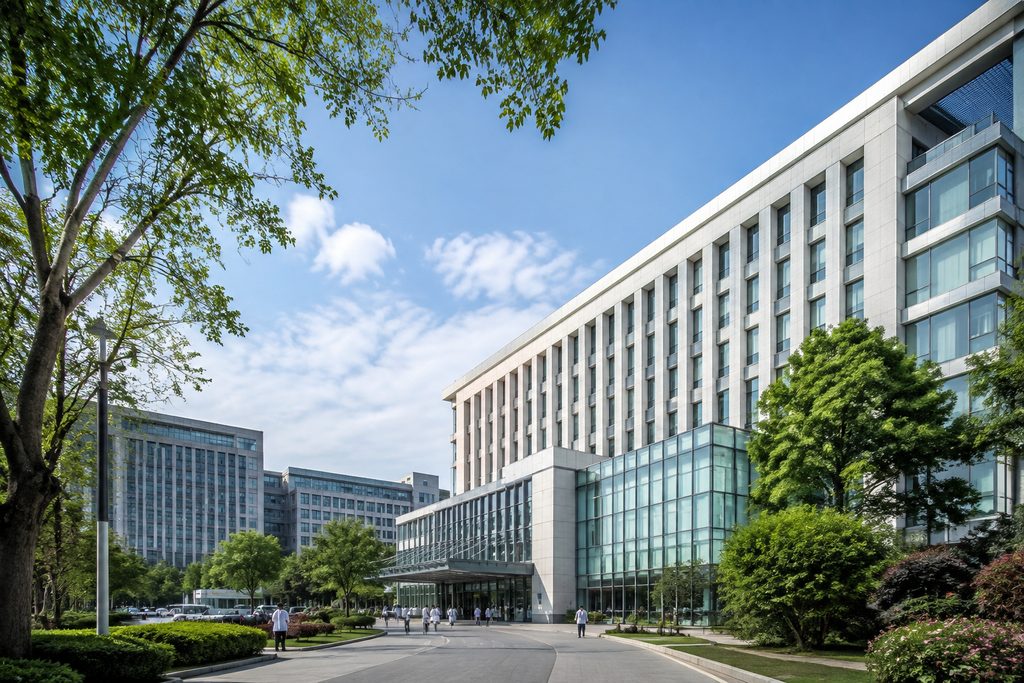
Key Takeaways
- First Hospital of Soochow University is a top-tier public hospital in Suzhou, roughly 30 minutes from Shanghai by high-speed rail — but its international-facing services are less developed than Beijing or Shanghai’s flagship hospitals.
- For straightforward cases, the hospital’s own international office can arrange appointments. For complex surgery, a remote second opinion before you fly is often the smarter first move.
- Public hospitals in China do not let you book an ordinary outpatient slot from overseas. You either register in person on the day, or you go through the international/VIP channel — and that costs roughly 1.5 to 2 times the standard fee.
- No hospital, in China or anywhere, can promise a specific surgeon or a guaranteed admission date. Anyone who says otherwise is selling you something that does not exist.
A hospital “international department” sounds simple enough. In practice, it means a separate administrative unit inside a large Chinese public hospital that handles foreign patients, English-language paperwork, and often a faster, pricier track through the system. First Hospital of Soochow University has one. What it can and cannot do for you depends entirely on your case.
If you are searching for help with First Hospital of Soochow University international patients, you are probably stuck somewhere between two questions: is this hospital actually right for my condition, and how do I get in the door from 6,000 miles away? This guide answers both honestly — including the parts that are inconvenient.
Why Foreign Patients Look at Suzhou in the First Place
Routine diagnostics, health checkups, chronic disease management, and many elective procedures are handled competently at large Chinese tertiary hospitals, and Suzhou is no exception. If you already have a diagnosis and a clear treatment plan, the hospital can often execute that plan at a fraction of Western pricing.
Patients who live in or near Suzhou — expatriates working in Jiangsu’s manufacturing and tech sectors, for instance — frequently use the hospital for exactly this reason. It is local, it is capable, and it does not require a trip to Shanghai.
Where it gets harder
Highly subspecialized surgery, rare cancers, and cases needing multidisciplinary input are where hospital choice starts to matter enormously. China’s specialty reputation rankings, published annually by Fudan University, list the top ten hospitals per specialty across 45 disciplines. Those lists are the single most useful public tool for matching a condition to a hospital.
If your case falls into a narrow subspecialty, the right answer may be a different hospital entirely — and that is worth knowing before you book flights. Our specialty-by-specialty hospital rankings let you check where a given condition is actually concentrated.
What Treatment in Suzhou Actually Costs
Cost is usually the second question, and the honest answer is a range, not a number. Pricing varies by hospital, by department, by whether you use the standard or international channel, and by how complex your case turns out to be once imaging is reviewed.
What we can give you is a structural comparison. The figures below are typical ranges for self-paying international patients at top-tier Chinese public hospitals; they are not quotes, and they exclude travel and accommodation. Final pricing must be confirmed by the hospital after your records are reviewed.
| Procedure | Typical China range (USD) | Typical US range (USD) |
|---|---|---|
| Coronary artery bypass graft | $12,000 – $20,000 | $120,000+ |
| Total knee replacement | $8,000 – $15,000 | $35,000 – $60,000 |
| Cataract surgery (per eye) | $1,500 – $4,000 | $3,500 – $7,000 |
| Comprehensive health checkup | $300 – $1,500 | $1,000 – $5,000 |
| MRI scan (single region) | $150 – $500 | $1,000 – $3,000 |
These numbers explain why Suzhou attracts medical travelers. A knee replacement at a Chinese tertiary hospital can cost less than a US insurance deductible.
But lower cost is not automatically better value. The relevant question is whether the surgeon doing your operation performs enough of them to be genuinely good at it. At China’s highest-volume centers, a senior orthopedic surgeon may complete several hundred joint replacements a year. Volume and outcome are correlated in surgery, and that correlation is the thing worth paying attention to — not the sticker price alone.
How to Get Treatment at Soochow University Hospital as a Foreigner
Here is where most overseas patients hit a wall, so let us be blunt about the mechanics.
Chinese public hospitals generally do not allow you to book an ordinary outpatient appointment from abroad. Registration happens on the day, in person, by queue or by app, and it is in Chinese. Surgery cannot be scheduled until a doctor has examined you face to face. There is no workaround for that rule at any public hospital in the country.
The alternative is the hospital’s international or VIP channel. That route gives you a senior physician, English-language support, and a much shorter queue. It also costs roughly 1.5 to 2 times the standard fee. For many foreign patients, that premium is worth it. For others, it is not — and both are legitimate conclusions.
A practical sequence that works:
- Assemble your existing records — imaging files on disc or DICOM, pathology reports, lab results, operative notes, and current medication list. Translated into English or Chinese where possible.
- Get a written second opinion from the relevant Chinese specialty before you commit to travel. This is the single highest-value step, because it tells you whether the trip is even necessary.
- If the plan is feasible, coordinate the appointment through the international office and confirm what documentation they need from you.
- Apply for the correct visa. For medical treatment, that is the S2 category, with S1 for stays exceeding 180 days. Accompanying family members apply under S2 as well. Note that the M visa is for commercial and trade activity and has nothing to do with medical care — a mistake we see repeatedly in online guides.
- Budget for a companion or interpreter. A hospital with tens of thousands of daily outpatient visits is not navigable without Chinese, even for confident travelers.
Comparing Your Real Options Before You Commit
Medical tourism packages for Suzhou, Shanghai, and the wider Yangtze River Delta vary enormously in what they actually include. Some bundle airport pickup, hotel, interpreter, and hospital coordination. Others are little more than a hotel booking with a markup.
When you evaluate any package — ours included — ask four questions:
Who reviews my records, and are they a specialist in my condition? A general practitioner glancing at an MRI is not a second opinion. You want the relevant department reading your file.
What happens if the appointment cannot be secured? A legitimate coordinator will tell you the refund terms up front. Ours: if we cannot secure the appointment you ordered, the coordination fee is refunded in full.
Is anyone promising a specific surgeon or a guaranteed surgery date? If yes, walk away. No coordinator can promise that at a Chinese public hospital, and anyone who does is misrepresenting their access.
What is the total cost, including the international-channel premium? The VIP track roughly doubles some fees. A quote that ignores this is not a quote.
One more consideration: patients sometimes assume a famous hospital name guarantees a good outcome for their specific problem. It does not. Matching the specialty to the condition matters more than the hospital’s overall reputation. A hospital ranked in the national top tier overall may still be mid-tier for your particular diagnosis.
Practical Considerations: Visas, Payment, and Follow-Up
Visa. The S2 visa covers short-stay medical treatment. You will typically need an invitation or appointment confirmation letter from the hospital, plus proof of funds and travel documents. Requirements shift, so verify current rules with the Chinese embassy or consulate in your country before applying. Approval is never guaranteed, and processing times vary by consulate and season.
Payment. Chinese public hospitals generally require prepayment for foreign self-paying patients, with insurance reimbursed afterward. Private international hospitals in larger cities often bill insurers directly. If you carry international health insurance, contact them before travel to confirm whether they will reimburse treatment in China and what documentation they require.
Language. Assume nothing will be in English beyond the international department’s own paperwork. Lab reports, consent forms, and pharmacy instructions are typically Chinese-only.
Follow-up. Plan your post-operative care before you leave. Ask your surgeon what imaging or lab work should be done at home, at what intervals, and request a written summary in English you can hand to your doctor. Getting that document after you have left the country is far harder than getting it while you are still there.
For a broader view of how the system fits together, our directory of top-ranked Chinese hospitals by city is organized to make comparison straightforward.
Frequently Asked Questions
Can I book an appointment at First Hospital of Soochow University from overseas?
Not for a standard outpatient slot. Public hospitals register same-day, in person. What you can do from abroad is contact the hospital’s international office or work through a coordinator to arrange an international-channel appointment, which is a separate and more expensive track. Expect the process to require your medical records in advance.
How much does treatment cost for foreigners compared with local patients?
Foreign patients using the international or VIP channel typically pay about 1.5 to 2 times the standard fee. Standard-channel pricing is theoretically available to foreign patients too, but it requires Chinese-language navigation and same-day queuing. Either way, costs remain well below comparable US pricing for most procedures.
What if the treatment does not go as planned?
This is the question worth asking before you travel, not after. Large Chinese tertiary hospitals have established complaint and complication-management procedures, but they operate in Chinese and follow Chinese medical practice standards. Before committing, confirm in writing what follow-up the hospital provides, who your point of contact is, and how your home physician will receive records. Travel insurance covering medical complications is a reasonable safeguard, though it does not cover the treatment itself.
Do I need a medical visa for China?
For short-stay medical treatment, the applicable category is S2. Stays beyond 180 days fall under S1. Family members accompanying you also apply under S2. The M visa is for commercial and trade activities and is not a medical visa. Always confirm current requirements with your nearest Chinese embassy or consulate, as rules and documentation expectations change.
Your Next Step
The core message is simple: First Hospital of Soochow University is a capable tertiary hospital in a convenient, affordable city — but whether it is the right hospital for you depends on your specific diagnosis, and that question deserves an answer before you book a flight. We are China Medical Services, a coordination service, not a hospital. We do not diagnose or treat anyone. What we do is help you get your records in front of the right Chinese specialists, understand your realistic options, and navigate the logistics if you decide to travel. If you would like a straightforward assessment of your case, you can start with a free consultation — no obligation, and no pressure either way.
This article is for general information only and is not medical advice. Treatment decisions should always be made with a qualified physician who has reviewed your individual case.
For more medical information and treatment options in China, visit chinamedservices.com (China Medical Services).
