Spine MRI in China: How to Arrange It and What It Costs
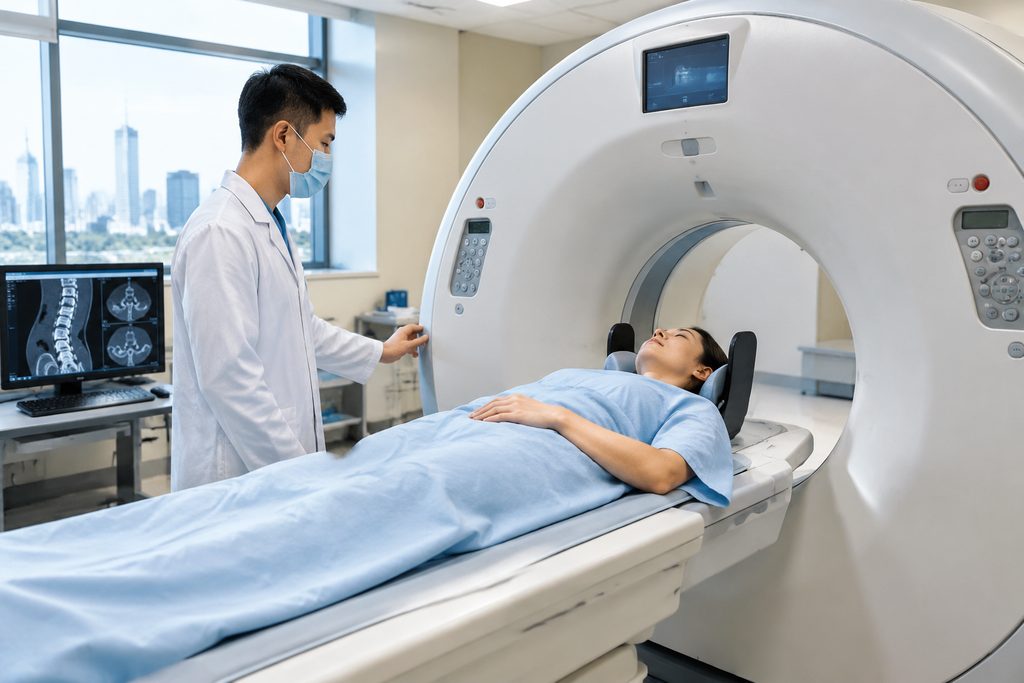
A spine MRI is a magnetic resonance imaging scan that uses a strong magnetic field and radio waves to build detailed pictures of your spinal cord, vertebrae and the discs between them. No radiation. No needles. You lie still in a tube-shaped machine for 20 to 45 minutes, and a radiologist reads the images afterward. That is the whole procedure.
The hard part is not the scan. It is figuring out where to get one, what it will cost, and whether a foreigner with limited Mandarin can walk into a Chinese hospital and make it happen. This guide answers that, based on what our team coordinates every week.
For most international patients, spine MRI cost China falls somewhere between $300 and $900 at a top-tier public hospital, and $800 to $1,800 at a private international facility. Compare that with $1,500 to $4,000 in the United States for the same study without insurance. The gap is real, and it is one reason medical travel to China for imaging has grown quietly rather than loudly.
How This Actually Works, Step by Step
Here is the honest sequence. It is not complicated, but it is also not instant.
Step one: you send us your existing records. That means your referral note, any prior imaging reports, previous MRI or CT discs if you have them, and a short description of your symptoms — numbness, radiating leg pain, a disc herniation diagnosed years ago, whatever the case is. Digital files are fine. Photos of paper reports are fine.
Step two: a Chinese specialist reviews the file. This matters more than people expect. A spine MRI without a clinical question is just a stack of pictures. The reviewing physician decides whether you need a cervical, thoracic or lumbar study, whether contrast dye should be used, and whether a plain X-ray or CT would actually answer the question faster and cheaper. Sometimes the answer is “you do not need this scan.” We would rather tell you that early.
Step three: we match you to a hospital and a slot. Public tertiary hospitals in China generally do not allow overseas patients to book an outpatient imaging slot directly from abroad. Appointments are released through the hospital’s international department or VIP channel, and that is the route we use. You get a confirmed date, a department, and a time window.
Step four: you arrive, register, and scan. On the day, you present your passport, complete registration, pay, and go to the imaging floor. A bilingual companion can handle the queueing, the payment window, and the instructions the technician gives you in Mandarin. Reports typically come back in 24 to 72 hours, sometimes same-day for urgent cases.
If you want the broader picture of how foreigners move through Chinese hospitals, our overview of medical treatment in China for international patients covers the full pathway from visa to discharge.
Where to Go: Choosing Between Public Giants and Private International Hospitals
Two very different experiences exist side by side in Chinese cities, and the choice changes your cost, your wait time and your comfort level.
Public tertiary hospitals — the ones in the Fudan rankings — have the newest 3-Tesla and even 7-Tesla MRI machines, enormous radiology volumes, and radiologists who read hundreds of spine studies a week. Volume builds pattern recognition. That is a genuine clinical advantage. The trade-off is crowds: a major hospital can see 10,000 or more outpatients in a single day. Without help, navigation is brutal.
Private international hospitals such as United Family, Jiahui, Parkway and Raffles offer English-speaking staff, JCI accreditation, direct insurance billing, and a calm waiting room. You will pay roughly two to three times the public-hospital price for the same scan. For a straightforward lumbar MRI, that may not be worth it. For a patient with anxiety, mobility problems, or a tight business-travel schedule, it often is.
When people ask about the best hospital for spine MRI in Shanghai, the honest answer is that several institutions qualify, and the right one depends on whether you need a radiologist’s report alone or a spine surgeon to read it with you. Shanghai’s top public hospitals and its international private facilities both sit within our network. You can browse them by city on our ranked directory of top Chinese hospitals.
A Realistic Timeline
People underestimate the paperwork. Here is what a typical arrangement looks like when nothing goes wrong.
| Stage | Timeframe | What Happens |
|---|---|---|
| Records collection | Days 1–3 | You gather reports, discs, symptom notes; we translate key documents |
| Specialist review | Days 3–7 | A Chinese physician confirms the scan type and clinical question |
| Hospital matching and slot booking | Days 5–14 | International department confirms date; popular specialists book out further |
| Visa (S2, if traveling) | 1–3 weeks | Applied for with hospital invitation documents; processing varies by consulate |
| Travel and scan day | Day of visit | Registration, payment, imaging — allow a half day at a public hospital |
| Report delivery | 24–72 hours | Written report, plus disc or digital files for your home physician |
| Follow-up consultation | Optional, same trip | Spine surgeon reviews images with you and discusses options |
Total elapsed time from first email to images in hand: usually two to four weeks if a visa is involved, and as little as five to seven days if you are already in China.
What Can Go Wrong — and What Happens Then
We would rather you hear the failure modes from us than discover them at a registration desk.
The scan you booked is the wrong scan. This happens when nobody reviewed the clinical history first. A patient arrives expecting a lumbar MRI and the radiologist needs cervical views too. Fix: the pre-review step exists precisely to prevent this. If it still happens, most hospitals can add sequences in the same session for an additional fee.
You cannot get the slot you wanted. Public hospital imaging schedules fill up, and no coordinator can override that. Our appointment coordination service refunds in full if we cannot secure the appointment shown in your order. That is the honest limit of what anyone can promise.
Contrast dye causes a reaction. Reactions to gadolinium contrast are uncommon and usually mild — a rash, a warm sensation. Serious reactions are rare. Hospitals keep resuscitation equipment on the imaging floor for exactly this reason. If you have known kidney impairment, tell the radiologist; contrast may be adjusted or skipped.
You are claustrophobic. Tell us in advance. Many Chinese hospitals have wide-bore or open MRI units, and sedation can be arranged with a physician’s approval. Do not simply hope it will be fine.
The report is in Chinese. It will be. Translation is part of what a companion service handles, and we provide a translated summary your home doctor can actually read.
Is It Safe, and Is It Worth It? A Second Angle
The question is it safe to get an MRI in China as a foreigner deserves a straight answer rather than reassurance.
MRI hardware in China’s top hospitals is current-generation equipment from the same global manufacturers used in Europe and North America — Siemens, GE, Philips, United Imaging. Scanning protocols follow international standards. The difference you will notice is operational, not technological: denser scheduling, shorter face time with the technician, and a report written in Chinese.
What about the radiologist reading your images? At a top-100 hospital, that person may read 40 to 60 spine studies in a day. High volume cuts both ways. It sharpens pattern recognition and it shortens the minutes available for your particular case. If your situation is complex — prior spinal surgery, a tumor question, a syrinx — ask specifically for a subspecialty neuro-radiology read, and expect to pay more for it.
On value: if you are paying cash in the US, a spine MRI can run $1,500 to $4,000 or higher depending on the facility and whether contrast is used. In China, the same study at a top public hospital typically lands between $300 and $900. Add a specialist consultation at $50 to $150 and you are still well under the US price of imaging alone. That arithmetic is why some patients combine a scan with a surgical opinion in a single trip.
But cost should not be the only driver. If your home insurance covers the scan with a $200 copay, staying home is the rational choice. Travel makes sense when you are uninsured, underinsured, facing a long wait, or specifically seeking a Chinese specialist’s opinion on a spine problem.
Practical Considerations: Records, Visa, Payment, Language
Records. Bring more than you think you need. Prior imaging is the single most useful thing you can carry, because a new scan is far more valuable when it can be compared against an old one. Digital discs beat printouts.
Visa. For medical travel to China, the applicable short-stay category is the S2 visa, typically annotated for medical treatment or private affairs, and it is issued subject to the latest requirements of the Chinese embassy or consulate in your country plus supporting hospital documents. Accompanying family members apply under the same category. Stays beyond 180 days fall under S1 instead. Note clearly: the M visa is for commercial and trade activity and has nothing to do with medical treatment. Anyone telling you otherwise is wrong. Approval is never guaranteed, and requirements shift, so confirm current rules before you apply.
Payment. Public hospitals require prepayment; you settle at a cashier window and claim reimbursement from your insurer afterward. Private international hospitals frequently bill your insurance directly. Bring a card that works internationally, and keep every receipt.
Language. This is the practical wall. Registration systems, floor signage, and technician instructions are in Chinese. A bilingual medical companion covers queueing, registration, payment, wayfinding and translation — from $300 per day, half-day or full-day. It is labor and coordination, not a purchased shortcut.
Follow-up at home. Ask for the DICOM files on a disc or via download link. Your physician at home can open them in any standard viewer. A translated report summary helps too.
Frequently Asked Questions
At a top public tertiary hospital, expect roughly $300 to $900 for a single spinal region, with contrast adding to the total. Private international hospitals run $800 to $1,800. Final pricing varies by hospital, city and case complexity, so treat these as reference ranges rather than quotes.
Yes, through the hospital’s international or VIP department — not through the ordinary outpatient queue, which does not accept overseas bookings in advance. We coordinate that channel directly. Lead time is typically one to two weeks, longer if you want a specific senior specialist.
For a scan alone, probably not — imaging is fast and you may not need hand-holding beyond one day. Packages make more sense when the MRI is bundled with a specialist consultation, a second opinion, or surgery planning. Be cautious of any package that promises a guaranteed appointment with a named professor or a fixed surgical date; those cannot honestly be guaranteed.
If you are traveling to China specifically for the scan, yes — the S2 category is the applicable route for short-stay medical visits, with supporting documents from the hospital. Citizens of some countries hold visa-free entry for short trips, but visa-free entry generally does not cover formal medical treatment. Check the current rules for your nationality before booking flights.
Some private international hospitals bill insurers directly; most public hospitals do not. In the public system you pay first and seek reimbursement at home. Confirm coverage with your insurer before you travel, and keep itemized receipts and the translated report.
Your Next Step
Arranging a spine MRI in China is genuinely straightforward once you know the sequence: records first, specialist review second, hospital slot third, travel last. The scan itself takes under an hour. The coordination is what determines whether the trip is smooth or frustrating.
Our team is not a clinic and does not practice medicine. We translate records, route them to the right Chinese specialty, coordinate appointments through official international departments, and provide bilingual support on the ground. If you would like a written review of your case or help securing an imaging slot, start with a no-obligation conversation through our patient consultation page — we will tell you honestly whether traveling to China makes sense for your situation, including when the answer is no.
This article is for general information only and is not medical advice. Imaging decisions, contrast use and treatment planning should always be made with a qualified physician who has reviewed your individual history.
For more medical information and treatment options in China, visit chinamedservices.com (China Medical Services).
