Spine Surgery China NZ: Complex Care When Options at Home Run Out
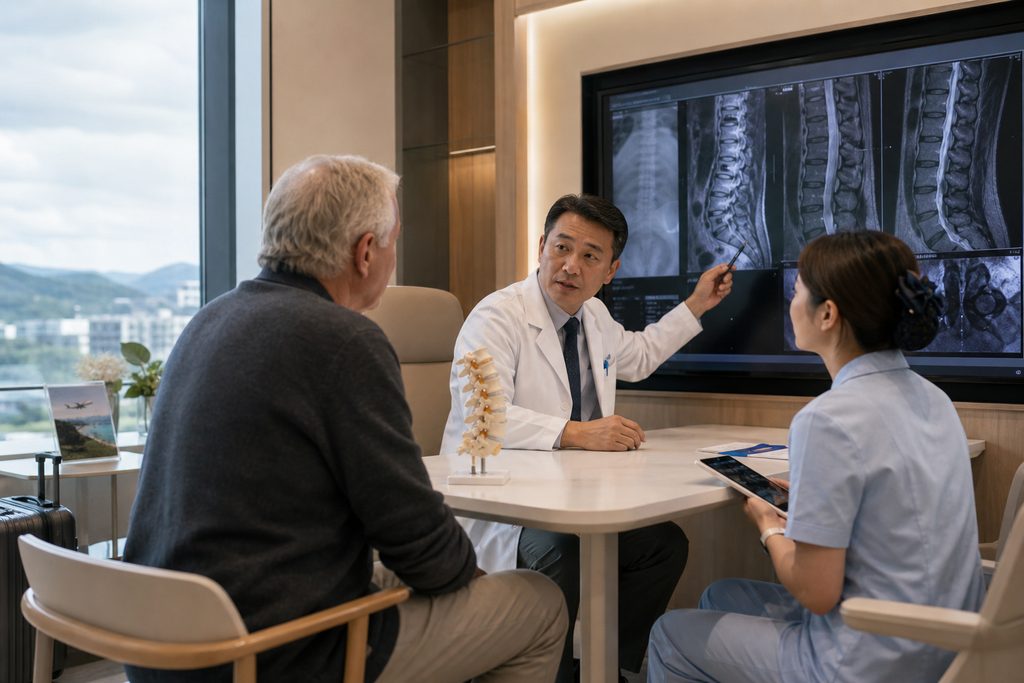
According to the New Zealand Ministry of Health, elective spinal surgeries carried a median wait time exceeding 280 days in 2023, with complex multi-level fusions often pushed beyond 18 months in the public system. For a patient with progressive neurological symptoms, that timeline isn’t an inconvenience. It’s a threat to mobility. The spine surgery cost China vs New Zealand equation starts with a stark reality: a lumbar fusion quoted at NZD 55,000-80,000 privately in Auckland routinely lands between USD 18,000 and 28,000 at a top-tier Chinese orthopedic center. But the numbers only tell half the story. The real question is whether the clinical capability matches the price advantage for cases deemed too complex at home.
Spine Surgery in China for NZ Patients: The Short Answer
Yes, China’s top orthopedic hospitals handle complex spinal deformity revisions, multi-level fusions, and tumor resections at volumes that dwarf most Australasian centers. A facility like Peking University Third Hospital performs over 6,000 spinal procedures annually. That’s roughly the entire yearly spinal caseload of several New Zealand DHBs combined. The catch is straightforward. Accessing that expertise requires navigating a system not built for walk-in international patients. You cannot simply email a professor and book a surgery date. The pathway runs through hospital international departments, requires on-the-ground coordination, and demands meticulous transfer of imaging records before any commitment is made.
Who This Is Right For — and Who It Isn’t
We see this work best for a specific patient profile. Not everyone should get on a plane.
Typically a good candidate:
- You have a confirmed diagnosis requiring multi-level instrumentation, revision of a prior failed fusion, or scoliosis correction exceeding 50 degrees Cobb angle.
- Your NZ surgeon has indicated the case exceeds local comfort levels, or the private quote is prohibitive.
- You are medically stable enough for a 12-hour flight and a 2-3 week in-country stay post-surgery.
- You have recent (under 3 months) MRI, CT, and standing X-rays in DICOM format ready to share.
Who should pause and reconsider:
- Patients with acute, unstable spinal cord compression requiring emergency decompression within 48 hours. The logistics of international transfer create unacceptable delay.
- Those with poorly controlled cardiac or pulmonary comorbidities that would make a long-haul flight risky without prior optimization.
- Anyone unwilling to spend at least two weeks in one city for post-operative monitoring before flying back. Chinese surgeons will not discharge a complex fusion patient to an international flight in under 10-14 days.
- Cases where the primary motivation is a modest cost saving on a single-level discectomy. The travel and coordination costs can erode the difference for simpler procedures.
Being blunt about exclusions builds trust. We’d rather tell you this isn’t the right path than have you discover it in a Beijing hotel room.
The Options, Compared
For a New Zealand patient facing complex spinal pathology, there are genuinely three pathways. Here they are side by side, with real numbers.
| Factor | NZ Public System | NZ Private Hospital | Top Chinese Orthopedic Center |
|---|---|---|---|
| Wait for complex fusion | 12-24 months | 3-8 weeks | 2-4 weeks post-arrival |
| Cost (lumbar fusion, 2-level) | Free at point of care | NZD 55,000-80,000 | USD 18,000-28,000 (approx. NZD 29,000-45,000) |
| Surgeon annual caseload | 50-100 complex cases | Varies widely | 300-600+ complex cases at tier-1 centers |
| Navigation/robotics availability | Limited to 1-2 centers | Limited | Widely available (Mazor, TiRobot, O-arm) |
| Language | English | English | Mandarin; international dept provides interpreter |
| Follow-up care back in NZ | In-house | Surgeon-led | Requires pre-arranged NZ spine surgeon or GP handover |
The public system wins on cost but loses on time. The private system wins on language and follow-up continuity but can be financially devastating. The Chinese pathway wins on surgeon experience density and cost, but demands that you solve the handoff back home. Which column fits depends on whether your condition can tolerate the public waitlist. If it can’t, and the private quote is out of reach, the third column becomes the only viable door left standing.
What “Complex Spine Surgery” Actually Means in a Chinese Center
New Zealand surgeons are technically excellent. But the epidemiological reality is that a country of 5 million people simply does not generate enough severe scoliosis revisions, spinal tumor resections, or multi-level post-traumatic reconstructions to keep a single surgeon’s skills at the absolute edge of the volume curve.
China does.
Take spinal deformity. A center like Nanjing Drum Tower Hospital‘s spine division sees more severe adolescent idiopathic scoliosis cases in one month than most NZ centers see in three years. Their surgeons routinely handle curves beyond 90 degrees, revision surgeries where prior hardware has failed, and congenital hemivertebra corrections in young children. The same pattern holds for spinal tumors. Shanghai Changzheng Hospital‘s orthopedic oncology unit is one of the busiest in the world for sacral chordoma and giant cell tumor resections. These are procedures where the margin between cure and catastrophic recurrence often comes down to whether the surgeon has done 20 of them or 200.
Does this mean every Chinese hospital is superior? Of course not. The gap between China’s top 5% of hospitals and the average tertiary facility is vast. Our database covers 340+ top-ranked hospitals across 37 cities, selected by Fudan University’s national ranking system and JCI accreditation status. For complex spine work, you are looking at perhaps 8-10 centers nationally with the case volume and international infrastructure to accept a foreign patient. The rest are not appropriate for this purpose.
Spine Surgery Cost China vs New Zealand: Breaking Down the Numbers
The headline figure is attractive. But the honest cost comparison requires line items.
A two-level lumbar fusion with posterior instrumentation at a top Chinese public hospital’s international department typically breaks down as follows:
- Surgical package (surgeon, anesthesiologist, OR, standard implants): USD 12,000-18,000
- Implant upgrades (if choosing imported titanium cages/rods vs. domestic): USD 3,000-6,000 additional
- Hospital stay (7-10 days in a VIP/international ward): USD 200-400 per day
- Medications, labs, imaging during admission: USD 1,500-2,500
- Coordination and bilingual companion services: from USD 300 for appointment coordination; daily companion services from USD 200/day
- Travel, accommodation, visa, meals for patient + one companion (3 weeks): USD 4,000-7,000
Total all-in, you are looking at roughly USD 22,000-35,000. That’s still 30-50% below the NZ private quote. But it is not the USD 18,000 often cited for the surgery alone. The distinction matters.
Is Spine Surgery in China Safe for International Patients?
This is the question that keeps people awake. It’s also the one where vague reassurance is worse than hard data.
Infection rates for instrumented spinal fusion at Chinese hospitals ranked in the Fudan top 10 for orthopedics are reported between 0.5% and 1.2%, in line with benchmarks from the US National Healthcare Safety Network. The top centers use laminar-flow operating theaters, intraoperative neuromonitoring, and O-arm CT navigation as standard for complex cases. These are not makeshift facilities.
Where safety becomes a shared responsibility is in three areas: implant selection, post-operative rehabilitation protocols, and the handoff back to a New Zealand provider. You need your Chinese surgeon’s operative note, implant card (with exact part numbers), and post-op imaging on a USB before you leave the country. If something goes wrong six months later in Hamilton, your local orthopedic surgeon needs to know exactly what hardware is in your spine. We have seen cases where a missing implant card turned a simple screw adjustment into a multi-hour salvage operation. That’s avoidable.
Also worth stating plainly: medical negligence and complication rates are not zero anywhere. The question isn’t whether China is perfectly safe. It’s whether the safety profile at a specific, named, top-10 center is comparable to the alternative you actually have — which, for many NZ patients, is waiting two years in progressive pain or paying a mortgage-level sum for private care. That calculus is personal.
Medical Tourism Spine Surgery Packages China: What’s Included and What’s Not
The term “medical tourism spine surgery packages China” suggests a bundled, all-inclusive product. The reality is more modular. Most international departments offer a core surgical package that covers the procedure, the hospital bed, and basic nursing care. Everything else gets layered on.
A typical package from a reputable facilitator (not the hospital directly — the hospital bills the medical component; the facilitator handles logistics) includes:
- Pre-arrival remote case review by the surgical team (often a written second opinion, USD 300-500, credited toward surgery if you proceed within 90 days)
- Airport pickup and hospital admission support
- Bilingual companion for the day of admission and key consultations
- Coordination of post-discharge hotel and follow-up clinic visits
What is almost never included: international airfare, visa fees, companion travel costs, post-discharge nursing care, physical therapy, or any treatment for unexpected complications that extend the stay. You should budget a 15-20% contingency above the quoted figure.
And be wary of any package that promises a specific surgery date before the surgeon has seen you in person. Legitimate top-tier hospitals will not schedule a complex fusion without a face-to-face examination. The remote review gets you a provisional plan and a green light to travel. The final surgical plan, implant selection, and exact date get locked in only after you are on the ground and the surgeon has examined you. That’s not bureaucracy. That’s good medicine.
How to Book Spine Surgery in China with a Fast Recovery Focus
Patients who want to book spine surgery China fast recovery need to understand that “fast” in spinal surgery is a function of three things: minimally invasive technique, early mobilization protocols, and pre-habilitation before the flight.
Many top Chinese centers have adopted Enhanced Recovery After Surgery (ERAS) protocols for spine patients. At facilities like Xuanwu Hospital in Beijing or West China Hospital in Chengdu, a two-level MIS-TLIF patient is typically standing with a physiotherapist within 24 hours. Discharge happens at day 5-7. That is not marketing. That’s the documented standard when no complications occur.
The practical sequence for a New Zealand patient looks like this:
- Week 1-2 (at home): Send DICOM imaging, recent clinical notes, and a brief medical summary. The surgical team reviews remotely and confirms they will accept the case.
- Week 3-4: Apply for an S2 visa with the hospital’s invitation letter. Book flights and accommodation near the hospital. Arrange a New Zealand GP or spine surgeon who agrees to receive the post-op file and see you for follow-up.
- Week 5 (arrival): In-person consultation, final imaging if needed, pre-op clearance. Surgery typically within 3-7 days of arrival, not the same week you land — jet lag and spinal anesthesia don’t mix well.
- Week 6-7: Surgery, inpatient recovery, early mobilization. Discharge to a nearby serviced apartment, not a flight.
- Week 8: Final clinic review, suture removal if not already done, receive full operative records and implant card. Flight home.
- Months 2-6: Rehabilitation back in NZ, with the Chinese surgeon’s protocol shared with your local physio.
This timeline assumes no major complications. A deep wound infection or dural tear extends the stay by weeks. That’s the risk you carry when leaving the country for surgery.
Practical Considerations: Records, Visas, and Follow-Up
Three logistics matter more than the rest.
Imaging transfer. Chinese spine surgeons want DICOM files on a CD or USB, not JPEGs emailed from a patient portal. The raw data lets them measure Cobb angles, assess bone quality on CT, and plan screw trajectories. If your NZ radiologist only gave you a written report and a few printed films, go back and request the DICOM export. It’s your legal right under health information privacy rules.
Visa category. Medical treatment in China uses the S2 short-stay visa, typically issued for 30-90 days with the hospital’s stamped invitation letter as supporting documentation. The accompanying family member also applies for an S2. Do not apply for an M visa; that is for commercial and trade activities and will not be accepted for medical purposes. Processing times at the Chinese embassy in Wellington or consulate in Auckland run 4-10 business days. Factor this in.
Follow-up back in New Zealand. This is the weak point of any international surgical pathway. Chinese surgeons do not have admitting privileges at NZ hospitals. If you develop a post-operative complication — a wound dehiscence, a late infection, adjacent segment disease — you will need a New Zealand-based orthopedic or spinal surgeon willing to see you. Do not assume your GP can manage this. Identify and contact that surgeon before you travel. Some will decline to take on another surgeon’s complex post-op patient. You need to know that before you are in pain and calling around from home.
Frequently Asked Questions
Look at the Fudan University national specialty rankings for orthopedics, published annually. Hospitals consistently in the top 10 include Peking University Third Hospital, West China Hospital, Shanghai Changzheng Hospital, and Nanjing Drum Tower Hospital. Within that list, some are stronger in deformity, others in tumors, others in degenerative disease. The right match depends on your specific diagnosis. A general “top hospital” ranking is less useful than the specialty-specific reputation. We help patients match their exact pathology to the right sub-specialty team, not just the biggest brand name. You can explore our specialty department directory to see which centers lead in orthopedics and spinal surgery.
Your Chinese surgeon will typically provide a written post-operative protocol and remain available via email or WeChat for urgent questions in the first 90 days. But they cannot prescribe across borders, order imaging in NZ, or admit you to a local hospital. You need a pre-identified NZ-based spine surgeon who has agreed to receive your file and see you if complications arise. This is not optional. If you cannot secure that local handoff before traveling, the risk profile changes materially. We have also seen cases where the Chinese team, on reviewing post-op imaging sent from NZ, identified a developing issue early and advised the local surgeon on the specific hardware involved — but that works only when the local surgeon is already in the loop.
Top Chinese centers stock both imported systems (Medtronic, DePuy Synthes, Stryker, NuVasive) and domestic brands (Weigao, Double Medical). The imported systems are identical to what you would receive in Auckland. The domestic systems have improved dramatically in the last decade and now hold CE marking or FDA 510(k) clearance in many cases. Whether a domestic implant is appropriate depends on your bone quality, the levels involved, and the surgeon’s experience with that system. You can and should ask explicitly which implant brand is planned and why. If you prefer an imported system, state that upfront. It will increase the implant line item but may give you more comfort regarding long-term compatibility with any future revision surgery back home.
Most NZ private health insurance policies (Southern Cross, nib, Accuro) have territorial limits and do not cover elective surgery performed outside New Zealand unless it’s an emergency. Some international expat policies (Cigna Global, Allianz Care) do provide worldwide coverage including China, but they typically require pre-authorization and may only cover treatment at JCI-accredited facilities. Check your policy wording for “geographical coverage area” and “international treatment” clauses. Do not assume coverage. Get written pre-approval before committing to travel. For most NZ patients, this will be a self-funded pathway, which is why the cost differential matters so much.
Your Next Step
Complex spine surgery abroad is not a decision to make from a Google search. It starts with a cold, hard look at your imaging and a frank conversation about whether the case is appropriate for international transfer at all. Our team does not perform surgery, does not make diagnoses, and does not push anyone toward a particular hospital. We handle the logistics that sit between a patient in New Zealand and a surgical team in China: case review coordination, hospital matching based on sub-specialty, visa documentation support, and on-the-ground bilingual companion services so you are not navigating a 10,000-patient-per-day hospital alone. If the public waitlist is untenable and the private quote is out of reach, request a free consultation to discuss your case. We’ll tell you honestly whether this pathway fits — and if it doesn’t, we’ll tell you that, too.
For more medical information and treatment options in China, visit chinamedservices.com (China Medical Services).
