Spine Surgery China Saudi: Deformity Correction with Halal-Conscious Care
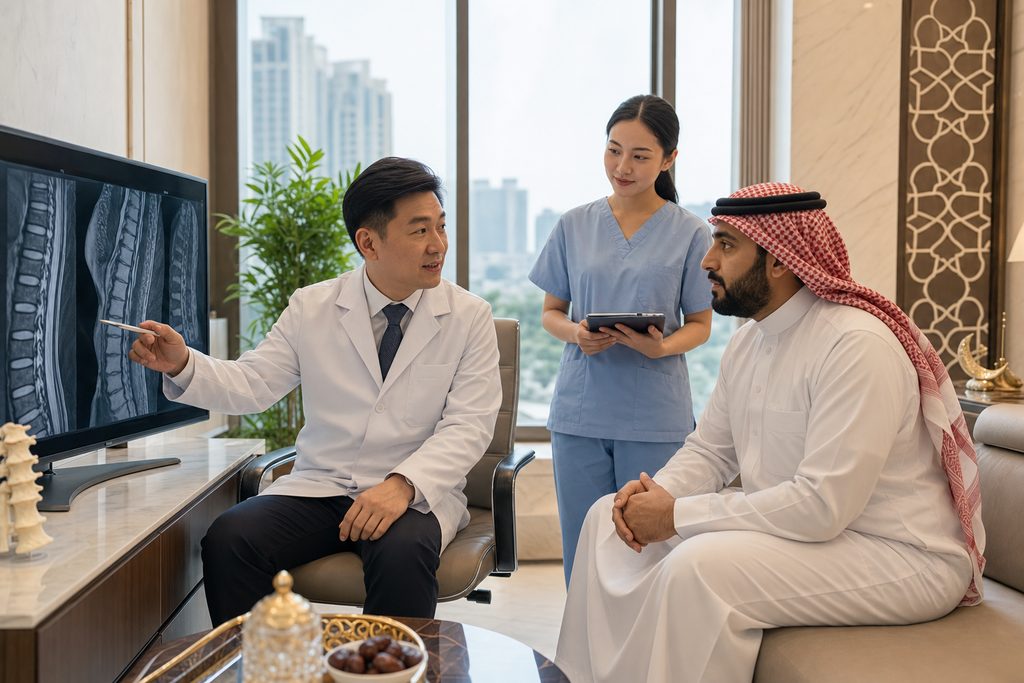
A spine deformity is not just a curve on an X-ray. It is a structural shift that can compress your lungs, wear down your joints unevenly, and turn standing in a grocery line into a test of endurance. For many, the word “scoliosis” entered their vocabulary in adolescence. For others, adult degenerative scoliosis arrived silently, stealing height and mobility year by year. The decision to pursue surgery is never casual. It arrives after months or years of physiotherapy, bracing, injections, and the slow realization that the curve is progressing anyway.
And then comes the second shock: the cost.
In Saudi Arabia, a complex spinal fusion with instrumentation can run between 150,000 and 250,000 SAR. In the United States, the same procedure often exceeds $120,000. For families without full international insurance coverage, these numbers can feel like a second diagnosis — one with no clear treatment path.
That is why an increasing number of Saudi patients are looking east. The spine deformity surgery cost China averages between $25,000 and $45,000 for procedures that involve multi-level fusion, pedicle screws, and intraoperative neuromonitoring. This is not discount surgery. This is the same instrumentation, the same neuromonitoring standards, and surgeons who perform hundreds of deformity corrections annually — at a fraction of the price. The question is no longer just “can I afford this?” It becomes “how do I do this safely, and how do I maintain my religious and dietary practices while recovering far from home?”
Key Takeaways
- Complex spine deformity correction in China typically costs $25,000–$45,000, compared to $120,000+ in the US and 150,000–250,000 SAR in Saudi Arabia.
- Major Chinese cities now offer verified halal hospital meal services, designated prayer spaces, and clinical teams with growing experience treating Muslim international patients.
- The biggest challenge is not clinical quality — it is navigation. Language barriers and unfamiliar hospital systems make professional coordination essential, not optional.
- No legitimate service can guarantee a specific surgeon or surgery date. What a good coordinator does is open the right doors, translate your records, and ensure nothing gets lost between languages.
The Problem: When a Curved Spine Becomes a Life-Limiting Condition
Scoliosis affects approximately 2–3% of the global population. Most cases are mild. But when a curve progresses past 45–50 degrees in an adolescent, or when adult degenerative scoliosis begins compressing nerve roots, the conversation shifts from observation to surgery. The spine does not self-correct. It continues to curve, typically at 0.5 to 1 degree per year. Over a decade, that means lost height, chronic pain, and in severe thoracic curves, measurable reductions in lung capacity.
Saudi Arabia has excellent orthopedic surgeons. The bottleneck is rarely skill. It is capacity and cost. A 2020 study in the Journal of Spine Surgery noted that access to specialized deformity surgeons remains concentrated in a handful of tertiary centers in the Gulf region. Wait times can stretch. And for patients without government coverage or top-tier private insurance, the out-of-pocket burden is immense.
A Saudi father we spoke with described it plainly: “I had the diagnosis. I had the surgical plan. What I did not have was 200,000 SAR. And my daughter’s curve was at 52 degrees and moving.”
That is the moment families start searching. They type phrases like “is scoliosis surgery safe in China for Muslims” or “how much is spinal fusion surgery abroad.” They are not looking for the cheapest option. They are looking for a viable option — one that does not mortgage their future or compromise on safety.
Why China Has Become a Serious Destination for Complex Spine Surgery
The rise of Chinese orthopedics as an international referral destination is not a marketing story. It is a volume story. And in complex surgery, volume correlates with outcomes.
Case Volume That Reshapes Surgical Instinct
A senior spine surgeon at a major Chinese tertiary hospital may perform 150 to 250 deformity corrections per year. Compare this to the average US orthopedic spine surgeon, who performs roughly 30 to 50 scoliosis fusions annually according to a 2019 analysis in Spine Deformity journal. The difference is not just a number. It is pattern recognition. A surgeon who sees 200 severe curves per year has encountered anatomical variations that a lower-volume surgeon might see once in a career. They know how a rigid thoracic curve responds differently than a flexible lumbar curve. They have managed the intraoperative surprises.
China’s top orthopedic centers — including Peking University Third Hospital, West China Hospital in Chengdu, and Changzheng Hospital in Shanghai — are ranked among the nation’s elite in the Fudan University hospital rankings. These are not small boutique clinics. They are massive academic medical centers where spinal deformity is a core subspecialty, not a side interest. You can explore the full list of ranked orthopedic departments on our specialty rankings page.
Technology That Matches Any Western Operating Room
Walk into a spine operating room at a top Chinese hospital and you will see familiar equipment: O-arm intraoperative CT, Medtronic or DePuy Synthes instrumentation, neuromonitoring systems that track spinal cord function in real time. The implants are the same global brands used in Riyadh or Houston. The sterilization protocols follow international standards.
What differs is the operational tempo. Chinese hospitals run on efficiency born of enormous patient volumes. A surgical team may complete three or four major spine cases in a day. This is not rushed care. It is systematized care — with dedicated anesthesia teams, specialized nursing staff, and postoperative pathways refined across thousands of cases.
Why the Spine Deformity Surgery Cost China Is So Much Lower
The cost gap is real and structural. Labor costs in Chinese healthcare are a fraction of Western equivalents — not because of lower training standards, but because of different economic baselines. Hospital overhead is lower. The same titanium pedicle screw system that costs $8,000 in the US may cost $2,000 in China, simply because of how the supply chain and procurement systems work.
A spinal fusion that would be billed at $120,000 in the US might cost $30,000 to $40,000 in China. That is not a 10% discount. That is a 70% reduction. For Saudi families paying out of pocket, this is the difference between surgery and continued deterioration.
| Procedure | Estimated Cost (China) | Estimated Cost (Saudi Arabia) | Estimated Cost (USA) |
|---|---|---|---|
| Adolescent scoliosis fusion (5-8 levels) | $25,000–$35,000 | 100,000–160,000 SAR | $100,000–$150,000 |
| Adult degenerative scoliosis correction | $30,000–$45,000 | 130,000–200,000 SAR | $120,000–$180,000 |
| Revision spine deformity surgery | $35,000–$50,000 | 150,000–250,000 SAR | $150,000–$250,000 |
Costs are estimates and vary by hospital, implant choice, length of stay, and case complexity. Always obtain a personalized quotation.
Halal Medical Tourism Package Spine Surgery China: What Actually Exists
Let us be direct. The phrase “halal medical tourism package spine surgery China” is a search query, not a standardized product. No hospital in China markets a “halal package” the way a travel agency sells an Umrah package. What does exist — and what matters for Saudi patients — is a growing infrastructure of halal-conscious services that can be assembled into a coherent care experience.
Major Chinese cities with international patient programs, particularly Shanghai, Beijing, and Guangzhou, have adapted quickly to the needs of Muslim patients. This adaptation is practical, not cosmetic.
Hospital kitchens in several international medical centers now source halal-certified meat and maintain separate preparation areas. This is not universal — you must verify with each hospital. But it is increasingly common in facilities that regularly receive patients from the Gulf states, Malaysia, and Indonesia.
Prayer facilities matter. A spinal fusion patient cannot easily leave the ward to find a mosque. Several international patient wards now designate small prayer rooms. Some provide Qibla direction indicators. Nursing staff are briefed on the basics: that a patient may need to perform wudu, that prayer times shift throughout the year, that modesty considerations affect physical therapy interactions.
These are not extravagant accommodations. They are basic dignity. And they are available — if you know which hospitals to ask and have someone who can ask in Mandarin.
For a broader overview of how we help match patients with the right facility, visit our China Medical Services homepage.
Is Scoliosis Surgery Safe in China for Muslims? A Straight Answer
Safety is not a binary question. It is a series of specific, verifiable factors. Let us break them down.
Surgical Safety: Comparable to International Benchmarks
China’s top-tier orthopedic centers report infection rates for instrumented spinal fusion in the 0.5–2% range, consistent with published rates from the Scoliosis Research Society. Neurological complication rates for deformity surgery — the outcome that keeps every spine surgeon awake at night — are approximately 0.3–0.5% in experienced hands. These are not Chinese statistics. They are global benchmarks, and the best Chinese centers meet them.
The key variable is not the country. It is the specific hospital and surgeon. A top-five orthopedic center in Shanghai is not the same as a general hospital in a smaller city. This is why the question “best spine surgeon for scoliosis China Saudi patient” is the right question to ask — but the answer is never one name. It is a shortlist of institutions where multiple surgeons have deep deformity experience and where the international patient infrastructure already exists.
Cultural and Religious Safety: What to Verify
For a Muslim patient, safety extends beyond the operating room. It includes:
– Can I maintain my prayer schedule during recovery?
– Will my food be halal — genuinely halal, not just “no pork”?
– Will female patients be treated with appropriate modesty during examinations and physical therapy?
– Can my family stay nearby and be involved in my care?
These are not secondary concerns. They are central to whether a patient can focus on healing or spends their recovery in a state of low-grade distress. The hospitals that serve international Muslim patients well are those that treat these questions as clinical requirements, not special favors.
How to Book Spine Deformity Correction China with Halal Food: The Practical Path
This is the section where search intent meets reality. Someone typed “book spine deformity correction China with halal food” because they want to know the sequence of steps. Here it is.
Step 1: Remote Evaluation Comes First
You do not book surgery from abroad. You book an evaluation. You will need to gather: standing full-spine X-rays (posteroanterior and lateral), a recent MRI if neurological symptoms are present, any previous surgical records, and a summary of your treatment history. These documents are translated into Chinese and submitted to the orthopedic department for review.
A written second opinion typically costs between $300 and $500. This is not a formality. The surgical team will assess whether you are a surgical candidate, what approach they recommend, how many levels need fusion, and whether any comorbidities need preoperative management. You can read more about how we coordinate this on our patient support page.
Step 2: The Surgical Plan and Cost Estimate
Only after the records review will you receive a detailed surgical plan and a cost estimate. This estimate should include: surgeon fees, hospital bed charges, implant costs, anesthesia, intraoperative neuromonitoring, and an estimated length of stay. It should also specify what is not included — typically, international airfare, accommodation for family members, and any extended rehabilitation.
Step 3: Visa and Travel Logistics
Medical travelers to China apply for an S2 visa, which covers short-term private affairs including medical treatment. The application requires an invitation letter from the treating hospital. Processing times vary by embassy. Plan for at least 3–4 weeks. Your family members traveling with you also apply for S2 visas.
Step 4: Arrival, Admission, and Surgery
You will arrive a few days before the scheduled admission for preoperative testing: blood work, cardiac clearance, possibly pulmonary function tests. The surgery itself may last 4 to 8 hours depending on the number of levels fused. Hospital stay after deformity surgery typically ranges from 7 to 14 days. You will be standing — with assistance — within 24 to 48 hours. Not because it is comfortable, but because early mobilization reduces complication rates.
Step 5: Recovery and Return
Most international patients are medically stable to fly home 2 to 3 weeks after surgery, provided the flight is under 8 hours and they can stand and walk periodically. You will leave with a detailed rehabilitation protocol. Follow-up X-rays are typically done at intervals back in Saudi Arabia and sent to the Chinese surgical team for review.
Choosing the Right Surgeon and Hospital: What Saudi Patients Need to Know
The phrase “best spine surgeon for scoliosis China Saudi patient” reflects a natural instinct — find the best, go there. But “best” in spine surgery is not a universal ranking. It is a match between your specific deformity and a surgeon’s specific experience.
What to Look For
Ask about annual deformity case volume. A surgeon who does 10 scoliosis fusions per year is not your surgeon. Ask about the surgical approach: posterior only, or combined anterior-posterior? Different deformities need different strategies. Ask about the implant system they use and why. Ask about their neuromonitoring protocols — what happens if signals change intraoperatively? These questions reveal how a surgeon thinks. You want someone who answers them directly, not someone who dismisses them.
What to Avoid
Avoid any service that promises a specific surgery date before reviewing your records. Avoid any claim that sounds like guaranteed access to a named surgeon. China’s top specialists are in high demand. A legitimate coordinator can facilitate the connection and navigate the hospital’s international patient channel. They cannot override the hospital’s scheduling system or bypass clinical triage.
Frequently Asked Questions
Will my insurance cover spine surgery in China?
Most Saudi insurance policies that include international coverage will reimburse treatment at JCI-accredited or internationally recognized hospitals. You must confirm this with your insurer before traveling. Chinese public hospitals typically require upfront payment. You pay, you receive detailed invoices and medical reports in English, and you submit them to your insurer for reimbursement. Some private international hospitals in China offer direct billing — but fewer of these have top-tier deformity surgery programs.
What if there is a complication after I return to Saudi Arabia?
This is the question every international patient should ask. The Chinese surgical team will provide a complete operative note, implant list, and postoperative protocol in English. You will need a spine surgeon in Saudi Arabia who agrees to provide follow-up care before you travel to China. Do not skip this step. Identify that local surgeon, share the Chinese team’s plan with them, and confirm they will see you postoperatively. Most are willing — but you must ask in advance, not after a problem arises.
How do I know the halal food is genuinely halal?
Ask for the halal certification of the kitchen or food supplier. Several hospitals in Shanghai and Beijing work with certified halal caterers. If a hospital cannot produce a certification but says “we can prepare food without pork,” that is not the same thing. Be clear about your requirements. Some Muslim patients arrange for family members to bring food from nearby halal restaurants during the hospital stay. This is logistically harder but sometimes necessary depending on the specific facility.
Can my family stay with me during recovery?
Most international patient wards allow one family member to stay in the room or in nearby accommodation arranged by the hospital. For Saudi families traveling as a group, serviced apartments near the hospital are often a better option than hotels. The hospital’s international patient coordinator can usually recommend options within walking distance. Factor accommodation costs into your budget — a 2–3 week stay for family members can add several thousand dollars.
How long before I can pray normally after spinal fusion?
This is a deeply personal and practical concern. In the first 2–4 weeks after surgery, bending and kneeling are restricted. You will not be able to perform sujud (prostration) in the standard manner. Many patients pray seated or in a chair during early recovery, using head gestures for ruku and sujud. By 6–8 weeks, as fusion begins to consolidate, some patients can gradually resume modified standing prayers. Full, unrestricted prayer postures may take 3–6 months. Discuss this timeline with your surgeon preoperatively so they understand its importance to you.
Your Next Step
You have the diagnosis. You probably have the X-rays on your phone right now. What you may not have is a clear, verified path from where you are to a surgical outcome you can afford and trust. That is the gap we exist to close. Our team at China Medical Services translates your records, submits them to the orthopedic departments best matched to your specific deformity, and coordinates the evaluation process — from the written second opinion through to admission logistics and on-the-ground support. We do not perform surgery. We do not make medical decisions. We make sure you can make them with accurate information and without the exhaustion of navigating an unfamiliar system alone. When you are ready to explore whether spine surgery in China is the right path for your family, we are here to walk through the options with you.
For more medical information and treatment options in China, visit chinamedservices.com (China Medical Services).
