Stroke Rehab Hospitals in China: Costs, Access & Recovery Timelines
Stroke Rehab Hospitals in China: Costs, Access & Recovery Timelines
In the United States, a single inpatient rehabilitation stay after stroke averages $1,500 to $2,500 per day. In Germany, rehabilitation clinics often run four to six weeks with limited bed availability. Meanwhile, stroke rehabilitation hospitals in China cost between $8,000 and $30,000 per month — including daily physician rounds, physical therapy, occupational therapy, and speech-language pathology — at facilities that treat more stroke patients annually than most Western countries combined.
That price gap is real. But it comes with a catch that nobody mentions in the brochures: China’s best rehabilitation hospitals do not operate like hotels. They are high-volume public institutions, and navigating them without Chinese language skills or local coordination is genuinely difficult.
The core trade-off: China offers world-class stroke rehabilitation at a fraction of Western costs — but access requires understanding a system built for domestic patients, not international ones.
Who This Is Right For — and Who It Isn’t
Stroke recovery is not one-size-fits-all. The patients who benefit most from coming to China share specific characteristics.
Good candidates typically include:
- Patients 3–12 months post-stroke with stable vital signs and a clear rehabilitation plan from their home neurologist
- Families facing $100,000+ rehabilitation costs in the US or waiting 8–16 weeks for a subacute bed in Canada or the UK
- Patients who need intensive, multi-disciplinary therapy (PT + OT + speech) five to six days per week
- Those open to combining Western rehabilitation with Traditional Chinese Medicine — acupuncture and tuina are integrated into many Chinese rehab programs
- Patients with a caregiver or family member who can travel for the duration of treatment
Who should not pursue this:
- Anyone medically unstable — recent hemorrhagic stroke without neurosurgical clearance, uncontrolled seizures, or active DVT
- Patients in the first 48–72 hours post-stroke, when acute hospital care takes priority over rehabilitation
- Individuals with severe cognitive impairment and no accompanying caregiver
- Those who cannot tolerate a 10–14 hour flight or who have contraindications to air travel
- Patients expecting a Western-style private room experience at a public hospital price — that combination does not exist
And here is the honest part: if you have good insurance coverage at home and a rehabilitation bed available within two weeks, staying local is almost always the simpler path. China makes sense when cost, speed, or therapy intensity is the deciding factor.
The Options, Compared
Understanding where China fits requires seeing the full landscape. The table below compares the realistic alternatives for a patient needing 4–8 weeks of intensive inpatient stroke rehabilitation.
| Destination | Typical Monthly Cost (USD) | Wait Time | Therapy Intensity | Language Support |
|---|---|---|---|---|
| United States (inpatient rehab facility) | $30,000–$60,000 | 1–3 weeks (with insurance) | 3 hours/day, 5–6 days/week | English |
| Germany (rehab clinic) | $18,000–$35,000 | 2–6 weeks | 3–4 hours/day, 6 days/week | German/English (varies) |
| China (top public hospital rehab dept.) | $8,000–$18,000 | 1–2 weeks (via international office) | 3–5 hours/day, 5–6 days/week | Limited English; interpreter needed |
| China (private international hospital) | $15,000–$30,000 | 3–7 days | 2–4 hours/day, 5 days/week | Full English service |
| Thailand (Bangkok rehab hospitals) | $10,000–$25,000 | 1–2 weeks | 2–3 hours/day, 5–6 days/week | Good English support |
The cheapest column is not automatically the best fit. A patient with complex comorbidities and no Mandarin-speaking companion will likely do better at a private international hospital in Shanghai or Beijing, even at double the public hospital rate. A patient focused purely on therapy volume and cost — with a bilingual family member — can access exceptional care through a top public hospital’s international department.
Finding the Best Stroke Rehab Center in Shanghai for Foreigners — and Beyond
Shanghai concentrates some of China’s strongest rehabilitation programs. Huashan Hospital, affiliated with Fudan University, operates one of the country’s leading neurology and rehabilitation departments. Ruijin Hospital, also under Fudan, has a well-established rehabilitation medicine unit. Both appear in the Fudan Hospital Rankings — China’s closest equivalent to the U.S. News hospital rankings — which place only the top 100 hospitals nationwide into tiered categories.
Beijing offers similar depth. Peking Union Medical College Hospital and China Rehabilitation Research Center (CRRC) in Beijing are reference points for post-stroke recovery. CRRC, in particular, was established specifically for rehabilitation medicine and handles a high volume of stroke patients annually.
Chengdu’s West China Hospital — one of the largest single-site hospitals in the world — also maintains comprehensive rehabilitation services, often at lower cost than Beijing or Shanghai.
For families who want to compare hospitals by specialty ranking, our department-level Top 10 lists break down rehabilitation medicine and neurology by institution. City-specific pages for Shanghai and Beijing list hospitals with international patient services.
Practical tip: The best stroke rehab center Shanghai for foreigners is not always the highest-ranked hospital overall. Look for hospitals with an established international department — that is where English-speaking coordinators, streamlined registration, and insurance billing actually exist.
How Long Does Stroke Rehab Take in China?
This is the question families ask most often, and the honest answer is: it depends on stroke severity, age, and how early rehabilitation begins. But Chinese rehabilitation hospitals typically structure treatment in defined blocks.
Weeks 1–2: Assessment and baseline. The rehabilitation physician conducts a functional assessment — usually using the Barthel Index or Fugl-Meyer Assessment — and sets measurable goals. Therapy begins immediately, often twice daily.
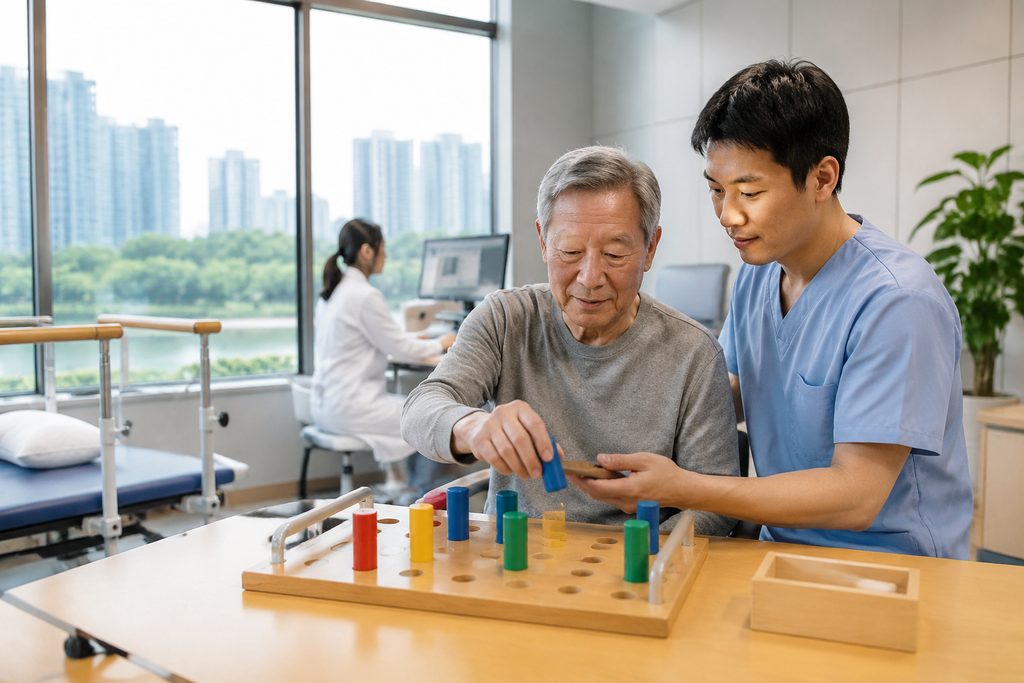
Weeks 3–6: Intensive phase. Patients receive 3–5 hours of daily therapy: physical therapy for gait and balance, occupational therapy for upper limb function and daily living skills, speech-language pathology for aphasia or dysphagia. TCM modalities — acupuncture, tuina massage — may be added for spasticity management and pain.
Weeks 7–12: Consolidation and transition. Therapy intensity may reduce as patients approach functional plateaus. Discharge planning begins, including home exercise programs and recommendations for outpatient follow-up.
Most international patients stay four to eight weeks. Some extend to twelve weeks for severe deficits. A small number — typically those with mild impairment — complete a focused three-week program.
How long does stroke rehab take in China compared to home? The timeline is similar. What differs is the waiting period before starting. In many Western systems, the gap between hospital discharge and rehabilitation admission can stretch to weeks. In China, through the international office channel, that gap often compresses to days.
What It Costs — and What Drives the Variance
Stroke rehabilitation hospitals in China cost between $8,000 and $30,000 per month for international patients. That range is wide because several factors move the number significantly.
Hospital tier and location. A public hospital rehabilitation department in Chengdu or Wuhan may charge $8,000–$12,000 monthly. The same duration at a private international hospital in Shanghai — with a private room, English-speaking nursing staff, and direct insurance billing — can reach $25,000–$30,000.
Therapy intensity. More hours per day means more cost. A patient receiving five hours of daily one-on-one therapy pays more than one in a group-based program.
Accommodation type. Public hospitals typically offer shared rooms (2–4 beds). VIP or international wards provide single rooms at 1.5–2x the standard rate.
Additional services. Imaging, botulinum toxin injections for spasticity, and specialist consultations add to the base cost.
What is typically included in a monthly rehabilitation fee at a Chinese hospital: daily physician rounds, nursing care, physical therapy, occupational therapy, speech therapy (if needed), medications administered during the stay, and basic room and board. What is usually not included: interpreter services, airport transfers, visa costs, meals outside hospital catering, and follow-up care after discharge.
For context, the same four-week program in the United States — assuming insurance covers it — generates billed charges of $120,000 or more. Even out-of-pocket, the Chinese equivalent runs $10,000–$30,000.
Practical Considerations: Visas, Records, and Payment
Getting into a Chinese rehabilitation hospital as a foreign patient requires more paperwork than most people expect. The process is manageable, but it is not walk-in friendly.
Medical records. Chinese hospitals want recent imaging (CT or MRI within the last three months), discharge summaries, medication lists, and a clear statement of rehabilitation goals. These should be translated into Chinese — hospitals generally will not review English-only documents for admission decisions.
Visa. Foreign patients coming to China for medical treatment apply for an S2 visa, which covers short-stay medical treatment and private affairs. Family members accompanying the patient also apply for S2. The M visa is for commercial and trade activities and is not the correct category for medical travel. Visa requirements change — always verify with the nearest Chinese embassy or consulate and submit supporting documents from the receiving hospital.
Payment. Public hospitals require prepayment or a deposit before admission. International credit cards are accepted at some hospitals but not all — bank transfers are more reliable. Private international hospitals often bill insurance directly, but confirm coverage before arrival.
Language. This is the single biggest practical barrier. Outside international departments, hospital staff rarely speak English. Signs, forms, and daily communication are in Chinese. A bilingual medical companion — someone who handles registration, queuing, payment, and translation — is not a luxury in this context. It is the difference between a functional experience and a frustrating one.
Follow-up after returning home. Chinese hospitals will provide discharge summaries and therapy notes. Ask for these in English if possible, and share them with your home physician before you leave China. Continuity of care matters more than any single rehabilitation block.
Frequently Asked Questions
China’s top-tier hospitals — those in the Fudan Top 100 — meet international standards for stroke rehabilitation, and many are JCI-accredited. The risks are not primarily clinical. They are logistical: communication gaps, unfamiliar systems, and the absence of a local support network. Patients who arrange proper coordination and bring a caregiver generally report safe, productive experiences.
Direct booking from overseas into a public hospital’s standard ward is generally not possible. Public hospitals require an in-person outpatient consultation before admission. The practical route is through a hospital’s international department or VIP channel, which can sometimes pre-arrange evaluation and bed allocation. Even then, final admission depends on the patient’s condition at assessment.
Some private hospitals and agencies offer bundled packages covering hospital stay, accommodation, and interpreter services. These vary widely in quality and transparency. The safest approach is to get a written cost estimate directly from the hospital’s international office, then arrange logistics separately. Bundled packages can be convenient but often obscure what is and is not included.
Chinese hospitals handle medical emergencies routinely, and top facilities have 24-hour emergency departments. But you should discuss escalation protocols — what happens if a new stroke occurs, who to contact, how decisions are made — before admission. Having a bilingual coordinator who can communicate with the medical team in real time is critical in these situations.
Your Next Step
Stroke rehabilitation in China offers a genuine alternative for families facing high costs, long waits, or limited therapy access at home. The care is real. The savings are real. But the system is not designed for international patients, and that gap is where most of the difficulty lives.
Our team at China Medical Services helps international patients navigate this landscape — from identifying the right hospital for your specific rehabilitation needs to coordinating appointments, arranging bilingual medical companions, and providing visa guidance. We are not a hospital and we do not provide medical advice. We connect you with the facilities and professionals who do.
If you are exploring options for stroke rehabilitation in China, start with a conversation. Our free consultation service helps you understand what is realistic for your situation — no pressure, no obligation, just clarity. You can also browse our database of 340+ top-ranked hospitals across 37 cities to begin your own research.
This article is for informational purposes only and does not constitute medical advice. Treatment decisions should always be made in consultation with qualified healthcare professionals. Costs and availability vary by hospital, city, and individual patient circumstances.
For more medical information and treatment options in China, visit chinamedservices.com (China Medical Services).
