Sun Yat-sen University Cancer Center: Your Gateway to Southern China’s Oncology Hub
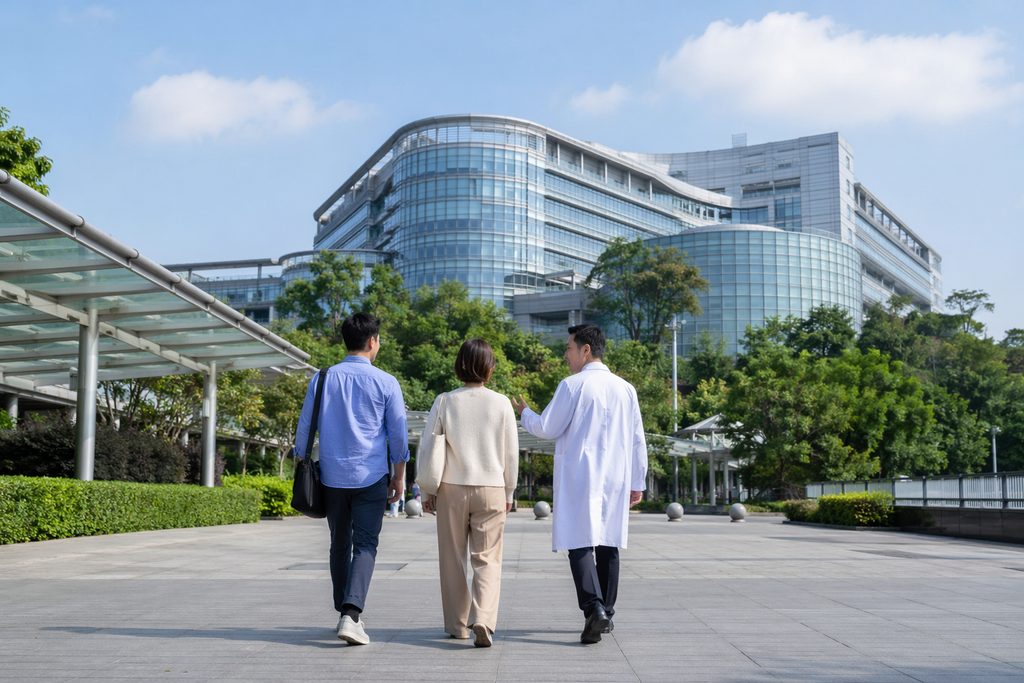
A cancer diagnosis stops time. The world narrows to a single question: where can I get the best possible care? For many international patients, that search leads to Guangzhou, China. Sun Yat-sen University Cancer Center (SYSUCC) handles over 130,000 inpatient admissions and 1.18 million outpatient visits annually. The numbers are staggering. But volume alone does not tell the full story. The center ranks among China’s top three oncology hospitals in the Fudan University Hospital Rankings, a distinction earned through decades of clinical excellence and research output that rivals any Western cancer center.
We are not a hospital. We do not provide medical treatment or clinical diagnoses. Our team acts as your logistical architects—bridging the gap between you and the expertise housed within SYSUCC’s walls. From the first inquiry to post-treatment recovery, we handle the coordination that makes seeking care in a foreign country possible without losing your mind in the process.
Key Takeaways
- Sun Yat-sen University Cancer Center ranks among China’s top 3 oncology hospitals, treating over 1.18 million outpatient visits yearly—clinical volume that directly correlates with better outcomes.
- Cancer treatment costs at SYSUCC typically range from 50-70% less than comparable care in the United States or Western Europe, with no compromise on clinical protocols or technology.
- Navigating a Chinese public hospital as a foreigner without local language skills and system knowledge is genuinely difficult—the international patient service exists to solve exactly this problem.
- The S2 visa process requires a formal invitation letter from the hospital. You cannot simply book a flight and walk in. Planning starts weeks before travel.
The Problem: Cancer Care Costs Are Breaking People—and Wait Times Are Making It Worse
A single course of immunotherapy in the United States can exceed $150,000. Radiation therapy adds tens of thousands more. Even with insurance, out-of-pocket maximums push families into medical debt that takes decades to clear. The American Cancer Society reports that approximately 42% of cancer patients deplete their entire life savings within two years of diagnosis. This is not a rare horror story. It is the statistical norm.
Canada and the UK offer public systems. But wait times tell a different kind of brutal story. A patient in Ontario waits a median of 23 days from referral to first oncology consultation. Then another 28 days for radiation. For aggressive cancers, those delays are clinically significant. The tumor does not wait for the queue.
So patients start searching. They look at options in Germany, in South Korea, in Singapore. And increasingly, they look at China. Specifically, at Guangzhou. At a cancer center that performs over 22,000 surgeries annually and runs more than 2,000 clinical trials at any given time. The question becomes not whether SYSUCC is good enough—but how to actually get in the door.
Who We Are
China Medical Services connects international patients with China’s top-ranked hospitals. We are coordinators, not clinicians. Our team handles hospital matching, appointment scheduling, bilingual medical companion services, visa guidance, and travel logistics. We do not promise miracle cures. We promise to remove every logistical obstacle between you and a consultation with the right oncologist at SYSUCC. That includes translating your medical records into Chinese, securing an invitation letter for your S2 visa, and having a Mandarin-English interpreter at your side during every consultation. We know the system because we work inside it every day.
Why Sun Yat-sen University Cancer Center Delivers Results
Clinical Volume That Creates Surgical Mastery
There is a well-documented relationship in medicine between volume and outcomes. Surgeons who perform a procedure hundreds of times per year have lower complication rates than those who perform it dozens of times. This is not controversial—it is settled data. The Leapfrog Group in the US sets minimum volume standards for surgical safety. SYSUCC’s thoracic surgery department alone performs over 4,000 lung cancer resections annually. Its head and neck surgeons complete more than 3,000 procedures each year. These numbers dwarf what most Western cancer centers achieve.
A thoracic surgeon at a major American academic center might perform 50-80 lobectomies per year. At SYSUCC, that number is closer to 300. The difference matters when you are the patient on the table. Muscle memory, pattern recognition, and intraoperative decision-making all sharpen with repetition. This is one structural reason why outcomes at high-volume Chinese centers compare favorably with Western benchmarks despite lower costs.
Technology Without the Wait
SYSUCC operates 16 linear accelerators for radiation therapy. Sixteen. Most US community cancer centers have one or two. The center houses the latest-generation Da Vinci surgical robots, PET-CT scanners, and a proton therapy system. The critical difference is not the equipment itself—it is the scheduling. A patient needing radiation at SYSUCC can typically start within days of treatment planning, not weeks. The center runs extended hours. Machines operate on shifts. The system is built for throughput without sacrificing precision.
The nasopharyngeal carcinoma (NPC) program exemplifies why this matters. NPC is relatively rare in the West but common in southern China. SYSUCC treats more NPC cases than any hospital on earth. Their radiation oncologists have refined targeting protocols through sheer case volume, achieving 5-year survival rates above 85% for locally advanced disease. That is world-leading by any standard.
The Sun Yat-sen University Cancer Center International Patient Price Reality
Let us address the question every international patient asks first. What does treatment actually cost?
The Sun Yat-sen University Cancer Center international patient price structure follows a pattern consistent across China’s top public hospitals. Treatment through the international patient service or VIP department costs approximately 1.5 to 2 times the standard Chinese rate. That premium buys English-speaking coordination, expedited appointment scheduling, and private or semi-private inpatient rooms. Even with that multiplier, the numbers remain dramatically lower than Western price tags.
| Treatment | SYSUCC (International Patient) | United States (Average) | United Kingdom (Private) |
|---|---|---|---|
| Radiation therapy (full course) | $8,000 – $15,000 | $50,000 – $90,000 | £30,000 – £55,000 |
| Lung cancer surgery (lobectomy) | $12,000 – $20,000 | $80,000 – $130,000 | £45,000 – £70,000 |
| Chemotherapy (6 cycles) | $6,000 – $18,000 | $30,000 – $120,000 | £20,000 – £60,000 |
| Immunotherapy (annual) | $25,000 – $45,000 | $120,000 – $180,000 | £80,000 – £130,000 |
Prices vary by drug regimen, hospital stay duration, and case complexity. These are estimates based on historical patient data—not binding quotes. The structural reasons for the cost gap are straightforward. Physician salaries in China are lower. Hospital construction costs are amortized differently. Administrative overhead is leaner. Pharmaceutical pricing is negotiated nationally. None of these factors reflects a compromise in clinical quality. They reflect different economic realities.
What You Need to Know Before Going Alone
We have seen patients try to navigate SYSUCC independently. Some succeed. Most do not. The barriers are real and they are not obvious from outside the system.
- Visa Requirements: Medical treatment in China requires an S2 visa with a formal invitation letter from the hospital. You cannot apply without this document. The hospital issues it only after confirming your appointment and treatment plan. This creates a chicken-and-egg problem that independent patients struggle to resolve. The invitation letter specifies the purpose and duration of your stay, and the visa office will scrutinize it closely.
- Language and Navigation: SYSUCC sees tens of thousands of patients daily. Signage is primarily in Chinese. Registration kiosks operate in Mandarin. Pharmacy instructions come in Chinese characters. Even finding the correct building on a sprawling campus requires local knowledge. A bilingual medical companion is not a luxury—it is the difference between getting care and getting lost.
- Payment Systems: Chinese public hospitals operate on a prepaid deposit model. You load funds onto a hospital card at admission, and charges are deducted daily. International credit cards are not accepted at hospital counters. You need a Chinese bank account or a local payment solution. International wire transfers take days to clear. Cash works but carrying large sums creates its own risks. The system was not designed with foreigners in mind.
- Medical Records Translation: SYSUCC oncologists need your complete history in Chinese. Not summarized. Not partially translated. Complete pathology reports, imaging studies on CD-ROM, prior chemotherapy regimens with exact drug names and dosages, radiation treatment plans with total doses and fractionation schedules. Missing details delay treatment decisions. Incorrect translations lead to clinical errors.
How We Help You Navigate This
These barriers exist for structural reasons. They are not designed to exclude international patients—they simply reflect a system built for a domestic population of 1.4 billion people. Our job is to make that system work for you.
Before you travel, we collect and translate your medical records. Every page. We submit them to the appropriate department at SYSUCC and secure a formal treatment assessment. If the hospital confirms they can treat you, we obtain the invitation letter for your S2 visa application. We coordinate your appointment date so it aligns with your travel window. We arrange airport pickup and accommodation near the hospital. None of this is theoretical. It is a checklist we have executed hundreds of times.
During your treatment, a bilingual medical companion stays with you. They handle registration, queue for blood draws, collect imaging results, translate during consultations, and explain medication instructions. They know which floor has the CT scanner and which window processes insurance claims. They speak Mandarin and Cantonese. They understand medical terminology in both languages. This is not a translator app on a phone. This is a human being who makes the hospital navigable.
After treatment concludes, we coordinate follow-up imaging schedules, help with medication refills, and arrange remote consultations if your local oncologist needs to discuss your case with the SYSUCC team. The relationship does not end when you board the return flight.
For patients asking how to get cancer treatment at Sun Yat-sen Cancer Center as foreigner, the answer is straightforward in principle but demanding in execution. You need a hospital willing to accept your case, a visa, translated records, local payment capability, and on-the-ground language support. We compress that process into a manageable timeline.
The question is Sun Yat-sen University Cancer Center good for international patients deserves an honest answer. The clinical quality is world-class. The international patient infrastructure exists but requires navigation. English-speaking staff are concentrated in the international department, not distributed throughout the hospital. Inpatient rooms in the VIP wing are comfortable and private. The cafeteria serves Chinese food, not Western options. These are trade-offs. For patients who prioritize clinical outcomes and cost savings over familiar amenities, SYSUCC is an excellent choice. For those who need a fully English-speaking environment with Western-style hospitality, a private international hospital may suit better. Both options exist in our network, and we help patients choose based on their actual priorities—not marketing brochures.
If you are searching for cancer treatment cost Guangzhou international patient data, the table above provides realistic ranges. But every case differs. A stage I breast cancer patient needs surgery and radiation. A stage IV lung cancer patient needs systemic therapy and possibly palliative radiation. The costs diverge dramatically. We provide personalized estimates only after reviewing your medical records and receiving a treatment plan from the hospital. Anyone quoting a fixed price before seeing your pathology report is guessing.
To book appointment Sun Yat-sen Cancer Center overseas patient, the process starts with a consultation. We review your diagnosis, current treatment status, and treatment goals. Then we approach the relevant department with your translated records. The hospital typically responds within 3-5 business days with an initial assessment. If they accept your case, we lock in an appointment date and begin the visa documentation process. The entire timeline from first contact to arriving in Guangzhou averages 3-4 weeks, though urgent cases can sometimes be expedited.
We also connect patients with specialized oncology departments across China when SYSUCC is not the optimal match. Different centers have different strengths. Nasopharyngeal carcinoma belongs at SYSUCC. Liver cancer might be better served in Shanghai. Leukemia protocols vary by institution. Our job is to match your specific diagnosis to the right team, not to push a single hospital.
For those considering broader options, our Guangzhou medical resources page covers the city’s full ecosystem of hospitals, from public giants like SYSUCC to JCI-accredited private facilities. Guangzhou is southern China’s healthcare hub, with 10 hospitals ranked in the Fudan Top 100. Understanding the landscape helps you make an informed choice.
Frequently Asked Questions
There is no single answer because treatment protocols vary enormously. A straightforward surgery with short hospitalization might cost $12,000-$20,000. A complex regimen combining surgery, chemotherapy, and radiation could reach $40,000-$70,000. Immunotherapy drug costs depend entirely on the specific agent and duration. We provide detailed estimates only after the hospital reviews your case and proposes a treatment plan. The prices are transparent once the plan exists—every line item is itemized on your hospital bill.
Most international insurance plans do not offer direct billing at Chinese public hospitals. You pay upfront and submit claims for reimbursement afterward. Some premium international policies have agreements with specific hospitals, but SYSUCC’s international department typically operates on a fee-for-service deposit model. We help patients obtain the detailed invoices and medical documentation required for insurance reimbursement. Check with your insurer before committing to travel.
SYSUCC is a full-spectrum cancer center with intensive care units, emergency surgical capacity, and 24/7 on-call specialists. It is not a boutique clinic that transfers complex cases elsewhere. The center manages its own complications. For international patients, we maintain communication with your home-country oncologist throughout treatment so that continuity of care is preserved. If an extended hospital stay becomes necessary, we handle visa extension paperwork and accommodation adjustments for accompanying family members.
SYSUCC’s senior oncologists typically hold MD and PhD degrees, have completed fellowships at major international centers, and publish regularly in peer-reviewed journals. Many department heads serve on guideline committees for the Chinese Society of Clinical Oncology. Their credentials are verifiable. During your initial consultation, you can and should ask about your attending physician’s experience with your specific cancer type and stage. A good doctor welcomes that question.
Yes. Translation apps work for ordering food. They fail when a radiologist is explaining contrast uptake patterns on your PET-CT or when a pharmacist is describing the tapering schedule for your dexamethasone. Medical conversations involve nuance, urgency, and precision. Misunderstanding a single instruction can have clinical consequences. A human interpreter who understands oncology terminology in both languages is not optional—it is a safety requirement.
Your Next Step
A cancer diagnosis demands action, but not rushed action. The right decision is the informed one. Sun Yat-sen University Cancer Center offers clinical expertise that competes with any Western institution at a fraction of the cost. Accessing that expertise requires navigating a system that was not built for international patients. That is what we do.
If you are considering treatment in China, start with a conversation. Tell us about your diagnosis, your current treatment status, and what you hope to achieve. We will tell you honestly whether SYSUCC—or another Chinese center—makes sense for your situation. There is no charge for that initial consultation and no pressure to commit. You deserve clarity before you make any decision. Contact our team when you are ready to explore your options.
For more medical information and treatment options in China, visit chinamedservices.com (China Medical Services).
