Tumor Board for Complex Cancer: How a Multidisciplinary Review Works
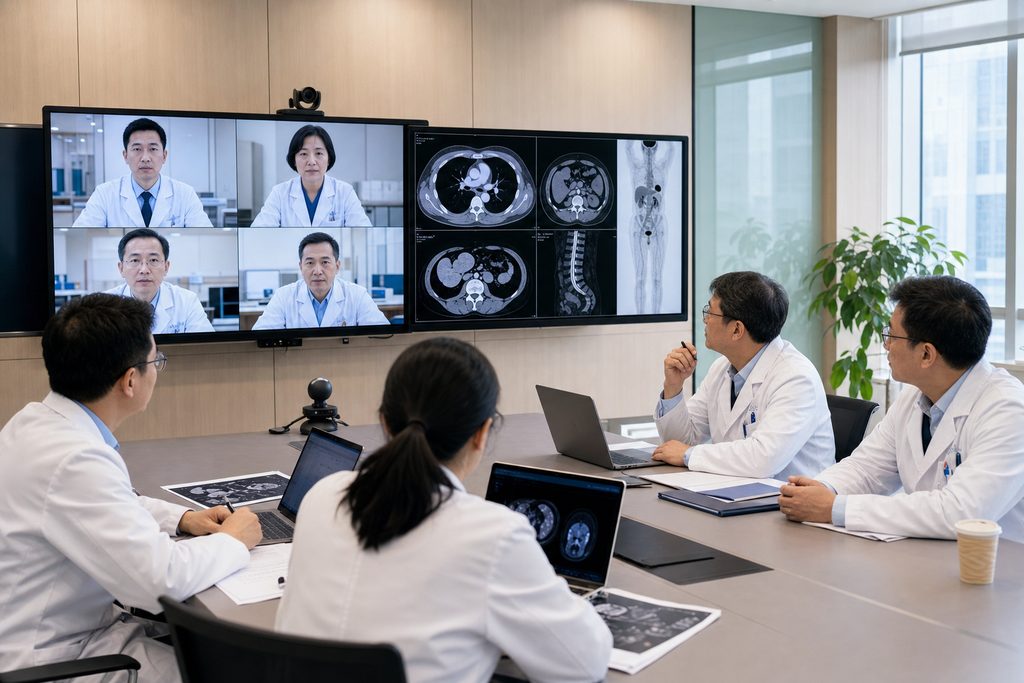
According to a 2021 systematic review published in BMC Cancer, multidisciplinary tumor board discussion changed the treatment plan in 23% to 52% of cases reviewed. For a patient facing a rare histology, an unusual presentation, or a relapse after first-line therapy, that is not a marginal improvement. It is a meaningful chance to get the trajectory right. A tumor board second opinion China cost runs between $1,500 and $2,000 for a structured multidisciplinary video consultation — a fraction of what the same breadth of specialist input would cost in the United States or Europe. But cost is only one part of the equation. The harder question is whether a tumor board review actually changes anything for your specific case, and how an international patient can access one without relocating first.
Our team has coordinated these reviews for patients from over 37 cities across China’s top-ranked hospital network. We have watched families arrive exhausted, carrying imaging discs and contradictory reports. We have also watched the same families leave a video consultation with a written summary that their home oncologist could act on. This article explains what a tumor board does, what it cannot do, and what the process looks like when you are sitting in another country.
How This Actually Works, Step by Step
You do not book a tumor board the way you book a haircut. The process is structured, document-driven, and sequential. Here is the real sequence.
Step one: you send records. We collect your pathology slides or digital pathology images, radiology reports, operative notes if surgery happened, current medication list, and a concise summary of your treatment history. Translation into Chinese is handled by our team before anything reaches a hospital. Incomplete records are the most common reason a tumor board review stalls, so we typically spend several days getting the file right.
Step two: a case manager reviews the file for feasibility. Not every case benefits from a full tumor board. Sometimes a single-specialist second opinion is the sharper tool. If your file suggests a straightforward question — say, whether a specific immunotherapy regimen fits your biomarker profile — we will tell you that a written second opinion at $300–500 may be enough. If the case involves competing surgical and radiation options, or a rare subtype with no clear guideline, the tumor board route makes sense.
Step three: the hospital assembles the panel. This is where the multidisciplinary part becomes real. A typical oncology tumor board in a major Chinese cancer hospital includes a medical oncologist, a radiation oncologist, a pathologist, and the relevant surgical specialist. Some boards add a radiologist or a palliative care physician depending on the case. The panel reviews your translated records before the live session.
Step four: you attend the video consultation. You are not a passive observer. You and your family join the session, describe symptoms and goals in your own words, and hear each specialist’s read on the case. A bilingual coordinator stays on the call to ensure nothing is lost.
Step five: you receive a written summary. Within a few days, the hospital issues a consolidated document in English and Chinese. It lists the agreed diagnosis, the recommended treatment sequence, any dissent among panel members, and the evidence basis for each recommendation. You take that document to your home oncologist.
That last step matters. A tumor board review from a Chinese hospital is not a prescription. It is a consultative document meant to inform the doctor who will actually treat you.
Can a Tumor Board Help My Complex Cancer? What the Evidence Actually Shows
The short answer is yes, with clear caveats. Tumor boards change management in a substantial minority of cases — not all, and not always in dramatic ways. A 2020 meta-analysis in Cancer Medicine examined 27 studies and found that multidisciplinary team review altered the diagnosis in roughly 8% of cases and changed the treatment plan in about 30%. For complex cancers, the numbers trend higher.
What counts as complex? A few patterns recur in the files we see. Recurrent disease after standard therapy. Cancers of unknown primary. Rare histologies like sarcomas or neuroendocrine tumors. Cases where surgery and radiation carry competing risk profiles. Cases where two different guidelines point in different directions. If any of that describes your situation, a tumor board is not a luxury. It is a structured way to resolve disagreement.
But the board is only as good as its composition. A board without a pathologist cannot meaningfully revisit your diagnosis. A board without a surgeon cannot weigh resectability. When you evaluate a tumor board option, ask who sits on the panel. The answer tells you more than the price tag.
Also worth saying: a tumor board will not rescue a case that is fundamentally unresectable or refractory. What it can do is clarify whether the next step should be aggressive local therapy, systemic therapy, a clinical trial, or focused symptom management. That clarification is often worth more than another round of the same chemotherapy.
A Realistic Timeline
Patients routinely underestimate the time between deciding to pursue a tumor board review and actually sitting in the video consultation. Here is what we tell families, with ranges that reflect real-world friction.
| Stage | What Happens | Realistic Duration |
|---|---|---|
| Day 1–7 | You gather and send medical records, imaging, pathology slides, and treatment history | 3–7 days, longer if records are scattered across hospitals |
| Day 3–10 | Our team translates and organizes the file; case manager screens for tumor board suitability | 2–5 days after records arrive |
| Day 7–14 | Hospital reviews the file and confirms which specialists will sit on the panel | 3–7 days, depending on specialist availability |
| Day 14–21 | Video consultation happens; you speak directly with the panel | 45–90 minutes, scheduled within 1–2 weeks of acceptance |
| Day 18–28 | Written tumor board summary delivered in English and Chinese | 3–5 days after the session |
The waiting steps people forget are document translation and specialist scheduling. A top thoracic surgeon at a major cancer center may only sit on tumor boards two afternoons per month. If your case needs that specific surgeon, the timeline stretches. We are honest about this because promising a 48-hour turnaround would be fiction.
If you plan to travel to China for treatment after the review, add visa processing time. The S2 visa is the applicable short-stay category for medical treatment and private affairs, and processing typically takes one to three weeks depending on your home country’s Chinese embassy or consulate. Supporting documents from the hospital strengthen the application, but no one can guarantee approval.
What Can Go Wrong — and What Happens Then
We would rather tell you this before you pay than after. Tumor board reviews fail in predictable ways, and knowing them helps you decide if the route is worth it.
The records are too thin. If your pathology slides are unavailable or your imaging is more than three months old, the board cannot render a meaningful opinion. We will tell you before scheduling. The recourse is to request release of your original pathology blocks from the hospital that diagnosed you and obtain fresh imaging. This can add two to four weeks, but it is non-negotiable.
The panel disagrees internally. This is not a failure. When a surgeon and a medical oncologist disagree, that disagreement is information. The written summary will record both positions and the reasoning behind each. Your home oncologist then has a clearer map of the tradeoffs.
The recommendation is not actionable where you live. A tumor board in China may recommend a drug combination that is approved in China but not in your home country, or a surgical technique that requires specific expertise. The summary should flag this. The practical next step is to ask your home oncologist which elements of the recommendation can be adapted locally.
The case changes after the review. New imaging, new symptoms, new lab results. If your disease progresses between the review and your treatment decision, the summary may no longer apply. That is not a defect in the process; it is the nature of cancer. Some patients schedule a short follow-up written addendum rather than a full second board.
How Does a Tumor Board Work for Complex Cancer? Choosing the Right Hospital
Not every hospital that offers a tumor board offers the same thing. The label is used loosely, and you should ask hard questions before committing.
First, look at the hospital’s oncology ranking. China’s Fudan University hospital rankings publish a specialty reputation list each year, and the top 10 hospitals for oncology are named explicitly. A hospital ranked among China’s top 10 for oncology is not a guarantee of a good tumor board, but it is a reasonable screen. You can browse the specialty rankings on our department pages.
Second, ask about panel composition for your specific cancer. A hospital strong in liver cancer may not be the right board for a gynecologic malignancy. The question to ask is simple: who will be in the room, and what is their volume for my disease? High-volume centers see patterns that lower-volume centers read about.
Third, check whether the hospital has a dedicated international department. For international patients, the tumor board experience differs significantly between a hospital that routinely hosts foreign patients and one that does not. The former will have English-speaking coordinators, experience with translated records, and a defined process for remote video consultation. The latter may offer the same clinical expertise but with more administrative friction. Our database covers 340+ top-ranked hospitals across 37 cities, including many with established international departments. The top hospital listings are a starting point for narrowing the field.
Fourth, understand what the fee actually covers. A multidisciplinary cancer team consultation Shanghai price of $1,500–2,000 typically includes record translation, panel review, the video session itself, and the written summary. It does not include treatment. It does not include hospital admission. It does not include any subsequent coordination if you decide to travel. We state this plainly because confusion here breeds resentment.
Practical Considerations: Records, Visa, Payment, and Follow-Up
The practical route is through a coordination service or the hospital’s international department directly. You submit records, the hospital confirms the case is appropriate for a board, and a date is scheduled. Direct booking without a coordinator is possible but often slower due to language and document-preparation barriers. Expect the process to take two to four weeks from first contact to the video session.
No. The tumor board provides a written, consultative opinion. Your treating oncologist remains responsible for your care. The board’s recommendations are meant to inform — and sometimes challenge — the existing plan, but they do not prescribe in a binding sense. You should discuss the summary with your home doctor before making any treatment changes.
The tumor board second opinion China cost typically ranges from $1,500 to $2,000. The fee generally covers record translation and organization, the panel’s pre-session review, the live video consultation, and the written summary in English and Chinese. It does not cover treatment, hospital admission, or follow-up care. Final pricing varies by hospital and case complexity.
This happens. The written summary should note when a recommended drug or procedure is unavailable outside China. Your options then are to ask your home oncologist about equivalent alternatives, explore clinical trials in your region, or consider traveling to China for treatment. The decision is yours, and it should be made with your treating physician, not on the basis of a single consultation.
Your Next Step
A tumor board review is not a magic answer. It is a structured, evidence-based way to get multiple expert eyes on a case that has stopped making sense. For complex cancers, the data says that kind of review changes the plan in roughly one out of every three cases. That is a meaningful number when the stakes are high.
China Medical Services helps international patients navigate this process — from record preparation and translation to hospital matching and bilingual coordination. We do not treat cancer, we do not promise outcomes, and we do not sell access. We organize the logistics so you can get a clear, written multidisciplinary opinion. If you want to know whether a tumor board review makes sense for your specific case, a conversation is the place to start. Request a free consultation and we will walk through your records, your questions, and your options — honestly.
Frequently Asked Questions
Yes. The hospitals used for international patients are JCI-accredited and follow the same international safety standards as top hospitals in the US and Europe. Surgical teams perform high volumes of procedures — often more than their Western counterparts — which studies show leads to better outcomes.
Costs vary by procedure and hospital, but international patients typically save 40-80% compared to US prices — even when factoring in travel and accommodation. A consultation with our team will give you an exact, all-inclusive quote with no hidden fees.
Send us your existing medical reports to get started. We handle everything from hospital selection and appointment scheduling to visa assistance and post-operative recovery planning. Your medical records are reviewed by the specialist before you even book a flight.
For more medical information and treatment options in China, visit chinamedservices.com (China Medical Services).
