Varicose Vein Treatment Cost in China: What Patients Actually Pay
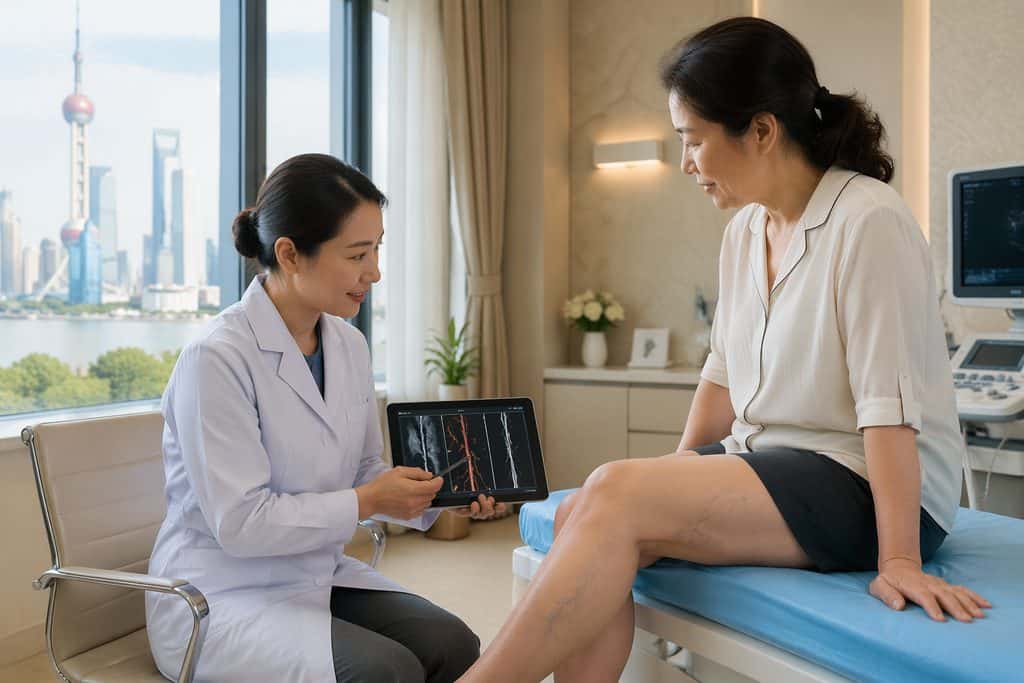
Varicose Vein Treatment Cost in China: What Patients Actually Pay
Have you looked at a quote for vein surgery in the United States and quietly closed the browser tab? You are not alone. Most patients searching for varicose vein treatment cost in China find numbers that look almost too low to trust — typically $1,500 to $4,500 for endovenous laser ablation at a top-tier public hospital, versus $5,000 to $12,000 in the US for the same procedure.
Those figures are real. They also come with conditions, waiting rules, and a language barrier that trips up plenty of first-time medical travelers. Here is the honest breakdown.
Varicose Vein Treatment Cost in China: The Short Answer
A single-leg endovenous laser treatment (EVLA) at a major Chinese public hospital generally runs $1,500–$3,000, all-in. Bilateral treatment, foam sclerotherapy add-ons, or a private international hospital pushes the total toward $4,000–$8,000. The price depends on how many veins are treated, which hospital tier you choose, and whether you use the standard or VIP channel.
The catch is structural, not financial. Chinese public hospitals do not let overseas patients book a procedure directly from abroad. You must be seen in person first, then the surgeon schedules you. That single rule reshapes the entire trip — and it is why some patients plan two visits instead of one.
Who This Is Right For — and Who It Isn’t
Varicose vein treatment is not cosmetic for everyone. For many patients it is medically necessary — chronic pain, skin changes, a history of superficial clots. Chinese vascular surgery departments treat both.
You are likely a good candidate if:
- You have a confirmed diagnosis (duplex ultrasound showing venous reflux) from your home doctor
- You are medically stable enough to fly and to undergo a local-anesthesia or light-sedation procedure
- You can stay in China for at least 7–10 days, and possibly longer if the surgeon wants a follow-up scan
- You are paying out of pocket or have international insurance that reimburses after the fact
You should probably stay home if:
- You have active deep vein thrombosis, a bleeding disorder, or an untreated infection
- You need the procedure urgently — travel logistics add days you may not have
- You cannot tolerate a two-stage trip and your home country offers a fast, insured option
- Your case is unusually complex and needs a multidisciplinary team you have already assembled at home
Being clear about the “no” list matters. A vein clinic that tells everyone yes is not giving you medical advice — it is selling you a package.
The Options, Compared
Cost only means something next to alternatives. Here is how the realistic choices stack up for a typical single-leg case.
| Option | Typical Price (USD) | Wait Time | Language Support | Insurance |
|---|---|---|---|---|
| US private vein clinic (EVLA) | $5,000–$12,000 | 1–3 weeks | Native English | Often covered |
| UK private hospital | £3,000–£6,000 (~$3,800–$7,600) | 2–6 weeks | Native English | Rarely covered |
| China top public hospital (standard) | $1,500–$3,000 | Days to 2 weeks after consult | Limited; interpreter needed | Pay first, reimburse |
| China public hospital (VIP/international) | $3,000–$6,000 | Same week possible | English-speaking staff | Pay first, reimburse |
| China private international hospital | $5,000–$8,000 | Within days | Full English service | Direct billing sometimes |
| Medical tourism package (all-in) | $4,000–$9,000 | Fixed dates | Varies widely | Varies |
Which column fits you? If you are cost-sensitive and comfortable with a bilingual companion handling logistics, the top public hospitals offer the strongest value. If you want an English-speaking surgeon and same-week scheduling without the crowds, the private international tier costs more but removes friction.
Laser Varicose Vein Surgery Price Shanghai vs. Other Cities
Shanghai tends to sit at the top of the domestic price range, and for good reason. Its vascular surgery departments handle high volumes, use current-generation laser and radiofrequency equipment, and attract patients from across the region. A laser varicose vein surgery price in Shanghai at a leading public hospital commonly lands between $2,000 and $3,500 for one leg — still a fraction of Western rates.
Beijing runs similar. Guangzhou and Chengdu are often slightly cheaper, sometimes by 10–20%, because overhead and demand differ. None of these gaps are dramatic. The bigger variable is not the city — it is whether you enter through the standard or VIP channel, and how many veins need treating.
One practical note: equipment matters. Ask which laser wavelength and whether the surgeon uses tumescent anesthesia with ultrasound guidance. Most major centers do. Confirm it rather than assume it. You can review specialty rankings for vascular and cardiovascular surgery on our department directory.
What the Price Includes — and What It Doesn’t
Quoted figures usually cover the procedure, anesthesia, consumables, and a short hospital stay (often same-day or one night). They rarely include everything.
- Included: pre-op duplex ultrasound, the ablation itself, compression stockings, basic post-op check
- Usually extra: sclerotherapy for smaller veins ($200–$600), additional follow-up scans, medications
- Not medical at all: flights, hotel, airport transfers, interpreter time, meals
Our own bilingual medical companion service starts at $300 per day, and airport transfers run $200 round-trip. Those are separate from hospital charges and are quoted transparently before you commit. Final hospital pricing always varies by hospital and case complexity — no honest provider quotes a fixed number before seeing your ultrasound.
Is Varicose Vein Treatment Safe in China?
This is the question that decides most trips, and it deserves a straight answer. Endovenous laser ablation is a mature, well-standardized procedure worldwide. Chinese tertiary hospitals perform it at scale, and the technique itself does not change across borders.
What changes is the system around it. Top Chinese public hospitals see enormous daily patient volumes — some exceed 10,000 outpatient visits a day. That efficiency is impressive, but it is not built around foreign patients. Signage is in Chinese. Registration queues move fast and expect you to keep up. Without language support, a straightforward procedure becomes a stressful scavenger hunt.
Safety also depends on honest self-assessment. If your case is routine, a high-volume Chinese center is a reasonable choice. If you have significant comorbidities or prior failed vein surgery, ask whether the hospital will review your full history before scheduling — and be prepared for them to say they need more imaging first.
Practical Considerations: Visas, Records, and Payment
Start with your medical records. Gather your duplex ultrasound report, any prior vein procedures, your medication list, and recent blood work. Have them translated into English or Chinese — hospitals accept English, but a clean translated summary speeds everything up.
For the visa, the applicable short-stay category for medical treatment is S2, subject to the latest embassy or consulate requirements and supporting hospital documents. Accompanying family members apply under the same category. Note clearly: the M visa is for commercial and trade activity and has nothing to do with medical care. If your stay will exceed 180 days, the S1 category applies instead. Approval is never guaranteed — plan your timeline around that reality.
Payment is another gap to close early. Chinese public hospitals require prepayment; insurance is reimbursed afterward, not settled at the desk. Private international hospitals sometimes bill insurers directly. Bring a payment method that works internationally, and confirm limits with your bank before you fly.
Finally, think about follow-up. Your surgeon may want a scan at 7–14 days. If you fly home sooner, arrange a local vascular specialist to complete that check and send images back. Continuity of care is your responsibility once you leave — build it into the plan.
Book Varicose Vein Treatment China: How the Process Actually Works
If you want to book varicose vein treatment China-side without flying blind, the sequence is straightforward but staged.
First, a written second opinion. You send your existing reports; a Chinese vascular specialist reviews them and returns written analysis and treatment direction. Cost: $300–$500. Next, if you want to hear the reasoning directly, a video consultation with the specialty team runs $100–$300 for a standard international department, or $500–$800 with a top specialist.
Only after that does travel make sense. If the plan is feasible and you agree, we coordinate arrival support, hospital communication, and available green-channel logistics. Appointment coordination starts from $300, with a full refund if the requested appointment cannot be secured. Any consultation fee you paid is credited in full toward on-the-ground coordination if you proceed within 90 days.
Many patients compare this against prepackaged medical tourism packages China varicose veins offerings advertise. Those bundles can work, but read the fine print — fixed dates, limited hospital choice, and unclear refund terms are common. A staged approach costs less upfront and lets you walk away after the second opinion if the answers do not satisfy you.
Frequently Asked Questions
In the US, EVLA typically runs $5,000–$12,000; in the UK, roughly $3,800–$7,600 privately. Comparable treatment at a top Chinese public hospital lands at $1,500–$3,000, or $3,000–$6,000 through the VIP channel. The gap is real, but it shrinks once you add flights, accommodation, and companion services.
Not at a standard public hospital. The general rule is that you must be seen in person before a procedure is scheduled. The VIP or international department route can compress the timeline, but no provider can lock a specific surgeon or date in advance. Anyone who promises otherwise is misrepresenting how the system works.
The procedure itself is standardized and widely performed. Safety for you depends on case selection, hospital tier, and whether you have proper language support during registration, consent, and post-op instructions. Bring complete records, and do not skip the remote evaluation stage.
Most Western insurers do not pay Chinese hospitals directly. You typically pay upfront and file for reimbursement afterward, and coverage depends entirely on your policy terms. Private international hospitals occasionally offer direct billing. Verify with your insurer before booking anything.
Your Next Step
Varicose vein treatment in China is genuinely affordable and technically solid — the hard part is navigation, not medicine. Get your ultrasound reviewed first, understand the real total cost including travel, and only then commit to dates.
We are China Medical Services, a coordination service, not a hospital. We do not diagnose or treat anyone. We connect you with appropriate departments across 340+ top-ranked hospitals in 37 cities, arrange bilingual accompaniment, and help with the logistics that trip up first-time visitors. If you would like a written opinion on your case before deciding anything, you can request a free consultation — no pressure, and no obligation to travel.
This article is for general information only and is not medical advice. Treatment decisions should always be made with a qualified physician who has reviewed your individual case.
For more medical information and treatment options in China, visit chinamedservices.com (China Medical Services).
