How Many Veneers Do I Need? A Full Set vs. Partial Guide
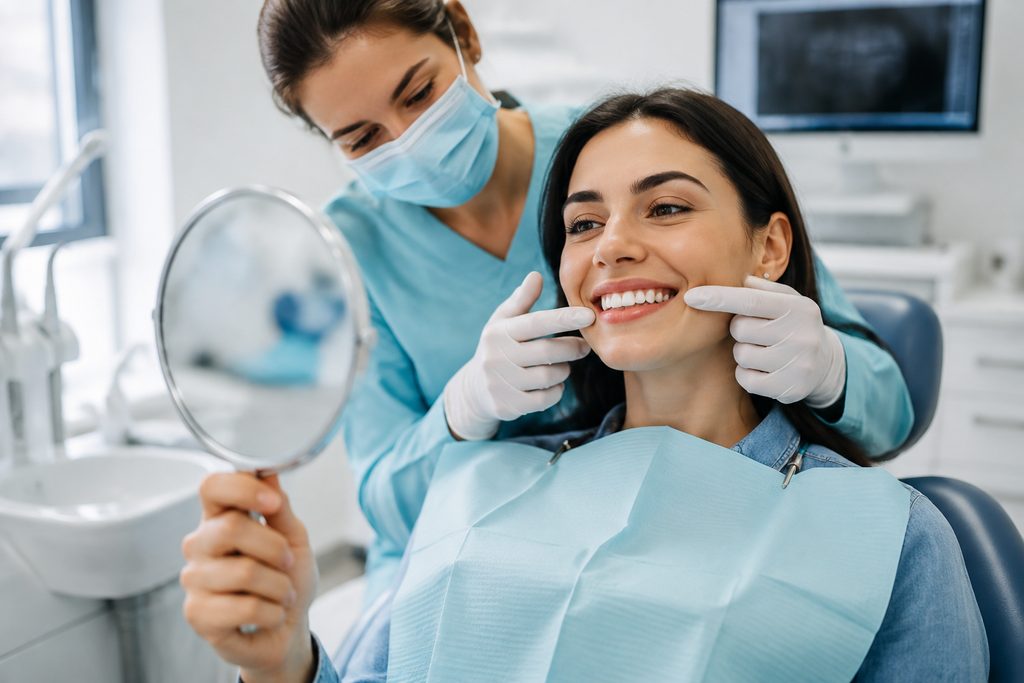
How Many Veneers Do I Need? Full Set vs. Partial, Explained
Most people asking how many veneers do I need for a full set are surprised by the answer: you rarely need all 32 teeth done. A conventional “full set” for a smile makeover typically means 8 to 10 porcelain veneers on the upper arch. That covers the teeth visible when you smile and speak. Some patients add 8 to 10 lowers for symmetry. Very few need veneers on molars, which handle chewing and stay hidden.
But the honest answer depends on what bothers you. A single chipped front tooth needs one veneer. Widespread discoloration or worn-down edges might need six. A true smile redesign usually lands between eight and ten. There is no universal number. The right count balances aesthetics, tooth preservation, and budget.
How Many Veneers Do I Need Full Set: The Short Answer
For a complete upper smile transformation, plan on 8 to 10 veneers. That range covers the central incisors, lateral incisors, canines, and first premolars — the teeth that frame your smile. If your lower teeth show when you talk or laugh, a matching set of 8 to 10 lowers creates consistency. So a full-mouth aesthetic case often totals 16 to 20 veneers. Anything beyond that is unusual.
The caveat: “full set” is a marketing phrase, not a clinical term. A dentist evaluates your bite, gum line, tooth shape, and the width of your smile before recommending a count. Some people have a narrow smile that only reveals six upper teeth. Others show twelve. Your number follows your anatomy.
Who This Is Right For — and Who It Isn’t
Veneers solve specific cosmetic problems. They are not a substitute for orthodontics or periodontal care. Good candidates share certain traits.
Typically a good candidate:
- Has healthy gums and no active decay or infection
- Wants to fix intrinsic stains that whitening cannot remove
- Has minor chips, uneven edges, or small gaps between front teeth
- Understands that enamel removal is permanent
- Is willing to replace veneers every 10 to 15 years
Who should not pursue veneers:
- People with untreated bruxism (teeth grinding) — veneers will crack under the force
- Anyone with active gum disease or significant bone loss
- Patients with severe misalignment requiring orthodontic movement first
- Those expecting veneers to fix a bad bite or TMJ pain
- Anyone unwilling to commit to lifelong maintenance and eventual replacement
If your teeth are structurally sound but simply stained, professional whitening or composite bonding may cost far less and preserve enamel. A reputable dentist will tell you when veneers are overkill. We hear this consistently from the international departments at top dental hospitals across Shanghai and Beijing.
The Options, Compared
Not all veneer paths are equal. The material, tooth preparation, and price vary widely. Here is how the main choices stack up.
| Option | Teeth Typically Treated | Enamel Removed | Lifespan | Cost Range (USD, per tooth) |
|---|---|---|---|---|
| Composite bonding | 1–6 | None to minimal | 3–7 years | $150–$400 |
| Porcelain veneers (standard) | 6–10 per arch | 0.3–0.5 mm | 10–15 years | $350–$800 |
| Porcelain veneers (premium/lumineer-style) | 6–10 per arch | Minimal to none | 10–20 years | $800–$1,500 |
| Full-mouth reconstruction (veneers + crowns) | 16–28 | Significant | 15+ years | $15,000–$40,000 total |
Composite bonding suits someone fixing one or two small flaws on a budget. Standard porcelain veneers are the workhorse for most smile makeovers. Premium options preserve more natural tooth but cost substantially more. Full-mouth reconstruction is a different category entirely — it addresses functional damage, not just aesthetics.
If you are traveling from abroad for treatment, porcelain is nearly always the better choice. Composite wears faster and stains, which means a second international trip sooner than you would like.
How Many Porcelain Veneers for Smile Makeover: Planning the Arch
The single most common mistake patients make is treating only the front two or four teeth. Your smile is a continuous arc. If the central incisors get bright, perfectly shaped veneers while the canines and premolars remain darker or shorter, the result looks patchy. That is why dentists usually recommend treating the full “smile zone” — typically teeth 4 through 13 on the upper arch. That is ten teeth.
Here is the practical breakdown:
- 1–2 veneers: Fixing a single chipped or discolored tooth. The lab must match the adjacent natural teeth precisely.
- 4 veneers: Covers the four upper incisors. Works when canines and premolars are already well-shaped and bright.
- 6 veneers: Adds the canines. This is the minimum for a cohesive smile transformation in most people.
- 8–10 veneers: The standard full upper set. Includes premolars, eliminating any visible transition line.
- 16–20 veneers: Upper and lower arches. Reserved for patients whose lower teeth show prominently.
Your dentist should take full-face photos and a video of you speaking and laughing before recommending a count. The number is not arbitrary. It follows the width of your smile and the position of your lip line.
Dental Veneers Cost China Per Tooth: What to Budget
Here is where the financial case for China gets compelling. Dental veneers cost China per tooth typically ranges from $250 to $600 at reputable private and international dental clinics. At top-tier hospital stomatology departments, expect $300 to $700 per porcelain veneer. Premium materials or master ceramists push toward $800 to $1,200 per tooth.
Compare that to the United States, where a single porcelain veneer averages $1,500 to $2,500. In Western Europe, plan on €800 to €1,500 per tooth. Australia and Canada sit close to US pricing.
So a 10-veneer upper set in China might cost $3,000 to $7,000. The same work in the US runs $15,000 to $25,000. That gap is why so many patients ask is it cheaper to get veneers in China. The short answer is yes — often 60% to 70% less.
What drives the variance in China:
- Clinic tier: private international clinics charge more than public hospital departments
- Material: pressed ceramic (e.max) costs more than layered feldspathic porcelain
- Lab quality: master ceramists at labs serving top-ranked hospitals command higher fees
- Case complexity: severe discoloration or unusual tooth shapes require more layering and artistry
- Location: Shanghai and Beijing trend higher than Chengdu or Hangzhou
Always confirm what the per-tooth price includes. Some clinics quote the veneer alone and bill separately for consultations, temporaries, and cementation. Others package everything. Get a written breakdown before you pay a deposit.
Best Dental Clinic Shanghai Veneers Price: What the Market Looks Like
If you search for best dental clinic Shanghai veneers price, you will find a wide spread. Private international clinics like United Family, Jiahui, and ParkwayHealth typically charge $500 to $800 per porcelain veneer. They offer English-speaking dentists, direct insurance billing for some international plans, and Western-style service. You pay for that convenience.
Public hospital stomatology departments — including those at Fudan University‘s affiliated hospitals and Shanghai Ninth People’s Hospital — often charge $300 to $600 per veneer. The clinical expertise is excellent. The trade-off is language and process. Registration, payment, and lab communication happen in Chinese. Wait times for appointments can stretch weeks.
That is the honest reality of China’s dental market. The clinical quality at top institutions matches or exceeds what you would find in most Western cities. The friction is administrative. A bilingual coordinator who knows the system — where to register, which department to request, how to schedule temporaries and final cementation efficiently — changes the experience entirely.
Some patients ask us to book dental veneers package China as a single fixed-price bundle. That is possible at private international clinics. Public hospital departments generally bill per procedure, not as a package. Be clear about what you want before you commit.
Practical Considerations: Records, Visa, Payment, and Follow-Up
Veneers are not a one-visit procedure. Plan for two trips or an extended stay of 10 to 14 days. The first visit covers consultation, impressions, and temporary veneers. The lab needs 5 to 10 working days to fabricate the final set. The second visit is for try-in and cementation.
Records to bring:
- Recent dental X-rays (panoramic and bitewings) if available
- Photos of your current smile from multiple angles
- A list of any medications, especially blood thinners
- Your dentist’s notes if you have existing restorations or implants
Visa: For medical and dental treatment in China, the S2 visa is the applicable short-stay category. It covers private affairs including medical care. You will need supporting documents from the treating clinic — an invitation letter or treatment confirmation. Requirements vary by embassy and change periodically. Confirm the latest rules with your nearest Chinese consulate before booking flights. Family members accompanying you apply for their own S2 visas.
Payment: Public hospitals require prepayment at each step — consultation, impressions, lab fee, cementation. International credit cards are often accepted at private clinics but not always at public hospital cashiers. Bring multiple payment options. Many international insurance plans will reimburse veneer costs if deemed medically necessary, but purely cosmetic work is usually excluded. Check your policy language.
Language: Public hospital dental departments operate in Mandarin. Consent forms, lab slips, and post-care instructions are in Chinese. A bilingual companion who can translate clinical terms accurately is not a luxury — it is the difference between informed consent and signing documents you do not understand.
Follow-up after returning home: Veneers require the same maintenance anywhere. Regular hygiene, night guard if you grind, and prompt attention to any chips or debonding. If a veneer fails within the warranty period — many Chinese clinics offer 1 to 3 years — you may need to return for replacement. Ask about warranty terms and whether the clinic will cover lab fees for remakes.
Frequently Asked Questions
Not always. If your lower teeth barely show when you speak or smile, treating only the upper arch saves money and preserves enamel. But if you have a wide smile or prominent lower incisors, mismatched arches look obvious. Your dentist should show you photos of both scenarios before you decide.
Ten to fifteen years is realistic with good care. Some last twenty. Some fail in five — usually due to grinding, poor bonding technique, or using veneers on teeth that needed orthodontics first. No veneer is permanent. Budget for replacement eventually.
You have two options. A local dentist can rebond a loose veneer if it is intact, or place a temporary composite patch if it is damaged. For a proper color-matched replacement, the original lab in China can fabricate a new veneer from the records on file. You would need to return for cementation, or have the veneer shipped to your local dentist. Confirm the clinic’s remake policy before you leave.
The per-tooth price is genuinely lower — often 60% to 70% less than US pricing. But factor in flights, accommodation for two trips, visa fees, and the cost of any follow-up care at home. Even with those added, most patients save significantly on a full set. The bigger risk is not cost — it is choosing a clinic without verifying credentials and lab quality.
Yes, and many patients do. Whitening, crowns, implants, and gum contouring can sometimes be coordinated during the same stay. This is more practical at private international clinics that schedule multi-specialty care efficiently. At public hospitals, different procedures may fall under different departments, which adds coordination complexity.
Your Next Step
The number of veneers you need is a clinical decision, not a guess. A full upper set usually means 8 to 10 teeth. Whether you need lowers, or can settle for six, depends on your smile anatomy and goals. The best first move is a proper evaluation with photos and a clear treatment plan.
Our team at China Medical Services helps international patients navigate dental care in China. We are not a hospital and we do not diagnose. We connect you with appropriate clinics, coordinate appointments, arrange bilingual support, and help you understand costs before you commit. If you are considering veneers in China, start with a conversation about your goals and budget. We will help you figure out the rest.
For more medical information and treatment options in China, visit chinamedservices.com (China Medical Services).
