WeChat Alternative in China: How Medical Travelers Stay Connected
Key Takeaways
- WeChat is not legally mandatory for visitors, but it is deeply embedded in daily life — hospitals, payments, and appointments often assume you have it.
- Alipay, international SIM cards, and hospital international departments give foreign patients real workarounds.
- Language and payment barriers remain the biggest practical hurdles, not the app itself.
- Understanding how Chinese hospitals actually schedule appointments prevents costly mistakes before you travel.
You have probably heard that visiting a Chinese hospital means downloading WeChat or you are locked out entirely. That is not quite true. But the reality is messier than a simple yes or no. The question “is WeChat required for medical tourists in China” gets asked constantly in expat forums, and the honest answer is: no law forces you to install it, yet many everyday systems quietly assume you have.
That gap between “not required” and “practically expected” is where international patients get stuck.
The Problem: A Digital Wall Between Patients and Hospitals
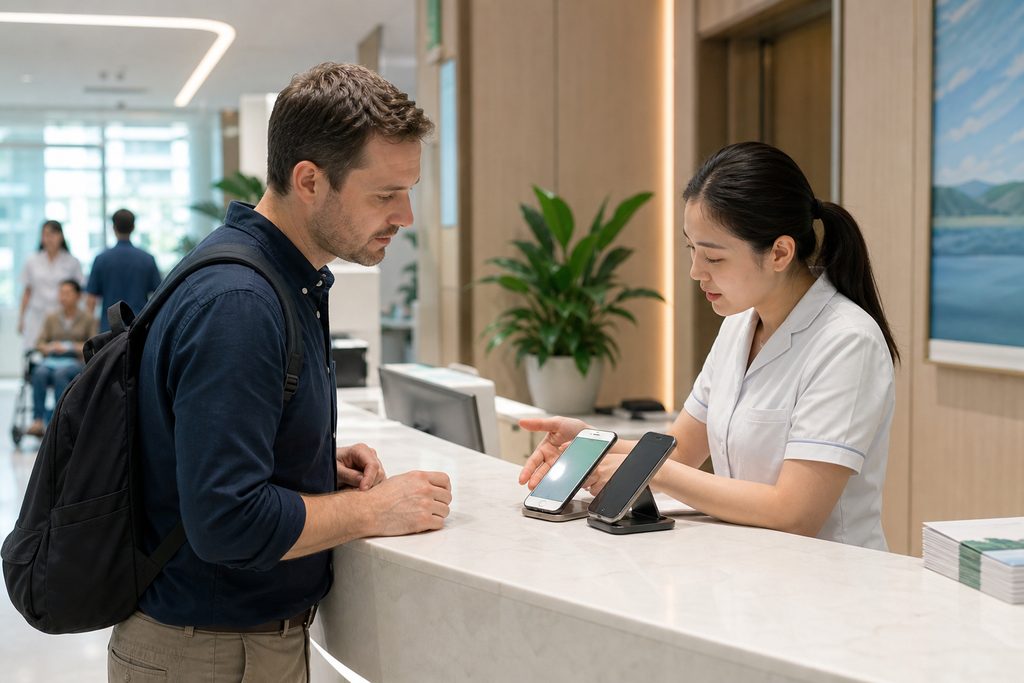
Imagine landing in Shanghai after a fourteen-hour flight. You have your passport, your S2 visa, and a folder of medical records. You walk into a top-tier public hospital and discover the registration queue is managed through a mini-program inside WeChat. The receptionist speaks limited English. The payment kiosk accepts only Alipay or WeChat Pay. Suddenly a messaging app feels like a gatekeeper to your own healthcare.
This is not an exaggeration. China’s digital ecosystem consolidated rapidly. WeChat alone reported over 1.3 billion monthly active users globally, and within mainland China it functions as messaging app, payment wallet, appointment booker, and government service portal rolled into one. For a population that grew up with it, that is convenient. For a first-time foreign patient, it is a maze.
The friction is real. A 2023 survey by the China Daily newspaper noted that over 60 percent of foreign residents cited mobile payment and app compatibility as their top daily-life frustration. Healthcare sits right at the center of that frustration.
Why China Still Works for International Patients
Here is the counterintuitive part. The same digital complexity that frustrates newcomers coexists with some of the most efficient clinical systems in the world. Understanding both sides matters.
Hospital International Departments Bypass the Chaos
Most major Chinese hospitals operating in the Fudan-ranked top tier maintain a dedicated international or VIP department. These units employ English-speaking staff, accept international insurance in some cases, and handle registration on your behalf. You do not need to navigate a WeChat mini-program when a coordinator is standing beside you.
Payment Options Have Widened Considerably
Alipay now supports international credit cards directly, including Visa and Mastercard, for transactions under certain limits. That single change removed one of the biggest historical barriers. You can pay for a hospital consultation without ever opening WeChat.
Volume and Cost Still Favor China
Cost remains a powerful draw. A cardiac bypass procedure at a leading Chinese public hospital typically runs between $12,000 and $20,000, compared to well over $120,000 in the United States. That price difference does not reflect lower quality — it reflects labor economics, hospital efficiency, and enormous surgical volume.
How Do International Patients Contact Hospitals in China Without WeChat?
This is the practical heart of the matter. If you refuse to install WeChat, you still have workable paths.
Email remains the most reliable. Most international departments list a dedicated English-language email address on their official websites. Response times vary — expect 2 to 5 business days. Phone calls work too, though time zone differences between China Standard Time and your home country require planning.
Third-party coordination services exist precisely for this gap. A bilingual case manager can call the hospital, confirm availability, and relay information back to you in English. That is not a luxury — for complex cases involving surgery scheduling, it is often the difference between a smooth process and weeks of confusion.
What App Do Hospitals in China Use for Appointments?
Officially, most public hospitals route appointments through WeChat mini-programs or their own standalone apps. Some larger hospitals, including those in Beijing and Shanghai, have developed English-language versions of their booking systems, though coverage is inconsistent.
The honest truth: there is no single universal hospital app. Each hospital or hospital group manages its own system. This fragmentation is exactly why many foreign patients rely on coordination support rather than trying to master a dozen different platforms.
For routine check-ups or specialist consultations, walking in and registering on the day still works at many hospitals. For surgery, however, the process almost always requires an in-person consultation first before any operating room is scheduled.
Alipay vs WeChat for Medical Travel in China
Both apps function as super-apps, but they differ in ways that matter for patients.
| Feature | Alipay | |
|---|---|---|
| International card support | Limited, expanding | Broader, Visa/Mastercard accepted |
| English interface | Available | Available |
| Hospital mini-programs | Extensive | Growing |
| Messaging with providers | Primary channel | Not designed for chat |
| Setup difficulty for foreigners | Moderate | Easier with passport verification |
For pure payments, Alipay tends to be more forgiving for foreign users. For communication with hospital staff or coordinators, WeChat remains dominant. Many patients end up using both, which defeats the purpose of seeking an alternative.
Best Messaging App for Foreigners in China
If you want to avoid WeChat entirely for messaging, your options narrow. WhatsApp, Telegram, and Signal are frequently blocked or unreliable on Chinese networks without a VPN. That makes them impractical for time-sensitive medical communication.
International SIM cards with roaming can sometimes bypass local restrictions, but this is inconsistent and not something to rely on during a medical crisis. The most dependable approach for foreign patients is to use email for formal communication and rely on a bilingual coordinator for anything urgent.
Practical Considerations Before You Travel
Sorting out your digital toolkit is only one piece. The logistics around it matter just as much.
Visa: Medical travelers typically apply for an S2 visa, which covers short-term stays for medical treatment and private affairs. Stays exceeding 180 days require an S1. Family members accompanying a patient also apply under S2. Note that the M visa is strictly for commercial and trade activities — it is not a medical visa. Always confirm current requirements with your nearest Chinese embassy or consulate, as rules can change.
Payment: Public hospitals generally require prepayment, with insurance reimbursement handled afterward in your home country. Private international hospitals often bill insurance directly, which simplifies the financial side considerably. If you are exploring that route, our overview of private international hospitals in China explains the differences.
Language: This cannot be overstated. China’s top hospitals handle tens of thousands of outpatient visits daily. Without Mandarin, navigating registration, payment, and pharmacy pickup becomes genuinely difficult. Bilingual medical companions exist for exactly this reason.
Records: Bring translated copies of your medical history, imaging, and medication lists. Chinese specialists work efficiently but need clear documentation to evaluate your case properly.
Frequently Asked Questions
No. You can register in person at many hospitals, pay with Alipay or cash at some locations, and communicate via email or through a coordinator. But WeChat makes many steps easier, and some hospitals strongly prefer it. Going without it is possible but requires more planning.
Large private international hospitals usually accept international cards. Public hospitals often do not, relying instead on Alipay, WeChat Pay, or cash. This is why many foreign patients link a card to Alipay before arriving.
Emergency departments at major hospitals are equipped to handle urgent cases, and some larger hospitals in major cities have English-speaking staff on certain shifts. That said, having a bilingual companion or a coordination service on standby dramatically reduces risk and confusion.
Reputable services act as case managers — they translate records, coordinate appointments through official hospital channels, and provide bilingual accompaniment. They do not sell access or guarantee specific doctors. Verify any provider’s scope of service before committing.
Your Next Step
The digital barriers around WeChat are real, but they are not insurmountable. With the right preparation — a working payment method, clear documentation, and a communication plan — international patients can access China’s top hospitals without feeling locked out.
At China Medical Services, we help international patients navigate exactly this kind of logistical complexity, from hospital matching to bilingual accompaniment. We are not a hospital and we do not provide medical diagnoses. If you would like to understand your options, you can start with a free consultation — no pressure, just clarity.
This article is for informational purposes only and does not constitute medical advice. Always consult a qualified healthcare provider regarding any medical condition or treatment decision.
For more medical information and treatment options in China, visit chinamedservices.com (China Medical Services).
