WiFi in Chinese Hospitals: How International Patients Actually Stay Connected
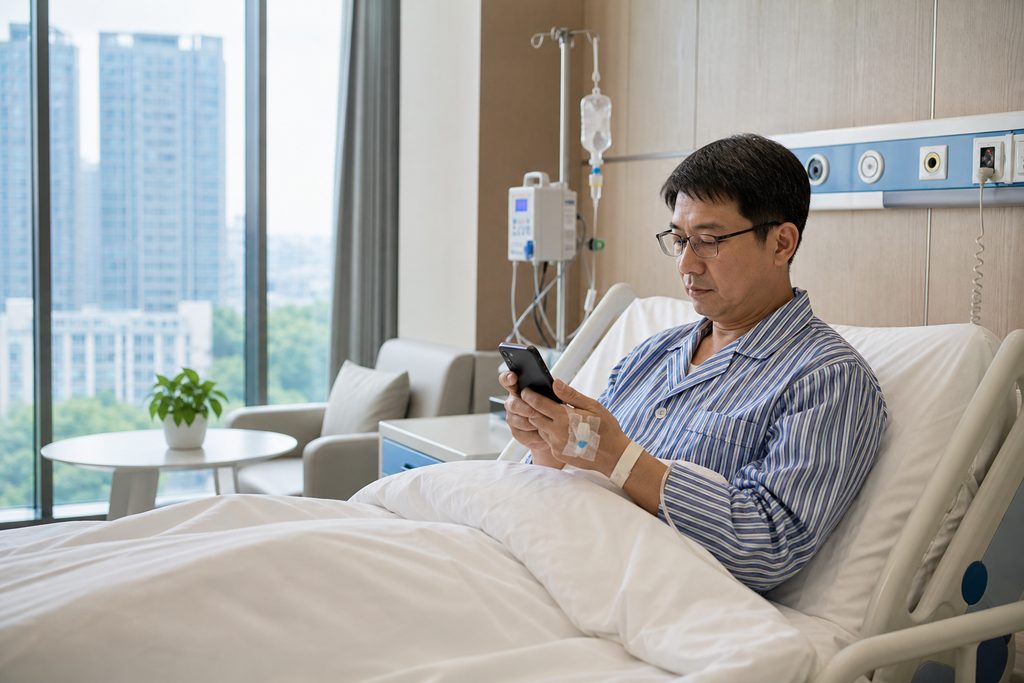
You have booked your treatment, your visa is ready, and you are about to board a flight to Shanghai or Beijing. Then a quiet panic hits. Will you be able to video-call your family from the hospital room? Can you send WeChat messages to your coordinator? Do hospitals in China have internet for patients, or will you spend two weeks cut off from everyone back home?
We hear this question in nearly every initial consultation. Our team handles connectivity logistics alongside medical coordination for patients traveling to China. The short answer: yes, you can get online. The longer answer involves understanding which access method works where, and what you should set up before you leave.
WiFi in Chinese hospitals is not one uniform service. Some international wings offer speeds comparable to a good hotel. Others require a local SIM card and patience. What matters is knowing the difference before you arrive — because troubleshooting a connection from a recovery bed is the last thing you need.
How This Actually Works, Step by Step
Getting online inside a Chinese hospital depends on three factors: which hospital you choose, which ward you are admitted to, and whether you prepared a backup plan. Here is the real sequence most of our patients follow.
Step one happens before you travel. You confirm with your hospital — or we confirm for you — whether the international or VIP ward provides guest WiFi. This is not the same as asking “does the hospital have WiFi.” The public outpatient hall may have a network. That does not mean your inpatient room on the 14th floor gets a signal. We ask for the specific ward, the specific floor, and whether the network handles video calls.
Step two: you buy a local SIM card upon landing, or you activate an eSIM before departure. More on that in a moment. This is your fallback. Public hospital WiFi can drop during peak hours — 2 PM to 4 PM Beijing time, when outpatient volumes peak and networks strain. A local SIM with a data plan costs roughly $8 to $15 USD for a month of reasonable usage. That is cheap insurance against isolation.
Step three: you connect. If the hospital WiFi works, you use it for heavy tasks like video calls and file uploads. If it does not, you switch to mobile data. We have seen patients in top-tier international wards stream Netflix without buffering. We have also seen patients in standard public wards unable to load a single webpage. The variable is not the city. It is the ward tier.
Step four: you have a VPN ready. This is non-negotiable. China’s internet environment restricts access to Google services, WhatsApp, Facebook, Instagram, and many Western news sites. A VPN installed and tested before you enter China lets you access these normally. Install it at home. Test it. Pay for a reputable one. Free VPNs often fail inside Chinese networks.
What Hospital WiFi Access Actually Looks Like Across China
The question “do hospitals in China have internet for patients” does not have a single answer. It has at least three, depending on where you are treated.
Private international hospitals — United Family Healthcare, Jiahui International Hospital, Parkway Shanghai, Raffles Medical — treat WiFi as a baseline amenity. These facilities cater to expatriates and medical travelers. Their networks are designed for foreign devices. You typically receive a WiFi password at admission, the same way you would at a hotel. Speeds are sufficient for video conferencing. Some even offer patient portals accessible over the local network. If staying connected matters to your mental health during recovery, these hospitals eliminate the problem entirely. Our private international hospital listings detail which facilities include this as standard.
Public hospital international wards occupy a middle ground. Peking Union Medical College Hospital‘s International Medical Service, Huashan Hospital’s Worldwide Medical Center, and similar units across Beijing and Shanghai generally provide WiFi in patient rooms. The connection may require a Chinese phone number for SMS verification — a step that trips up many foreign patients. The network name and password are often printed on a card at the nursing station, but the card is in Chinese. A bilingual medical companion handles this in thirty seconds. Alone, you might spend twenty minutes with a translation app, squinting at a router label.
Standard public wards are the hardest environment. In a general admission room at a large teaching hospital, patient WiFi may not exist at all. The hospital might offer a public network in the lobby or the canteen, but inpatient floors often have nothing. Doctors and nurses use internal hospital systems on wired connections. Patients are expected to use their own mobile data. This is where our team strongly recommends a local SIM card with at least 20 GB of data for a two-week stay.
The best hospitals in China with WiFi for international patients cluster in Shanghai, Beijing, and Guangzhou. Shanghai’s Jiahui and United Family Pudong top the list for reliable connectivity. In Beijing, the international wing of Peking Union Medical College and Beijing United Family Hospital both deliver solid networks. Guangzhou’s Clifford Hospital, which has a long history of serving international patients, also provides guest WiFi in its international wards. These are not the only options, but they are the ones where connectivity complaints rarely reach our desk.
A Realistic Timeline
Preparing your internet access should run parallel to your medical preparations, not after them. Here is what a sensible timeline looks like.
| When | Action | Why It Matters |
|---|---|---|
| 4 weeks before travel | Confirm hospital and specific ward type with your coordinator | Determines whether you rely on hospital WiFi or need a strong mobile backup |
| 3 weeks before travel | Research and purchase a paid VPN subscription; install on all devices | Free VPNs get blocked; testing at home catches configuration problems early |
| 2 weeks before travel | Check if your phone is unlocked; order an eSIM or plan to buy a physical SIM on arrival | Locked phones cannot accept foreign SIMs; eSIMs can be activated before you land |
| 1 week before travel | Download offline maps, translation apps, and any entertainment for offline use | You may hit periods without connectivity during transit or initial admission |
| Day of arrival | Buy a local SIM at the airport or activate eSIM; test VPN immediately | Airport counters speak some English; troubleshooting is easier before you reach the hospital |
| Admission day | Ask ward staff for WiFi credentials; have your companion assist if needed | Credentials may require a Chinese phone number; your companion’s number can receive the SMS |
| First 48 hours | Test video call quality; identify dead zones in your room; switch to mobile data if needed | Some rooms have signal interference from medical equipment; knowing this early prevents frustration |
This timeline assumes a standard lead time. Last-minute patients compress these steps, and we adjust accordingly. But the VPN installation cannot be skipped, and the SIM card purchase cannot be skipped. Those are the two non-negotiable items.
What Can Go Wrong — and What Happens Then
We have seen every connectivity failure mode. Here are the common ones, and what you actually do about them.
The hospital says they have WiFi, but your room gets no signal. This happens in older buildings with thick concrete walls. The router sits in the corridor, and your bed is in a far corner. Solution: a portable travel router or a mobile hotspot from your phone. If you have a local SIM with data, you switch to that. If you do not, you ask your companion to buy one immediately. This is why we never let patients arrive without a mobile data plan — even when the hospital promises WiFi.
The network requires a Chinese phone number for SMS verification, and you only have your home number. This is the most common block for foreign patients. The hospital WiFi portal sends a verification code, and your UK or US number never receives it. Solution: your bilingual companion provides their number, receives the code, and logs you in. Without a companion, you ask the nursing station — some wards keep a staff phone for exactly this purpose, but communication requires Mandarin or immense patience.
Your VPN stops working on day three. China’s firewall aggressively blocks VPN protocols, and some providers work on Monday and fail by Wednesday. Solution: have two VPNs from different providers installed before you travel. If one fails, switch to the other. Also, some messaging apps like WeChat work without a VPN — use those as your fallback communication channel with your coordinator.
The China hospital WiFi access cost surprises you. Most international wards include WiFi in the room rate. Some public hospital wards charge a small daily fee — typically 10 to 30 RMB per day, roughly $1.50 to $4.50 USD. This is not expensive, but it is often not advertised in English. You find out when you see the itemized bill. It is not a scam; it is just a line item that English-language materials omit.
How to Book a Hospital in China with Good Internet — Without Guessing
The search phrase “book hospital in China with good internet” reflects a real decision-making need. Internet quality is not listed on hospital ranking charts. The Fudan Hospital Rankings, which we use to identify China’s top 5% of institutions, do not grade WiFi. So how do you actually choose?
You ask about the ward, not the hospital. A single hospital can contain a world-class international wing with flawless WiFi and a general ward with none. Peking Union Medical College Hospital is one of China’s finest medical institutions, ranked A++++ on the Fudan comprehensive list. Its International Medical Service provides guest WiFi. Its standard inpatient building may not. The hospital brand does not predict connectivity — the specific admission unit does.
You ask about recent patient experience. Our team maintains current information on connectivity conditions across the hospitals in our network. We know which international wards upgraded their routers in the last year. We know which ones still use a single access point for an entire floor. This is not published data. It is operational knowledge gathered from patient feedback and companion reports. When a patient asks “how to get online in Shanghai hospital,” we answer with the specific ward they are considering, not a generic reassurance.
You prioritize hospitals that serve a high volume of international patients. These facilities have learned, through repeated experience, that a British patient expects to FaceTime their children at 8 PM London time. They have invested in infrastructure accordingly. Shanghai’s Jiahui International Hospital, for example, was designed from the ground up for a mixed Chinese and international patient base. Its network infrastructure reflects that. Older public hospitals that added an international wing later may have retrofitted WiFi that works inconsistently.
If connectivity is critical for your work or your mental health, this becomes a filtering criterion at the hospital selection stage. We have had patients who chose a slightly lower-ranked hospital specifically because its international ward guaranteed reliable internet, and they needed to work remotely during a three-week recovery. That is a legitimate trade-off, and one you should make consciously rather than discovering post-admission.
Practical Considerations: SIM Cards, VPNs, and Device Setup
Beyond hospital WiFi itself, several practical matters determine whether you actually stay connected.
Local SIM cards: China Mobile, China Unicom, and China Telecom operate physical stores and airport counters. A tourist data plan with 20 GB to 30 GB costs roughly 100 to 200 RMB, or $15 to $30 USD. Airport counters see foreign travelers daily and handle passport registration routinely. The process takes about fifteen minutes. Your phone must be unlocked. If it is locked to your home carrier, you cannot use a Chinese SIM — period. Check this before you pack.
eSIM alternatives: Services like Airalo, Holafly, and Nomad offer China data eSIMs that activate on arrival. These are more expensive per gigabyte than a local physical SIM — perhaps $20 to $40 USD for 10 GB — but they require zero paperwork. You install them before departure, and they connect when you land. The catch: some eSIMs route data through Hong Kong servers, which can confuse location-based services. For basic browsing, messaging, and video calls, they work fine. For anything requiring a mainland Chinese IP address, a physical SIM is better.
VPN reality: The “Great Firewall” is real and sophisticated. It does not block all VPNs, but it blocks many, and the list changes. ExpressVPN, Astrill, and NordVPN have varying success rates depending on the week and the protocol. The safest approach: install two different VPN services, configure them to use obfuscated or stealth protocols, and test them at home before you fly. Also install WeChat and set up an account. WeChat works without a VPN and is the primary communication tool used by hospital staff, coordinators, and essentially everyone in China. Even if your VPN fails completely, WeChat keeps you connected to your support network.
Frequently Asked Questions
In private international hospitals and most public hospital international wards, yes — WiFi is included in your room charges. In some standard public wards, a small daily fee of 10 to 30 RMB (roughly $1.50 to $4.50 USD) may apply. This fee is rarely mentioned in English pre-admission materials, so it is worth confirming with your coordinator. The cost is trivial, but the surprise is avoidable.
No. WhatsApp, Google services, Facebook, Instagram, and most Western platforms are blocked on all Chinese networks, including hospital WiFi. A VPN installed and tested before you enter China is the only reliable way to access these services. WeChat works without a VPN and is widely used for communication with hospital staff and coordinators. Install it as a backup.
Switch to mobile data. A local SIM with a 4G or 5G data plan consistently outperforms overloaded hospital WiFi during peak hours. If you have not purchased a local SIM, ask your medical companion to arrange one immediately. Most Chinese cities have excellent mobile coverage, and a data connection from your phone is often faster than the shared hospital network.
Increasingly, yes. Many hospital networks now require SMS verification to a Chinese phone number before granting access. This is a regulatory requirement, not a hospital policy choice. If you do not have a Chinese number, your bilingual companion can receive the verification code on their phone. Without a companion, ask the nursing station — some international wards have a workaround, but this is not guaranteed.
Private international hospitals — United Family, Jiahui, Parkway, Raffles — consistently provide the most reliable guest WiFi, designed for foreign devices and usage patterns. Among public hospitals, the international medical centers at Peking Union Medical College Hospital (Beijing), Huashan Hospital (Shanghai), and West China Hospital (Chengdu) offer functional WiFi in their international wards. Our top-ranked hospital listings include ward-level details that help you choose with connectivity in mind.
Your Next Step
Staying connected during a hospital stay in China is not complicated once you know the variables. The key is matching your connectivity needs to the right hospital and the right ward, then arriving with a tested backup plan. A local SIM, a working VPN, and WeChat on your phone solve nearly every scenario.
Our team handles these logistics as part of the broader coordination for patients traveling to China for medical care. We do not sell internet access — we make sure you have it, alongside the hospital matching, visa guidance, and bilingual companionship that turn a daunting process into a manageable one. If you are considering treatment in China and want to understand the full picture — from WiFi to ward selection to recovery support — reach out for a free consultation. We will walk you through what applies to your specific situation, honestly and without pressure.
For more medical information and treatment options in China, visit chinamedservices.com (China Medical Services).
