First Affiliated Hospital Zhejiang University: International Patient Guide to Hangzhou Care
Key Takeaways
- The First Affiliated Hospital, Zhejiang University School of Medicine (FAHZU) is one of China’s oldest and most prestigious medical institutions, ranked in the Fudan Top 100 A++++ tier, handling over 5 million outpatient visits annually.
- International patients can access FAHZU’s comprehensive care through its dedicated International Healthcare Center, which provides English-language coordination, direct billing with 40+ global insurers, and streamlined VIP pathways — bypassing standard public queues.
- Without a structured pathway, navigating a Chinese public hospital as a foreigner is genuinely difficult: registration systems are Mandarin-only, payment requires local QR-code platforms, and walk-in specialist appointments can mean hours of waiting.
- Understanding the real costs — from a $400 comprehensive health check to a $15,000-22,000 cardiac procedure — requires looking beyond a simple price list to grasp how hospital tiers, specialist seniority, and ward class affect your final bill.
The Problem: Cutting Through the Noise When You Need Certainty
You have been handed a diagnosis. Or maybe you are planning a comprehensive health screening that goes deeper than what your local clinic offers. You start researching options abroad. The numbers you find for US or European private care can stop you cold — a cardiac bypass at $120,000, a full-body executive health screen running into five figures. Then someone mentions China. Specifically, Hangzhou. The city looks beautiful. The hospital rankings look impressive. But then you hit the wall. What does it actually cost? Is there a First Affiliated Hospital Zhejiang University international patient price list that you can just download and trust?
The short answer is no — not a simple, fixed menu like a hotel rate card. And that uncertainty is frustrating when you are trying to budget for something this important. Approximately 1 in 8 international patients who contact us cite “opaque pricing” as their primary reason for almost giving up on the idea entirely. The anxiety is real. You do not want to travel 7,000 miles only to face a surprise bill.
Who We Are
We are not a hospital. We do not provide medical treatment, clinical diagnoses, or guarantee specific surgical outcomes. Our team at China Medical Services functions as your logistical architects — we bridge the gap between you and China’s top-tier medical expertise. We have built a database of 340+ top-ranked hospitals across 37 cities, and we use that knowledge to match your specific medical needs to the right institution, then handle every practical barrier from visa guidance to bilingual in-hospital accompaniment. Think of us as the local partner who knows the system well enough to make it feel seamless for you.
Why FAHZU Delivers Results for International Patients
Hangzhou is not just a scenic city with West Lake. It is home to one of China’s most academically powerful hospital systems. The First Affiliated Hospital, Zhejiang University School of Medicine, was founded in 1947. It is now a colossal center treating over 20,000 inpatients and 5 million outpatients each year. For context, that outpatient volume rivals the entire annual patient load of some mid-sized European nations. This is not just about size — it is about clinical repetition. A surgical team that performs a specific complex procedure 400 times a year simply sees patterns and complications that a team doing 40 cannot.
Clinical Volume That Backs Up Reputation
The hospital consistently sits in the Fudan University Hospital Ranking’s highest tier — A++++ — placing it among the top 5% of China’s more than 35,000 hospitals. Its Department of Hepatobiliary and Pancreatic Surgery is a national leader. Its organ transplantation center is one of the largest in the country. For an international patient wondering, “is Zhejiang University hospital good for foreigners,” the data is clear: you are accessing a facility where the clinical teams have deep experience with rare and complex cases. The hospital performs over 600 liver transplants annually. It has pioneered living-donor liver transplantation techniques that are now standard across Asia. This is also where China’s first liver transplant was performed.
Technology and Efficiency at a Scale Most Hospitals Never Reach
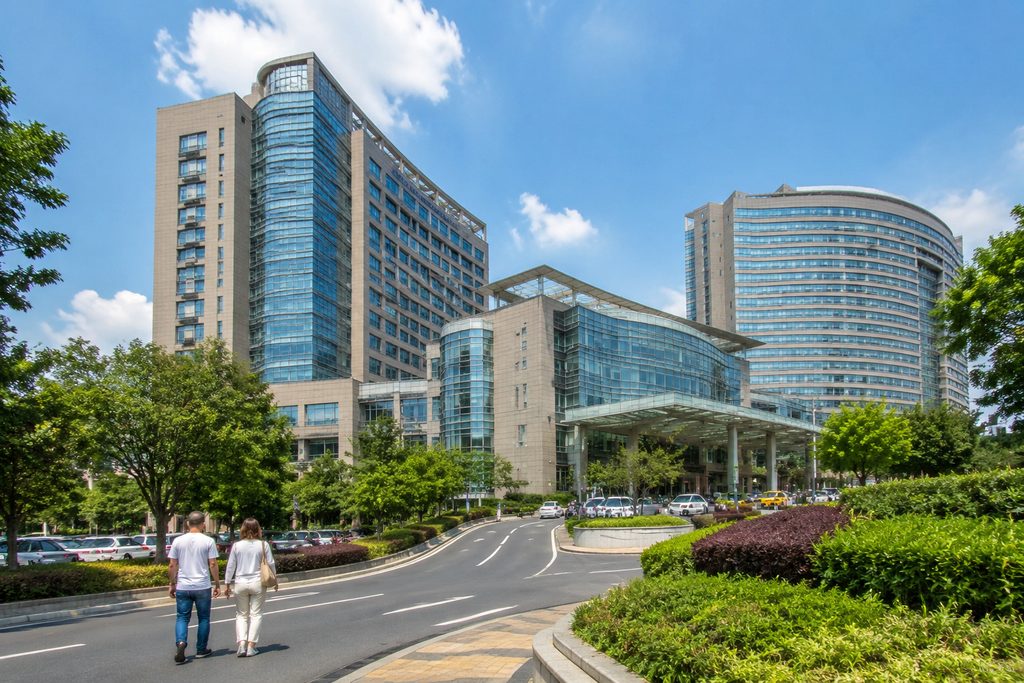
FAHZU operates across multiple campuses in Hangzhou, with the main Qingchun campus and the newer Yuhang campus acting as its twin engines. The International Healthcare Center sits within the Qingchun campus, purpose-built to handle the friction points that foreign patients dread. They use a centralized digital medical record system. Your CT scan from this morning is on the specialist’s screen this afternoon. The hospital has invested heavily in Da Vinci surgical robots, hybrid operating suites, and proton therapy planning — but the real differentiator is the operational tempo. A blood draw, an MRI, and a specialist consult can often be sequenced within a single day through the international VIP channel, a pace that would be logistically impossible in many Western public systems.
Cost Advantage Without Cutting Corners
Let us address the question that sits behind every search for a First Affiliated Hospital Zhejiang University international patient price list. How much cheaper is it really? A cardiac bypass graft at FAHZU through the international department typically ranges from $15,000 to $22,000. That same procedure in the United States averages over $120,000. A comprehensive health check package with advanced imaging — low-dose chest CT, full abdominal ultrasound, tumor markers, cardiac evaluation — runs between $400 and $1,200 depending on depth. These are not budget-tier prices achieved through lower standards. They reflect structural economics: lower labor costs for highly trained personnel, hospital-owned equipment that runs at high utilization rates, and a system built on throughput rather than third-party insurance complexity. The hospital is JCI-accredited, which means it has passed the same international patient safety standards as top hospitals in Singapore or Germany.
For those researching a top JCI hospital China comprehensive health check package, FAHZU represents a compelling intersection of academic rigor and operational efficiency. You are not trading quality for price. You are trading a high-cost, fragmented insurance landscape for a system where the numbers simply work differently.
What You Need to Know Before Going Alone
We have walked hundreds of patients through this process. The medical care at FAHZU is excellent. The administrative pathway, if you are trying to do it solo, can be punishing. Here is what you will face.
- Registration Is a Mandarin-Only Digital Gate: The hospital’s standard outpatient system requires a Chinese ID-linked account on their mini-program or app. Even if you manage to download it, the interface has no English toggle. Walk-in registration at the public counters involves filling out forms in Chinese characters. The staff at the general information desk may not speak English. You can physically stand in the right building and still be unable to book a specialist.
- Payment Systems That Reject Foreign Cards: Chinese hospitals operate on a prepaid, QR-code-based ecosystem. WeChat Pay and Alipay dominate. While it is now possible to link some foreign cards to these platforms, the process is finicky and often fails at hospital terminals. The cashier window may not accept international credit cards. Without a local payment method, you cannot load funds onto your hospital card to pay for each test, each consultation, each prescription — all of which are paid incrementally, not in one final bill.
- Medical Records and the Translation Gap: To get an accurate consultation, FAHZU specialists need your full medical history in Chinese. Radiology images on a CD need to be readable by their systems. Pathology slides need to be sent ahead and re-examined by the hospital’s own lab. Managing this cross-border documentation chain, with certified translation, is where most solo attempts collapse. A missing page or an untranslated surgical note can mean your appointment is rescheduled.
How We Help You Navigate This
These barriers are not flaws in the hospital. They are simply features of a system designed for a domestic patient population of 1.4 billion. Our role is to create a parallel pathway that works for you. We start with a free consultation to understand your diagnosis, your timeline, and your budget. We then match you to the right department at FAHZU — or, if your condition is better served elsewhere, to another hospital in our network. Once we confirm the match, we coordinate directly with the International Healthcare Center to secure a confirmed appointment slot. Not a vague “show up and wait” instruction. A specific time with the specialist you need.
Before you travel, we handle the documentation bridge: certified translation of your medical records, digital transfer of imaging files, and a clear S2 visa guidance letter that you can present at the Chinese embassy. When you land in Hangzhou, a bilingual medical companion meets you at the hospital. This person is not a doctor. They are your navigator — they queue for you, pay the hospital deposit through our verified channels so you never have to fight with a QR code, translate the doctor’s questions and explanations in real time, and make sure your CT scan happens before lunch so the specialist can review it by 2 p.m. After your consultation or procedure, we translate the discharge summary and follow-up plan into clear English and stay available for any ongoing coordination.
For those exploring the best hospital in Hangzhou for cancer treatment cost, the pathway often involves a multi-disciplinary team review. We can arrange that — bringing together a surgeon, an oncologist, a radiologist, and a pathologist in a single video or in-person consultation that produces a unified treatment plan. The logistical complexity of assembling that team on your own is significant. With our coordination, it becomes a single scheduled event.
Frequently Asked Questions
No single fixed document exists. Hospital charges in China are itemized and depend on your specific diagnosis, the seniority of your specialist, your choice of ward class, and the complexity of any procedure. What we provide — and what the International Healthcare Center confirms — is a detailed cost estimate built around your individual treatment plan. That estimate is what you can budget against. It is not a generic menu, but it is also not a mystery once your case is reviewed.
The practical route is through the International Healthcare Center. You can attempt to call them directly, but response times vary and the initial intake forms are in Chinese. Our service compresses this process: we submit your translated records, receive a confirmed appointment date and time, and handle the pre-arrival paperwork. The alternative — navigating the public registration system alone — is technically possible but extremely difficult without Mandarin fluency and a local contact.
You are never obligated to proceed. If a surgical recommendation arises during your consultation, you can take the diagnosis and proposed plan back to your home physician for a second opinion. We can also arrange a formal written second opinion from another top specialist within China for $300-500. The decision always remains yours. We are here to facilitate clarity, not to push you toward an operating table.
For foreign patients, yes. The public outpatient system at FAHZU is high-volume and Mandarin-only. You would face multi-hour waits, crowded hallways, and a near-total language barrier. The International Healthcare Center is a controlled environment with English-speaking coordinators, private consultation rooms, and a streamlined schedule. The premium — typically 1.5 to 2 times the public rate — buys you access, speed, and comprehension. For a medical tourism Hangzhou international patient services experience that does not leave you exhausted and confused, the international pathway is the only sensible choice.
Your Next Step
FAHZU represents a genuine opportunity: world-class clinical expertise in a city that is easier to navigate than Beijing or Shanghai, at a cost structure that makes financial sense. The gap between reading about it and actually walking through the doors is real, but it is a gap we close every day. If you are considering treatment or a comprehensive health check in Hangzhou, start with a conversation about your specific case. The pathway becomes clear once someone who knows the system draws the map.
For more medical information and treatment options in China, visit chinamedservices.com (China Medical Services).
