Zhujiang Hospital: International Patient Guide to Costs & Care
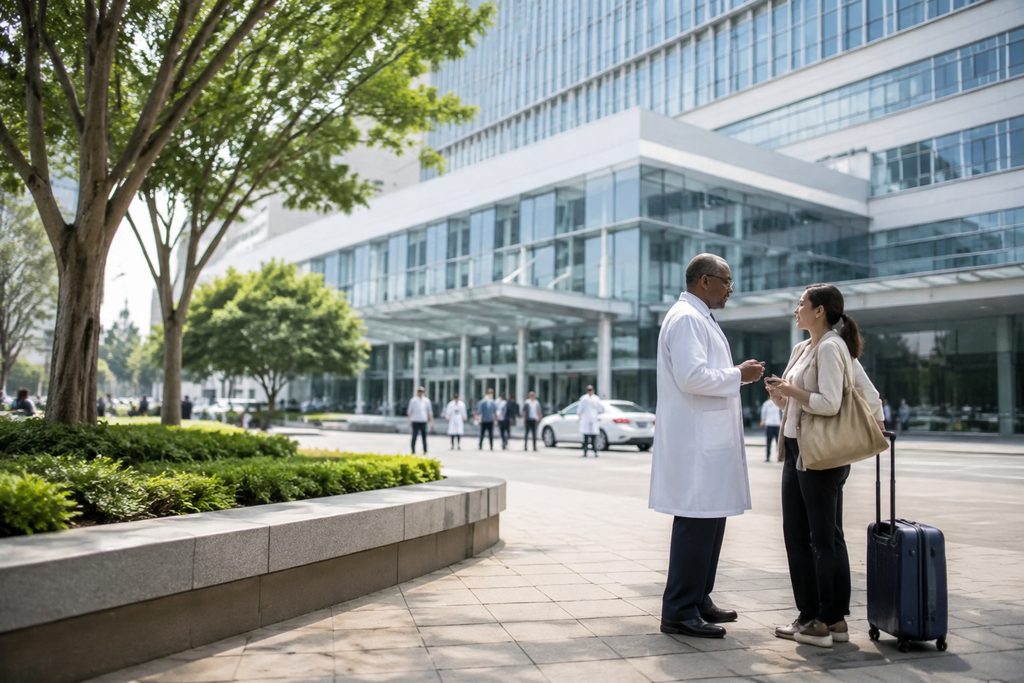
Zhujiang Hospital international patient services are not a single front desk with a welcome sign. They are a set of separate pathways — some public, some premium — and knowing which one fits your case changes both your timeline and your bill. Zhujiang Hospital (the Second Affiliated Hospital of Southern Medical University) sits in Guangzhou, a city with 10 hospitals in the Fudan Top 100 ranking, third in China after Beijing and Shanghai. That density matters. It means you have real choices within a 30-minute drive, and it means the coordination work — not the medicine — is usually what trips foreign patients up.
Key Takeaways
- Zhujiang Hospital is a major tertiary hospital in Guangzhou’s Haizhu district, with particular strength in orthopedics, rehabilitation, and emergency/critical care — not a dedicated international hospital.
- Public hospital outpatient registration generally cannot be locked in from overseas in advance; same-day queuing is the norm, and surgery requires an in-person consultation first.
- Costs for comparable procedures in China’s top public hospitals commonly run one-fifth to one-tenth of U.S. prices, but final figures vary by hospital and case complexity.
- Language is the real barrier. A hospital handling tens of thousands of outpatient visits daily is not built around English-first navigation.
The Problem: You Found the Hospital, Now What?
You’ve probably heard that getting care in China as a foreigner means either paying Western private-hospital prices or gambling on a public system you can’t navigate. Neither is quite true. But the gap between “I found a good hospital” and “I’m actually admitted and treated” is where most international patients lose weeks.
Consider the arithmetic. China has more than 35,000 hospitals. The Fudan ranking’s Top 100 — the tier our database tracks — represents roughly the top 5% by reputation and clinical capability. Guangzhou alone contributes 10 of them. Zhujiang Hospital is a large tertiary (Grade 3A) teaching hospital within that ecosystem, affiliated with Southern Medical University.
Here’s the friction point. A hospital of this size may process tens of thousands of outpatient visits in a single day. Registration windows open early and fill fast. Appointments for most public outpatient departments are taken on the day, in person, in Chinese. If you land in Guangzhou with a folder of English MRI reports and no plan, you will spend your first week figuring out which building to stand in.
That’s not a knock on the hospital. It’s how the system is structured — high volume, high throughput, minimal hand-holding.
Why Guangzhou and Zhujiang Hospital Deserve Serious Consideration
Clinical Volume That Western Hospitals Can’t Match
Volume is not a marketing word in surgery. It’s a proxy for repetition, and repetition correlates with outcomes. A senior Chinese orthopedic surgeon may complete several hundred joint replacements a year; the average American orthopedic surgeon performs closer to 65, according to data cited in orthopedic workforce literature. Zhujiang Hospital’s orthopedics and rehabilitation departments sit inside a referral network that feeds them cases from across southern China.
Does that guarantee a better result for you? No. It means the team has seen your problem many times before. For complex revision surgery or post-trauma reconstruction, that matters.
Technology and Efficiency at Scale
Large Chinese tertiary hospitals run imaging, lab, and operating capacity as an integrated pipeline. A CT ordered in the morning is frequently completed the same day. Bloodwork returns within hours. In a U.S. academic center, the same sequence often stretches across two or three visits and several weeks of scheduling.
The tradeoff is real: less hand-holding, more self-navigation, and a queue-based culture. Efficiency here is a product of density, not concierge service.
Cost Advantage Without the Quality Cliff
Labor economics, purchasing scale, and government price guidance on procedures push Chinese public hospital costs far below U.S. levels. A cardiac bypass at a top Chinese public hospital commonly runs $12,000–$20,000; the same procedure in the U.S. frequently exceeds $120,000. Orthopedic and rehabilitation admissions follow a similar pattern — a fraction of Western pricing, with the caveat that final quotes depend on implant choice, length of stay, and complication risk.
Lower cost does not automatically mean lower quality. It does mean you should verify credentials rather than assume them.
How to Book an Appointment at Zhujiang Hospital China — The Real Sequence
This is the part most guides skip. Here is the honest workflow.
Step 1 — Decide which door you’re using. Public outpatient, or the hospital’s international/VIP channel. Public is cheaper and slower to arrange. The VIP or international department typically offers senior specialists, English-capable staff, and faster scheduling, at roughly 1.5–2x the public-channel price. Neither door can be booked from overseas with certainty for general outpatient slots.
Step 2 — Get a remote opinion first. Before buying a plane ticket, have your existing imaging and reports reviewed. A written second opinion or video consultation through the hospital’s international department tells you whether Zhujiang Hospital is even the right facility for your condition — or whether a Guangzhou peer like Sun Yat-sen Memorial Hospital or a specialist center elsewhere fits better.
Step 3 — Confirm the in-person consultation. Surgery in Chinese public hospitals requires an in-person examination first. No exceptions, no remote surgical scheduling. Plan for the consultation visit, then the admission.
Step 4 — Prepare documents. Passport, visa, prior imaging on disc or film, pathology slides if relevant, medication list, and translated summaries. Bring more than you think you need.
Step 5 — Arrive with a plan for day one. Registration, medical card creation, and department routing all happen on-site. This is where a bilingual medical companion earns their fee — not by unlocking doors, but by making sure you’re standing at the right window.
What Does Zhujiang Hospital Cost for International Patients?
Nobody can quote you a surgical price before seeing your scans. Anyone who does is guessing. What we can give you is the structure of the costs and realistic reference ranges for coordination services.
| Service / Item | Typical Range (USD) | Notes |
|---|---|---|
| Written second opinion (top-tier hospital specialist) | $300–500 | For reference only, not a prescription |
| Video consultation (public international dept. / private international dept.) | $100–300 | Records submitted in advance |
| Top-specialist video consultation | $500–800 | Senior specialist, scheduled slot |
| Multidisciplinary team (MDT) video consultation | $1,500–2,000 | Multiple departments review together |
| In-person top-specialist consultation coordination | $800–1,200 | Coordination fee only |
| Hospital appointment coordination (checkup / outpatient / admission) | from $300 | Full refund if the listed appointment cannot be secured |
| Bilingual medical companion | from $300/day | Half day 4 hrs / full day 8 hrs |
| Airport transfer | $200 round-trip | Both directions |
Two things worth flagging. First, any consultation fee is credited in full toward on-the-ground coordination if you proceed to travel within 90 days — a one-time credit applied to the coordination fee, never to hospital treatment charges. Second, our role is case management: medical record translation, appointment coordination through the hospital’s official international or VIP channel, and bilingual accompaniment. It is not an access fee, and we never promise a specific surgeon or a specific surgery date.
For hospital-level pricing across specialties, the department rankings by specialty give you a starting map of where China’s strongest programs sit.
Is Zhujiang Hospital Good for International Patients?
Depends on what you need.
Good fit: orthopedic and rehabilitation cases, complex trauma follow-up, emergency and critical care referrals, and patients already in southern China or the Greater Bay Area who want a large tertiary center without flying to Beijing or Shanghai.
Weaker fit: patients who need a fully English-language, Western-style hospital experience with direct insurance billing and hotel-like amenities. That’s the private international hospital model — United Family, Jiahui, Parkway, Raffles — and it exists in Guangzhou and nearby Shenzhen. Those facilities cost more, settle directly with many international insurers, and feel familiar. For straightforward procedures, they’re often the simpler choice.
Not a fit at all: anyone expecting a public hospital to function like a concierge service. It won’t.
One more honest note. If your condition is highly specialized — a rare pediatric cardiac defect, a specific sarcoma subtype — the right answer may be a different city entirely. Our Fudan Top 100 hospital directory by city exists precisely so you can compare before committing.
Practical Considerations: Visa, Payment, and Follow-Up
Visa. Medical travel to China uses the S2 visa, annotated for medical treatment purposes; stays exceeding 180 days fall under S1. Accompanying family members also apply for S2. The M visa is for commercial and trade activity and has nothing to do with medical treatment. Requirements shift, so confirm current documentation with the nearest Chinese embassy or consulate and secure supporting letters from the receiving hospital.
Payment. Public hospitals require upfront payment for most services; international insurance is typically reimbursed after the fact, not settled at the counter. Private international hospitals more often bill insurers directly. Bring a payment method that works in China, and confirm card acceptance with your bank before departure.
Language. Assume nothing is in English. Bring translated records. Arrange interpretation in advance rather than hoping a bilingual staff member is free.
After you go home. Request copies of operative notes, imaging, and discharge summaries before you leave the hospital. Getting them later, from another country, is slow and sometimes impossible. Share them with your home physician for continuity of care.
A note on remote arrangements: no service can guarantee admission, a specific specialist, or a clinical outcome. Chinese public hospitals apply their own admission rules, and those rules govern — not any third party’s promises.
Frequently Asked Questions
For general public outpatient departments, no — registration is typically same-day and in person. For the hospital’s international or VIP channel, coordination is possible through official channels, but a confirmed slot is not guaranteed. Surgery always requires an in-person consultation first. Plan your trip around the consultation, not around a pre-booked operation.
For most surgical and inpatient procedures, yes — often substantially. Comparable procedures in China’s top public hospitals commonly run one-fifth to one-tenth of U.S. prices. But final cost depends on your specific diagnosis, implant or device choice, length of stay, and whether complications arise. Treat any pre-travel estimate as a range, not a quote.
Large tertiary hospitals have established emergency and critical care capacity, and Zhujiang Hospital is known in part for that. That said, you should understand your recourse options, carry travel medical insurance that covers China, and keep a bilingual point of contact available. We coordinate logistics and communication; we do not practice medicine and cannot influence clinical decisions.
Plenty of patients manage alone, particularly at private international hospitals. At a large public hospital like Zhujiang, the practical obstacles are registration queues, department routing, payment windows, and pharmacy pickup — all in Chinese. If you have no Mandarin and no local support, a bilingual companion removes a genuine source of delay.
Your Next Step
The core message is simple: Zhujiang Hospital is a capable tertiary center in a city with real depth, but access runs through pathways that reward preparation and punish improvisation. Get a remote opinion before you book flights. Confirm which channel you’re using. Bring translated records.
We’re China Medical Services — a coordination service, not a hospital, and we don’t diagnose or treat. We match international patients with appropriate Chinese hospitals, arrange written second opinions and video consultations, handle appointment coordination, and provide bilingual accompaniment on the ground. If you’d like a straight assessment of whether Zhujiang Hospital fits your case, start with a free consultation and we’ll tell you honestly — including when the answer is a different hospital.
This article is for general information only and does not constitute medical advice. Always consult a qualified physician regarding diagnosis and treatment decisions.
For more medical information and treatment options in China, visit chinamedservices.com (China Medical Services).
