ZJU Second Hospital Hangzhou Eye Center: Cataract & Retinal Surgery for International Patients
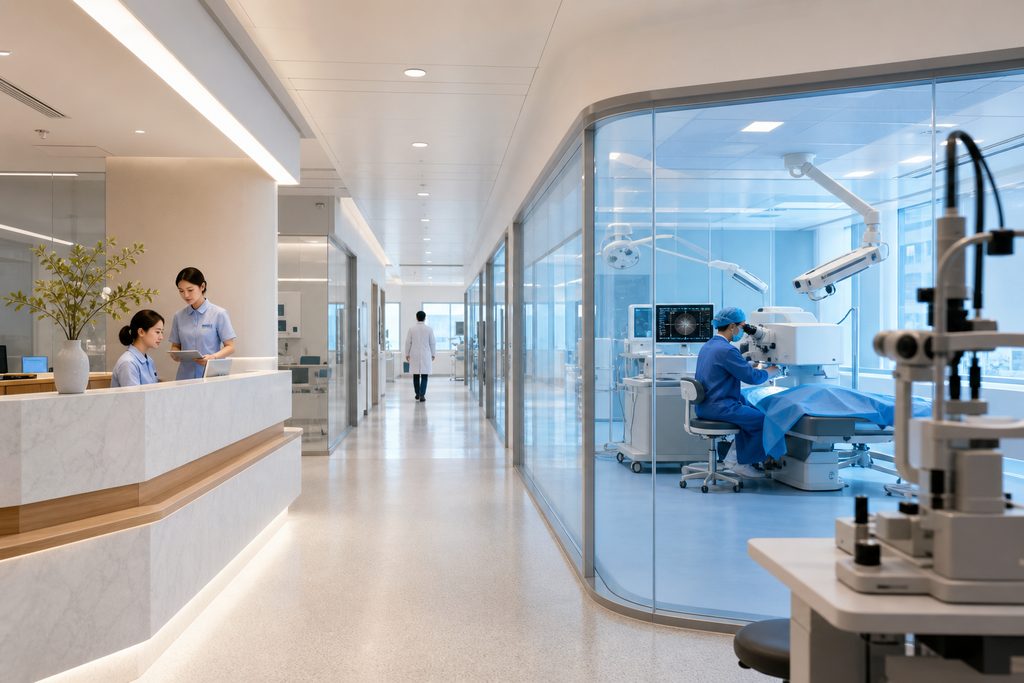
A patient in London waits 18 weeks for a cataract consultation. At ZJU Second Hospital’s Eye Center in Hangzhou, the surgical volume exceeds 15,000 procedures annually, with international patients often securing surgery within two weeks of arrival. The math is stark. The systems are different. Understanding that difference is where clarity begins.
Key Takeaways
- The Eye Center at the Second Affiliated Hospital of Zhejiang University School of Medicine performs over 15,000 ocular surgeries each year, placing it among China’s highest-volume ophthalmology units.
- Total cataract surgery cost at ZJU hospital Hangzhou typically ranges from $2,500 to $4,500 per eye through the international VIP channel, roughly 70-80% less than US private-pay rates.
- No public hospital in China allows overseas patients to book surgery remotely without an in-person consultation first — any service promising otherwise is misleading you.
- Vitrectomy recovery abroad requires a minimum 10-14 day stay in Hangzhou for the critical post-operative monitoring window before flying home.
The Problem: Eye Surgery Costs Are Reshaping Where Patients Seek Care
Approximately 94 million people worldwide live with vision impairment due to cataract, according to the World Health Organization. In the United States, the average out-of-pocket cost for cataract surgery with a premium intraocular lens runs between $3,500 and $7,000 per eye for patients with high-deductible plans or no insurance. Retinal detachment repair — a far more urgent procedure — can exceed $15,000 in a US surgical center. In the UK, NHS waiting times for ophthalmology have stretched past 18 weeks for routine referrals in many trusts, with some patients reporting waits of over a year in certain postcodes.
These numbers do not exist in a vacuum. They push real people to make hard choices. A retiree in Vancouver watches her vision cloud over while she waits. A software engineer in Dubai gets quoted a price that eats through his savings. The condition progresses. The anxiety compounds. And the question shifts from “should I get this fixed” to “where on earth can I afford to get this fixed.”
China has emerged as a serious answer to that question. Not because it is cheap. Because it is structurally different — high surgical volume, concentrated specialist expertise, and an infrastructure built to handle scale that most Western systems simply cannot match.
Who We Are
We are not a hospital. We do not provide medical treatment, make clinical recommendations, or promise outcomes. Our team functions as your logistical architects — we bridge the gap between you and China’s top-tier medical institutions. We handle hospital matching, appointment coordination through official international departments, bilingual medical companion services, visa guidance, and all the ground-level friction that makes seeking care abroad feel overwhelming. Think of us as the people who make sure you walk into the right building, see the right specialist, and understand every word spoken in the exam room. Nothing more. Nothing less.
Why the Eye Center at ZJU Second Hospital Delivers Results
The Second Affiliated Hospital of Zhejiang University School of Medicine — commonly called ZJU Second Hospital or simply “Zhejiang Second” — runs one of the most active ophthalmology departments in eastern China. Its Eye Center is not a small clinic attached to a general hospital. It is a dedicated, multi-story facility with subspecialty units covering cataract and refractive surgery, vitreoretinal disease, glaucoma, corneal disorders, pediatric ophthalmology, and oculoplastics.
Clinical Volume That Creates Surgical Precision
Volume matters in eye surgery. A 2018 study published in Ophthalmology found that surgeons performing more than 1,000 cataract procedures annually had significantly lower complication rates than those performing fewer than 100. The cataract surgeons at ZJU Second Hospital operate at volumes that exceed those thresholds by multiples. The department completes more than 15,000 ocular surgeries per year. A single senior retinal surgeon here may perform over 400 vitrectomies annually — a number that places them in the top percentile globally by case experience.
This is not abstract. Retinal detachment surgery is technically demanding. The surgeon works through a microscope on tissue thinner than a sheet of paper. The difference between a surgeon who has done this 3,000 times and one who has done it 300 times is not marginal. It is the difference between confidence and hesitation when intraoperative surprises arise. At ZJU Second, the surgeons have seen the surprises. They have managed the complications. The volume has sharpened them.
Technology Infrastructure Built for High-Throughput Precision
The Eye Center operates with equipment that matches what you would find at Moorfields in London or Bascom Palmer in Miami. Femtosecond laser platforms for bladeless cataract surgery. Top-of-the-line phacoemulsification systems. Wide-angle viewing systems for complex vitreoretinal procedures. Optical coherence tomography on every pre-op and post-op patient. The difference is not the machines. It is how they are used.
In a Western academic center, a single OCT machine might serve a clinic seeing 40 patients a day. At ZJU Second, the workflow is designed for triple that volume without sacrificing diagnostic rigor. Patients move through pre-operative testing in a choreographed sequence — biometry, corneal topography, OCT, endothelial cell count — often completed within 90 minutes. The system is built for throughput. International patients accessing the VIP channel experience the same diagnostic thoroughness with added time for translation and discussion.
Cost Structure That Reflects Economics, Not Quality Cuts
Let us address the elephant directly. The cataract surgery cost at ZJU hospital Hangzhou runs between $2,500 and $4,500 per eye through the international patient channel. That includes the surgeon fee, facility charge, standard monofocal or premium multifocal intraocular lens implant, and pre- and post-operative consultations. A comparable procedure with a premium lens in the United States costs $5,000 to $8,000 per eye. In Australia, $4,000 to $6,000. In the UK private sector, £3,500 to £5,500.
For retinal cases, the numbers get more dramatic. Retinal detachment surgery price China — specifically vitrectomy with gas or silicone oil tamponade at a top-tier center like ZJU Second — falls between $6,000 and $10,000. The same procedure in the US: $12,000 to $20,000. In Singapore: $10,000 to $15,000. The cost difference is structural. Chinese surgeon salaries are lower. Hospital overhead is spread across vastly higher patient volumes. The pharmaceutical supply chain is domestic for many consumables. None of these factors imply lower quality. They imply a different economic model.
| Procedure | ZJU Second Hospital (Int’l VIP) | United States (Private Pay) | United Kingdom (Private) |
|---|---|---|---|
| Cataract Surgery (per eye, premium IOL) | $2,500 – $4,500 | $5,000 – $8,000 | £3,500 – £5,500 |
| Vitrectomy for Retinal Detachment | $6,000 – $10,000 | $12,000 – $20,000 | £8,000 – £14,000 |
| Comprehensive Eye Exam & Diagnostics | $150 – $300 | $250 – $500 | £200 – £400 |
Prices vary by case complexity, lens choice, and length of hospital stay. These figures come from our coordination experience with the hospital’s international department — they are reference points, not binding quotes.
What You Need to Know Before Going Alone
We have coordinated care for patients from over a dozen countries. The clinical part is straightforward compared to the logistics. Here is what trips people up.
- No Remote Surgery Booking: China’s public hospitals, including ZJU Second, do not allow overseas patients to schedule surgery from abroad. You must arrive in Hangzhou, complete an in-person consultation, undergo diagnostics, and receive a surgical recommendation. Only then can a surgery date be set. This is non-negotiable. Anyone telling you they can lock in a vitrectomy date before you land is either confused or dishonest.
- Visa Requirements Are Specific: Medical treatment in China requires an S2 visa with “medical treatment” noted as the purpose. Your accompanying family member also needs an S2. An M visa is for commercial business — it does not cover medical care. Getting the documentation right means obtaining an official invitation letter from the hospital’s international department, which must be submitted with your visa application. Mistakes here cause delays. Delays can worsen vision-threatening conditions.
- Language Barriers Are Absolute: ZJU Second Hospital sees thousands of patients daily. The clinical staff speak Mandarin. Some senior ophthalmologists speak English, but the nurses, technicians, registration clerks, and billing staff generally do not. Navigating registration, payment, pharmacy pickup, and post-op instructions without Chinese language ability ranges from exhausting to impossible. This is not a criticism of the hospital. It is a description of reality in any high-volume Chinese public institution.
- Payment Is Upfront: The international VIP department requires payment before surgery. International insurance is not directly billed in most cases — you pay, then seek reimbursement from your insurer. Bring a credit card with a high limit. Confirm with your insurer before traveling that overseas ophthalmology is covered and understand what documentation they require for claims.
How We Help You Navigate This
These barriers exist for structural reasons. They are not designed to exclude international patients — they are simply the byproducts of a system built primarily for domestic demand. Our entire service exists to solve them.
Before you travel, we translate and format your medical records, imaging, and diagnostic reports for review by the hospital’s international department. We coordinate with the ophthalmology team to schedule your initial consultation — ensuring you see a subspecialist relevant to your condition, whether that is a cataract surgeon, a retinal specialist, or both. We arrange the official invitation documentation required for your S2 visa application.
On the ground in Hangzhou, a bilingual medical companion meets you at the hospital. This person handles registration, guides you through the diagnostic workflow, translates every conversation with your surgeon, and ensures you understand your diagnosis, surgical plan, risks, and post-operative instructions. They manage pharmacy pickup, payment processing, and follow-up appointment scheduling. You focus on your eyes. They handle everything else.
After surgery, your companion coordinates follow-up visits, translates discharge instructions, and helps arrange accommodation extensions if your recovery requires a longer stay. For retinal surgery patients, they help schedule the critical post-operative checks that determine when gas bubbles have resolved and flying is safe.
We also offer video consultation coordination with ZJU Second’s specialists before you commit to travel. A written second opinion from a senior ophthalmologist costs $300 to $500 and gives you an evidence-based assessment of your condition and treatment options — for reference only, never a prescription. If you later proceed with on-the-ground coordination through us, that fee is credited in full toward the coordination service.
The Clinical Reality of Retinal Surgery Recovery Abroad
Patients searching how long to recover from vitrectomy abroad need honest answers, not optimistic timelines. Vitrectomy recovery splits into phases. The first 24 to 72 hours are the most critical — your surgeon checks intraocular pressure, confirms retinal attachment, and monitors for infection or bleeding. The first 10 to 14 days require frequent follow-up visits, typically at day 1, day 3, day 7, and day 14 post-operatively.
If gas tamponade was used, you must maintain specific head positioning — often face-down for several days — to keep the gas bubble pressed against the retinal tear. This is uncomfortable and disorienting. Doing this in a hotel room in a foreign country is psychologically harder than doing it at home. We tell patients this directly. The clinical outcome depends on positioning compliance. We arrange accommodation with appropriate support — beds configured for face-down positioning, meal delivery, daily check-ins from your companion. The medical quality is excellent. The experience is still difficult. We do not sugarcoat that.
For cataract surgery, recovery is far simpler. Most patients see dramatic improvement within 24 to 48 hours. Post-operative drops continue for several weeks. Flying is generally safe within 3 to 5 days after uncomplicated cataract surgery, though your surgeon must confirm this. Many international patients combine cataract surgery with a brief trip — arrive, consult, operate, recover for a few days, fly home. It is logistically straightforward compared to retinal work.
Is ZJU Second Hospital Good for Eye Surgery? The Evidence
The question is ZJU Second Hospital good for eye surgery deserves a direct answer. The hospital is ranked among China’s top ophthalmology departments in the Fudan University hospital rankings, which evaluate clinical reputation and research output across 45 specialties. It serves as a major referral center for complex retinal cases across Zhejiang province and neighboring regions — a catchment area of over 60 million people. Its ophthalmologists train at top Chinese medical programs and many have completed fellowships in the United States, Europe, or Japan.
Clinical outcomes data for individual Chinese hospitals is not publicly reported with the granularity found in, say, the UK’s National Ophthalmology Database. This is a limitation we acknowledge openly. What exists instead are proxy indicators: surgical volume, peer reputation, referral patterns, and the fact that the department is a designated national training center for ophthalmology residents and fellows. In the Chinese system, training center designation signals that a department meets the highest standards for clinical volume, faculty expertise, and surgical diversity.
For international patients specifically, the picture is nuanced. The clinical care is strong. The international patient infrastructure — dedicated coordinators, English-capable scheduling, streamlined billing — is functional but not luxurious. This is not a private international hospital with hotel-like amenities. It is a high-volume academic medical center that has built a parallel channel for overseas patients. The care is excellent. The experience requires navigation. That is the honest trade-off.
Hangzhou as a Medical Destination
A patient searching for the best eye hospital Hangzhou for foreigners should understand the city context. Hangzhou is not Beijing or Shanghai. It is a city of 12 million people, famous for West Lake and its tech industry — Alibaba is headquartered here. The international infrastructure is solid but smaller in scale than Shanghai’s. Direct flights connect Hangzhou Xiaoshan International Airport to major hubs in Europe, the Middle East, and Southeast Asia. High-speed trains reach Shanghai in 45 minutes.
The city offers a genuine advantage for post-operative recovery: it is calmer than Shanghai, greener, and significantly less expensive for accommodation. A comfortable hotel near the hospital runs $60 to $120 per night. Restaurant meals are affordable. The lakeside parks provide pleasant walking environments during the later stages of recovery when your surgeon clears you for light activity. For patients combining eye surgery with a recovery period, Hangzhou’s pace works in your favor.
ZJU Second Hospital’s main campus sits in central Hangzhou, accessible by taxi or metro. The Eye Center is a distinct building within the hospital complex. Your companion meets you at the entrance and handles navigation — but knowing the geography helps with trip planning.
Frequently Asked Questions
No. The pathway to book retinal surgery China medical tourism always starts with an in-person consultation. Chinese public hospitals require the surgeon to examine you directly, review your imaging, and confirm the diagnosis and surgical plan before scheduling. What you can arrange in advance is the consultation itself, your visa documentation, and your logistical support — all of which we handle. The consultation-to-surgery timeline typically spans 3 to 10 days depending on urgency and surgeon availability.
All surgery carries risk. Cataract surgery has a serious complication rate below 1% in experienced hands. Vitrectomy carries higher risks — infection, bleeding, retinal re-detachment, elevated eye pressure. ZJU Second Hospital manages these complications in-house. The retinal team handles complex revision cases routinely. From a practical standpoint, if a complication arises, your stay in Hangzhou extends. Your companion helps coordinate the extended care, accommodation changes, and communication with your insurer. We have managed this scenario before. It is stressful but navigable.
The intraocular lenses used at ZJU Second come from the same manufacturers that supply Western hospitals — Alcon, Johnson & Johnson Vision, Bausch + Lomb, Zeiss. Premium multifocal and toric lenses are available. The phacoemulsification machines and vitrectomy platforms are current-generation equipment from the same manufacturers used in US and European operating rooms. The technology is equivalent. The surgical technique follows international standards. The variable is surgeon experience, and on that metric, ZJU Second’s high-volume surgeons compare favorably with their Western peers.
Some international insurance plans cover overseas ophthalmology, particularly if the procedure is medically necessary and the cost is lower than domestic alternatives. Most plans require pre-authorization. You pay the hospital directly, then file for reimbursement with your insurer’s claim form, the hospital’s itemized invoice, and your medical records. We provide documentation support. We do not handle direct insurance billing at ZJU Second — that is more common at private international hospitals like United Family, which you can explore on our private hospitals page.
Minimum 10 to 14 days for the acute post-operative monitoring phase. If gas tamponade is used and you plan to fly home, you must remain until the gas bubble resolves — which can take 2 to 8 weeks depending on whether short-acting (SF6) or long-acting (C3F8) gas was used. Your surgeon determines when flying is safe based on clinical examination, not a calendar. Do not book a return flight until your surgeon clears you. We help with flexible accommodation arrangements for exactly this reason.
Your Next Step
The decision to travel abroad for eye surgery is not small. It sits at the intersection of your vision, your finances, and your tolerance for complexity. ZJU Second Hospital’s Eye Center offers genuine clinical excellence at a cost that makes treatment accessible to patients who might otherwise wait too long or pay too much. The trade-off is logistical. You need a plan. You need someone on the ground.
If you want to understand whether this path fits your specific situation, start with a free consultation. We will review your case, explain your options at ZJU Second and other top ophthalmology centers across China’s 37-city network, and give you an honest assessment — including reasons you might choose to stay home. No pressure. No promises we cannot keep. Just clarity, so you can make a good decision with your eyes open.
Medical Disclaimer: This article provides general information only and does not constitute medical advice. All treatment decisions should be made in consultation with a qualified ophthalmologist. Surgical outcomes vary by individual case. We do not guarantee any specific clinical result. Always consult your doctor before making decisions about your eye health or traveling for medical care.
For more medical information and treatment options in China, visit chinamedservices.com (China Medical Services).
