Dr Guo Zheng Orthopedic Oncologist China: 3D Printed Bone Tumor Prosthesis at Tangdu Hospital
Key Takeaways
- Tangdu Hospital’s orthopedic oncology team, led by specialists like Dr Guo Zheng, has treated over 10,000 bone tumor cases using advanced limb-salvage techniques, including custom 3D printed prostheses.
- A custom 3D printed titanium pelvic or limb implant in China typically costs between $15,000 and $35,000 — roughly 20% to 35% of what the same technology and hospitalization would cost in the United States.
- Public hospitals in China, including Tangdu Hospital, operate on a face-to-face consultation model. You cannot lock in a surgery date or a specific surgeon from overseas without first attending an in-person outpatient appointment.
- Navigating Tangdu Hospital without Mandarin fluency is extremely difficult. A bilingual medical companion is not a luxury here — it is the mechanism that makes treatment logistically possible for international patients.
The Problem: When a Bone Tumor Diagnosis Leaves You With Bad Options
Primary bone sarcomas are rare. They account for less than 0.2% of all adult cancers. That rarity creates a brutal clinical problem: most orthopedic surgeons in the United States or Europe will see only a handful of cases in their entire career. When a tumor wraps around a pelvis, a femur, or a shoulder girdle, the default pathway at many Western centers is still a conversation about amputation or a functionally limited off-the-shelf implant that was never designed for your specific anatomy. The wait for a sarcoma specialist in the UK can stretch past 62 days from urgent GP referral to first treatment. In Canada, the median wait from diagnosis to orthopedic oncology surgery is 34 days — and that is for cases that are not triaged lower due to resource constraints. If you are reading this, you already know the fear. The clock is ticking. The tumor is real. And the solution being offered does not feel like a solution at all.
This is where a different approach matters. Not a miracle cure. A different clinical pathway — one built around high-volume surgical expertise, custom manufacturing speed, and a structural cost advantage that changes what is financially possible for a family facing a sarcoma diagnosis.
Who We Are
We are China Medical Services. We are not a hospital. We do not provide medical treatment, clinical diagnoses, or surgical opinions. Our team acts as your logistical architects — we bridge the gap between you and China’s top-tier orthopedic oncology centers. We handle hospital matching, appointment coordination, bilingual medical companionship, visa guidance, and post-operative recovery logistics. When you search for Dr Guo Zheng orthopedic oncologist Tangdu Hospital, you are looking for a specific clinical expert. Our role is to make sure you can actually reach that expert, communicate clearly, and move through a complex foreign hospital system without getting lost in translation or bureaucracy.
Why Tangdu Hospital and 3D Printed Bone Tumor Prostheses Deliver Results
Clinical Volume That Western Sarcoma Centers Rarely Match
Tangdu Hospital, affiliated with the Air Force Medical University in Xi’an, is not a small boutique clinic. It is a massive, high-throughput tertiary hospital. Its orthopedic oncology department handles a caseload that dwarfs most Western sarcoma centers. While a major US academic center might perform 50 to 80 pelvic tumor resections per year, Tangdu’s team operates at multiples of that volume. Dr Guo Zheng and his colleagues see complex cases — osteosarcoma, chondrosarcoma, Ewing’s sarcoma, giant cell tumors with extensive bone destruction — on a daily basis, not a monthly one. This matters. A 2016 study in The Lancet Oncology found a clear volume-outcome relationship in sarcoma surgery: patients treated at high-volume centers had significantly lower rates of local recurrence and better limb-salvage success. Volume is not a marketing point. It is a survival variable.
The department has accumulated over 10,000 surgically treated bone tumor cases. That number includes thousands of limb-salvage procedures where the alternative would have been amputation. When a surgeon has reconstructed 200 pelvises, the 201st is not an experiment. It is a protocol.
How Does 3D Printed Bone Implant Work for Sarcoma Patients?
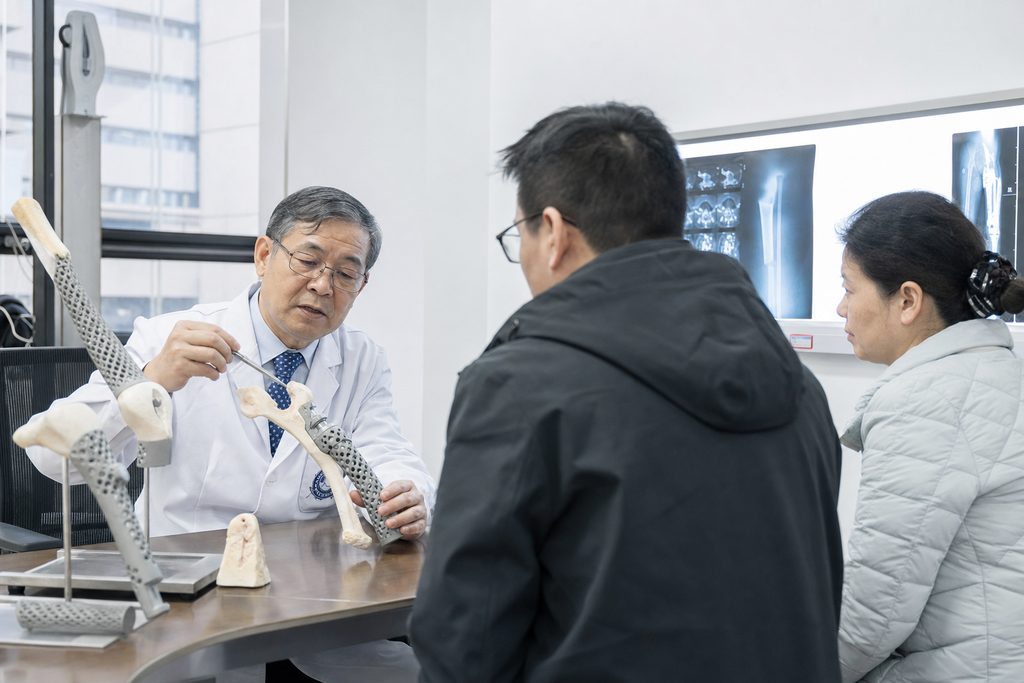
The technology is not science fiction. It is a clinical engineering workflow that solves a specific anatomical problem. When a sarcoma eats into the pelvis or the distal femur, the tumor and a margin of healthy bone must be removed en bloc. You are left with a complex, irregular bone defect that no standard off-the-shelf implant can fill. A 3D printed custom prosthesis works like this: the patient’s CT and MRI data are fed into CAD software. The surgical team plans the exact resection planes — the cuts — digitally. An implant is then designed to match the precise geometry of the remaining healthy bone. The implant is printed in titanium alloy powder using electron beam melting (EBM) or selective laser melting (SLM). The surface that contacts the host bone is printed with a porous trabecular structure — tiny interconnected pores that encourage bone ingrowth for long-term biological fixation. The implant is manufactured, sterilized, and delivered to the operating theater, often within two weeks of design approval.
This is not a generic hip replacement. It is a patient-specific reconstruction device. For a pelvic sarcoma, the implant might replace half the iliac wing and the acetabulum. For a distal femoral sarcoma, it might replace the knee joint and 15 centimeters of femoral shaft in a single component. The implant fits because it was built to fit. Tangdu Hospital has been publishing clinical outcomes on 3D printed prostheses since at least 2017, with follow-up studies showing acceptable complication rates and functional scores that allow patients to walk independently — outcomes that were simply not achievable with older modular systems.
The 3D Printed Bone Tumor Prosthesis Cost in China Changes the Equation
Let us talk numbers. A custom 3D printed pelvic prosthesis with hospitalization, surgical fees, and post-operative care at a top US orthopedic oncology center can exceed $100,000. Often significantly more when you factor in the implant itself, which can cost $40,000 to $70,000 from a Western manufacturer. At Tangdu Hospital, the all-in cost for a similar custom 3D printed titanium implant and the associated surgical hospitalization typically ranges from $15,000 to $35,000. The implant manufacturing cost in China is lower because the design and printing ecosystem is domestic — the engineers, the software, the powder metallurgy supply chain, and the printing facilities are all in-country, often on the hospital campus or nearby. This is not cheap care dressed up as innovation. This is the same EBM titanium printing technology used globally, delivered through a cost structure that reflects Chinese medical economics: lower labor costs, high surgical throughput, and domestic implant manufacturing without the regulatory and distribution markups that inflate Western device prices.
Is Tangdu Hospital good for bone cancer surgery? The question is fair. The hospital is consistently ranked among China’s top orthopedic centers. Its orthopedic oncology team publishes in international peer-reviewed journals, presents at Musculoskeletal Tumor Society meetings, and has contributed to the clinical evidence base for 3D printed reconstruction. The implant designs used here have been refined over thousands of cases. The technology is mature. The team is experienced. The cost is structurally lower — not because corners are cut, but because the entire clinical-manufacturing pipeline operates on a different economic model.
What You Need to Know Before Going Alone
We want to be completely direct about this. Seeking treatment at Tangdu Hospital as an international patient is logistically hard. It is not impossible. But it is hard. Here is what you will face if you attempt to arrange everything independently:
- No Remote Surgical Booking: Tangdu Hospital is a public Chinese hospital. You cannot email the department, send your imaging, and receive a surgery date. The system does not work that way. You must physically present for an outpatient consultation. A surgeon will evaluate you, review your scans, and only then discuss a surgical plan and timeline. You cannot lock in Dr Guo Zheng from overseas without an in-person visit.
- The Language Barrier Is Absolute: Tangdu Hospital does not have an English-language international patient department in the way a private hospital in Shanghai might. Registration forms, consent documents, pre-operative instructions, post-operative nursing communication — all of this happens in Mandarin. Even finding the correct building on a campus that serves over 10,000 outpatients daily requires reading Chinese signage and asking for directions in Chinese.
- Payment Is Upfront and Cash-Based: Public Chinese hospitals require a deposit before admission. International credit cards are not accepted at the registration counter. You will need a Chinese bank account or a local payment method. Insurance reimbursement is retrospective — you pay the hospital first, then file claims with your insurer after discharge. There is no direct billing.
How We Help You Navigate This
These barriers are not flaws in the system. They are structural features of how Chinese public hospitals operate at scale. Our job is to make them navigable. Before you travel, we coordinate with the hospital’s international liaison channels to schedule your initial outpatient consultation. We do not promise a specific surgeon or a specific surgery date — nobody can honestly promise that. But we ensure your case is reviewed by the appropriate clinical team and that an appointment is confirmed. Our bilingual medical companion meets you at the hospital entrance. They handle registration, queue management, payment deposits, and real-time translation during your consultation. They translate your questions and the surgeon’s answers — not summarized, but precisely. When a surgical plan is proposed, they help you understand the implant design rationale, the rehabilitation timeline, and the risks in your own language.
We also handle the non-clinical logistics. S2 visa guidance for medical treatment. Airport transfers. Accommodation near the hospital for family members. Post-operative follow-up coordination. If you need a written second opinion before committing to travel, we can arrange a remote consultation with a top orthopedic oncologist — and if you later proceed to on-the-ground treatment, that consultation fee is credited in full toward our coordination service. This is not a sales tactic. It is a structural acknowledgment that you deserve to be confident in your decision before you get on a plane.
For patients seeking the best orthopedic oncologist China for custom tumor prosthesis, the clinical expertise exists at Tangdu Hospital. The challenge has always been access. We solve the access problem.
Frequently Asked Questions
You can schedule an outpatient appointment through proper channels, which is what we coordinate. What you cannot do is secure a guaranteed surgery slot with a specific named surgeon from overseas. Chinese public hospital regulations require an in-person evaluation before any surgical commitment is made. We arrange the consultation. The surgeon makes the clinical decision. This is the honest reality of how the system functions.
For a complex custom implant — a pelvis, a distal femur with joint reconstruction, a total humerus — the implant itself ranges from approximately $8,000 to $20,000. Hospitalization, surgical fees, anesthesia, and a standard post-operative stay typically add another $7,000 to $15,000. The all-in range is $15,000 to $35,000. Simpler cases cost less. Cases with vascular reconstruction or prolonged ICU stays cost more. Every case is quoted individually after surgical planning is complete. These are cash prices paid to the hospital. They do not include our coordination fees, travel, or accommodation.
A standard modular implant is assembled from pre-manufactured components — stems, bodies, joints — in different sizes. The surgeon picks the closest match in the operating room. For complex defects, especially in the pelvis, the fit is approximate. A custom 3D printed implant is designed pre-operatively to match the exact resection planes. The bone-implant interface is optimized for contact area and screw trajectory. The porous surface encourages bone ingrowth rather than relying solely on cement. The functional result is typically a more stable reconstruction with better load distribution. It is not appropriate for every case — small, contained tumors can often be treated with simpler methods. But for large, geometrically complex defects, the custom approach offers a limb-salvage option that did not exist fifteen years ago.
This is the hardest question, and it deserves an honest answer. Post-operative complications — infection, implant loosening, local recurrence — can happen after any sarcoma surgery, anywhere in the world. If a complication arises after you return to your home country, you will need a local orthopedic oncologist willing to manage the case. We strongly recommend establishing this relationship before you travel to China. Share your imaging and your planned procedure with a local specialist. Get their agreement to provide follow-up care. We can facilitate communication between your home physician and the Tangdu surgical team, including sharing operative notes, implant specifications, and post-operative imaging. But the day-to-day management of late complications happens at home. This is not a reason to avoid treatment. It is a reason to plan thoroughly.
Your Next Step
A bone sarcoma diagnosis forces decisions that nobody is prepared to make. The search for Dr Guo Zheng orthopedic oncologist Tangdu Hospital suggests you are exploring options beyond what has been offered locally. That instinct — to find the highest-volume, most technologically equipped team you can access — is sound. Tangdu Hospital’s orthopedic oncology department has the case volume, the implant manufacturing capability, and the published outcomes to be a serious contender for complex limb-salvage reconstruction. The barrier has never been clinical quality. The barrier has been navigation.
We exist to remove that barrier. Not with promises we cannot keep. Not with inflated claims about guaranteed outcomes. With logistical competence, honest communication, and a bilingual team that ensures you understand every word of every consultation. If you want to understand whether Tangdu Hospital is the right option for your specific case, start with a free consultation. We will discuss your diagnosis, your imaging, and your goals. We will tell you honestly whether this pathway makes sense. No pressure. No sales script. Just the information you need to make the hardest decision of your life with clarity.
For more medical information and treatment options in China, visit chinamedservices.com (China Medical Services).
