Multi-Language Patient Communication Platform China: Chat, Voice & Video in Your Language
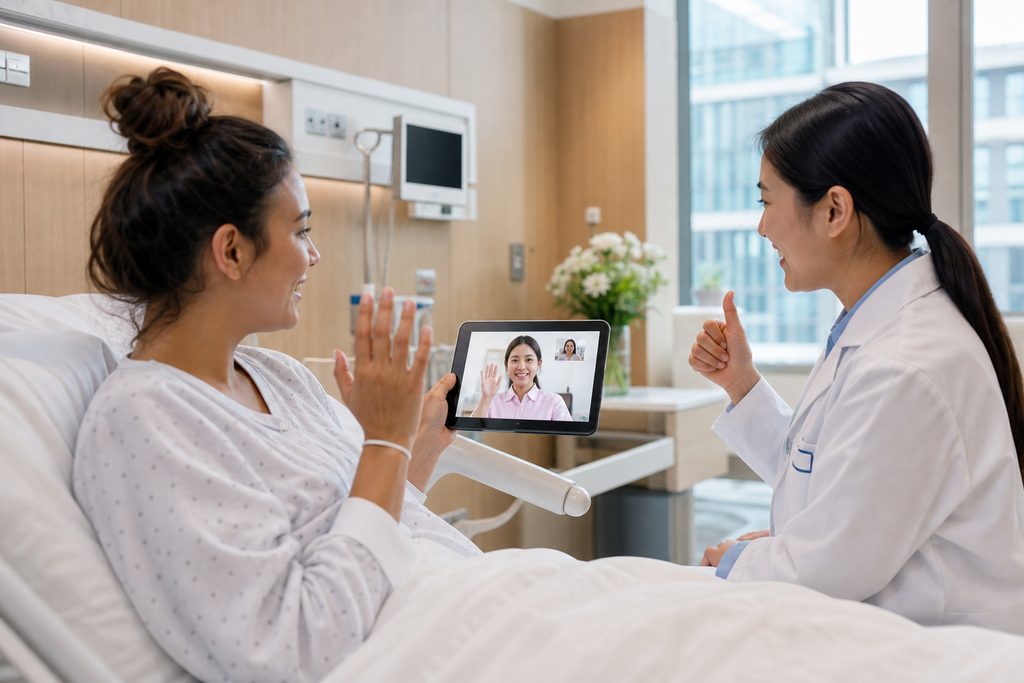
A medical consultation hinges on precision. A misunderstood symptom. A mistranslated dosage. The gap between “discomfort” and “sharp, radiating pain” can alter a diagnosis entirely. For international patients, this gap has always been the hardest part of seeking care in China.
We have watched that gap narrow dramatically.
Our team at China Medical Services connects patients from over a dozen countries with 340+ top-ranked hospitals. We do not provide clinical care. We solve the logistics that make clinical care possible—and the most persistent logistical problem is language. The tools now available to solve it are better than most patients realize.
Key Takeaways
- Real-time medical translation apps have matured to the point where a live, three-way conversation—patient, doctor, and an AI-powered voice translator—is viable in a clinical setting, with costs starting from free for basic tiers.
- China’s top hospitals are integrating multilingual telemedicine platforms that let you video-call an English-speaking specialist from home before you ever book a flight.
- Technology alone cannot fix medical translation. A voice translator for medical treatment abroad in China will struggle with regional accents, background noise, and the dense shorthand of a senior surgeon—which is where a human bilingual companion becomes essential.
- You should understand the real cost structure: a real-time translation app for a hospital visit in China costs little, but the coordination to use it effectively inside a busy Chinese public hospital is a different calculation.
The Problem: A Language Barrier That Carries Clinical Risk
Approximately 1 in 5 international patients who contact us cite communication fear as their primary reason for delaying a trip to a Chinese hospital. Not cost. Not visa complexity. The raw fear of sitting across from a top specialist at Peking Union Medical College Hospital and understanding nothing.
Chinese public hospitals are high-volume environments. A single outpatient department can process 10,000 patients in a day. Doctors move fast. Nurses move faster. No one has time to type into a phone for every sentence. Without a communication strategy, the patient experience collapses into guesswork. That is not acceptable when the stakes are a surgical plan or a cancer protocol.
Who We Are
We are not a hospital. We do not treat patients or offer medical advice. We are a medical concierge team built specifically for international patients navigating China’s healthcare system. We match you with the right specialist from a database of hospitals ranked in the top 5% of China’s 35,000+ institutions, then we handle the communication layer—technology, human interpreters, and the workflow that connects them. Our job is to make sure you are understood.
How International Patients Actually Communicate in Chinese Hospitals Right Now
The question “how do international patients communicate in Chinese hospitals” has three answers. The first answer is what most people imagine: they bring a family member who speaks some English and some Mandarin, and they hope. That works for a pharmacy run. It fails for a pre-operative briefing.
The second answer is institutional. Large public hospitals in Beijing, Shanghai, and Guangzhou operate international medical centers. These centers employ English-speaking coordinators. Some have French, Arabic, or Russian staff. But they are not available in every department. A patient admitted through the international center at Huashan Hospital will have English support at registration and during consultation with the assigned specialist. Step into the imaging department for a CT scan, and the radiologist may speak only Mandarin.
The third answer is the one that has changed fastest: software.
Real-Time Translation App for Hospital Visit China Cost: What You Actually Pay
Let us address the cost question directly. A real-time translation app for a hospital visit in China costs between zero and roughly $300 per month, depending on the tier. The free versions—Google Translate, Microsoft Translator, Baidu Translate—handle basic medical conversations. Microsoft Translator’s multi-person conversation mode lets a doctor, patient, and nurse join a session from their own devices and see translated text in real time. It is free. It works in Mandarin, English, and over 70 other languages.
Paid tiers unlock specialized medical lexicons. Some platforms train their models on clinical dialogue datasets. That matters. The word “stent” in a cardiology context is not the same as a generic translation of “tube.” A paid medical-grade translation engine—typically $15 to $50 per month for individual use—reduces the error rate on technical terms by a measurable margin. For a patient planning a single hospital visit, the cost is negligible. For a hospital deploying the platform across departments, enterprise pricing runs $200 to $300 per month per license.
But here is what the app stores do not tell you. The cost of the app is not the cost of communication.
Can I Video Call a Doctor in China in My Language? The Rise of Multilingual Telemedicine
Yes. And the infrastructure has scaled faster than most Western patients realize.
China’s top-tier hospitals began investing heavily in telemedicine during the pandemic and never stopped. Today, a patient in London or Dubai can schedule a video consultation with a specialist at Ruijin Hospital or West China Hospital and speak English throughout the session. The hospital provides the interpreter or the platform handles it natively.
This is the core of the multilingual telemedicine platform China pricing question. The platforms themselves are not expensive. A single video consultation through a hospital’s international center typically costs $100 to $300. A written second opinion from a top specialist runs $300 to $500. A top-specialist video consultation ranges from $500 to $800. Multidisciplinary team consultations—where an oncologist, surgeon, and radiologist review your case together—cost $1,500 to $2,000.
Those prices include the interpretation layer. You speak English. The doctor speaks Mandarin. A medically qualified interpreter bridges the gap in real time, either on-screen or through a consecutive interpretation model. The platform handles the connection. We handle the scheduling, medical record translation, and follow-up.
One structural advantage that is rarely discussed: any telemedicine fee you pay through our coordination is fully credited toward in-person treatment if you travel to China within 90 days. The remote consult becomes a down payment on the actual procedure. That changes the economics for patients who are testing the waters.
Voice Translator for Medical Treatment Abroad China: What Works in a Real Exam Room
A voice translator for medical treatment abroad in China sounds like science fiction. It is not. It is a smartphone app with a microphone. But its performance in a live clinical setting depends on three factors that no demo video shows you.
First: ambient noise. A Chinese public hospital outpatient hall is loud. Voice recognition accuracy drops sharply above 65 decibels, and a busy registration area easily hits 75. The translator will struggle. Second: medical shorthand. A senior surgeon dictating notes speaks in compressed phrases that general-purpose AI models were not trained to parse. Third: accent variation. A patient from Glasgow and a doctor from Sichuan are both speaking English and Mandarin respectively, but the regional drift confuses the engine.
None of this makes voice translators useless. They are remarkably good for structured interactions—describing symptoms, understanding medication instructions, confirming appointment times. For those use cases, a free app is sufficient. For the high-stakes moments—a surgical consent form discussion, a diagnosis delivery, a complex treatment plan—we always pair the technology with a human bilingual medical companion.
Book Consultation with English Speaking Doctor Shanghai Online: The Workflow
The search query “book consultation with English speaking doctor Shanghai online” describes a specific patient journey. Here is what that journey actually looks like.
Shanghai has 18 hospitals on the Fudan Ranking Top 100 list. Several of them—Zhongshan Hospital, Huashan Hospital, Ruijin Hospital—operate international medical centers with English-speaking staff. You cannot simply visit a website, pick a time slot, and book. Chinese public hospital systems do not work like Western online scheduling platforms. The international center must review your medical records first, confirm the appropriate specialist, and then propose a consultation window.
We handle that entire chain. You send us your medical history. We translate it into clinical Chinese. We submit it to the international center. We negotiate the timing. We set up the video call, provide the interpreter if needed, and ensure the specialist has reviewed your file before the camera turns on. The online consultation is the visible part. The invisible part is the coordination that makes it productive.
For patients who want direct access to a specific named specialist, the coordination fee ranges from $800 to $1,200. That covers the case management, not the hospital’s consultation charge. If we cannot secure the appointment, the coordination fee is refunded in full.
What You Need to Know Before Relying on Technology Alone
We have seen patients arrive at a Chinese hospital with a translation app and nothing else. Some do fine. Some do not. The difference usually comes down to these structural realities:
- Hospital Registration Systems Are Not in English: The self-service kiosks that print your queue number and direct you to the correct department operate in Mandarin. A translation app cannot help you tap the right button on a touchscreen. You need someone who knows the system.
- Payment Workflows Require Local Context: Public hospitals require upfront payment before many tests and procedures. The payment window, the invoice system, the insurance reimbursement paperwork—none of this is designed for international patients. Alipay and WeChat Pay dominate. Foreign credit cards are increasingly accepted but not universally. Cash works, but counting change in a crowded hall while a queue forms behind you is not a communication strategy.
- Informed Consent Is a Legal Process, Not a Translation Exercise: Before any surgical procedure, you will sign a consent form. The form is in Chinese. The legal implications are in Chinese law. A translation app can tell you what the words mean. It cannot tell you what the document means for your rights and obligations. That requires a human who understands both the language and the medical-legal context.
How We Bridge the Gap Between Technology and Trust
Our approach is layered. Technology handles the routine. Humans handle the critical moments.
Before you travel, we set up your telemedicine consultation on a multilingual platform. We translate your records. We brief the specialist. During your hospital visit, a bilingual medical companion stays with you—not just translating words, but navigating the physical space. They know which floor handles CT scans at Fuwai Hospital. They know that the pharmacy window closes at 5 p.m. and that you need to collect your medication before the afternoon shift change. This is not language translation. This is operational fluency.
Our companions cost from $200 per day. That covers a half-day or full-day of escort, queuing, payment handling, and interpretation. It is not a luxury add-on. For a patient facing a complex diagnostic workup across multiple departments, it is the difference between a coherent experience and a day spent lost in a 5,000-patient-per-day hospital.
We also handle the airport transfer, the visa guidance—S2 visas for medical treatment, not M visas for business—and the accommodation recommendations. The communication platform is the centerpiece, but the surrounding logistics make it work.
The Structural Reason China’s Telemedicine Costs Less
International patients sometimes see the price of a multilingual video consultation—$100 to $300—and assume corners are being cut. They are not. The cost structure is different for reasons that have nothing to do with quality.
Chinese specialists see enormous patient volumes. A cardiac surgeon at Fuwai Hospital may perform over 300 surgeries annually, compared to roughly 100 to 150 for a busy US counterpart. The hospital’s fixed costs are spread across far more procedures. Labor costs for support staff, interpreters, and coordinators are lower not because they are less skilled, but because the broader economy operates on a different wage baseline. The technology infrastructure—the telemedicine platforms, the hospital apps, the WeChat-based scheduling systems—was built at scale for a domestic population of 1.4 billion. Adding international patients to that existing infrastructure costs the hospital very little.
The result is a system where you can video-call a top-10 nationally ranked oncologist, in English, for less than the cost of an urgent care visit in the United States. That is not a discount. That is structural efficiency.
Frequently Asked Questions
Yes, for basic interactions. A free app handles symptom description, simple instructions, and appointment times adequately. For surgical consent, complex diagnoses, or anything involving legal documents, we strongly recommend a human interpreter. The app is a tool, not a substitute for clinical communication accuracy.
You cannot book directly through a public-facing website. You go through the hospital’s international medical center or through a coordination service like ours. We collect your medical records, translate them, submit them to the appropriate department, and arrange the video consultation. The process typically takes 3 to 7 business days from record submission to confirmed appointment.
Mistakes happen. Background noise, accents, and medical jargon all increase the error rate. That is why we do not rely on voice translators for critical conversations. When a human companion is present, they catch and correct machine errors in real time. When the consultation is remote, we use medically qualified interpreters who understand the terminology and can clarify ambiguities immediately.
The platform fee for the consultation itself is generally not refundable once the session has occurred—you are paying for the specialist’s time and the interpretation service. However, if you paid a coordination fee through us to arrange the consultation and we could not secure the appointment, that coordination fee is refunded in full. And if you do travel to China for treatment within 90 days, the entire telemedicine cost is credited toward your on-the-ground coordination service.
Most Chinese public hospitals do not directly bill international insurance for outpatient telemedicine. You pay upfront and seek reimbursement from your insurer. Private international hospitals in China—United Family, Jiahui, Parkway—often have direct billing arrangements with major global insurers. We can advise on which option fits your coverage before you commit to a consultation.
Your Next Step
The technology to speak with a Chinese specialist in your own language exists. It is mature, it is affordable, and it is deployed across the country’s best hospitals. The harder part is the coordination—getting the right specialist, at the right time, with your records properly translated and your questions fully answered. That is where we come in.
If you are considering a consultation, start with a conversation. Tell us about your case. We will help you understand which platform, which hospital, and which communication approach makes sense for your situation. No pressure. Just clarity.
For more medical information and treatment options in China, visit chinamedservices.com (China Medical Services).
