Children Activity Program During Parent Hospital Stay in China: Day Care and Entertainment Solutions
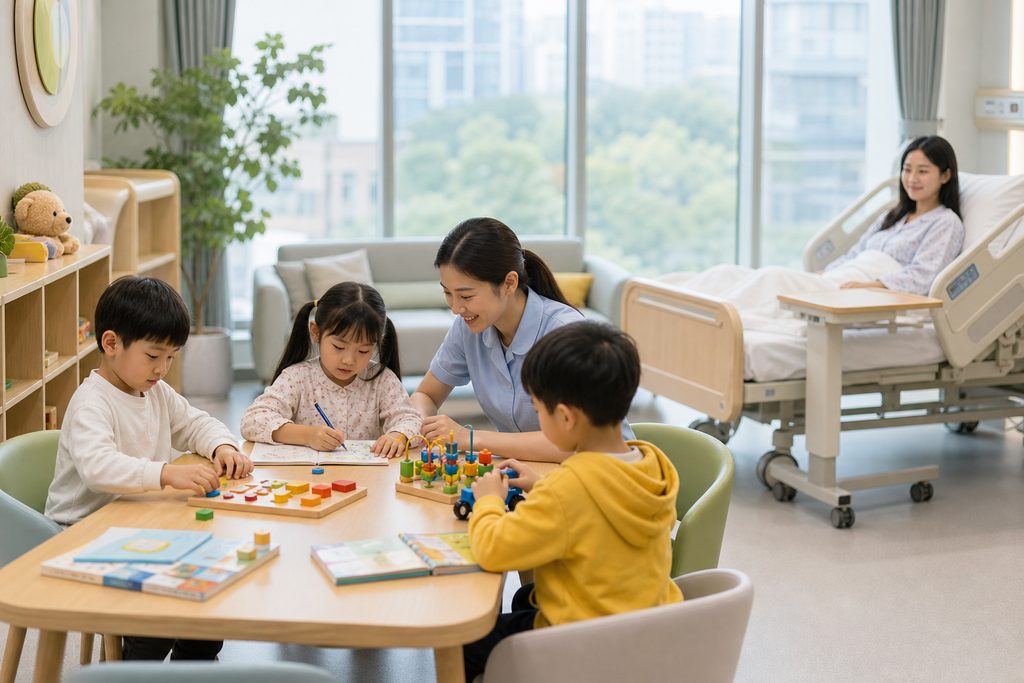
Key Takeaways
- Several top-tier hospitals in Beijing and Shanghai maintain in-house or partnered children’s activity centers, but fewer than 15% of China’s 35,000+ hospitals offer structured pediatric programming for visiting families.
- Private international hospitals like United Family and Jiahui run English-speaking day care programs starting from approximately $80 per day, while public hospital VIP wings can arrange childminding services through third-party agencies.
- Language barriers make spontaneous childcare arrangements risky — most local daycares operate exclusively in Mandarin and require Chinese ID documentation for enrollment, even for short-term care.
- A well-planned children’s program does more than entertain — it gives the recovering parent uninterrupted rest and protects young children from the sensory overload of a busy Chinese hospital ward.
The Problem: Your Surgery Is Scheduled, But What About Your Child?
You have done the hard part. You chose the hospital, booked the flight, and mentally prepared for a procedure that costs a fraction of what it would back home. Then the question hits you at 2 AM: who watches my six-year-old while I am under anesthesia for four hours? Or during the three days of inpatient recovery that follow? This is not a niche worry. Medical tourism involving parents with dependent children has grown steadily — one 2023 report from the Medical Tourism Association noted that approximately 22% of inbound medical travelers to Asia now bring at least one family member under 18. Yet hospital websites rarely mention childcare for patients kids during hospital stay China on their English-language pages. The information exists. It is just buried.
We hear this anxiety from families every week. A father from London needs a hip replacement at a Shanghai orthopedic center and is traveling solo with his eight-year-old daughter. A mother from Dubai is coming to Beijing for oncology treatment and her husband cannot take three weeks off work — so she brings her twins and a nanny, but the nanny speaks no Mandarin and cannot navigate the hospital campus. The scenarios vary. The core question stays the same: can I keep my child safe, engaged, and happy while I focus on getting better?
Who We Are
We are China Medical Services. We are not a hospital, not a daycare operator, and we do not provide medical treatment or clinical diagnoses. Our team functions as your logistical architects — we bridge the gap between you and China’s top-tier medical expertise. Since our founding, we have built direct relationships with over 340 top-ranked hospitals across 37 cities. When a family asks us about children activity program hospital China prices or whether a specific facility can accommodate a child during a parent’s surgery, we do not guess. We call the hospital’s international patient center, verify the current offerings, check staff language capabilities, and report back with specifics. That is the service layer most medical travelers lack — a bilingual, on-the-ground team that handles the questions Google cannot answer.
What Childcare Options Actually Exist at Chinese Hospitals
If your priority is a seamless, English-speaking daycare for international patients children Shanghai or Beijing, the private international hospital group is where you start. United Family Healthcare operates facilities in both cities with dedicated pediatric activity programs. Their Shanghai location offers a supervised play area staffed by early childhood educators who speak English and Mandarin. Children can stay for half-day or full-day sessions while a parent attends appointments or rests post-procedure. Jiahui International Hospital, also in Shanghai, runs a similar program integrated with their international patient services desk. Pricing for these programs starts around $80 per day for a half-day session and can reach $150 for a full day with meals included.
The trade-off is cost — private international hospitals charge Western-level fees for both medical care and ancillary services. A parent coming for a complex cardiac procedure might find the total package exceeds their budget if they also need two weeks of daily childcare. But for shorter stays or diagnostic visits, the convenience is hard to beat.
Public Hospital VIP Wings: Custom Arrangements, Higher Coordination Effort
Here is where our team spends a lot of time. The VIP or international medical wards at top public hospitals — Peking Union Medical College Hospital, Zhongshan Hospital Fudan University, West China Hospital in Chengdu — do not advertise children’s programs on their websites. But their international patient coordinators can arrange childminding services through vetted local agencies. The process works like this: you tell us your surgery dates and your child’s age, we contact the hospital’s VIP ward coordinator, and they source a qualified caregiver — often a retired pediatric nurse or a certified early childhood educator — who comes to a designated family waiting area within the hospital.
This is not a drop-in daycare model. It is a pre-booked, one-on-one arrangement. You know exactly who will be with your child, their qualifications, and their language abilities, before you arrive. Costs range from $120 to $200 per day depending on the city and the caregiver’s credentials. The arrangement requires advance notice — ideally two to three weeks — because good caregivers book up. Last-minute requests are possible but the pool of available, English-speaking staff shrinks considerably.
Third-Party Medical Tourism Childcare Services
A small but growing industry has emerged around medical tourism China family child entertainment services. Independent agencies in Beijing, Shanghai, and Guangzhou now offer packages specifically for families traveling for medical care. These packages bundle airport pickup, a vetted nanny or childminder, daily activity itineraries, and even educational outings — a visit to the Shanghai Natural History Museum, a calligraphy workshop in a Beijing hutong, a morning at a Chengdu panda base. The advantage is flexibility. The caregiver comes to your hotel or serviced apartment, not the hospital, which means your child is in a calmer environment while you are in surgery. Prices for a full-service package start around $250 per day and climb based on the number of children and the complexity of the itinerary.
The risk is quality control. Anyone can put up a website and claim to offer “medical tourism childcare.” We have seen families arrive in China only to discover their pre-paid caregiver speaks almost no English or has no pediatric first-aid certification. Our team vets these agencies directly — we check credentials, interview caregivers, and only recommend partners with a documented track record. If you want to book hospital with kids program China through an independent provider, do not rely on online reviews alone. Get a trusted local intermediary to verify the details.
What to Do with Kids While a Parent Has Surgery in China: A Practical Timeline
Every family’s situation is different, but a framework helps. Let us walk through what what to do with kids while parent has surgery in China looks like across the three phases of a medical trip.
Phase 1: Pre-Surgery — Consultation and Testing Days
These are the lighter days. You might have a two-hour consultation in the morning and lab work in the afternoon. For a school-aged child, a half-day hospital-based activity program often works well. They can do art projects, read, or watch movies in a supervised setting while you move between appointments. Younger children — toddlers and preschoolers — need more hands-on attention. A one-on-one caregiver in your hotel is usually the better choice for this age group. The hospital environment overwhelms them quickly.
Some families bring a grandparent or a trusted relative specifically for this phase. If that is an option, it simplifies everything. But we know it is not always possible. That is when a pre-arranged local caregiver becomes essential.
Phase 2: Surgery Day — The Critical Window
Surgery day is the non-negotiable. You will be in the operating room for anywhere from two to eight hours, then in recovery for several more. Your child cannot be in the surgical waiting area alone. Most Chinese hospitals require a designated adult guardian for any minor on the premises. This is not a flexible policy — it is a hard rule enforced by hospital security.
The solution we recommend most often: a caregiver stays with your child at your hotel or a nearby family-friendly venue for the full day. The caregiver sends you (or your designated contact) updates via WeChat — photos, activity summaries, reassurance that everything is fine. When you are out of recovery and coherent, you reconnect. Some hospitals with VIP wards will allow the caregiver and child to visit you briefly in a private recovery room, but this must be cleared with the nursing staff in advance.
Phase 3: Inpatient Recovery — The Balancing Act
You are in a hospital bed for two to five days. You are tired, possibly in pain, and not in a position to entertain an active child. This phase is where the quality of the children’s program really matters. A good program provides structure — morning activities, lunch, quiet time, afternoon outings or projects — so your child feels secure and occupied while you rest. The caregiver brings the child to visit you for short periods, then takes them out again before restlessness sets in.
One practical note: Chinese hospital wards, even in VIP sections, are not spacious. A standard private room might have a chair for one visitor and limited floor space. Long visits with a young child are uncomfortable for everyone. Plan for short, positive visits — 20 to 30 minutes — and let the caregiver handle the rest of the day.
What You Need to Know Before Arranging Childcare Independently
Some families try to arrange childcare on their own before arriving. We understand the impulse — it feels like saving money and maintaining control. But the friction points are real, and they can derail a medical trip fast.
- Language and Documentation Barriers: Local Chinese daycares operate almost exclusively in Mandarin. Enrollment requires a Chinese ID card, a local residence permit, and a health check from a designated Chinese hospital — none of which a short-term visitor possesses. Walk-in registration simply does not work for foreign families on S2 medical visas.
- Safety and Certification Gaps: China does not have a unified national licensing system for childcare workers equivalent to the CDA (Child Development Associate) credential in the US. Quality varies enormously. A caregiver who looks great on a bilingual website might have no formal pediatric first-aid training. Without a local intermediary to verify credentials, you are taking a significant risk.
- Payment and Cancellation Traps: Independent agencies often require full prepayment via wire transfer to a Chinese bank account. If your surgery date changes — and surgery dates do change — getting a refund can involve weeks of back-and-forth in Mandarin with no guarantee of resolution. We have seen families lose thousands of dollars this way.
How We Help You Navigate This
Our process is straightforward because we have done it hundreds of times. When you contact us about your medical trip, we ask about your children — ages, languages spoken, any special needs, your preferred childcare arrangement. We then cross-reference your hospital choice with our database of vetted childcare options. If the hospital has an in-house program, we confirm availability and book it. If not, we source a qualified caregiver through our partner network and handle the contracting, payment, and scheduling.
On the ground, our bilingual medical companion can serve as the bridge between you, the caregiver, and the hospital staff. If a scheduling conflict arises — your surgery gets moved from Tuesday to Wednesday, for example — we adjust the childcare booking immediately. You focus on your health. We handle the logistics.
For families exploring broader medical tourism China family child entertainment services, we can also coordinate cultural activities and excursions that make the trip meaningful for your child, not just a stressful interlude. A well-designed children’s program transforms the experience from an ordeal into something closer to a family adventure — with the medical care at the center, but not dominating every moment.
Frequently Asked Questions
Can my child stay with me in the hospital room overnight?
In most Chinese public hospitals, the answer is no. Inpatient wards have strict rules: one adult companion per patient, and children under 12 are generally not permitted to stay overnight. Private international hospitals are more flexible — United Family and Jiahui both allow a child to stay in a parent’s private room with prior arrangement, though they strongly recommend against it for the child’s comfort. The hospital environment is disruptive to sleep, and a well-rested child is easier for everyone to manage. We typically recommend a hotel or serviced apartment with the caregiver for overnight stays.
What if my child gets sick while we are in China?
This is a legitimate concern, and one we prepare for. Our vetted caregivers carry pediatric first-aid certification. If your child needs medical attention, we can arrange a same-day appointment at the pediatric department of your hospital or at a nearby international clinic. The private international hospitals we work with — United Family, Jiahui, Parkway — all have English-speaking pediatricians and can see a child on short notice. We also provide you with a local emergency contact number staffed by our bilingual team, so you are never navigating a pediatric fever at 10 PM alone in an unfamiliar city.
Are there any hospitals in China with dedicated children’s activity centers?
Yes, though the list is short. United Family Shanghai and Beijing both have supervised play areas. Jiahui International Hospital in Shanghai runs a structured children’s program. A few public hospital VIP wings — Peking Union Medical College Hospital’s International Medical Service and Zhongshan Hospital’s International VIP Clinic — can arrange childminding through partner agencies, but they do not operate their own drop-in centers. Outside of Beijing and Shanghai, options thin out quickly. Guangzhou has some private clinic options. Chengdu’s West China Hospital can arrange caregivers through their international desk with advance notice. For hospitals in smaller cities, a hotel-based caregiver is usually the only viable path.
How far in advance do I need to book a children’s activity program?
For private international hospitals with in-house programs, two weeks is usually sufficient. For caregiver arrangements through public hospital VIP wings or third-party agencies, we recommend three to four weeks, especially during peak travel seasons (Chinese New Year, summer holidays, and the October Golden Week). The pool of qualified, English-speaking caregivers is not large, and the best ones are booked well ahead. Last-minute requests are possible but limit your options and may cost more.
Important: No childcare arrangement — however well-vetted — eliminates all risk. We strongly recommend that families carry comprehensive travel insurance that covers both the patient and accompanying children. Confirm with your insurer that your policy includes medical evacuation coverage for dependents in the event of a serious illness or injury.
Your Next Step
Bringing a child to China for your medical treatment is not a complication to fear. It is a logistics challenge with proven solutions. The hospitals exist. The caregivers exist. The activity programs, while not universal, are available in the cities where most international patients seek care. What makes the difference is having someone on the ground who knows which hospital offers what, who speaks the language, and who can move fast when plans change. That is the role we fill. If you are considering treatment in China and need to bring your child, reach out to our team for a free consultation. We will map out the childcare options specific to your hospital, your dates, and your child’s needs — no pressure, no commitment, just clear information so you can make a confident decision.
For more medical information and treatment options in China, visit chinamedservices.com (China Medical Services).
