3D Printed Custom Implants in China: Orthopedic & Craniofacial Surgery Access
When 42-year-old Michael first heard the diagnosis, he had no idea where to start looking for treatment. A benign but aggressive tumor had eroded a section of his mandible. His surgeon in Manchester recommended a custom titanium reconstruction. The quote stopped him cold. Nearly £45,000 for the implant alone. The NHS waiting list stretched past eleven months. He started searching online late one night. “Custom titanium skull implant Shanghai price.” The results showed numbers that seemed impossible. A similar implant, designed from his own CT data and 3D printed in medical-grade titanium, quoted at roughly one-third to one-fifth of what he had been told at home.
That search leads many patients straight into a maze of questions. Is the quality the same? Which hospital actually performs these procedures? How does a foreigner even begin the process?
Our team has guided patients through this exact pathway. We are not a hospital. We do not provide medical treatment, surgical opinions, or clinical diagnoses. We are your logistical architects. We bridge the gap between you and China’s top-tier orthopedic and craniofacial surgical teams. We handle the coordination, the language barrier, and the thousand small details that make the difference between a stressful ordeal and a smooth recovery.
Key Takeaways
- A custom 3D printed craniofacial or orthopedic implant in China typically costs 60–80% less than in the US or UK, with implant prices starting from $3,000–$8,000 depending on complexity.
- China’s top hospitals now use in-house digital design and metal 3D printing systems, cutting production time to as little as 48–72 hours for a patient-specific titanium implant.
- Public hospitals cannot book surgery remotely. You must attend an in-person consultation first. The international VIP pathway is the only reliable way to lock in a surgical date before traveling.
- Language, payment logistics, and visa requirements create real friction for solo international patients. A local coordination team turns an overwhelming process into a structured plan.
The Problem: When Off-the-Shelf Implants Are Not Enough
Standard orthopedic and craniofacial implants work for most patients. They really do. A stock hip stem. A pre-formed cranial plate. Surgeons adapt them intraoperatively. Bend a mesh here. Trim a margin there. For routine cases, this is perfectly acceptable. But approximately 15–20% of complex reconstructions demand something more precise. Trauma defects, congenital asymmetries, tumor resections, failed previous implants. These cases do not fit a catalog.
In the United States, a patient-specific 3D printed titanium cranial implant can cost $15,000 to $35,000 before a single surgical fee is added. In Western Europe, the numbers are similar. Wait times for design and production stretch from four to eight weeks. For a patient with an exposed brain or a destabilized joint, that wait is not just inconvenient. It is dangerous. The structural reasons are straightforward. Western hospitals outsource digital design and printing to third-party biomedical firms. Each layer adds margin. Each handoff adds delay. The surgeon sends a CT scan, waits for a design proposal, approves or revises, waits again, and eventually receives a finished implant weeks later. The patient waits too.
China has collapsed that timeline. Not through magic. Through vertical integration.
Who We Are
We maintain a curated database of 340+ top-ranked hospitals across 37 cities in China. These represent the top 5% of the nation’s 35,000+ hospitals, ranked by the authoritative Fudan University hospital rankings and JCI accreditation standards. Our team does not treat patients. We connect you with the surgical teams that do. We translate your medical records, coordinate your visa documentation, arrange bilingual medical companions, and manage hospital appointment scheduling through official international department channels. Think of us as your local operations team on the ground before you ever board a plane.
Why China’s 3D Printed Implant Pathway Delivers Results
Clinical Volume Drives Surgical Precision
A craniofacial surgeon at a top Chinese public hospital may perform 150–250 complex reconstructions annually. Compare that to a typical Western surgeon handling perhaps 30–50 similar cases per year. Volume is not a vanity metric. Studies published in the Journal of Oral and Maxillofacial Surgery have repeatedly demonstrated that higher surgical volume correlates directly with lower complication rates and shorter operative times in complex craniofacial procedures. When a team sees challenging anatomy week after week, pattern recognition sharpens. Intraoperative decision-making accelerates. The digital design team, often sitting one floor away from the operating theater, receives immediate feedback on what worked and what could improve. That feedback loop is incredibly short. It shows in the results.
In-House Digital Design and Metal Printing
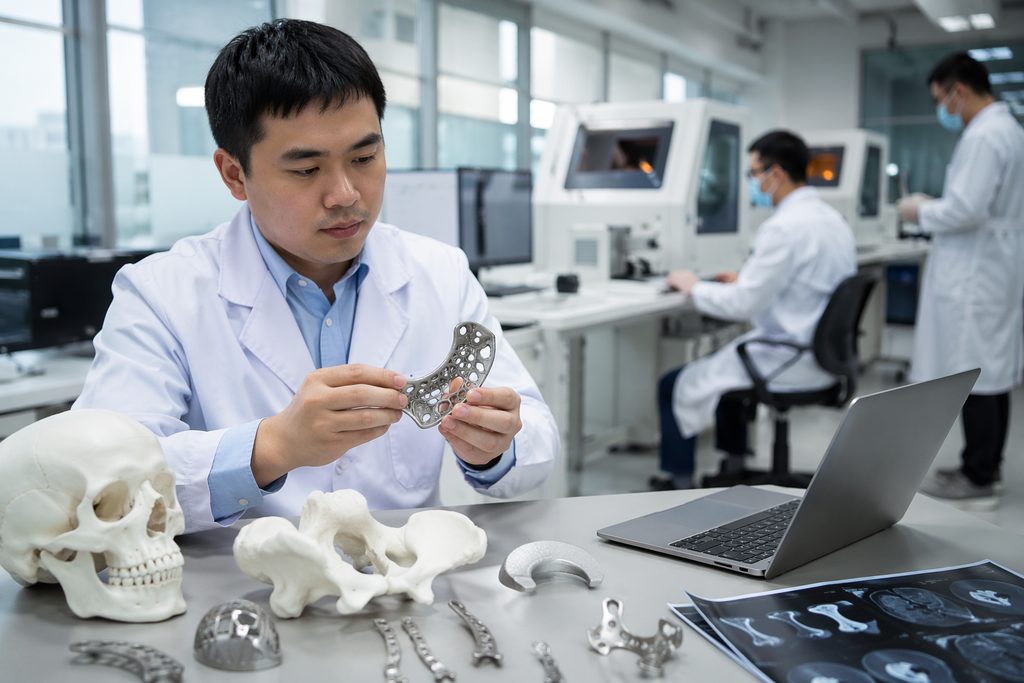
Several major Chinese hospitals now operate their own digital manufacturing centers. This is not a third-party service down the street. It is a lab inside the hospital. A patient’s high-resolution CT scan flows directly to biomedical engineers who sit in the same building as the surgeon. They segment the DICOM data, mirror the unaffected contralateral anatomy, and design a patient-specific implant that matches the defect with sub-millimeter accuracy. The file goes to a medical-grade titanium powder bed fusion printer. The implant prints. It undergoes post-processing, sterilization, and packaging. Total time from CT scan to finished implant: often 48 to 72 hours. This speed changes what is surgically possible. A trauma patient with a shattered orbital floor can be scanned on Monday and in surgery by Thursday with a perfectly contoured titanium plate that fits like a missing puzzle piece.
The Cost Structure: Why the Numbers Are Different
Let us address the obvious question. How can the 3d printed craniofacial implant cost China be so much lower without sacrificing quality? The answer lies in structural economics, not corner-cutting. A custom titanium skull implant that costs $20,000 in the US might cost $4,000–$7,000 in China. The titanium powder is sourced globally and costs roughly the same. The printing machines are the same German and Swedish brands used in Western biomedical firms. The difference is labor costs, hospital overhead, and the elimination of multiple corporate profit layers. The design engineer, the printing technician, the quality control specialist—their salaries are lower in China. The hospital owns the printer and amortizes it across a massive patient volume. There is no external biomedical company adding a 40% margin. There is no multi-tier distribution chain. The implant goes from hospital printer to hospital sterilizer to operating room. That vertical integration slashes cost without touching quality.
| Procedure | US/EU Implant Cost (USD) | China Implant Cost (USD) |
|---|---|---|
| Custom Titanium Cranial Plate | $15,000–$35,000 | $3,500–$8,000 |
| Custom Mandibular Reconstruction | $20,000–$45,000 | $5,000–$12,000 |
| Patient-Specific Orthopedic (Hip/Knee) | $8,000–$18,000 | $2,500–$6,000 |
| Custom Orbital Floor Implant | $6,000–$15,000 | $1,800–$4,500 |
Note: Implant costs are approximate and vary by hospital, case complexity, and design requirements. Surgical fees, hospital stay, and anesthesia are additional and quoted separately.
What You Need to Know Before Going Alone
The pathway exists. It is proven. But walking it alone as an international patient is genuinely difficult. Here is what you will face.
- Visa Requirements Are Specific: Medical treatment in China requires an S2 visa, annotated for medical purposes. Accompanying family members also need S2 visas. The application demands an official invitation letter from the treating hospital, confirmed appointment documentation, and proof of sufficient funds. Hospitals do not issue invitation letters without a confirmed consultation. And you cannot confirm a consultation without being physically present—unless you use the international VIP pathway. This circular problem frustrates many solo patients. An M visa is for business and commerce. It is not valid for medical treatment. Using the wrong visa category risks denial at the border.
- Public Hospital Registration Is In-Person Only: China’s public hospitals, including the top-tier institutions on the Fudan rankings, operate a same-day queuing system for outpatient clinics. You cannot book a specialist consultation online from overseas. You show up at 6:00 AM, queue for a registration ticket, and hope the specialist you need is available that day. For a complex craniofacial reconstruction requiring a specific surgical team, this model is not viable. The international department or VIP channel is the only route that allows pre-arranged surgical scheduling. It costs more—typically 1.5 to 2 times the standard rate—but it guarantees English-speaking coordination and a confirmed surgical slot.
- Payment Systems Are Fundamentally Different: Chinese public hospitals require prepayment. You deposit funds at admission, and the hospital draws down against that balance. International credit cards are not accepted at most public hospital counters. You need a Chinese bank account, a local payment app like WeChat Pay or Alipay, or a local coordinator who can handle the transactions. Private international hospitals are more flexible and often accept direct insurance billing, but the top surgical talent for complex 3D printed implant cases resides primarily in the public university hospitals.
How We Help You Navigate This
These barriers exist for structural reasons. They are not designed to exclude international patients—they simply reflect a healthcare system built for a domestic population of 1.4 billion. Our job is to create a bridge across every single one of them.
Before you travel, we collect your medical records, imaging data, and diagnostic reports. We translate everything into clinical Chinese, formatted to the standards Chinese surgeons expect. We submit your case to the international departments of hospitals known for 3d printed craniofacial implant cost China competitiveness and surgical excellence. We secure a written treatment proposal and a cost estimate. We coordinate the hospital invitation letter that unlocks your S2 visa application. We do not promise a specific surgeon or an exact surgery date—no ethical coordinator can. But we do promise that if we cannot secure the appointment we commit to, we refund our coordination fee in full.
During your stay, a bilingual medical companion meets you at the airport. They accompany you to every consultation, translating medical terminology accurately—not just conversational phrases. They handle registration, payment deposits, prescription pickups, and navigation through hospital corridors that can span the size of small airports. They are your voice and your ears in a system where not speaking Chinese leaves you functionally invisible.
After discharge, we coordinate follow-up imaging, rehabilitation appointments, and the eventual clearance for travel home. If you need a remote video consultation with your Chinese surgeon six months later, we arrange it. Any video consultation fee you pay is credited in full toward future on-the-ground coordination if you return for follow-up surgery—a one-time credit applied within 90 days.
How to Get a Custom 3D Printed Implant in China as a Foreigner
The process is more linear than most patients expect. It starts with data. Your CT scan, in DICOM format, is the single most important document in this entire journey. Without a high-resolution CT with thin slices—ideally 1mm or less—no surgeon can design a patient-specific implant. The digital design team uses that data to create a virtual 3D model of your anatomy. They plan the resection margins, the screw trajectories, and the implant geometry. You review and approve the plan remotely. The implant prints while you arrange your travel. You arrive. You have surgery. You recover. The entire timeline from first contact to surgery can be as short as three to four weeks for urgent cases.
For patients searching for the best hospital for 3d printed orthopedic implants China, the answer depends on the anatomical site. Craniofacial cases concentrate in Shanghai and Beijing. Complex orthopedic reconstructions, including custom hip and knee implants, cluster in Beijing, Shanghai, and Chengdu. Our specialty department rankings help you match your specific condition to the hospitals with the deepest experience in that exact procedure. A hospital that excels at custom cranial implants may not be the right choice for a custom acetabular reconstruction. Specificity matters.
Frequently Asked Questions
The implant itself typically ranges from $3,500 to $8,000 for a custom titanium cranial or facial implant, compared to $15,000–$35,000 in the United States. This covers the digital design, titanium powder, 3D printing, post-processing, and sterilization. It does not include surgeon fees, anesthesia, or hospital stay. Total all-inclusive surgical packages for international patients generally fall between $15,000 and $35,000, depending on complexity. That compares to $60,000–$120,000+ in the US for the equivalent procedure. The variance is wide because no two reconstructions are identical. We help you obtain a specific written quote tied to your CT data before you commit to travel.
Yes, through the international VIP pathway. Standard public outpatient registration cannot be done remotely. But the international departments of top hospitals accept pre-arranged cases with translated medical records and imaging. Once a surgeon reviews your file and agrees to take your case, we secure a surgical slot and an invitation letter for your S2 visa. This is the only reliable way to book 3d printed implant surgery China international patient cases with certainty. Without this coordination, you are gambling on showing up and hoping for availability.
This is the question every patient should ask. The hospitals we work with are accredited public university hospitals with complication rates comparable to major Western centers. They carry malpractice insurance and follow standardized surgical protocols. Your bilingual medical companion remains with you throughout hospitalization and can escalate any concern immediately. In the rare event of a surgical complication requiring extended care, the hospital has the resources to manage it—these are massive institutions with full ICU, infectious disease, and rehabilitation departments under one roof. We also help coordinate medical evacuation logistics if a patient needs to return home urgently, though we strongly advise purchasing comprehensive medical travel insurance that covers complication management and evacuation before departure.
Some private international hospitals offer bundled packages. However, the most experienced craniofacial surgeons work in public university hospitals, where pricing is itemized rather than packaged. What we coordinate is a structured plan: implant cost, surgeon fees, hospital bed charges, anesthesia, medications, and post-operative imaging. You see every line item. You pay the hospital directly. Our coordination fee is separate and transparent. For patients seeking comprehensive medical tourism packages for craniofacial surgery China, we can build a full itinerary including airport transfers, accommodation, bilingual companionship, and all hospital coordination. But the surgical costs always flow directly to the hospital, never through us. This keeps incentives aligned.
In Shanghai’s top craniofacial centers, a patient-specific titanium skull implant generally costs between $4,000 and $7,500 for the implant itself. Shanghai has become a hub for digital craniofacial surgery, with several hospitals operating in-house metal 3D printing facilities. The total surgical package, including implant, surgeon fees, hospital stay, and anesthesia, typically ranges from $18,000 to $30,000. This varies significantly based on defect size, implant complexity, and the specific hospital. Shanghai also offers the most English-friendly medical environment in mainland China, which reduces the logistical burden for international patients.
Your Next Step
A custom 3D printed implant is not a commodity. It is a precision medical device designed around your unique anatomy, built from your own imaging data, and implanted by a surgical team whose skill determines the outcome. The technology in China is world-class. The cost advantage is real. The logistical barriers are also real—but they are navigable with the right support. You do not need to figure out visa categories, hospital registration systems, or payment logistics on your own. That is what our team exists to handle.
Start with your CT scan. If you have DICOM files and a brief medical history, we can begin the process today. Visit our patient coordination page to submit your case for a free initial consultation. No commitment. No pressure. Just a clear assessment of what is possible.
For more medical information and treatment options in China, visit chinamedservices.com (China Medical Services).
