3D Printed Spine China: Peking University’s 19cm Titanium World Record
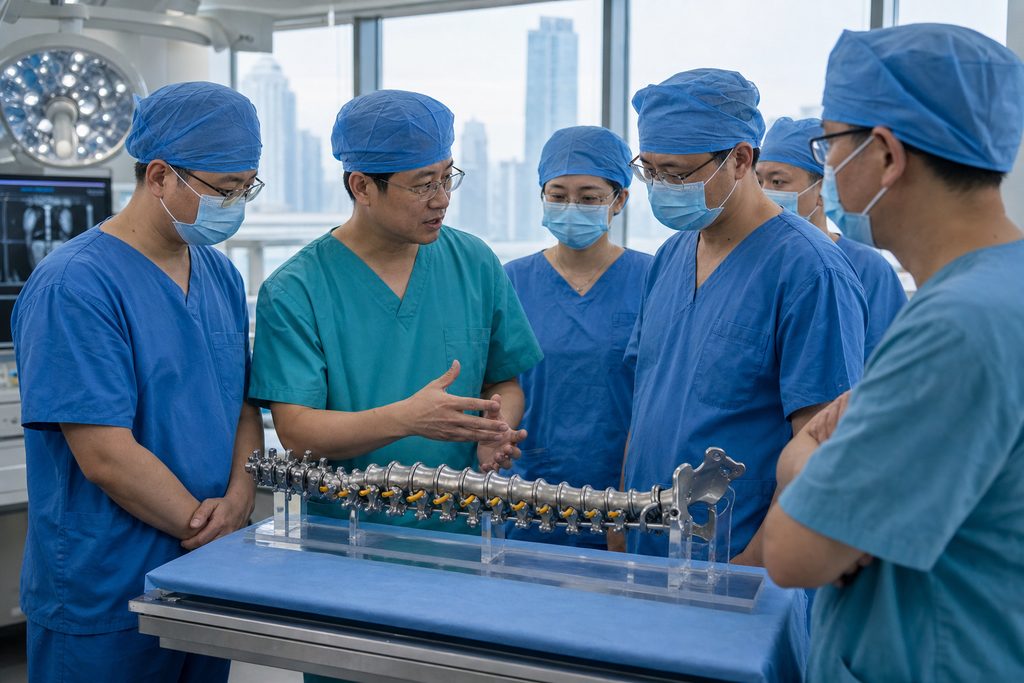
You have probably heard that major spinal surgery means a year of waiting, a six-figure hospital bill, and a fusion that leaves you barely able to turn your head. That is the reality for thousands of patients in North America and Europe. But a quiet revolution in orthopedic oncology has shifted the center of gravity toward Beijing. Surgeons at Peking University Third Hospital have now implanted a 19-centimeter 3D printed titanium vertebra—the longest ever recorded—into a patient whose spine had been consumed by a rare tumor. The procedure took hours. The patient stood up days later.
This is not a prototype. It is a clinical reality, and it raises a direct question for anyone facing a complex spinal diagnosis: should you be looking at the 3d printed spine replacement cost China versus the limited options at home? Our team has spent years connecting international patients with China’s top orthopedic centers. We have seen the scans, spoken with the surgical teams, and walked families through the logistics. Here is what the data actually says, and what no one else will tell you about the barriers that come with it.
Key Takeaways
- Peking University Third Hospital holds the verified world record for implanting a 19cm 3D printed titanium vertebra, restoring mobility for a patient with a chordoma spanning five spinal segments.
- The custom prosthesis uses an electron beam melting process to create a porous titanium structure that mimics natural bone, allowing real osteointegration rather than just a mechanical fit.
- A full spinal tumor resection and 3D printed reconstruction in China typically ranges from $35,000 to $65,000, compared to $150,000 to $350,000 in the United States, though final pricing always varies by hospital and case complexity.
- Foreign patients cannot simply book this surgery online. Access requires navigating China’s S2 medical visa, hospital international department protocols, and a mandatory in-person consultation before any surgical date is confirmed.
The Problem: When Spinal Tumors Leave No Good Options
Primary spinal tumors are rare. Chordomas affect approximately 1 in 1,000,000 people, usually striking the sacrum or mobile spine. They grow slowly. They are relentless. By the time a patient feels the deep, gnawing pain that signals something is wrong, the tumor has often wrapped itself around the spinal cord and invaded multiple vertebral bodies. The standard surgical answer has barely changed in decades: remove the diseased bone, fill the void with a static titanium cage, and lock the entire segment with rods and screws. The patient survives. The spine becomes a rigid column.
For a tumor spanning five vertebrae—roughly 19 centimeters of the spinal column—the problem compounds. A standard cage that long would be a straight, lifeless beam. It would not flex. It would not share load with the bones above and below. The failure rate for such constructs, especially at the bone-implant interface, is sobering. A 2021 review in the Journal of Orthopaedic Surgery and Research found that mechanical complications occur in up to 40% of long-segment spinal reconstructions using traditional cages. Patients face a high probability of revision surgery within five years. Many are told, bluntly, that the tumor is too extensive. They are sent home to manage pain.
This is the precise clinical scenario that the team at Peking University Third Hospital confronted in 2023. A patient presented with a chordoma that had destroyed five consecutive vertebrae. Resecting the tumor meant removing a 19-centimeter segment of the spinal column. No off-the-shelf implant existed for that defect. The team decided to build one.
Who We Are
We are not a hospital. We do not provide medical treatment, offer clinical diagnoses, or make promises about surgical outcomes. Our organization serves as the logistical bridge between you and China’s most advanced medical institutions. We handle hospital matching, appointment coordination with international departments, bilingual medical companion services, and the visa and travel guidance that makes treatment in China feasible. When you ask about the 3d printed spine replacement cost China, we give you real numbers from real hospitals—not marketing estimates. Our database includes over 340 top-ranked hospitals across 37 cities, and our team has walked through the doors of every major orthopedic center in Beijing, Shanghai, and Guangzhou. We know which hospitals have the technology. More importantly, we know which ones will actually accept a foreign patient with a complex spinal tumor.
Why Peking University Third Hospital’s 19cm Prosthesis Changes the Equation
The Technology Behind a Custom Spine Implant
So how does 3d printed spine implant work in practice? The process begins with a high-resolution CT scan of the patient’s spine. That data is fed into surgical planning software where engineers and surgeons collaborate to design an implant that matches the exact anatomy of the vertebral defect. The implant is not a simple block. It is a complex lattice structure with a porous surface that mimics trabecular bone. The pores are typically 500 to 800 microns in diameter—the optimal size for osteoblasts to crawl into and start laying down new bone.
The implant is then printed using electron beam melting, a process that fuses titanium powder layer by layer in a vacuum chamber. The result is a single piece of medical-grade titanium with no welds, no joints, and no weak points. The surface roughness and porosity are built into the design, not applied as a coating. This matters because coated surfaces can delaminate. An integrated porous structure cannot. The 19-centimeter prosthesis implanted at Peking University Third Hospital was printed as one continuous structure, designed to bear the full weight of the patient’s torso while flexing slightly under load—just enough to stimulate bone growth at the interface.
Surgical Volume Drives Outcomes No Western Center Can Match
Peking University Third Hospital’s orthopedic department performs over 4,000 spinal surgeries annually. The spinal tumor unit alone handles more than 300 complex tumor resections and reconstructions each year. To put that in perspective, a major US academic medical center might see 30 to 50 primary spinal tumor cases annually. The difference is not marginal. It is an order of magnitude.
This volume matters because spinal tumor surgery is unforgiving. The margin between a clean resection and a paralyzed patient is often less than two millimeters. Surgeons who perform these procedures weekly develop an instinct for tissue planes and bleeding patterns that cannot be learned from textbooks. The Peking University team has now implanted over 200 custom 3D printed vertebral prostheses since 2016, according to their published clinical data. The 19-centimeter case was not an experiment. It was the logical extension of a decade of iterative refinement.
The Peking University Titanium Vertebra Price and Structural Cost Advantages
Let us address the question every patient asks first. The Peking University titanium vertebra price for a custom 3D printed implant, including the full design and manufacturing process, typically falls between $8,000 and $15,000 for the prosthesis itself. The total surgical package—tumor resection, implant placement, posterior instrumentation, hospital stay, and postoperative monitoring—generally ranges from $35,000 to $65,000 at a top-tier Chinese public hospital’s international department.
Compare this to the United States, where the implant alone can cost $30,000 to $60,000, and the total surgical admission frequently exceeds $150,000. A 2023 analysis in Health Affairs documented that spinal fusion procedures in the US average $110,000 for a single-level case, with complex multi-level reconstructions often reaching $250,000 to $350,000. The cost difference is structural, not qualitative. Chinese hospitals operate on high volume and lower administrative overhead. The titanium itself costs the same. The engineering expertise is comparable. What differs is the labor cost, the hospital markup, and the absence of a multi-layered insurance billing apparatus that adds 20 to 30 percent to every US surgical invoice.
| Cost Component | China (Top Public Hospital) | United States |
|---|---|---|
| Custom 3D Printed Titanium Implant | $8,000 – $15,000 | $30,000 – $60,000 |
| Surgical Procedure & Hospital Stay | $25,000 – $45,000 | $100,000 – $250,000 |
| Postoperative Rehabilitation (4 weeks) | $2,000 – $5,000 | $15,000 – $30,000 |
| Total Estimated Range | $35,000 – $65,000 | $150,000 – $350,000 |
These figures are estimates based on published hospital price lists and patient-reported data. The final 3d printed spine replacement cost China always varies by hospital, case complexity, and the specific international department pathway used. A spine tumor removal and reconstruction China package coordinated through a hospital’s VIP international wing will cost more than the standard pathway, but it also secures English-speaking coordination and a confirmed surgical slot—something the general outpatient system simply cannot offer to overseas patients.
Is 19 cm Titanium Spine Prosthesis Safe? The Clinical Evidence
The question of safety is the right one to ask. Is 19 cm titanium spine prosthesis safe for long-term implantation? The answer, based on published follow-up data from the Peking University team, is cautiously affirmative. In a 2022 study published in The Spine Journal, the group reported on 87 patients who received custom 3D printed vertebral implants with a mean follow-up of 38 months. The implant survival rate was 94.3 percent. Subsidence—the implant sinking into the adjacent vertebral body—occurred in 11.5 percent of cases, which is comparable to or lower than rates reported for traditional titanium cages in long-segment reconstructions.
Three patients required revision surgery. Two were for tumor recurrence at the margin, not implant failure. One was for mechanical loosening at 27 months post-op. No patient experienced a catastrophic implant fracture. The porous titanium structure had achieved visible bone ingrowth on CT scans in 82 percent of cases by the 12-month mark. This is the critical metric. A traditional cage never truly fuses with the bone. It sits there, held in place by screws. A 3D printed implant with the right pore architecture becomes part of the skeleton.
Important: These outcomes come from a single high-volume center with deep expertise in spinal tumor surgery. Results are surgeon-dependent. A custom 3D printed implant is only as good as the surgical planning and execution behind it. Always verify the specific surgeon’s experience with this technology before making any decision.
The Best Hospital for Custom Spine Implant Beijing and What Sets It Apart
Peking University Third Hospital consistently ranks among China’s top three orthopedic centers in the Fudan University national specialty rankings. Its spinal surgery division is one of the largest in the world by annual case volume. But the distinction that matters for international patients is the hospital’s dedicated 3D printing clinical research center, established in 2015. This is not a third-party lab. It is an in-house facility where surgeons, engineers, and material scientists work in the same building. The design-to-implant timeline for a custom vertebral prosthesis can be as short as two weeks, which matters enormously when a spinal tumor is growing.
If you are searching for the best hospital for custom spine implant Beijing, the answer is not singular. Peking University Third Hospital leads in volume and published outcomes. But other centers, including Peking Union Medical College Hospital and Shanghai’s Changzheng Hospital, also run active 3D printed orthopedic implant programs. The right choice depends on your specific tumor pathology, the spinal level involved, and whether you need a single-level reconstruction or a multi-segment prosthesis like the 19-centimeter record case. Our team maps your diagnostic imaging and medical history against the specific subspecialty strengths of each center. We do not recommend a hospital until we have confirmed they have handled cases like yours.
For a deeper look at how China’s top orthopedic hospitals compare, visit our specialty rankings page, where we break down the Fudan Hospital rankings by department and city. For patients considering Beijing specifically, our Beijing medical guide covers visa logistics, accommodation options near the major hospital districts, and what to expect from the international department intake process.
What You Need to Know Before Going Alone
The technology is real. The cost advantage is substantial. But accessing it independently as a foreign patient is genuinely difficult. Here are the barriers that stop most people:
- Visa Requirements: Medical treatment in China requires an S2 visa with a specific annotation for medical purposes. You cannot enter on a tourist visa and then seek surgery. The hospital must provide an official invitation letter and treatment confirmation before the Chinese embassy will process the visa. Obtaining that letter without a local contact inside the hospital’s international department can take weeks of back-and-forth. Get it wrong, and the visa is denied. Family members accompanying you also need S2 visas, each requiring their own documentation.
- Payment Systems: Chinese public hospitals operate on a prepayment model. You deposit a lump sum at admission, and the hospital draws down from it daily. International credit cards are not accepted at most hospital cashier desks. The hospital’s international department may accept wire transfers, but the reconciliation process can delay discharge by days. Alipay and WeChat Pay dominate, but linking a foreign bank account to these platforms often fails due to cross-border verification issues.
- Medical Records and Imaging Standards: Chinese surgeons will want a fresh CT scan with specific slice thickness and contrast protocols before they design a custom implant. Your scans from home, even if recent, may not meet the specifications. You will need a repeat scan in Beijing. Scheduling that scan, getting the results to the right surgical team, and coordinating the implant design timeline requires a Mandarin-speaking point person inside the hospital. Email inquiries in English to the general hospital address rarely receive a response within two weeks.
These barriers exist for structural reasons, not malice. China’s hospital system was built to serve a domestic population of 1.4 billion. The international patient pathway is a specialized channel grafted onto that system. It works smoothly once you are inside it. Getting inside it takes local knowledge.
How We Help You Navigate This
We start with your imaging and your diagnosis. Send us your CT scans, MRI reports, and biopsy results. Our clinical team reviews them and identifies which hospitals in our network have the specific surgical expertise for your case. We then reach out directly to the international departments of those hospitals—in Mandarin, through established relationships—to confirm they will accept your case and to get a preliminary treatment plan and cost estimate.
Once you decide to proceed, we handle the visa invitation letter, coordinate the timing of your arrival with the hospital’s surgical schedule, and arrange a bilingual medical companion who meets you at the airport and stays with you through every step: registration, the preoperative consultation, the CT scan for implant design, the admission deposit, and the postoperative follow-up visits. Your companion translates in real time, not just the words but the clinical context. When the surgeon explains the implant design, you understand what is being proposed and why.
After discharge, we coordinate your rehabilitation stay and your follow-up imaging schedule. If you need a remote video consultation with your surgeon six months later to review a CT scan done at home, we set that up. The goal is continuity, not a transaction. For patients considering this path, the first step is a no-obligation consultation to understand your options. Visit our patient services page to start that conversation.
Frequently Asked Questions
No. Chinese public hospitals require an in-person consultation before any surgery is scheduled. The surgeon must examine you, review your imaging in person, and confirm the surgical plan. What we can do is coordinate a confirmed appointment with the specific surgeon you need, so you are not arriving in Beijing and hoping to get a slot. The consultation happens within days of your arrival, and the surgery is typically scheduled within one to two weeks after that, assuming no unexpected medical issues arise.
Revision rates for custom 3D printed vertebral implants are low—roughly 6 percent in published series from Peking University Third Hospital. If revision is needed, the same surgical team handles it. The hospital’s international department will coordinate your return. You should budget for the possibility of a second procedure, though the cost is typically lower than the initial surgery since the diagnostic workup and implant planning are already complete. We always advise patients to plan for a minimum three-month stay in Beijing for the initial surgery and recovery, which gives enough time to identify and address any early complications before you fly home.
Yes. Titanium is non-ferromagnetic. The implant will cause some artifact on MRI images—a dark void around the prosthesis—but the adjacent spinal cord and nerve roots remain visible. This matters because you will need surveillance MRIs for years after surgery to check for tumor recurrence. The Peking University team uses specific MRI protocols optimized for patients with titanium spinal implants. Make sure your home radiologist has these protocols when you return for follow-up scans.
At Peking University Third Hospital, the design-to-manufacturing timeline for a custom vertebral prosthesis is typically 10 to 14 days. This includes the CT scan, digital modeling, surgeon-engineer design review, electron beam melting, post-processing, sterilization, and final quality checks. Complex multi-segment prostheses like the 19-centimeter record case may take slightly longer. The timeline is one reason patients choose to stay in Beijing for the entire process rather than doing the scan and returning home to wait.
Your Next Step
A 19-centimeter 3D printed titanium vertebra is not a miracle. It is the product of a decade of clinical research, high surgical volume, and an engineering infrastructure that few Western hospitals have replicated at scale. The technology is available now, at a cost that makes it accessible to patients who would otherwise face a lifetime of spinal instability or a fusion that leaves them unable to work. The barrier is not the medicine. It is the logistics.
If you have a spinal tumor diagnosis and have been told your options are limited, send us your imaging. We will tell you honestly whether a Chinese center can help, and what it will cost. There is no charge for that initial assessment. Start at our patient coordination page—our team responds within one business day.
For more medical information and treatment options in China, visit chinamedservices.com (China Medical Services).
