TCM Wellness Retreat in China: Combining Treatment with Recovery
Key Takeaways
- A structured TCM recovery retreat in China typically runs $2,500–$6,000 per week at reputable hospital-affiliated centers, roughly one-third the cost of comparable integrative programs in the United States or Switzerland.
- China’s top-tier TCM hospitals combine acupuncture, herbal medicine, and physiotherapy under one roof — the same model that treats over 900 million outpatient visits annually across the country.
- The biggest barrier for international patients is not treatment quality but coordination: language, hospital navigation, and knowing which programs are legitimate versus tourist traps.
- You should understand the difference between a clinical TCM rehabilitation program and a wellness resort before committing — they serve different needs and carry different price tags.
What Is a TCM Wellness Retreat, Exactly?
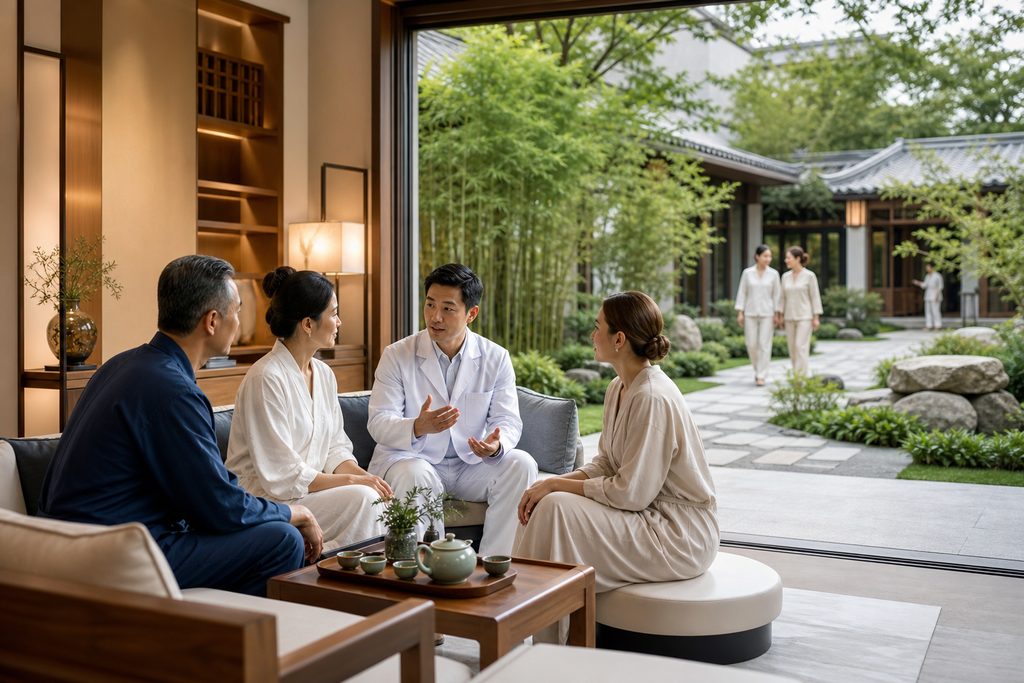
Most people hear “TCM retreat” and picture meditation cushions and herbal tea in a bamboo forest. That exists. But the term now covers a much broader spectrum — from luxury spa-style detox weeks to hospital-based rehabilitation programs where acupuncture and herbal formulas are prescribed alongside physical therapy after knee surgery or stroke recovery. A TCM wellness retreat China cost varies enormously depending on which end of that spectrum you choose.
The clinical end is what draws many international patients. China’s top-tier public TCM hospitals — several ranked among the country’s best by the Fudan University hospital rankings — run dedicated international wards where patients receive daily acupuncture, tuina massage, herbal decoctions, and dietary therapy under physician supervision. These are not resorts. They are medical facilities with wellness programming layered on top.
Then there are private wellness centers, often in Hangzhou, Chengdu, or the hills outside Beijing, that cater specifically to foreigners. English-speaking staff, Western-style rooms, organic meals. The treatment is real but the setting feels closer to a retreat. Prices run higher, naturally.
The Problem: Recovery Without Structure Fails
Roughly 310 million people worldwide undergo major surgery each year, according to the World Health Organization. A substantial share of them — particularly orthopedic, cardiac, and oncology patients — leave the hospital with a prescription for rest and a vague instruction to “take it easy.” What they actually need is structured rehabilitation.
In the United States, the average post-surgical rehab stay at an inpatient facility costs between $1,500 and $3,000 per day. A two-week stay can easily exceed $40,000 before insurance negotiations. In much of Europe, public systems provide rehab but with long waitlists and compressed session counts. A patient recovering from a total knee replacement in the UK might receive six physiotherapy sessions total. Six.
The gap between what recovery demands and what most systems deliver is where patients start looking abroad. And that search increasingly leads to China.
Why China’s TCM Recovery Model Delivers Results
Integrated Treatment Under One Roof
Western rehabilitation separates disciplines. You see a physiotherapist on Tuesday, a pain specialist on Thursday, maybe a nutritionist if you push for it. A Chinese TCM hospital integrates them by default. Your daily schedule at a hospital-affiliated retreat typically includes acupuncture in the morning, tuina or cupping in the afternoon, herbal medicine taken with meals, and physiotherapy sessions woven throughout. One attending physician coordinates all of it.
This is not fringe medicine. The World Health Organization’s 2019 global report on traditional and complementary medicine noted that 170 of 194 member states reported use of traditional medicine, with acupuncture among the most widely practiced forms. China’s TCM hospital network is the largest structured implementation of that model anywhere on earth.
Volume Creates Proficiency
Chinese TCM physicians see staggering patient volumes. A senior acupuncturist at a major Shanghai hospital may treat 40–60 patients in a single day. That repetition builds a level of procedural fluency that is hard to match in countries where a practitioner might see eight patients daily. For post-stroke rehabilitation, chronic pain management, and post-surgical recovery — the three areas where TCM shows the strongest evidence — that volume translates into refined technique and better pattern recognition.
Studies published in journals like Pain and JAMA Network Open have found acupuncture provides statistically significant pain relief for chronic back pain, osteoarthritis, and migraine compared to sham controls. The effect sizes are modest but real. What China adds is the full TCM stack — herbs, manual therapy, dietary therapy — applied systematically rather than piecemeal.
Cost Structure Without the US Markup
A hospital-affiliated TCM recovery program in China runs roughly $350–$700 per day for international patients at top institutions. That includes daily acupuncture, herbal prescriptions, physiotherapy, and accommodation in the international ward. A comparable integrative program in the US or Germany would run $1,500–$3,000 per day. The structural reasons are simple: lower labor costs for skilled practitioners, hospital-owned facilities, and a healthcare system built for volume rather than margin.
Lower cost does not mean lower rigor. The top TCM hospitals in Beijing and Shanghai are research institutions with published clinical trial programs. Several hold JCI accreditation or equivalent international quality certifications. You are not trading quality for savings — you are trading a high-cost delivery system for a high-efficiency one.
How Does a TCM Recovery Retreat Work in China: The Typical Two-Week Structure
A standard hospital-affiliated program follows a predictable rhythm. Week one focuses on assessment and stabilization: intake with a TCM physician, pulse and tongue diagnosis, baseline lab work if needed, and the first acupuncture sessions. Week two shifts to active rehabilitation — increased physiotherapy intensity, adjusted herbal formulas, and discharge planning with a written protocol for continuing care at home.
Here is what a typical day looks like at a mid-tier hospital TCM international ward:
| Time | Activity | Duration |
|---|---|---|
| 7:30 AM | Morning herbal decoction, light breakfast | 30 min |
| 8:30 AM | Acupuncture session (targeted to condition) | 45–60 min |
| 10:00 AM | Physiotherapy or guided movement therapy | 60 min |
| 1:30 PM | Tuina massage or cupping therapy | 45 min |
| 3:00 PM | Physician check-in, herbal formula adjustment | 20 min |
| 4:30 PM | Dietary therapy consultation or group session | 30 min |
Private retreats are less regimented. You might have two or three treatments per day with afternoons free for rest, sightseeing, or light exercise. The clinical intensity is lower, but so is the medical oversight. Choose based on what you actually need: structured rehabilitation or restorative wellness.
Is TCM Rehabilitation Safe for Post-Surgery Recovery?
The honest answer: yes, with qualifications. Acupuncture is remarkably safe when performed by trained practitioners. A 2023 systematic review in The BMJ examining over 200,000 acupuncture sessions found serious adverse events occurred in fewer than 1 in 10,000 treatments. The most common side effects are minor bruising, soreness, and occasional fatigue.
Herbal medicine carries more risk. Some Chinese herbs interact with anticoagulants, immunosuppressants, and chemotherapy agents. This is not a reason to avoid TCM — it is a reason to demand physician oversight. Hospital-based programs in China have licensed TCM pharmacists reviewing every formula against your medication list. That is the standard you want.
For post-surgical recovery specifically, the evidence supports TCM as an adjunct, not a replacement. A 2022 meta-analysis in Frontiers in Pharmacology found that acupuncture combined with standard rehabilitation improved functional outcomes after total knee replacement more than rehabilitation alone. The mechanism appears to be pain reduction enabling more aggressive physiotherapy. TCM helps you do the hard work of recovery — it does not do the work for you.
Critical caveat: If you are on blood thinners, have a bleeding disorder, or are within two weeks of major surgery, tell the TCM physician before any acupuncture or cupping session. Hospital programs screen for this. Private retreats may not.
Best Traditional Chinese Medicine Retreat Shanghai: What to Look For
Shanghai has the densest concentration of high-quality TCM institutions in China. The city hosts multiple hospitals ranked among China’s top 10 for TCM by the Fudan specialty reputation rankings, and several have dedicated international departments with English-speaking coordinators. When patients ask us about the best traditional Chinese medicine retreat Shanghai options, we point them toward hospital-affiliated programs first.
Why hospital-affiliated over standalone retreats? Three reasons. First, physician oversight — a licensed TCM doctor reviews your case daily, not a wellness coach with a certificate. Second, pharmacy quality — hospital dispensaries source herbs from audited suppliers and test for heavy metals and pesticide residues, which unregulated retreats rarely do. Third, emergency capability — if something goes wrong, you are already inside a hospital.
That said, Shanghai also has excellent private TCM wellness centers for patients who want a softer experience. The key is verification: ask about practitioner credentials (licensed TCM physician vs. therapist), herbal sourcing, and whether they accept international patients regularly. If a center cannot answer those questions clearly, walk away.
Medical Tourism Package TCM Healing China: What Is Actually Included
Yes, when delivered under physician supervision. Acupuncture has an excellent safety record, with serious adverse events occurring in fewer than 1 in 10,000 treatments. Herbal medicine requires more caution due to potential drug interactions — hospital programs review your medication list, which is the standard you want.
Hospital-affiliated programs have emergency departments on site. Private retreats typically have transfer agreements with nearby hospitals. Ask about emergency protocols before booking. Travel insurance with medical evacuation coverage is strongly recommended.
No, but it helps enormously. Hospital international departments have English-speaking staff, but the broader hospital environment — registration desks, pharmacies, cafeterias — operates in Chinese. A bilingual medical companion bridges that gap for $300 per day and is worth considering for at least the first few days.
Yes, and this is increasingly common. Some patients schedule a TCM recovery program after surgery at a Western-style hospital in Shanghai or Beijing. The key is coordination — both medical teams need to know what the other is doing. Our free consultation can help you map out a combined itinerary that makes medical sense.
Your Next Step
Recovery is not passive. The patients who do best after surgery or chronic illness are the ones who treat rehabilitation as seriously as the original treatment. A TCM recovery retreat in China offers a structured, evidence-informed, and cost-effective path — but only if you choose a legitimate program and go in with clear expectations. We help international patients navigate that process: matching you with hospital-affiliated TCM programs, coordinating invitations and logistics, and providing bilingual support on the ground. We are not a hospital and we do not provide medical advice — we are the bridge between you and the right medical team. Explore our TCM hospital directory to see what is available, or reach out for a free consultation when you are ready to plan seriously.
Frequently Asked Questions
Yes. The hospitals used for international patients are JCI-accredited and follow the same international safety standards as top hospitals in the US and Europe. Surgical teams perform high volumes of procedures — often more than their Western counterparts — which studies show leads to better outcomes.
Costs vary by procedure and hospital, but international patients typically save 40-80% compared to US prices — even when factoring in travel and accommodation. A consultation with our team will give you an exact, all-inclusive quote with no hidden fees.
Send us your existing medical reports to get started. We handle everything from hospital selection and appointment scheduling to visa assistance and post-operative recovery planning. Your medical records are reviewed by the specialist before you even book a flight.
For more medical information and treatment options in China, visit chinamedservices.com (China Medical Services).
