Remote Island Medical Evacuation to China: A Pacific Patient’s Guide
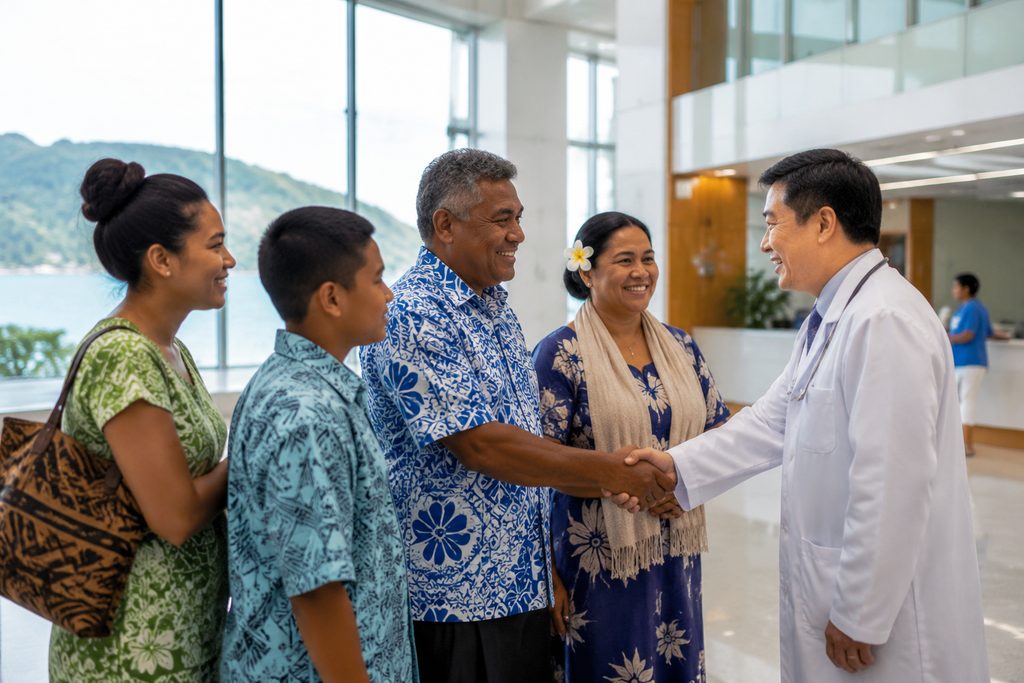
When 58-year-old Hana from Nukuʻalofa finally received her cardiac diagnosis, the local hospital gave her a timeline she couldn’t accept. The necessary valve replacement surgery wasn’t available in Tonga. The nearest referral center in New Zealand had a public system waitlist stretching past eleven months. Flying commercially meant risking a deep vein thrombosis at 30,000 feet. Her family felt trapped by geography.
Hana’s situation is not unique. Across the Pacific Islands, from Fiji to Samoa to Vanuatu, approximately 1 in 3 patients diagnosed with a complex condition requiring tertiary care face an agonizing gap between the treatment they need and the treatment they can access locally. The geography that defines paradise also defines a critical healthcare barrier.
For a growing number of Pacific Islanders, the solution now lies northwest. Not in Australia. Not in New Zealand. But in China. A country where cardiac surgery volumes at a single hospital can exceed 14,000 cases annually, where the medical evacuation from pacific islands to China cost can be structured far more affordably than traditional Western routes, and where the clinical outcomes for many procedures now match or surpass global benchmarks.
Our team at China Medical Services has coordinated these exact patient journeys. We are not a hospital. We do not fly the aircraft. We are the logistical architects who bridge the gap between a diagnosis on a remote island and a pre-arranged bed at a top-ranked Chinese hospital. We handle the case management. You focus on recovery.
Key Takeaways
- A dedicated air ambulance from Vanuatu to China price typically ranges from $25,000 to $55,000 USD, depending on aircraft type and medical escort requirements — significantly less than the $80,000+ cost of a comparable evacuation to the US West Coast.
- China’s top-tier hospitals perform high-volume, high-complexity procedures daily, with cardiac surgery volumes up to 10 times higher than the average Australian or New Zealand center, directly correlating with lower complication rates.
- Coordinating a safe international patient transport from Fiji to China requires meticulous pre-flight stabilization, visa processing under the S2 medical category, and direct hospital-to-hospital handoff — gaps in any step can ground the entire mission.
- Remote island medical evacuation to China is safe when managed through a fixed-wing air ambulance with a pressurized cabin and a critical care flight team, but it is not a commercial airline flight and requires case-specific planning.
The Problem: When the Ocean Becomes a Clinical Barrier
The Pacific Ocean covers more than 63 million square miles. It connects nothing. It separates everything. For patients on islands like Port Vila, Apia, or Suva, the nearest cardiac surgery suite or neuro-interventional lab is often a four-hour flight over open water. And that is if a commercial flight with a lie-flat seat happens to be departing that day.
The World Health Organization’s Western Pacific Region data shows that non-communicable diseases — heart disease, stroke, cancer, diabetes — now account for over 75% of deaths in Pacific Island countries. Yet the surgical workforce density in nations like Vanuatu and Samoa sits below 2 per 100,000 population. For comparison, China’s top-tier hospitals in Beijing and Shanghai operate at a density of over 40 specialist surgeons per 100,000. The math is unforgiving.
What does this mean on the ground? A patient in Fiji with a newly diagnosed brain tumor might wait six months for a surgical slot in Auckland’s public system. A patient in Tonga needing a complex spinal fusion faces a $60,000 quote for private surgery in Australia — plus evacuation costs. The status quo punishes patients for their postal code.
Something had to change.
Who We Are
China Medical Services operates as a dedicated case management team for international patients navigating the Chinese healthcare system. We do not provide clinical treatment or make medical decisions. We do, however, translate your medical records into mandarin clinical terminology, coordinate directly with the international patient centers at hospitals like Fuwai Hospital and Peking Union Medical College Hospital, secure S2 medical visa invitation letters, arrange bilingual medical companions, and ensure that when your air ambulance touches down in Shanghai or Beijing, a receiving physician is already waiting. We handle the friction. You get the care.
Why China Delivers Results for Pacific Evacuation Patients
Clinical Volume at a Scale Most Systems Cannot Match
Volume matters in surgery. A 2019 analysis published in The Lancet examined over 900,000 surgical cases and found a strong, positive relationship between hospital procedure volume and patient survival for complex operations. This is where China’s hospital infrastructure fundamentally differs from what most Pacific patients have experienced.
Take Fuwai Hospital in Beijing. It performs over 14,000 cardiac surgeries annually — the highest volume of any cardiac center globally. A top cardiac surgeon there completes more valve replacements in a single month than many surgeons in New Zealand or Australia complete in an entire year. When you book emergency medical flight from Samoa to China, you are not just buying transport. You are buying access to a surgical team that has seen your exact condition hundreds of times before.
The same pattern holds across specialties. West China Hospital in Chengdu handles a patient volume that dwarfs most European university hospitals. The orthopedics department at Peking University Third Hospital manages complex spinal cases at a scale where rare complications become predictable and preventable. For a Pacific patient facing a once-in-a-lifetime surgery, that repetition translates directly into lower risk.
Technology and Efficiency Without the Waitlist
China’s top-ranked hospitals operate on a fundamentally different model from the public health systems most Pacific Islanders are familiar with. There is no queue stretching months into the future for a CT scan. No waiting for a surgical slot to open up based on triage category.
A patient arriving via international patient transport from Fiji to China can often complete a full diagnostic workup — MRI, CT, echocardiogram, blood panels — within 48 hours of arrival. The results are reviewed by a multidisciplinary team within the same week. Surgery can often be scheduled within days, not months. This speed is not the result of cutting corners. It is the result of massive capacity and operational efficiency built into hospitals that serve outpatient volumes of 10,000 to 15,000 patients per day.
And the technology is current. Robotic surgical systems, intraoperative MRI, proton beam therapy centers — these are not rare exceptions in China’s top-tier hospitals. They are standard equipment. For a patient who has been told their condition is too complex for the local hospital, this infrastructure changes the conversation entirely.
Cost Advantage Without Quality Compromise
Let us address the obvious question directly. Why is the medical evacuation from pacific islands to China cost so much lower than evacuation to the US or Australia? And does lower cost mean lower quality?
The cost difference is structural, not qualitative. A coronary artery bypass graft that costs $120,000 in the United States costs between $12,000 and $20,000 at a top Chinese public hospital. The air ambulance Vanuatu to China price runs approximately $25,000 to $55,000, compared to $80,000 to $120,000 for a similar-distance evacuation to Los Angeles. These differences exist because of lower labor costs, higher patient throughput, and a healthcare economy that has not been inflated by the insurance and administrative overhead that drives up prices in Western systems.
But the clinical outcomes tell the real story. Fuwai Hospital reports a 30-day post-operative mortality rate for isolated coronary bypass surgery of approximately 0.6%. The Society of Thoracic Surgeons database in the United States reports a national average of around 1.8%. Lower cost. Comparable or better outcomes. For a family in Port Moresby or Honiara making a life-altering decision with limited savings, this math matters enormously.
What You Need to Know Before Arranging an Evacuation
Honesty builds trust. So let us be direct about what makes this process genuinely difficult to navigate alone.
- Visa Requirements Are Specific and Unforgiving: Medical treatment in China requires an S2 visa, annotated specifically for medical purposes. This is not a tourist visa. It is not an M business visa. The hospital you are traveling to must issue an official invitation letter with its institutional stamp. Without that letter, the visa application fails. Processing times vary by Chinese embassy location across the Pacific, and incomplete documentation means starting over. Our team secures these invitation letters directly from the hospital’s international department before you ever book a flight.
- Payment Systems Do Not Work the Way You Expect: Chinese public hospitals operate on a pre-payment model. You deposit funds at admission. Treatment is charged against that deposit. International credit cards are not universally accepted at hospital cashier counters. WeChat Pay and Alipay dominate the domestic payment ecosystem, and many international patients find their Visa or Mastercard useless at the point of payment. We guide families through setting up the correct payment channels before arrival so there are no surprises at the discharge desk.
- Medical Records Must Be Translated Precisely, Not Literally: A pathology report translated by a general translator can contain errors that change a clinical decision. Chinese physicians need records rendered into the specific clinical terminology used in Chinese medical practice. A single mistranslated lab value or imaging finding can delay surgery or lead to redundant testing. Our team includes medical translators who understand both the source language and the target clinical context.
How a Coordinated Evacuation Actually Works
Here is what the patient journey looks like when managed properly. It begins the moment a family decides that staying on the island is not an option.
First, we receive the patient’s medical records, radiology images, and the treating physician’s summary. These are translated and presented to the international department of the most appropriate Chinese hospital for the specific condition — not just any hospital, but the one with the highest volume and best outcomes for that exact procedure. The hospital reviews the case and issues a pre-acceptance letter and a treatment cost estimate. This is the document that unlocks the S2 visa.
While the family handles the visa application at the nearest Chinese embassy or consulate, we coordinate the air ambulance. This is not a simple charter flight. A proper fixed-wing medical evacuation from a Pacific island involves a pressurized aircraft configured as a flying intensive care unit. A critical care nurse and a physician are on board. The aircraft carries oxygen, monitoring equipment, and emergency medications. The flight plan accounts for the patient’s specific clinical fragility — cabin altitude restrictions for a pneumothorax patient, for instance, or frequent vital sign checks for a post-infarction cardiac case.
Upon landing in China, a bilingual medical companion meets the aircraft. The patient is transferred directly to the receiving hospital via a pre-arranged ground ambulance. The hospital’s international department has already prepared the admission paperwork. There is no waiting in a general emergency department. No language barrier at the registration desk. The handoff is direct, structured, and safe.
After discharge, the process continues. Follow-up appointments are scheduled before the patient leaves the hospital. Medication instructions are translated. If the patient requires rehabilitation or traditional Chinese medicine support, we coordinate those referrals through our network, including access to accredited TCM hospitals for post-operative recovery protocols. The goal is not just successful surgery. It is a complete episode of care with a clear path to recovery.
Is Remote Island Medical Evacuation to China Safe?
This is the question every family asks. And they should ask it.
The safety of a long-range medical evacuation depends on three factors: the clinical stability of the patient at the time of transport, the capabilities of the air ambulance provider, and the quality of the receiving facility. A patient in active cardiac failure with an unsecured airway is not a candidate for a six-hour flight over open ocean. That patient needs stabilization first — sometimes via a shorter evacuation to a regional center — before the long-haul leg.
But for a patient who is clinically stable enough to travel with medical support, a properly executed fixed-wing evacuation to a top-tier Chinese hospital carries risk comparable to any inter-hospital transfer. The key is the pressurized cabin. Commercial airlines pressurize their cabins to the equivalent of approximately 8,000 feet above sea level. For a patient with compromised respiratory or cardiac function, that altitude can be dangerous. A dedicated air ambulance can maintain a sea-level cabin pressure, which is critical for patients with certain conditions. When evaluating any air ambulance Vanuatu to China price quote, the cabin pressurization capability must be a non-negotiable part of the specification.
China’s hospital air evacuation service for Pacific patients has matured significantly over the past five years. The receiving hospitals now have dedicated international patient coordinators who understand the specific needs of evacuated patients — the need for rapid admission, the importance of clear communication with the sending physician back on the island, and the cultural considerations that matter to Pacific families.
Frequently Asked Questions
The medical evacuation from pacific islands to China cost breaks into two components. The air ambulance itself typically ranges from $25,000 to $55,000 USD, depending on the departure point, aircraft type, and medical crew requirements. The hospital treatment cost is separate and varies by procedure — a cardiac bypass at a top Chinese public hospital runs $12,000 to $20,000, while a complex neurosurgical procedure may range from $25,000 to $40,000. These figures are estimates and vary by hospital and case complexity.
The process begins with a clinical case review by the receiving Chinese hospital. Once the hospital accepts the patient, it issues an invitation letter for the S2 medical visa. Simultaneously, an air ambulance provider is contracted for the fixed-wing evacuation with a medical team on board. The patient is stabilized at the originating hospital, transferred to the aircraft, and flown directly to a Chinese city with the receiving hospital — typically Shanghai, Beijing, or Guangzhou. A ground ambulance and bilingual coordinator meet the flight. The patient is admitted directly to the international ward.
Yes, but “short notice” in this context means 48 to 72 hours, not same-day. The air ambulance provider needs time to file flight plans, secure overflight permits, position the aircraft, and brief the medical crew on the patient’s condition. The Chinese hospital needs time to prepare the admission and issue the visa invitation letter. The visa itself can sometimes be expedited at the Chinese embassy, but this requires coordination. A true same-day evacuation from a remote Pacific island is logistically extremely difficult and should not be assumed.
A properly configured fixed-wing air ambulance carries a full intensive care setup: ventilator, defibrillator, suction, oxygen, and a full pharmacopeia of emergency drugs. The medical crew — typically a critical care physician and a critical care nurse — is trained to manage in-flight deterioration. They can divert the aircraft to the nearest suitable airport if necessary. This is not a commercial flight with a first-aid kit. It is a flying ICU. That said, no transport is risk-free, and the decision to evacuate must be made jointly by the sending physician and the receiving team based on the patient’s specific clinical stability.
It depends on the condition and the patient’s priorities. Australia and New Zealand offer excellent care, English-speaking environments, and geographic proximity. But they also have public system waitlists that can stretch for months for non-urgent surgery, and private care costs that rival the United States. China offers a combination of high-volume surgical expertise, significantly lower costs, and the ability to schedule treatment within days or weeks rather than months. For a patient who needs complex surgery soon and cannot afford Australian private hospital rates, China often represents the most viable path to timely treatment.
Your Next Step
The distance between a Pacific island and a top-ranked Chinese hospital is approximately 5,000 miles. But the real distance is measured in logistics, language, and institutional access. Those are solvable problems. Every week, our team manages case files for patients who have made this exact journey — from Suva, from Port Vila, from Apia — and who are now recovering after surgeries that were simply unavailable at home.
If you or a family member is facing a diagnosis that demands more than your local hospital can offer, the first step is a conversation. Not a commitment. Not a payment. Just a clear-eyed discussion about your medical records, your timeline, and whether China’s hospital system is the right destination for your specific case. You can start that conversation through our patient coordination page. The ocean does not have to be the barrier. It can just be the route.
For more medical information and treatment options in China, visit chinamedservices.com (China Medical Services).
