Bed-to-Bed Transfer to China: Full Hospital Coordination & Real Costs
Key Takeaways
- Full bed-to-bed transfer to a top Chinese hospital typically costs 70-90% less than equivalent US procedures, with coordination fees starting from $5,000 for VIP end-to-end service.
- China’s top-ranked hospitals now perform volumes that dwarf Western centers — Fuwai Hospital alone completes over 14,000 cardiac surgeries annually, building procedural expertise that directly impacts outcomes.
- International patients cannot simply book a hospital bed remotely. The process requires an in-person specialist consultation first, a visa specifically annotated for medical treatment, and navigation of hospital systems not designed for foreign workflows.
- Coordination services handle the structural barriers — from S2 visa documentation to bilingual inpatient accompaniment — but they do not and cannot guarantee specific surgery dates or individual surgeon assignments.
You have probably read that traveling to China for surgery means rolling the dice on quality. The data says otherwise. Fudan University’s hospital ranking system evaluates over 35,000 Chinese hospitals and identifies a top tier of approximately 100 institutions that match or exceed Western benchmarks on infection rates, surgical volume, and patient outcomes. The real barrier is not clinical quality. It is logistics. Moving a patient from a hospital bed in London, Dubai, or Los Angeles to a hospital bed in Shanghai or Beijing requires a chain of coordination that most patients underestimate until they are deep in the process.
What Bed-to-Bed International Transfer Actually Means
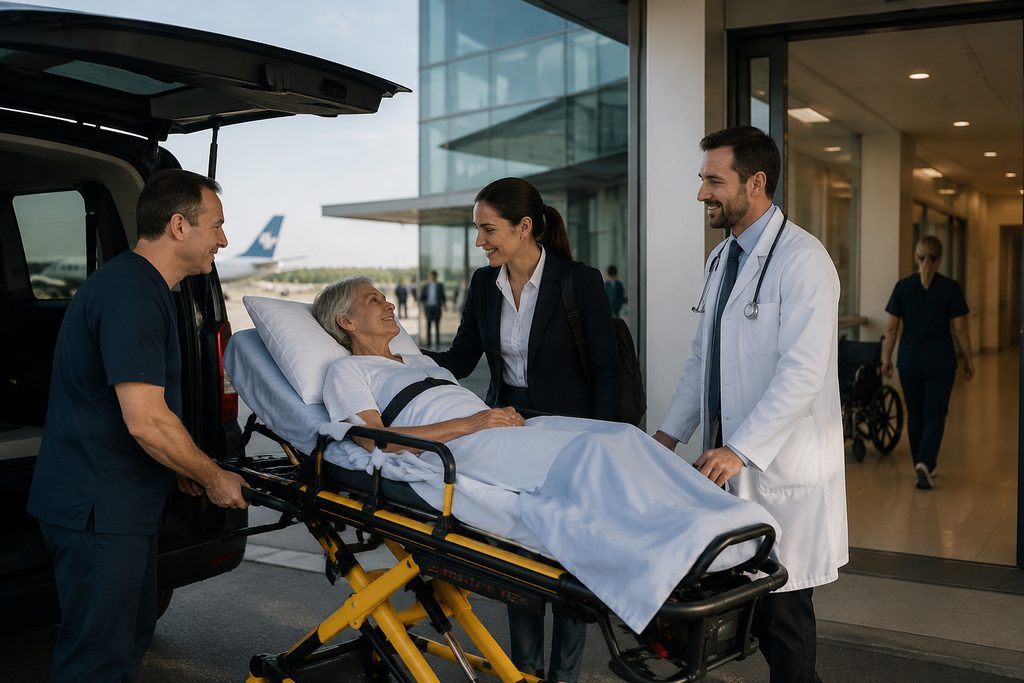
A genuine bed-to-bed transfer covers every step from discharge at the originating facility to admission at the destination hospital. It is not an air ambulance booking. It is not a medical tourism package that drops you at the airport. The full scope includes clinical handover documentation, visa processing with the correct medical annotations, ground transport at both ends, admission pre-clearance, inpatient bed reservation through the hospital’s international department, and continuous bilingual accompaniment throughout the inpatient stay.
Most patients discover the gaps only after something breaks. A visa application gets rejected because the invitation letter from the Chinese hospital lacks the required stamp. A scheduled admission gets delayed because the international department requires an in-person specialist consultation before approving the bed. These are not rare edge cases. They are the default experience for anyone attempting this independently.
Our team has managed these transfers for patients from over 15 countries. We do not provide clinical care. We are not a hospital. We are the operational layer that connects international patients with China’s top-tier medical institutions — handling the documentation, scheduling, translation, and on-ground support that the hospitals’ international departments require but cannot staff for every incoming patient.
How Does Bed to Bed Medical Transfer to China Work
The process follows a sequence that surprises many first-time patients. It starts weeks before any flight is booked.
Step 1: Clinical Assessment and Hospital Matching
We begin with your existing medical records — imaging, pathology reports, treatment history, and the referring physician’s summary. Our team translates these documents into clinical Chinese and submits them to the international departments of hospitals matched to your condition. This is not a generic submission. Different hospitals have different documentation requirements, and incomplete submissions get ignored.
We draw from a database of 340+ top-ranked hospitals across 37 cities, including institutions on the Fudan University Hospital Ranking and those with Joint Commission International accreditation. For cardiac cases, we may recommend specialized centers like Fuwai Hospital, which performs more cardiac surgeries annually than any other center globally. For oncology, hospitals ranked among China’s top 10 for cancer care by the Fudan specialist reputation survey become the focus.
Step 2: Specialist Consultation — The Non-Negotiable Gate
Here is a fact that every patient must understand. Chinese public hospitals do not allow remote booking of inpatient beds or surgeries. The specialist must see the patient in person during an outpatient consultation before any admission or surgical scheduling can proceed. This is not a policy we can bypass. It is the structural reality of China’s hospital system.
What we do is coordinate that initial consultation through the hospital’s international department or VIP channel. This means a confirmed appointment with a senior specialist, not a general queue number. The consultation happens within days of arrival, not weeks. From there, the specialist determines the admission timeline, required pre-operative tests, and surgery date. Our coordination fee for this process starts from $800, and if we cannot secure the appointment as confirmed, the fee is refunded in full.
Step 3: Visa Processing — S2, Not M
Medical treatment in China requires an S2 visa annotated for medical purposes. The accompanying family member applies for the same S2 category. This is specific and non-negotiable. An M visa is for commercial activities and will be rejected if the stated purpose is medical treatment. We have seen this mistake cost patients weeks of delay.
The application requires an invitation letter from the Chinese hospital. Not a generic letter. It must come from the hospital’s official international department, bear the appropriate institutional stamp, and specify the treatment purpose. We coordinate directly with the hospital to obtain this documentation and guide you through the consular submission process.
Step 4: Ground Transport and Admission
On arrival, our bilingual medical companion meets the patient at the airport. This is not a driver. This is a trained coordinator who handles hospital registration, payment deposits, ward navigation, and real-time translation with nursing staff. The companion stays through the admission process until the patient is settled in the inpatient bed. Daily accompaniment during the hospital stay is available from $200 per day.
International Hospital Transfer Service China Price: A Transparent Breakdown
The international hospital transfer service China price varies significantly depending on the level of coordination required and the hospital selected. What follows are reference ranges based on actual cases we have managed. Every final quote depends on the specific hospital, case complexity, and specialist availability.
| Service Component | Price Range (USD) | What It Covers |
|---|---|---|
| Hospital Appointment Coordination | from $300 | Medical record translation, international department liaison, outpatient specialist appointment confirmation |
| In-Person Specialist Consultation Coordination | $800 – 1,200 | VIP/senior specialist appointment, on-site bilingual accompaniment, real-time interpretation during consultation |
| VIP End-to-End Coordination | $5,000 – 8,000 | Full journey management: pre-arrival documentation, visa invitation letter, airport transfer, admission coordination, daily bilingual companion, discharge planning |
| Bilingual Medical Companion (daily) | from $200/day | Inpatient accompaniment, nurse communication, meal ordering, family liaison, discharge paperwork |
| Airport Transfer (round-trip) | $200 | Private vehicle, airport meet-and-greet, hospital drop-off and return |
These coordination fees are separate from hospital treatment charges. The treatment itself — surgery, hospitalization, medications — is paid directly to the hospital. A cardiac bypass procedure at a top public hospital in Beijing or Shanghai typically ranges from $12,000 to $20,000. The same procedure in the United States averages over $120,000. The cost advantage is structural, not a reflection of quality differences.
For patients who begin with a remote video consultation or written second opinion, any fees paid for those services are credited in full toward on-the-ground coordination if the patient proceeds with treatment in China within 90 days. This applies to the coordination fee only, never to hospital treatment charges.
Best Hospital to Hospital Transfer Companies China: What to Look For
Searching for the best hospital to hospital transfer companies China returns a mix of medical tourism agencies, air ambulance operators, and logistics firms. Most handle one piece of the puzzle. Very few manage the full chain from originating hospital discharge to destination hospital admission with clinical continuity intact.
A competent transfer partner should demonstrate three capabilities. First, direct relationships with hospital international departments — not just a phone number, but a documented history of successful patient admissions. Second, in-house bilingual medical staff who can read clinical Chinese and communicate with nursing teams in real time. Third, transparent pricing that separates coordination fees from hospital charges, with clear refund terms if appointments cannot be secured.
Ask any prospective provider how many patients they have transferred to your target hospital in the past year. Ask what happens if the specialist consultation does not lead to the expected treatment plan. Ask whether their companion stays with the patient through the entire first day of admission or leaves after registration. The answers reveal whether you are dealing with a coordination service or a referral agent.
What Is Included in Medical Transfer Package to Shanghai
Shanghai concentrates 18 of China’s Fudan-ranked top 100 hospitals, including Zhongshan Hospital, Ruijin Hospital, and Huashan Hospital. A comprehensive medical transfer package to Shanghai should cover the following elements as a minimum.
Pre-arrival: clinical document translation into Chinese, hospital selection based on your specific condition, submission to the international department, and confirmation of a specialist outpatient appointment. Visa support: the official hospital invitation letter required for the S2 medical visa application. Arrival: airport meet-and-greet, private transfer to the hospital, accompaniment through the registration and payment deposit process. Inpatient phase: daily bilingual companion presence, communication with the ward nursing team, coordination of any additional tests or consultations ordered by the specialist. Discharge: medication instructions translated into English, follow-up appointment scheduling, and transfer back to the airport or recovery accommodation.
What is typically not included: the hospital’s own treatment charges, international airfare, accommodation for accompanying family members, and any post-discharge rehabilitation services outside the hospital. These are arranged separately and paid directly to the relevant providers.
Book Full Coordination Medical Transport to Beijing
Beijing hosts 21 of China’s top 100 hospitals — the highest concentration in the country. Institutions like Peking Union Medical College Hospital, Fuwai Hospital, and Peking University Third Hospital attract international patients seeking complex cardiac, neurological, and orthopedic care.
To book full coordination medical transport to Beijing, the process begins with a detailed case review. We need your complete medical file — not a summary, but the full clinical documentation including imaging on disc, pathology slides where relevant, and the referring physician’s treatment notes. Our team translates these materials and submits them to the international department of the hospital best matched to your condition.
The timeline from initial contact to arrival in Beijing typically spans two to four weeks. The longest variable is the hospital’s internal scheduling of the specialist consultation. We cannot accelerate that process, but we can ensure your submission is complete and prioritized. Once the appointment is confirmed, we coordinate the visa invitation letter, book the consultation date, and arrange all ground logistics. The patient travels to Beijing, attends the specialist consultation — with our bilingual companion present — and the specialist determines the admission and treatment plan from there.
Beijing’s hospitals operate on a scale that can feel overwhelming. A single outpatient building may process 10,000 patients daily. Without a companion who knows the physical layout, the registration流程, and the payment counters, a foreign patient can spend hours lost in corridors. This is not a reflection of disorganization. It is a function of volume. Our companion’s job is to make that volume invisible to you.
JCI Accredited Hospital Transfer Service China Cost
Joint Commission International accreditation provides an externally audited standard for hospital quality and patient safety. For international patients, JCI accreditation signals that a hospital operates with protocols, documentation standards, and safety practices comparable to Western institutions.
The JCI accredited hospital transfer service China cost tends to run higher than transfers to public hospitals without JCI accreditation, for two reasons. First, JCI-accredited hospitals in China are predominantly private international facilities — United Family Healthcare, Jiahui International Hospital, ParkwayHealth — where treatment charges are higher than public hospital international departments. Second, these hospitals often handle direct insurance billing, which simplifies the payment process but comes with higher base pricing.
A transfer coordinated to a JCI-accredited private hospital in Shanghai or Beijing typically involves the same coordination fees outlined above, but the hospital’s own treatment charges may be 1.5 to 3 times higher than a public hospital’s international department. The trade-off is a more Western-style care environment with English-speaking clinical staff throughout, not just in the international liaison office. For patients with comprehensive international insurance that covers treatment in JCI-accredited facilities abroad, this route can mean minimal out-of-pocket treatment costs beyond the coordination service fees.
Public hospitals with JCI accreditation do exist in China, though they are fewer. Some top-ranked public institutions have sought JCI accreditation for specific departments or facilities. We can identify these options during the hospital matching process if JCI accreditation is a requirement for your insurance coverage or personal preference.
The Structural Barriers You Will Face Without Coordination
Attempting a bed-to-bed transfer independently means confronting several barriers that coordination services exist to absorb.
Language is the most obvious but not the most difficult. Chinese public hospitals operate almost entirely in Mandarin. Medical records, consent forms, nursing instructions, pharmacy labels — none of it will be in English. A translation app cannot handle clinical terminology reliably, and it certainly cannot advocate for you with a ward nurse at 2 a.m. when post-operative pain management needs adjustment.
Payment systems present a harder problem. Public hospitals require upfront deposit payments before admission. International credit cards are not universally accepted at hospital cashier counters. Wire transfers can take days to clear. The deposit amount is not always communicated clearly in advance, and under-depositing can delay admission or interrupt treatment. We handle deposit coordination and can advise on the payment methods that work at each specific hospital.
Medical documentation standards differ between China and Western countries. A discharge summary from a UK hospital does not automatically satisfy a Chinese specialist’s requirements for pre-admission review. Missing elements — a specific imaging sequence, a pathology stain, a particular lab value — can cause the specialist to order repeat testing before proceeding. Our document review process identifies these gaps before submission, reducing the likelihood of delays after arrival.
But perhaps the most underestimated barrier is simply navigating the physical environment. A top Chinese hospital’s outpatient building can be the size of a Western shopping mall, with registration counters on one floor, consultation rooms on another, payment windows on a third, and the pharmacy in a separate building. Signage is primarily in Chinese. Queue numbers are called in Mandarin. A patient who is already unwell, possibly in pain, and unfamiliar with the system will find this exhausting and disorienting. Our companion absorbs that friction.
Frequently Asked Questions
No. Chinese public hospitals require an in-person specialist consultation before any inpatient admission or surgical scheduling can occur. This is a universal rule. What we can do is secure a confirmed specialist appointment through the hospital’s international department, so you arrive with a scheduled consultation rather than joining a general queue. The specialist determines the admission timeline during that consultation.
This happens. The specialist’s recommendation is based on their clinical assessment, not on the treatment plan you arrived with. If the recommended approach differs significantly from what you anticipated, our companion helps facilitate a thorough discussion — ensuring you understand the clinical reasoning, the alternatives, and the expected outcomes. You are never obligated to proceed with treatment. The coordination fees for services already delivered are non-refundable, but you retain full control over your medical decisions.
Most international patients pay hospital charges directly and then seek reimbursement from their insurer. We provide all documentation required for insurance claims — itemized hospital invoices, treatment summaries in English, and admission/discharge records. Some JCI-accredited private hospitals in China offer direct billing arrangements with major international insurers. We can identify these hospitals during the matching process if insurance compatibility is a priority.
We coordinate a written discharge summary in English that includes the full treatment record, medication regimen, and recommended follow-up schedule. This document is designed to be handed directly to your primary care physician or local specialist. If a follow-up video consultation with the treating Chinese specialist is needed, we can arrange that — fees range from $100 to $800 depending on the specialist’s seniority. Any post-operative complications should be managed by your local medical team, with the Chinese specialist available for remote consultation as needed.
Your Next Step
A bed-to-bed international transfer to a top Chinese hospital is logistically demanding but clinically sound. The hospitals exist. The expertise is real. The cost advantage is documented. What stands between a patient and successful treatment is not quality of care — it is the coordination layer that most patients do not know they need until they are already struggling.
If you are considering treatment in China, start with a case review. Send us your medical records. We will assess which hospitals match your condition, confirm specialist availability, and give you a clear picture of timelines and costs — coordination and treatment — before you commit to anything. Request a free consultation to begin that conversation. No pressure. No pitch. Just the information you need to make a sound decision.
For more medical information and treatment options in China, visit chinamedservices.com (China Medical Services).
