Cancer Hospital CAMS Medical Oncology for International Patients: A Practical Guide
According to the National Cancer Center of China, the country records approximately 4.82 million new cancer cases annually. That staggering volume drives a level of clinical repetition few Western centers can match. For international patients, the question is not whether China treats cancer well. It is whether the system is navigable. The CAMS cancer hospital cost for foreigners is a legitimate starting point, but the deeper issue is fit, access, and expectation management. This article breaks down what the Cancer Hospital Chinese Academy of Medical Sciences (CAMS) actually offers medical oncology patients from abroad, what it costs, and how the process works in practice.
Cancer Hospital CAMS Medical Oncology for International Patients: The Short Answer
CAMS operates one of the most experienced medical oncology departments in China. Its parent institution, the Chinese Academy of Medical Sciences, is the national center for cancer research and clinical care. For a foreign patient, the hospital can deliver world-class chemotherapy, targeted therapy, and immunotherapy protocols. But getting in the door requires navigating a system built for domestic patients first. You cannot simply book a first appointment online from New York or London. You need documents, a strategy, and often a local coordinator.
That is the honest tension. The clinical quality is real. The administrative friction is equally real.
Who This Is Right For — and Who It Isn’t
CAMS makes sense for a specific profile of international patient. It is not a universal solution.
Typically a good fit:
- Patients with a confirmed diagnosis and complete pathology reports, imaging, and treatment history
- Those seeking a second opinion on a complex or rare cancer where high case volume matters
- Patients who have exhausted standard options at home and want access to clinical trials or alternative chemotherapy regimens
- Families with a budget for private or international-department coordination, or fluency in Mandarin
- Patients from regions where oncology care is limited or wait times exceed what their disease allows
Who should not pursue this:
- Patients without a confirmed tissue diagnosis — CAMS will not start treatment on suspicion alone
- Those in acute crisis requiring immediate ICU-level stabilization; travel itself poses risk
- Patients expecting a US or European private-hospital experience; CAMS is a high-volume public institution
- Anyone unwilling to accept that no one can guarantee a specific oncologist or an exact treatment start date
If you are medically stable and have your records in order, CAMS is a serious option. If you are unstable or expect concierge-level autonomy, reconsider.
The Options, Compared
International cancer patients weighing China against other destinations need concrete numbers, not adjectives. Here is how CAMS stacks up against typical alternatives for medical oncology.
| Factor | CAMS (Beijing) | US Academic Center | Private Hospital in China (e.g., United Family) |
|---|---|---|---|
| Medical oncology expertise | Top 10 nationally in Fudan oncology rankings | High, with strong research base | Variable; often relies on part-time senior consultants |
| Case volume | Very high; daily outpatient volume exceeds 3,000 | Moderate to high | Low to moderate |
| Cost for 6 cycles of standard chemo | $15,000–$40,000 (varies by regimen) | $80,000–$150,000+ | $50,000–$90,000 |
| Language support | Limited in public wards; better via international department | Native English | Strong English support |
| Insurance direct billing | Rare; typically pay upfront and claim | Common | Common |
| Access to clinical trials | Extensive; many domestic trials | Extensive | Limited |
The right column depends on your priorities. If you want the lowest cost with high clinical volume, CAMS wins. If you need insurance simplicity and English everywhere, a private hospital in China or staying in the US makes more sense. Many patients use CAMS for the treatment plan and a private facility for execution. That hybrid approach is increasingly common.
What “Medical Oncology at CAMS” Actually Means
Medical oncology at the Cancer Hospital CAMS is not a single department in the Western sense. It is a network of subspecialty wards organized by cancer type — lung, breast, gastrointestinal, lymphoma, and others. Each ward runs its own protocols, tumor boards, and clinical trial portfolios. A patient with stage IV lung cancer is not seeing a general oncologist. They are seeing a thoracic medical oncology team that treats hundreds of similar cases every month.
That specialization is the core value proposition. But it also means your records must be complete enough to route you to the correct ward on the first attempt. Missing a molecular pathology report can delay everything by weeks.
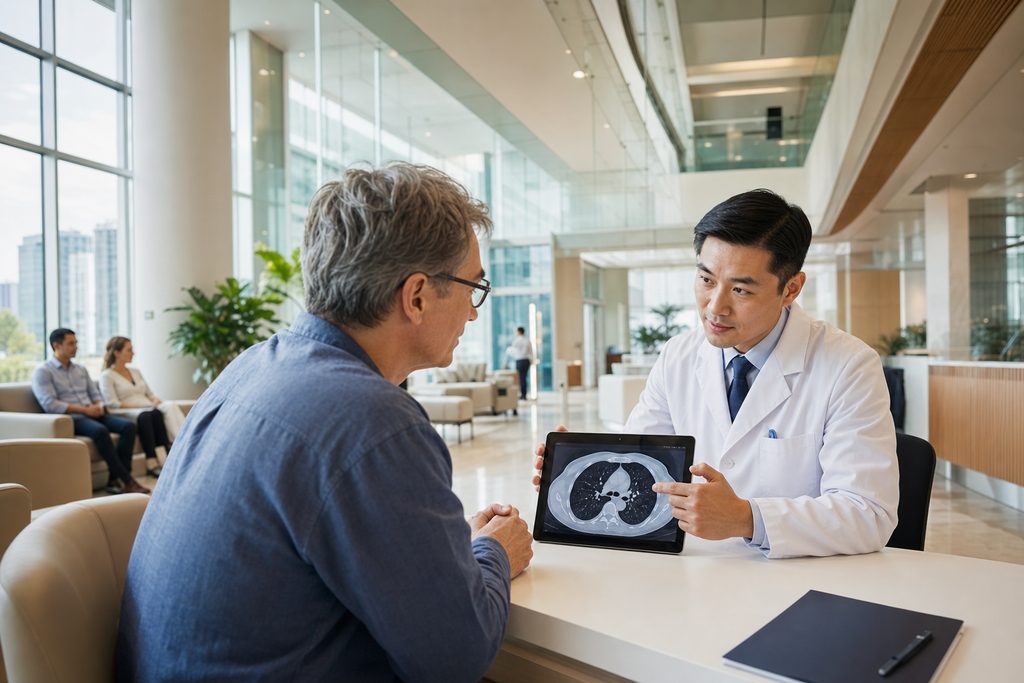
So what does a typical first visit look like? You arrive with translated records. The oncologist reviews them, orders any missing tests — often repeat imaging or bloodwork — and then issues a written treatment recommendation. This is not a quick 15-minute consult. Expect a half-day or full-day process.
Is CAMS Hospital Good for International Cancer Patients?
The short answer is yes, with conditions. CAMS ranks among China’s top oncology institutions in the Fudan specialty reputation rankings. Its clinicians publish in major international journals. Its tumor boards include surgeons, radiation oncologists, pathologists, and medical oncologists. For many cancers, the treatment protocols align with NCCN and ESMO guidelines.
But “good for international patients” is a different question than “good at oncology.” The hospital’s default operating model assumes Mandarin-speaking patients who can navigate a complex, high-volume public system. Registration kiosks, lab queues, pharmacy pickup — all of it runs in Chinese. The international department exists, and it helps, but it does not transform CAMS into a Western-style facility.
What makes CAMS genuinely good for foreigners is the depth of clinical experience at a fraction of Western prices. What makes it hard is everything around the medicine.
CAMS Cancer Hospital Cost for Foreigners: What to Budget
Let’s talk numbers. The CAMS cancer hospital cost for foreigners depends heavily on cancer type, stage, regimen, and whether you go through the public channel or the international department. Public-channel pricing is the same for domestic and foreign patients in principle, but foreigners are typically routed to the international department, which carries higher fees.
Typical ranges for common scenarios:
- Initial consultation with a senior oncologist: $50–$150 (public) or $200–$500 (international department)
- Standard chemotherapy cycle (drugs + administration): $2,500–$8,000 per cycle
- Targeted therapy per month: $3,000–$12,000 depending on the drug
- Immunotherapy (PD-1/PD-L1 inhibitors) per cycle: $2,000–$6,000
- PET-CT scan: $800–$1,200
- Comprehensive genomic profiling: $1,500–$3,000
These figures are estimates. Actual costs vary by hospital and case complexity, and drug prices change frequently. A six-month treatment course for metastatic cancer at CAMS might run $30,000–$70,000. The same course in the US could exceed $200,000. That gap is the reason most international patients make the trip.
How to Get Cancer Treatment at CAMS Hospital Beijing
The process is sequential, and skipping steps causes delays.
Step 1: Prepare your medical records. You need pathology reports, imaging (CDs or DICOM files), surgical notes, treatment summaries, and a current medication list. Translate everything into Chinese. A certified medical translator is worth the cost.
Step 2: Choose your route. You can contact the hospital’s international department directly, or work with a coordinator who handles registration, document submission, and appointment scheduling. Direct contact is possible but slow. Coordinators do not give you medical priority — they reduce administrative friction.
Step 3: Submit for review. The oncology department reviews your records and decides whether to accept your case. Acceptance is not guaranteed. Some patients are declined because the cancer is too advanced for meaningful intervention, or because the department lacks a relevant clinical trial.
Step 4: Travel and first visit. You come to Beijing, attend the consultation, and receive a written treatment plan. If additional tests are needed, expect several days before treatment begins.
Step 5: Begin treatment. Chemotherapy, targeted therapy, or immunotherapy starts only after the oncologist confirms the plan and you complete payment. Public hospitals in China require prepayment. International departments may accept credit cards; public wards often require cash or Chinese bank transfers.
Medical Oncology Price China International Patients: What’s Included and What’s Not
The headline price for medical oncology price China international patients see quoted usually covers only the medical service itself — the drug, the infusion, the oncologist’s fee. It does not cover:
- Translation of medical records before arrival
- Visa application fees
- Flights and accommodation in Beijing
- Daily living expenses during treatment
- Interpreter or companion services during hospital visits
- Follow-up care after returning home
This is not a hidden-fee situation. It is simply how Chinese public hospitals operate. The medical bill is one line item in a much larger travel-and-treatment budget. Patients who plan only for the medical cost are consistently surprised by the total.
And insurance matters. Most Chinese public hospitals, including CAMS, do not bill international insurers directly. You pay first, then claim reimbursement. Check your policy’s out-of-network and international treatment clauses before committing.
Practical Considerations: Records, Visa, Payment, and Follow-Up
Records and documentation. Incomplete records are the single biggest source of delay. Bring original pathology slides if possible — CAMS pathologists often want to re-read them. Digital copies of everything are essential. Paper originals help.
Visa category. Foreigners traveling to China for medical treatment typically apply for an S2 visa, which covers short-term private affairs including medical care. Accompanying family members also apply for S2. Stays longer than 180 days require an S1 visa. The hospital provides a treatment invitation letter that supports the visa application. The M visa is for commercial and trade activities and is not appropriate for medical travel. Visa requirements change, so confirm with the nearest Chinese embassy or consulate before booking flights.
Payment methods. International departments generally accept major credit cards. Public wards may require payment via Chinese bank card, WeChat Pay, or Alipay — none of which are straightforward for foreigners without local bank accounts. Plan accordingly.
Language. English-speaking staff exist in the international department but are not guaranteed in every interaction. Radiology, pharmacy, and nursing stations often operate in Chinese only. A bilingual companion or coordinator changes the experience dramatically.
Follow-up after returning home. Your CAMS oncologist will provide a written summary and treatment plan in Chinese. You will need it translated back into English for your home oncologist. Ongoing communication with CAMS after departure is possible but limited — do not expect responsive email correspondence. Get everything you need before you leave.
Frequently Asked Questions
Yes, but not through a simple online portal. You or a coordinator must contact the international department, submit translated records, and wait for departmental review. Direct booking without Chinese language ability is slow and error-prone. Many international patients use a local coordinator to handle submission and scheduling.
For standard chemotherapy regimens, CAMS typically costs 20–30% of the US price. For targeted therapy and immunotherapy, the gap narrows but remains significant — often 40–60% of US costs. The biggest savings come from high-volume generic chemotherapy drugs, which are dramatically cheaper in China. The trade-off is administrative complexity and limited insurance direct billing.
This happens frequently, especially with domestically approved targeted therapies and immunotherapy combinations that are not yet available in the US or Europe. You can receive the treatment at CAMS, but you will need to stay in Beijing for the duration. Returning home mid-regimen is possible only if your home oncologist agrees to continue the same protocol, which is not guaranteed.
Generally, no direct billing for public wards. The international department may work with some insurers, but most patients pay upfront and submit claims themselves. Confirm with your insurer before traveling. Some policies exclude treatment in China entirely.
Realistically, four to eight weeks. Record translation takes one to two weeks. Departmental review takes one to three weeks. Visa processing takes one to two weeks. Then you travel, attend the first consultation, complete any additional testing, and begin treatment. Patients who rush this timeline make mistakes in documentation that cost more time later.
Your Next Step
CAMS is a serious institution with genuine oncology depth. It is not a walk-in clinic, and it is not built for international patients by default. But with the right preparation, it offers clinical quality and cost advantages that few Western centers can match. Our team at China Medical Services helps international patients navigate exactly this process — document translation, departmental submission, appointment coordination, and bilingual support on the ground. We are not a hospital. We do not diagnose or treat. We simply reduce the friction between you and the care you are seeking. If you are considering CAMS for medical oncology, start with a conversation about your specific case and we will tell you honestly whether it makes sense.
For more medical information and treatment options in China, visit chinamedservices.com (China Medical Services).
