Full Mouth Dental Implants in China: Cost, Safety, and the Whole Journey
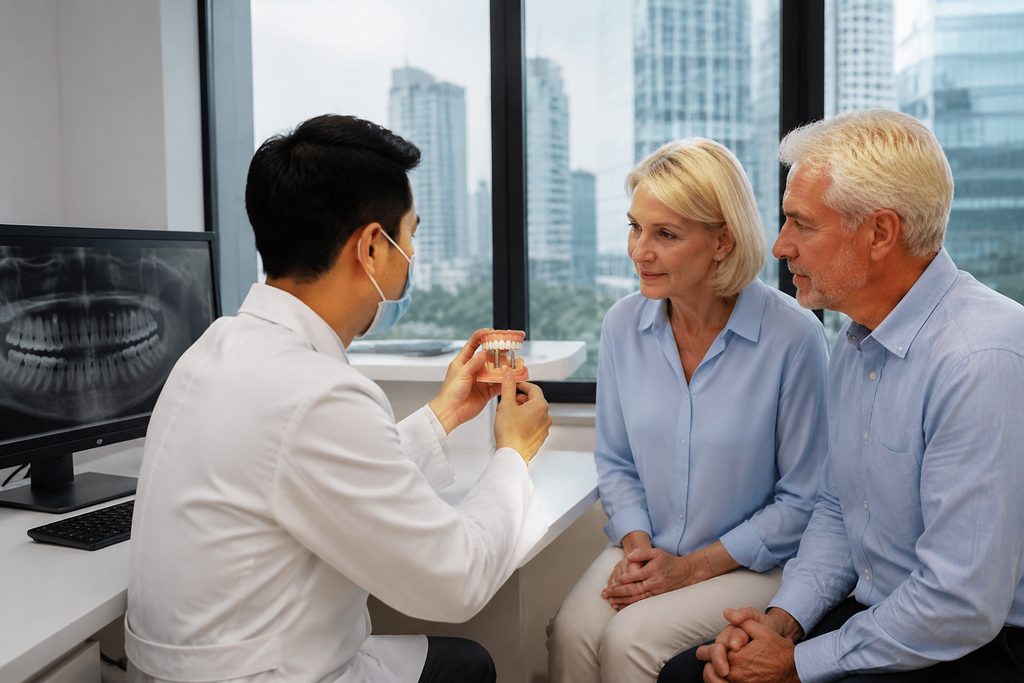
When 54-year-old Daniel from Manchester finally accepted that his remaining teeth could not be saved, the quote from his local specialist stopped him cold. Nearly £28,000 for full-arch restoration. A colleague mentioned treatment abroad. Daniel started searching and landed on the same question you are probably asking right now: what does the full mouth dental implants cost China actually look like, and can a foreigner realistically navigate the process?
The short answer is yes — and the savings are substantial. Full mouth dental implants cost China between $8,000 and $25,000 depending on the technique, materials, and hospital tier. The same procedure in the United States typically runs $45,000 to $90,000, and in the UK between £25,000 and £50,000. But price is only one part of the story. Safety protocols, implant brands, surgeon experience, and the logistics of traveling for a multi-visit procedure matter just as much.
Full Mouth Dental Implants in China: The Short Answer
A full mouth restoration in China using the All-on-4 or All-on-6 technique costs between $8,000 and $18,000 per arch at a reputable public hospital or private dental hospital. Premium clinics in Shanghai and Beijing using Swiss or German implant systems charge $18,000 to $25,000 per arch. These figures include the surgical placement, the temporary prosthesis, and in most packages, the final zirconia or acrylic bridge.
What complicates a one-line answer is the variation. A public tertiary hospital dental department will quote differently from a JCI-accredited private dental hospital. The implant brand matters enormously — Straumann, Nobel Biocare, and Osstem are all available in China, but they sit at very different price points. And the number of implants per arch changes everything: four implants for All-on-4, six for All-on-6, or eight to ten for a more traditional fixed bridge approach.
Who This Is Right For — and Who It Isn’t
Full mouth dental implants in China suit a specific profile. You are likely a good candidate if you have lost most or all of your teeth, have adequate jawbone density or are open to bone grafting, and can commit to two separate trips over a four-to-six-month period.
Good candidates typically include:
- Patients with failing dentition who have been quoted $40,000+ at home and want a fixed solution, not removable dentures
- People who already travel internationally and are comfortable with a structured medical itinerary
- Those who can take 10–14 days off for the first surgical trip and 7–10 days for the final prosthesis delivery
- Patients with controlled diabetes, no active gum infection, and a non-smoking status or willingness to quit temporarily
This is not right for everyone. You should think carefully before pursuing this if you have uncontrolled diabetes, severe osteoporosis treated with bisphosphonates, active periodontal disease, or a heavy smoking habit. These conditions directly affect osseointegration — the process where the implant fuses with bone — and raise failure rates regardless of where the surgery happens.
And if you need everything completed in a single week, full mouth implants abroad are not realistic. The bone needs time to heal around the implants before the final bridge is loaded. Some clinics advertise “same-day teeth,” but that refers to the temporary prosthesis, not the final restoration.
The Options, Compared
Not all full mouth implant approaches are equal. Here is how the main options stack up for a patient considering treatment in China:
| Option | Implants per Arch | Cost per Arch in China | Treatment Timeline | Best For |
|---|---|---|---|---|
| All-on-4 | 4 | $8,000–$14,000 | 2 trips, 4–6 months | Moderate bone loss, budget-conscious patients |
| All-on-6 | 6 | $10,000–$18,000 | 2 trips, 4–6 months | Better load distribution, more stability |
| Full fixed bridge (8–10 implants) | 8–10 | $18,000–$25,000 | 2–3 trips, 6–9 months | Maximum stability, patients with strong bone |
| Implant-supported overdenture | 2–4 | $6,000–$10,000 | 2 trips, 3–4 months | Lower cost, removable option |
The All-on-4 approach dominates the international patient market in China for a reason. Fewer implants mean lower surgical cost and less healing time. But if you have the bone volume and the budget, All-on-6 or a full fixed bridge offers measurably better long-term stability. The overdenture route works for patients who want implants to anchor a removable denture rather than a permanently fixed bridge.
Best Dental Implant Clinic Shanghai: Where Foreigners Actually Go
If you search for the best dental implant clinic Shanghai, you will find a mix of public hospital stomatology departments and private dental hospitals. The distinction matters for international patients.
Shanghai Ninth People’s Hospital, affiliated with Shanghai Jiao Tong University, operates one of the largest oral and maxillofacial surgery departments in China. Its implant volume is enormous, and its surgeons handle complex full-arch cases daily. But it is a public hospital. That means crowded waiting areas, limited English support, and a system designed for domestic patients who navigate it in Mandarin.
Private dental hospitals in Shanghai — including Jiahui Health, United Family, and Parkway-affiliated dental centers — offer English-speaking coordinators, direct insurance billing, and Western-style appointment scheduling. The trade-off is cost. Expect to pay 30–50% more at a private international dental hospital than at a top public hospital for the same implant system.
What many patients do not realize is that the implant brand matters more than the hospital name on the door. A Straumann or Nobel Biocare implant placed by a competent surgeon at a mid-tier private clinic will generally outperform a budget Korean implant placed at a top-tier public hospital. Ask every clinic the same three questions: which implant system do you use, what is the surgeon’s annual full-arch case volume, and what warranty do you provide on the prosthesis.
How Much Are Full Mouth Implants in Beijing? A Price Breakdown
The question how much are full mouth implants in Beijing deserves a precise answer, because Beijing pricing differs from Shanghai.
At Peking University School of Stomatology, the top public dental institution in northern China, a full-arch All-on-4 restoration using imported implants runs approximately $10,000 to $15,000 per arch. Private dental hospitals in Beijing’s Chaoyang district — the area most popular with expatriates — charge $14,000 to $22,000 per arch for the same clinical work, with the premium going toward English service, shorter waits, and a more comfortable environment.
What drives the variance:
- Implant system: Swiss (Straumann) and German (Bego, Ankylos) systems cost more than Korean (Osstem) or Chinese domestic brands
- Prosthesis material: zirconia bridges cost $3,000–$6,000 more per arch than acrylic hybrid bridges
- Bone grafting: if you need sinus lifts or ridge augmentation, add $1,500–$4,000 per arch
- Anesthesia: local anesthesia is standard and included; IV sedation or general anesthesia adds $500–$1,500
One thing to understand clearly: Chinese public hospitals require prepayment for surgical procedures. Private international hospitals may bill your insurer directly if you have a plan that covers overseas dental work, but most dental insurance plans do not. Budget as if you are paying out of pocket, and treat any insurance reimbursement as a bonus.
Is Full Mouth Dental Implant Safe in China?
The question is full mouth dental implant safe in China deserves a straight answer. Yes — at the right facility, with the right surgeon, using the right implant system. And no, if you choose purely on price.
China’s top dental hospitals perform full-arch implant surgeries at a scale that few Western institutions match. A single oral surgery department at a major Chinese hospital may complete more full-arch cases in a month than a typical Western dental practice completes in a year. Volume builds competence. That is the argument for China.
But the regulatory landscape is uneven. China’s medical device approval process for dental implants is rigorous for imported systems — Straumann and Nobel Biocare implants sold in China are the same products sold in Europe and the US. The risk lies not in counterfeit implants, which are rare at licensed hospitals, but in clinics that cut corners on sterilization protocols or use undertrained surgeons for complex cases.
What you can do to protect yourself:
- Verify the hospital’s license through the National Health Commission database
- Ask for the surgeon’s specific full-arch case volume, not the department’s total
- Confirm the implant system’s serial number and verify it with the manufacturer
- Request a written treatment plan with implant brand, number, and prosthesis material specified
- Check whether the clinic has JCI accreditation or a dedicated international patient department
None of this replaces your own due diligence. But it reduces the risk substantially.
All on 4 Dental Implants China Price: What the Package Includes
When you research all on 4 dental implants China price, you will see package deals advertised from $8,000 per arch. What does that actually include?
A legitimate full-arch package at a reputable Chinese dental hospital typically covers:
- Pre-operative CBCT scan and treatment planning
- Surgical placement of four implants per arch
- Any necessary extractions of remaining teeth
- Temporary fixed prosthesis fitted on the day of surgery
- Final prosthesis delivered after the healing period
- Standard post-operative medications and follow-up visits
What it often does not include:
- Bone grafting or sinus lift if required
- Premium implant brands (package prices usually assume mid-tier brands)
- Zirconia final prosthesis (packages typically include acrylic hybrid)
- IV sedation or general anesthesia
- Your flights, accommodation, and local transport
- Complications requiring additional surgery
This is where a medical coordinator earns their fee. We review package inclusions line by line with the hospital before you commit, so you know exactly what you are paying for and what might be added later.
Book Full Mouth Dental Implants China Package: The Two-Trip Reality
If you are searching for a way to book full mouth dental implants China package, understand the timeline before you book anything.
Trip one — surgery: You arrive in China, typically for 10–14 days. Day one is the consultation and CBCT scan. Day two or three is the surgical placement of implants and fitting of the temporary bridge. The remaining days allow for post-operative checks and any adjustments. You fly home with a fixed temporary prosthesis and a healing period ahead.
The healing gap: Four to six months. During this time, the implants osseointegrate with your jawbone. You eat a soft diet and maintain careful oral hygiene. This happens at home, not in China.
Trip two — final prosthesis: You return for 7–10 days. The clinic takes impressions, fabricates the final bridge, and fits it. Adjustments happen over a few visits. You fly home with your permanent restoration.
Some clinics offer immediate-load protocols where the final prosthesis is fitted on the same trip, but this is only suitable for select cases with excellent bone quality. Do not let anyone promise you a one-trip full mouth restoration without a thorough CBCT review first.
Practical Considerations: Visas, Records, and Payment
Traveling to China for dental treatment involves more than booking a flight. Here is what you need to handle.
Visa: Foreign nationals traveling to China for medical treatment apply for an S2 visa, which covers short-term private affairs including medical care. You will need a supporting letter from the treating hospital confirming your appointment and treatment plan. Your companion, if traveling with you, also applies for an S2 visa. Processing times vary by embassy, so start the visa process at least six to eight weeks before your planned surgery date.
Records: Bring recent panoramic X-rays or a CBCT scan from your home dentist. These allow the Chinese clinic to do a preliminary assessment before you travel. If your records are older than six months, expect to repeat imaging in China — and budget for that.
Payment: Chinese hospitals require prepayment for surgical procedures. International bank transfers work, as do major credit cards at private hospitals. Public hospitals may require payment through Chinese banking channels, which is one reason many international patients choose private dental hospitals. Confirm the payment method before you commit.
Language: Public hospital dental departments operate almost entirely in Mandarin. Private international dental hospitals have English-speaking staff. If you choose a public hospital for cost reasons, a bilingual medical companion becomes essential — not a luxury.
Follow-up: After you return home, your local dentist can handle routine maintenance and any minor adjustments. The Chinese clinic should provide a written warranty on the implants and prosthesis, typically 5–10 years on implants and 1–3 years on the prosthesis. Confirm the warranty terms in writing before treatment.
Frequently Asked Questions
For both upper and lower arches, expect $16,000 to $36,000 using the All-on-4 or All-on-6 technique at a reputable Chinese dental hospital. Premium clinics using Swiss implant systems and zirconia prostheses can reach $50,000 for both arches. The same treatment in the US typically costs $45,000 to $90,000.
Plan for two separate trips. The first trip lasts 10–14 days for surgery and the temporary prosthesis. The second trip, 4–6 months later, lasts 7–10 days for the final bridge. Some patients combine the second trip with a holiday, but the medical appointments themselves require about a week.
Implant failure rates for full-arch restorations in China at reputable hospitals are comparable to Western rates — roughly 2–5% over ten years. If an implant fails, the standard remedy is removal and replacement, often at reduced or no cost under the clinic’s warranty. But you would need to return to China for the replacement surgery. Ask about the clinic’s specific failure policy and warranty terms before you commit.
Most dental insurance plans do not cover overseas treatment, and full mouth implants are rarely covered even domestically. Some international health insurance plans with dental riders may reimburse part of the cost. Private international hospitals in China can provide itemized invoices for insurance claims. Budget as a self-pay patient and treat any reimbursement as unexpected good news.
At a top-tier Chinese dental hospital or JCI-accredited private dental hospital, the clinical safety standards are comparable to Western institutions. The key variables are surgeon experience, implant brand, and sterilization protocols — all of which you can verify before committing. The risk profile changes if you choose a clinic based on price alone. Due diligence matters more than geography.
Your Next Step
Full mouth dental implants in China offer genuine savings without compromising clinical quality — if you choose the right facility and understand the process. The patients who have the best outcomes are the ones who ask hard questions before they book a flight.
We help international patients navigate the Chinese dental system. We are not a hospital, we do not perform treatment, and we do not give medical advice. What we do is connect you with accredited dental hospitals, coordinate appointments, arrange bilingual support, and make sure you understand every line of your treatment plan before you commit. Start with a free consultation at our patient services page — tell us your situation, and we will tell you honestly whether China makes sense for you.
The decision to replace all your teeth is big enough. The logistics should not be the hard part.
For more medical information and treatment options in China, visit chinamedservices.com (China Medical Services).
