Dental Implants China Australia: Full Mouth Access Without the Wait
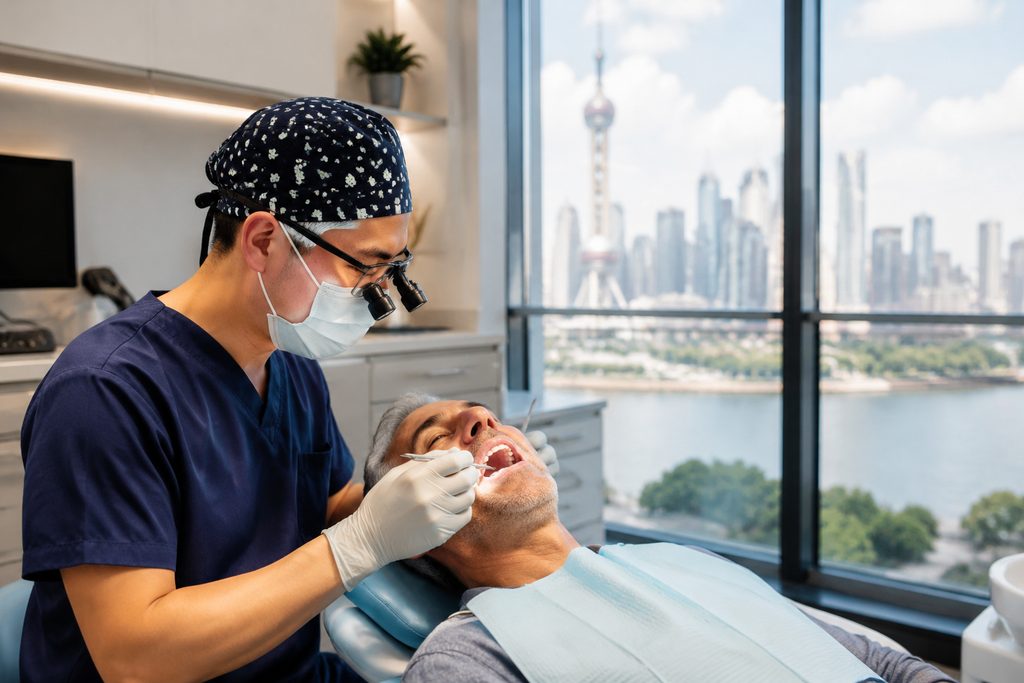
You have probably been quoted a figure in Australia that made you sit down. A full arch restoration — $45,000 to $70,000 per jaw. A complete mouth, double that. And then someone mentioned China. Not as a punchline about manufacturing, but as a genuine destination for implantology. The immediate reflex is skepticism. Cheap dentistry abroad. We have all heard the horror stories. But the reflex misses a structural shift. China’s top-tier dental hospitals now run digital workflows, immediate-load protocols, and lab systems that rival anything in Melbourne or Sydney. The price difference is not about cutting corners. It is about volume, lower operating costs, and a system built to move fast.
Full Mouth Dental Implants Cost China: The Short Answer
A full arch restoration in a reputable Chinese hospital costs between $8,000 and $25,000 per jaw. That is all-on-4 or all-on-6, including the surgical placement and the fixed acrylic or porcelain bridge. A complete mouth runs $16,000 to $45,000. These are real, verifiable ranges from university-affiliated stomatology hospitals and JCI-accredited private clinics. The equivalent in Australia sits between $45,000 and $70,000 per arch. So the savings are substantial. But the short answer hides what actually determines whether this works for you. The price you end up paying hinges on bone volume, the implant system used, the material of the final prosthesis, and whether you need extensive grafting or sinus lifts. A $16,000 quote can become $30,000 fast if your CT scan shows significant maxillary atrophy. Anyone quoting a flat fee before seeing a CBCT is guessing.
Who This Is Right For — and Who It Isn’t
This path makes sense for a specific person. Someone who needs full mouth rehabilitation, has been told they are a candidate for all-on-4 or all-on-6, and is facing a bill at home that means delaying treatment by years. The math is straightforward. Fly to China, stay two to three weeks, get provisional teeth fixed on implants the same day, and fly home with a functioning smile. Return once for the final prosthesis or have it shipped if your local dentist agrees to fit it.
Good candidates typically have adequate bone volume in the anterior maxilla and mandible, are non-smokers or willing to quit for the healing period, and have controlled systemic conditions. They are also people comfortable with remote planning and follow-up.
Who should not do this. Anyone with uncontrolled diabetes or severe immunocompromise. Heavy smokers who cannot stop. Patients with severe bruxism that has not been managed. People who need complex zygomatic implants or extensive grafting that requires multiple staged surgeries over many months — the travel logistics become punishing. And anyone who expects a seamless handover to their local dentist with no friction. Australian dentists may be reluctant to take over care for work done abroad. You need to have that conversation before you leave, not after you return with a complication.
The Options, Compared
The choice is not just China versus Australia. It is about which implant system, which prosthetic material, and which clinical pathway.
| Factor | China — University Hospital | China — Private International Clinic | Australia — Private Practice |
|---|---|---|---|
| Cost per arch (all-on-4) | $8,000 – $15,000 | $18,000 – $25,000 | $45,000 – $70,000 |
| Implant brands used | Straumann, Nobel Biocare, domestic (WEGO, Trausim) | Straumann, Nobel Biocare, Zimmer | Straumann, Nobel Biocare, NeoBiotech |
| Prosthetic material | Acrylic hybrid, porcelain-fused-to-metal | Monolithic zirconia, porcelain hybrid | Zirconia, porcelain hybrid |
| Typical stay required | 10–14 days for provisional | 10–14 days for provisional | Multiple visits over 6–12 months |
| English-speaking staff | Limited; interpreter needed | Fluent; international patient coordinators | Native |
| Warranty on implants | Varies; often manufacturer warranty only | Clinic warranty, typically 5–10 years | Clinic warranty, 5–15 years |
The university hospital route saves the most money. But you will navigate a system not designed for foreigners. That means longer waits, less English, and a clinical environment that feels busy rather than boutique. Private international clinics in Shanghai, Beijing, and Guangzhou bridge the gap. They charge more — roughly double the public option — but provide coordinators, English documentation, and a patient experience closer to what you expect at home. The premium is still a fraction of Australian private fees.
All on 4 Dental Implants Price China vs Australia: Why the Gap Exists
The price difference is not mysterious. Australian dental fees reflect labor costs, regulatory overhead, indemnity insurance, and a market where specialists command high hourly rates. A prosthodontist in Sydney bills $400 to $600 per hour. A lab technician fabricating a full arch zirconia bridge charges thousands. Rent in a medical-grade building in a major city is punishing. China’s stomatology hospitals operate at scale. The Ninth People’s Hospital in Shanghai, affiliated with Shanghai Jiao Tong University, handles a volume of implant cases that dwarfs any Australian practice. Their implantology department places thousands of fixtures annually. That volume drives down per-unit costs for implants and prosthetic components. Labs run 24-hour shifts. Digital workflows — intraoral scanning, CAD/CAM milling, 3D-printed surgical guides — are standard equipment, not premium add-ons.
And then there is the implant brand question. Many Chinese hospitals use Straumann or Nobel Biocare, the same Swiss and Swedish systems used in Australia. The cost for the implant fixture itself is similar worldwide. The difference is what gets charged on top. Some clinics also offer domestic implant systems like WEGO or Trausim, which are clinically documented and cost significantly less. If a quote seems too low, ask which implant brand is being proposed. A full arch on domestic implants can come in under $10,000. The same arch on Straumann Pro Arch might be $18,000. Both can work. The decision should be made with your surgeon, not by a price list.
Dental Implants China Reviews Australian Patients: What People Actually Say
Australian patients who have done this tend to talk about the same things. The speed. The cost. And the communication gaps.
The speed surprises people. In Australia, the pathway from extraction to final prosthesis can stretch over a year. Multiple surgeries. Healing periods. Temporary dentures. In China, the immediate-load protocol is the default for qualifying patients. You arrive, have any remaining failing teeth extracted, implants placed, and a provisional fixed bridge screwed on within 24 to 48 hours. You leave with teeth. That is not a gimmick. It is a well-documented technique with high survival rates when case selection is correct.
The communication gaps frustrate people. Even in hospitals that advertise English services, the surgeon may speak limited English. The coordinator translates. Nuance gets lost. Informed consent feels different when filtered through a third party. Patients who bring a detailed treatment plan from their Australian dentist and have it reviewed remotely before travel report a smoother experience. Those who show up expecting a Western-style consultation process often feel rushed.
The cost is what everyone talks about. But the reviews that ring true mention the hidden costs. Flights. Accommodation for two trips. The cost of a local dentist willing to provide aftercare. The risk of needing a revision and having no one local to call. The savings are real, but they are not free money. They are compensation for taking on logistical complexity and clinical distance.
How Much Are Full Mouth Implants in China for Australians: The Real Numbers
Let us break down a realistic budget. Assume a private international clinic in Shanghai, all-on-6 on both arches, using Nobel Biocare implants with a monolithic zirconia final bridge.
The treatment fee: $35,000 to $45,000 total for both arches. That includes extractions, implant placement, provisional bridge, and final zirconia prosthesis. Flights from Sydney or Melbourne to Shanghai: $1,200 to $2,000 round trip in economy. Accommodation for a two-week stay: $1,500 to $3,000 depending on your standards. Two trips are typically needed — one for surgery and provisional teeth, one four to six months later for the final bridge. So double the travel costs. Add incidentals, visa fees, and meals. Total outlay: roughly $40,000 to $52,000.
Compare that to the Australian quote: $90,000 to $140,000 for the equivalent treatment using the same implant system and final material. The saving is not trivial. But it is not the “90% cheaper” figure that some marketing claims suggest. The real saving is 50% to 60% once travel is factored in.
If you choose a university hospital and accept a porcelain-fused-to-metal bridge on domestic implants, the all-in cost can drop to $20,000 to $30,000. That is where the dramatic savings live. But you trade off prosthetic aesthetics, English support, and the ease of follow-up care.
Best Dental Implant Clinic China for Overseas Patients: What to Look For
There is no single best clinic. There is the clinic that matches your priorities. If your priority is the lowest possible price with acceptable quality, a university stomatology hospital in a tier-2 city like Chengdu or Wuhan will serve you well. The clinical standards are high. The experience will be bare-bones. If your priority is a smooth, English-speaking experience with a warranty you can enforce, look at JCI-accredited private hospitals in Shanghai or Beijing. Our database of private international hospitals includes facilities with dedicated dental implant programs for overseas patients.
Verify credentials. The surgeon should be a board-certified stomatologist or oral and maxillofacial surgeon. Ask how many full arch cases they complete per year. A number below 50 should give you pause. Ask to see cases similar to yours — not just smiling photos, but CBCT scans showing implant positioning and bone integration. Ask about their prosthetic complication rate. Screw loosening, prosthesis fracture, and implant failure happen even in the best hands. A clinic that claims a 100% success rate is not being honest.
Ask about the lab. The final prosthesis is made by a dental technician, often in a separate facility. The best clinics have in-house labs or work exclusively with labs that use the same digital workflow. If the clinic sends impressions to an external lab with a two-week turnaround, that adds time to your stay.
Book Full Mouth Restoration China Package Deal: What’s Actually Included
Some clinics market “package deals” that bundle treatment, accommodation, and airport transfers. These can be convenient. They can also obscure what you are actually buying. Read the inclusions carefully.
A legitimate package should specify the implant brand and number of implants per arch. It should state the prosthetic material — “acrylic hybrid” is not the same as “monolithic zirconia,” and the price difference is thousands of dollars. It should clarify whether extractions, bone grafting, and sinus lifts are included or billed separately. It should state the warranty period and what it covers. Implant fracture? Prosthetic fracture? Peri-implantitis treatment? Most warranties cover the implant fixture only, not the prosthetic work.
Packages that include accommodation often use partner hotels. The quality varies. Confirm the hotel name and check reviews independently. Airport transfer is standard and unremarkable. The value in a package is the coordination — having one point of contact who manages appointments, translation, and logistics. That is worth paying for if you are traveling alone. If you are traveling with a Mandarin-speaking family member, you may not need it.
Do not pay the full amount upfront. A deposit to secure the surgical slot is standard. The balance should be due after the provisional bridge is fitted and you are satisfied. Any clinic demanding full payment before treatment begins is a red flag.
Practical Considerations: Records, Visas, and Follow-Up
You need a recent CBCT scan before any clinic can give you a meaningful treatment plan and quote. Not a panoramic X-ray. A cone beam CT. Your Australian dentist or a radiology center can provide this. Send the DICOM files, not just the report. The implant surgeon needs to measure bone volume in three dimensions. Without this, any quote is provisional at best.
The visa category for medical treatment in China is S2. Not M. M is for commercial visits. The S2 visa covers private affairs, including medical treatment. You will need an invitation letter from the hospital confirming your appointment. Processing times vary by consulate. Apply at least four weeks before your intended travel date. China Medical Services provides guidance on documentation requirements, but the final decision rests with the visa officer.
Payment is almost always upfront and in full before surgery. Chinese hospitals, both public and private, operate on a prepayment model. International clinics may accept credit cards or international bank transfers. Public hospitals often require payment via a local bank card or cash loaded onto a hospital-issued card. Confirm the payment method before you arrive. Your Australian private health insurance will almost certainly not cover treatment in China. Some international health insurance plans may offer partial reimbursement. Check your policy. Do not assume.
Follow-up is the hardest part. Implants need maintenance. Peri-implantitis can develop years later. Your Australian dentist may not want to touch another clinic’s work. Before you leave for China, find a local dentist who agrees in writing to provide ongoing maintenance care. Get a copy of your complete treatment records — implant brand, serial numbers, abutment types, torque values used. Without these, a local dentist cannot help you if a screw loosens or a prosthesis needs repair.
Frequently Asked Questions
Can I really get teeth the same day as surgery in China?
Yes, if you qualify. The immediate-load protocol places a provisional fixed bridge on the implants within 24 to 48 hours of surgery. This requires sufficient primary stability of the implants — meaning the surgeon can torque them to a minimum value at placement. If your bone is soft or grafting is needed, immediate loading may not be possible. The surgeon will make that call during surgery. You may wake up with a removable denture instead of fixed teeth. Discuss this possibility before the procedure so you are not blindsided.
What happens if an implant fails after I return to Australia?
This is the hardest scenario. Most Chinese clinics will replace a failed implant at no cost — if you return to China. The implant fixture itself is usually under manufacturer warranty. But the flight, accommodation, and time off work are on you. Some international clinics have partner dentists in Australia who can handle simple complications. Ask about this before committing. If the answer is vague, assume you are on your own. A local oral surgeon can remove a failed implant and place a new one, but you will pay Australian fees for that revision.
Are Chinese dental implants the same quality as what I get in Australia?
The major international brands — Straumann, Nobel Biocare, Zimmer — are identical whether sold in Shanghai or Sydney. They come from the same factories with the same regulatory certifications. Chinese domestic brands like WEGO have CE marking and clinical data, but they have less long-term evidence than the Swiss and Swedish systems. The implant is only one variable. Surgical skill, prosthetic design, and maintenance matter more for long-term survival than the brand name on the fixture. A well-placed domestic implant outperforms a poorly placed premium implant every time.
How long do I need to stay in China for full mouth implants?
Plan for 10 to 14 days for the surgical trip. Day one: consultation, CBCT if needed, treatment planning. Day two or three: surgery and provisional bridge delivery. The remaining days: post-operative checks, suture removal, and adjusting to the provisional teeth. You return four to six months later for the final prosthesis. That second trip is shorter — five to seven days for impressions, try-in, and final fitting. Some clinics can complete the final prosthesis in three days if the lab runs overnight shifts. Confirm the timeline for your specific case.
Your Next Step
Full mouth rehabilitation abroad is a serious undertaking. The savings are real, but they come with trade-offs in continuity of care and logistical complexity. The patients who do well are the ones who plan meticulously, verify credentials, and have a local dentist lined up before they leave. We help international patients connect with vetted dental departments in China’s top hospitals — not by selling packages, but by clarifying which options match your clinical needs and budget. We do not provide medical advice or make clinical recommendations. We handle the coordination so you can make an informed choice.
If you want to explore whether this path makes sense for your case, reach out for a free initial consultation. Bring your CBCT and your questions. We will help you understand what is realistic, what it costs, and what to expect — without pressure and without promises we cannot keep.
For more medical information and treatment options in China, visit chinamedservices.com (China Medical Services).
