Athlete Checkup in China: What to Test and What It Costs
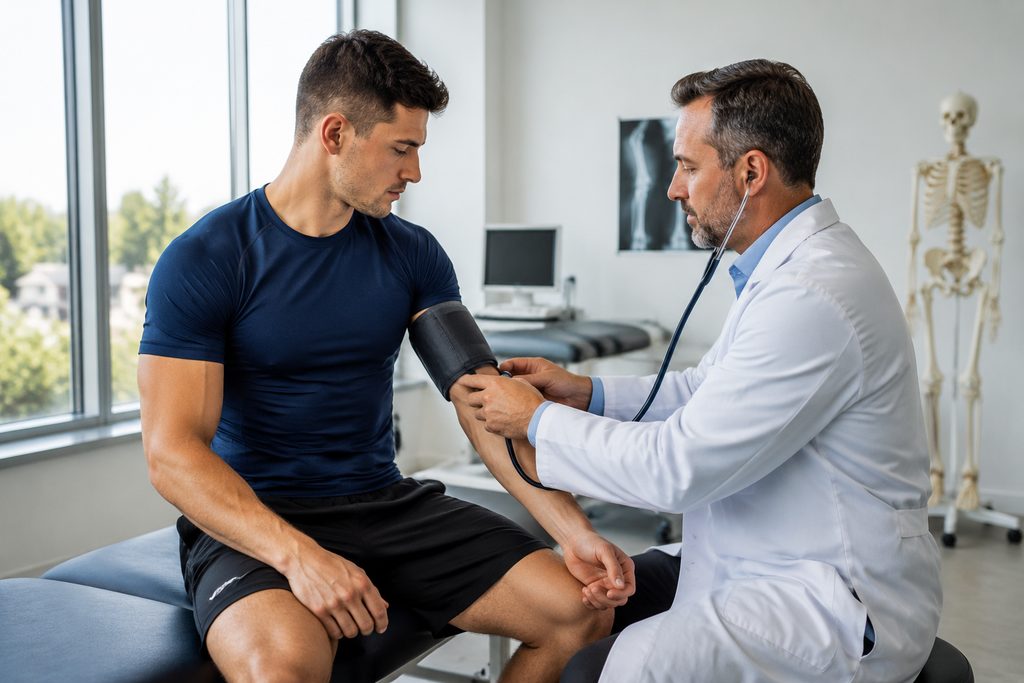
When a 24-year-old triathlete from Oregon tore his meniscus three weeks before qualifiers, his first instinct wasn’t surgery. It was information. He wanted a full musculoskeletal workup — MRI, biomechanical gait analysis, cardiac screening — without waiting eleven weeks for a specialist appointment back home. His question to us was blunt: could he fly to China, get everything done in a week, and know exactly what was wrong?
That is the practical case for an athlete checkup in China. Not because Chinese sports medicine is a miracle cure, but because the throughput is extraordinary. A top-tier hospital can run imaging, cardiac testing, and orthopedic assessment inside a single week — something that takes months to assemble in most Western systems. The athlete checkup cost China hospitals charge is often a fraction of U.S. pricing, too.
This guide covers what a serious pre-participation screening actually includes, what it costs, which cities and hospitals make sense, and where the process gets harder than the brochures suggest.
How This Actually Works, Step by Step
Here is the real sequence, from your couch to your discharge summary.
Step one — you send records. You email existing MRI discs, bloodwork, ECG tracings, injury history, and your training load. Our medical team translates the key documents and routes them to the relevant specialty at a shortlisted hospital. This is the written second opinion stage, and it costs $300–500 at a top hospital. It tells you whether China is even the right call.
Step two — a video consultation. You speak directly with the Chinese sports medicine or cardiology team. You describe symptoms, goals, and timeline. They tell you which tests they’d run and roughly how long it takes. Video consultation with a standard international department runs $100–300; a top-specialist session runs $500–800.
Step three — appointment coordination. Once you agree on a plan, we handle registration, the hospital medical card, and scheduling across departments. Appointment coordination starts from $300. If we can’t secure the appointment shown in your order, that fee is refunded in full.
Step four — you arrive. A bilingual medical companion meets you, handles queuing, payment, wayfinding, and translation. That service runs from $300 per day.
Step five — results and a written plan. Most athletes leave with imaging, a cardiac clearance decision, and a rehabilitation or surgical recommendation in hand.
What Tests Are Included in an Athlete Checkup
This is where expectations diverge most. There is no single “athlete checkup” package in China — you build it. The components below are what sports medicine departments typically offer, and what serious athletes usually request.
- Cardiac screening: 12-lead ECG, echocardiogram, 24-hour Holter monitoring, and exercise stress testing. For masters athletes over 35, this is the non-negotiable core.
- Musculoskeletal imaging: MRI (3T machines are common at top hospitals), ultrasound, and weight-bearing X-ray. Chinese imaging volume is enormous, so slots open fast.
- Biomechanical assessment: gait analysis, force-plate testing, and motion capture. Availability varies sharply by hospital — this is one to confirm before booking.
- Comprehensive bloodwork: full metabolic panel, iron studies, vitamin D, hormone panels, inflammatory markers.
- Pulmonary function testing: spirometry and VO2 max testing where the department supports it.
- Orthopedic and physiotherapy evaluation: joint-by-joint assessment with a rehabilitation plan.
Not every hospital offers every item. A cardiac-focused workup at a cardiovascular powerhouse looks nothing like a musculoskeletal workup at an orthopedics-led facility. Be specific about your sport and your injury history — vague requests produce vague packages.
What the Athlete Checkup Cost in China Actually Looks Like
Prices vary by hospital tier, city, and how many tests you stack. The table below reflects typical ranges for international-department pricing, which runs roughly 1.5–2x standard public-channel rates but includes English-speaking staff and shorter waits.
| Service | Typical Range (USD) | Notes |
|---|---|---|
| Written second opinion | $300–500 | Top-hospital specialist review, for reference only |
| Video consultation | $100–300 | Standard international department |
| Top-specialist video consult | $500–800 | Senior sports medicine or cardiology |
| Basic screening panel | $400–900 | Bloodwork, ECG, basic imaging |
| Full cardiac + MSK workup | $1,500–4,000 | MRI, echo, stress test, gait analysis |
| Bilingual medical companion | from $300/day | 8-hour day; half-day available |
| Airport transfer | $200 round-trip | Both directions |
For comparison, a comparable executive-style sports screening in the United States frequently lands between $3,000 and $8,000 once imaging is included. That gap is the honest headline. It is not a marketing claim — it reflects lower physician labor costs and vastly higher patient throughput.
Is Sports Medicine in China Good for Athletes?
For diagnostic workups and rehabilitation, yes — with caveats. China’s top hospitals see patient volumes that Western centers simply don’t. Fuwai Hospital in Beijing performs more than 14,000 cardiac surgeries annually, the highest volume in the world. That kind of repetition produces real diagnostic fluency.
Where China is weaker: elite return-to-play protocols for professional contracts, and the niche sports science infrastructure you’d find at a dedicated Olympic training center. If you’re a weekend marathoner chasing a diagnosis, the top hospitals are excellent. If you’re a professional negotiating a comeback timeline with a team physician, you may want a hybrid approach.
Shanghai is the strongest single city for this. Its sports medicine hospital ecosystem combines orthopedic depth with international-department infrastructure, and English penetration is higher than in most Chinese cities. For a broader view of what’s available, our specialty rankings by department list the top hospitals across orthopedics, cardiology, and rehabilitation medicine.
A Realistic Timeline
Most athletes underestimate the front end. Here’s what actually happens, in weeks.
- Days 1–3: You gather records. This is slower than people expect — old MRI discs need locating, reports need translating.
- Days 3–7: Document translation and routing to the specialty team. Add 2–3 days if your records are in a less common language.
- Week 2: Written second opinion or video consultation. You get a test plan and a rough cost estimate.
- Weeks 2–4: Appointment coordination and visa. The S2 visa is the correct category for short-stay medical travel; S1 applies if you’ll stay beyond 180 days. Processing typically takes 4–10 business days, and requirements vary by consulate — always confirm with the latest embassy guidance.
- Week 4–6: Travel and testing. Most full workups compress into 3–6 days on the ground.
- Weeks 6–8: Results, a written plan, and any follow-up imaging.
Total: roughly six to eight weeks from first email to a completed workup. Rush timelines exist, but they cost more and depend on hospital capacity that week.
What Can Go Wrong — and What Happens Then
Honest failure modes, because you deserve them.
You can’t book a specific public-hospital outpatient slot from abroad. That’s the general rule at public hospitals — same-day registration is standard. If you need a locked-in appointment with a senior specialist, you go through the international or VIP channel, which costs more. We coordinate through official international departments; we are not paying anyone for queue-jumping, and we never promise a specific doctor on a specific date.
The test you wanted isn’t offered at that hospital. Gait analysis is the usual culprit. The fix is simple: confirm the test list before you book flights, not after.
Imaging reveals something that needs surgery. Now you’re in a different process. Surgery in China requires an in-person consultation first — no exceptions at public hospitals. Admission is always subject to hospital rules and the treating team’s judgment.
Language breaks down outside the hospital. Taxis, pharmacies, hotel check-in. This is exactly what bilingual companions exist for, and it’s the single most common thing athletes underestimate.
You need follow-up at home. Bring printed imaging and reports in English. Chinese hospital systems don’t automatically transmit to foreign providers.
Practical Considerations: Records, Visa, Payment, Insurance
Records first. Get your imaging on physical media or a cloud link. Translated summaries speed everything up.
On the visa: S2 for short-stay medical treatment, S1 for stays over 180 days. Accompanying family members apply for S2 as well. The M visa is for commercial and trade activity and has nothing to do with medical travel — don’t let anyone tell you otherwise.
Payment is the friction point. Public hospitals require prepayment, and you file for reimbursement with your insurer afterward. Private international hospitals often bill insurance directly, which is a real advantage if you carry international coverage. For a breakdown of that trade-off, see our guide to private international hospitals with direct insurance billing.
One more: if you’re considering traditional Chinese medicine for recovery — acupuncture, tuina, herbal support — that’s a genuinely different track, best explored through our TCM hospital directory. It complements sports rehabilitation well, but it isn’t a substitute for diagnostic imaging.
Frequently Asked Questions
Usually yes, for imaging, cardiac testing, and orthopedic assessment combined. Book the appointment coordination at least three to four weeks ahead, and confirm the specific test list with the hospital before you buy flights. Gait analysis and VO2 max testing are the items most likely to need extra scheduling.
The S2 visa covers short-stay medical treatment, and family traveling with you applies under the same category. Processing generally takes 4–10 business days, but requirements shift — verify current rules with the relevant Chinese embassy or consulate before applying. Approval is never guaranteed.
No, but it isn’t a straight equivalence either. Lower physician labor costs and high patient volume drive the price gap. What you should verify is the specific hospital’s ranking in your relevant specialty, whether the international department has English-capable staff, and whether the equipment matches what you need. Our directory of top-ranked hospitals by city is a reasonable starting filter.
You’ll get a written recommendation, and if surgery is indicated, it requires an in-person consultation at a public hospital before anything is scheduled. Admission and treatment decisions rest entirely with the hospital and treating physicians. No service can promise an outcome, a date, or a bed.
Your Next Step
Athlete checkups in China work best when you treat them as a diagnostic project, not a vacation add-on. Get your records in order, confirm the test list, and understand that the cheap, fast part is the testing — the coordination is what makes it usable.
We’re China Medical Services. We help international patients match with appropriate hospitals, coordinate appointments through official international departments, and provide bilingual support on the ground. We are not physicians, and we don’t provide medical advice or guarantee clinical outcomes. If you want a straight read on whether your case fits the China route, start with a free consultation — no pressure, no obligation.
For more medical information and treatment options in China, visit chinamedservices.com (China Medical Services).
