China Airport Medical Clearance: How We Arrange Your Fit to Fly
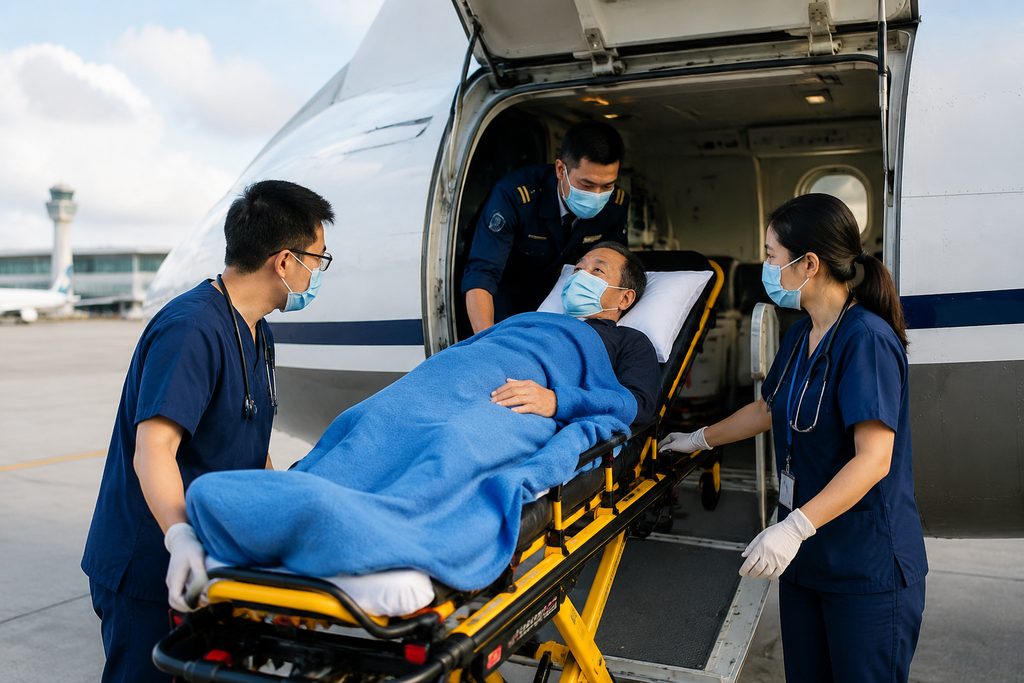
While a patient in the United States might wait 3 to 6 weeks to see a cardiologist for a routine post-surgical clearance, a top-tier Chinese hospital can often complete the same evaluation in under 48 hours. That gap reshapes how international patients plan their departure. Getting home safely after treatment in China is not a bureaucratic afterthought. It is a clinical decision with real consequences—and we coordinate it every week for patients flying out of Beijing, Shanghai, and Guangzhou.
Key Takeaways
- A fit to fly certificate from a Chinese hospital is typically issued 24–72 hours after your final post-operative evaluation, depending on the procedure and your recovery trajectory.
- Most airlines require medical clearance for flights within 7–14 days of major surgery, especially abdominal, cardiac, orthopedic, or neurosurgical procedures.
- China’s top hospitals handle enormous surgical volumes—Fuwai Hospital alone performs over 14,000 cardiac operations annually—so evaluating physicians see post-operative recovery patterns most Western clinicians rarely encounter.
- Documentation must match airline requirements exactly, including the treating physician’s signature, hospital stamp, and specific wording about oxygen needs, mobility restrictions, and thrombosis risk.
The Problem: Airline Rules Are Strict, and Post-Surgical Complications Are Real
You have just had a hip replacement at a top orthopedic hospital in Beijing. Your surgeon says you are recovering well. You book a flight home for day six. At check-in, the airline agent notices you are using crutches. She asks for a medical clearance letter. You do not have one. The flight departs without you.
This scenario is not rare. Airlines operate under International Air Transport Association (IATA) medical guidelines that require passengers to be medically stable for the intended flight. After major surgery, the risk of deep vein thrombosis (DVT) increases significantly. A 2022 study in the Journal of the American Medical Association found that the incidence of symptomatic venous thromboembolism within 90 days of major orthopedic surgery without prophylaxis is approximately 4.3%. Cabin pressure changes, prolonged immobility, and dehydration compound that risk. Airlines know this. They protect themselves—and you—by demanding documentation.
How to get medical clearance for flying after surgery in China is not just about getting a signature. It is about timing, clinical judgment, and paperwork that satisfies airline medical desks in Frankfurt, Dubai, or Los Angeles. The requirements vary by carrier. Emirates has its own MEDIF form. Lufthansa requires a specific medical information form for recent surgeries. American carriers often accept a hospital letter if it includes specific language. Our team tracks these differences so patients do not show up at the airport with the wrong document.
Why Chinese Hospitals Deliver Reliable Fit to Fly Evaluations
China’s top-tier hospitals evaluate post-operative patients at a scale that creates genuine clinical expertise. That matters when a physician must decide whether you are safe to fly. The doctor assessing you at Peking Union Medical College Hospital or Zhongshan Hospital in Shanghai has likely cleared hundreds of international patients for flights home. They know what airlines look for. They know what complications present in the first week after surgery. And they can schedule the evaluation quickly—often the day after your final wound check.
Clinical Volume Means Familiarity With Recovery Patterns
Fuwai Hospital in Beijing performs more cardiac surgeries annually than any hospital in the world—over 14,000 cases per year. A cardiac surgeon there sees post-bypass patients daily. When that surgeon writes a fit to fly certificate, the clinical judgment behind it is grounded in thousands of cases. Compare that to a regional hospital in the United States that performs 200 cardiac surgeries a year. The volume difference is not marketing. It is clinical exposure.
Integrated Departments Speed Up the Clearance Process
Chinese public hospitals operate as integrated systems. Your surgeon, the radiology department, the laboratory, and the international medical office are in the same building. A post-surgery flight clearance service China price includes coordinating those moving parts. A patient who needs a chest X-ray, a blood test for D-dimer, and a final wound inspection can complete all three in one morning. In many Western systems, those would be three separate appointments over two weeks. That structural efficiency is why patients can realistically get medical clearance 48 hours before a flight.
Cost Advantage Without Cutting Corners
A post surgery flight clearance service China price typically ranges from $300 to $800, depending on the hospital tier and the complexity of the evaluation. That includes the physician consultation, any required imaging or labs, and the documentation itself. At a private hospital in Singapore or the United States, the same evaluation might cost $1,500 to $3,000. The lower cost in China is structural—lower labor costs, higher patient throughput, and hospital pricing that is regulated differently—not a reflection of lower clinical standards. The physician signing your certificate is a senior specialist at a hospital ranked among the top 5% of China’s 35,000+ hospitals by Fudan University’s hospital rankings.
What a Fit to Fly Certificate Actually Contains—and Why Details Matter
Airlines do not accept vague letters. A valid fit to fly certificate China airport staff will accept typically includes six elements. The treating physician’s full name and department. The patient’s full name and passport number. The date of surgery and the procedure performed. A clear statement that the patient is medically stable for air travel. Specific instructions about mobility (can the patient walk to the lavatory unassisted?), oxygen requirements (is supplemental oxygen needed in flight?), and medication needs. And the hospital’s official stamp—called a hongzhang in Chinese—which carries legal weight in China.
Missing any of these elements can trigger a denial at check-in. We have seen patients turned away because the letter said “cleared for travel” but did not specify the flight date. Or because the hospital stamp was on page two but not page one. Or because the physician wrote “patient may need wheelchair assistance” without specifying whether the airline must provide it or the patient is self-sufficient. These details are not bureaucratic trivia. They are the difference between boarding and being stranded.
Do not assume your surgeon’s routine discharge summary doubles as a fit to fly letter. It does not. Airlines require a separate document that explicitly addresses fitness for air travel. The discharge summary describes your hospital course. The fit to fly certificate addresses the specific physiological stresses of flight: cabin pressure, oxygen saturation at altitude, immobility, and thrombosis risk.
Is a Fit to Fly Certificate Required After Surgery in Shanghai? Here Is the Real Answer
There is no Chinese law that requires a fit to fly certificate for every post-surgical patient. Is a fit to fly certificate required after surgery in Shanghai? The requirement comes from the airline, not the Chinese government. But in practice, if you had major surgery in Shanghai and you are flying within two weeks, the airline will almost certainly ask for one. And if you arrive at Pudong International Airport without it, the airline’s medical desk may refuse boarding.
Different airlines have different thresholds. Some require clearance for any surgery within 10 days. Others require it for any surgery within 30 days if the passenger has mobility restrictions. A few airlines—particularly Middle Eastern carriers—require clearance for any hospital admission within 7 days, even without surgery. The safest approach is to assume you need a fit to fly certificate if you had any procedure requiring general anesthesia, regional anesthesia, or an overnight hospital stay, and you are flying within two weeks.
| Airline Category | Typical Clearance Window After Surgery | Common Documentation Required |
|---|---|---|
| Major Middle Eastern carriers (Emirates, Qatar, Etihad) | Within 7–14 days for any surgery; within 7 days for any hospital admission | MEDIF form or equivalent, hospital letter with stamp |
| European carriers (Lufthansa, Air France, KLM) | Within 10–14 days for major surgery; longer for orthopedic or cardiac procedures | Carrier-specific medical form, treating physician letter |
| North American carriers (United, Delta, American) | Within 7–10 days for major surgery; case-by-case for minor procedures | Hospital letter with specific fitness statement |
| Asian carriers (Cathay Pacific, Singapore Airlines, ANA) | Within 7–14 days for major surgery; some require clearance up to 30 days | Hospital letter, sometimes carrier medical form |
These windows shift. Airlines update their medical policies periodically. The IATA Medical Manual provides baseline guidance, but each carrier interprets it differently. That is why we verify the current requirement with your specific airline before your final hospital evaluation. A letter written for Emirates may not satisfy Lufthansa. Getting the wrong letter is almost as bad as getting no letter.
How the Clearance Process Actually Works: A Timeline
Here is what a typical post-surgery flight clearance looks like for a patient treated at a top Chinese hospital. Day one: your surgeon performs a final wound check and reviews your post-operative imaging or labs. Day two: you visit the hospital’s international medical department for the fit to fly evaluation. The evaluating physician—often a specialist in the same department, sometimes the surgeon who operated—assesses your mobility, oxygen saturation, pain control, and thrombosis risk. If everything is stable, the certificate is issued the same day. Day three: you fly.
That is the ideal timeline. It works when the surgery was uncomplicated, the recovery is on track, and the airline’s documentation requirements were confirmed in advance. But complications happen. A wound infection delays clearance. An elevated D-dimer triggers further testing. A cardiac patient with new arrhythmia needs a cardiology consult before anyone signs a fit to fly letter. In those cases, clearance takes longer—and it should. No reputable physician in China or anywhere else will sign a fit to fly certificate for a patient who is not stable. That refusal is not an obstacle. It is protection.
Book medical clearance for flight after treatment in China as early as possible. Ideally, you discuss the fit to fly requirement with your surgeon before the operation. That way, the final evaluation is already on the schedule, and the surgeon knows the airline’s specific requirements from the start. Waiting until the day before your flight to request a certificate is how patients get stuck.
China Medical Tourism Package With Fit to Fly Letter: What That Actually Means
Some agencies market a China medical tourism package with fit to fly letter as a bundled product. The phrase sounds convenient. But it is worth understanding what that package actually includes—and what it cannot guarantee. A legitimate package coordinates the logistics: hospital appointments, bilingual interpretation, documentation preparation, and the final clearance evaluation. It does not guarantee that a physician will sign a fit to fly certificate. No ethical doctor makes that promise before seeing the patient.
Our approach is different. We do not sell a package that implies a certificate is guaranteed. We coordinate the process so that, if you are medically stable, you get the documentation you need without delay. That coordination includes confirming the airline’s exact requirements, scheduling the evaluation with the right department, ensuring the letter contains the required language, and arranging for the hospital’s official stamp. If the evaluating physician determines you are not fit to fly, we help you understand why and what needs to happen before you can travel.
The distinction matters. A fit to fly certificate is a clinical document, not a travel formality. It reflects a physician’s judgment about your safety at 35,000 feet. Any service that treats it as a rubber stamp is doing you a disservice. The value of coordination is not in guaranteeing the outcome. It is in removing the logistical friction so the clinical decision can happen quickly and correctly.
Practical Considerations: Documents, Timing, and What You Need in Hand
Before your final hospital evaluation, gather the following. Your passport and a copy of the photo page. Your airline booking confirmation with the flight number and date. Your hospital discharge summary, if you have been discharged. A list of current medications, including dosages. Any relevant imaging reports from your post-operative course. And, if your airline has a specific medical form, bring a printed copy.
Visa timing is a separate issue. If you came to China for treatment on an S2 visa, that visa is typically valid for short stays. If your recovery extends beyond your visa’s validity, you may need to apply for an extension through the local public security bureau. That process takes time—often 5 to 10 business days. We advise patients to check their visa expiry date before surgery and plan buffer time. A fit to fly certificate does not override an expired visa.
Payment for the clearance evaluation is straightforward. Chinese public hospitals require prepayment for services. The international medical department will quote a fee for the consultation and any required tests. You pay at the hospital cashier, typically by card or cash. If you have international health insurance, you will likely need to pay first and submit for reimbursement later. Private international hospitals in China, such as those in our private hospital network, may offer direct billing with certain insurers. That can simplify the process if your insurer has a direct billing agreement.
Language is the final practical hurdle. The physician who evaluates you may not speak English fluently. The hospital’s international department usually provides interpretation, but that is not guaranteed at every facility. A bilingual companion who understands both the clinical terminology and the airline’s documentation requirements can prevent costly misunderstandings. That is not a luxury. It is a practical safeguard when a single word in a medical letter changes its meaning to an airline’s medical desk.
Frequently Asked Questions
Request it 3 to 5 days before your intended departure. That allows time for the evaluation, any additional testing if needed, and document revisions. Requesting it the day before your flight leaves no margin for error. Airlines may also require that the certificate be dated within a specific window before travel—often 72 hours to 7 days.
That means the physician has identified a clinical risk that makes flying unsafe. Common reasons include uncontrolled pain, wound infection, elevated thrombosis risk, or unstable cardiovascular status. The refusal is not permanent. It means you need additional treatment or observation before travel. We help patients understand what the physician is looking for and how to address it. No reputable service can override a physician’s clinical judgment.
Yes, but it is less straightforward. The evaluating physician needs your complete medical records, including the operative report and post-operative course. A doctor unfamiliar with your case may request additional testing before signing. It is generally faster and more reliable to get the certificate from the hospital where you had surgery, where your records are complete and the evaluating physician can consult your surgeon directly.
No. The certificate is a medical document. The airline makes the final boarding decision. Airlines can still deny boarding if they believe the passenger poses a risk to themselves or other passengers, or if the passenger requires services the airline cannot provide on that specific flight. A properly documented certificate from a reputable hospital makes denial unlikely, but it is not a boarding pass.
Typically, the fee covers the physician’s evaluation, any required point-of-care testing, and the preparation of the certificate itself. Prices range from $300 to $800 at top public hospitals, with private international hospitals sometimes charging more. The fee does not include treatment for any complications discovered during the evaluation. If the physician finds a problem, treating that problem is a separate clinical service with its own cost.
Your Next Step
Getting home safely after treatment in China requires more than a plane ticket. It requires a physician who knows your case, documentation that meets your airline’s exact standards, and enough time to handle complications if they arise. We coordinate that process for patients treated at China’s top-ranked hospitals in Beijing, Shanghai, Guangzhou, and 34 other cities. We are not a hospital and we do not provide medical advice. We are the bridge between your treating team and your journey home.
If you are planning treatment in China or recovering from a procedure and need to arrange your fit to fly documentation, start with a conversation. Our team will review your situation, confirm your airline’s requirements, and map out a realistic timeline. Get a free consultation and let us help you get home safely.
For more medical information and treatment options in China, visit chinamedservices.com (China Medical Services).
