Should I Go to China for Dental Implants? Our Honest Guide
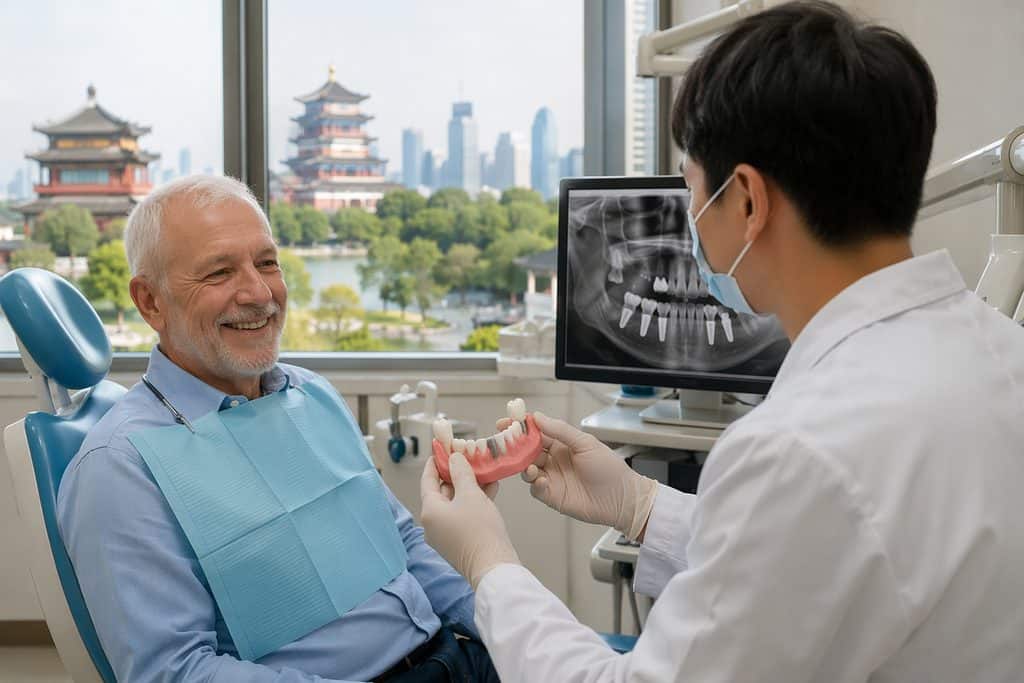
You have probably heard that getting dental work done in China means gambling with quality. The opposite is closer to the truth for top-tier implant centers in Beijing and Shanghai. But the honest answer to whether you should fly across the world for titanium screws in your jaw is not a simple yes. It depends on what you need, where you live, and how much legwork you are willing to do before you board the plane.
Key Takeaways
- Dental implants in China typically cost $900–$2,500 per implant, compared to $3,000–$6,000 in the United States — a 60–70% saving before travel costs.
- Top Chinese dental hospitals use the same implant systems you know: Straumann, Nobel Biocare, and Osstem. The hardware is not the variable; the surgeon and lab are.
- The biggest barriers are language, follow-up care, and verification. If an implant fails after you fly home, your local dentist may be reluctant to touch another clinician’s work.
- You should only consider China if you need multiple implants or a full-arch restoration. For a single implant, travel costs often erase the savings.
The Problem: Dental Implants Are Pricing People Out of Care
Roughly 178 million Americans are missing at least one tooth, and about 40 million are missing all of them, according to the American College of Prosthodontists. The standard fix — a titanium implant with a porcelain crown — runs $3,000 to $6,000 per tooth in the US. Need a full arch? You are looking at $24,000 to $50,000. Most dental insurance plans cap annual benefits at $1,500. That leaves a massive gap between what patients need and what they can pay.
This is not an American problem alone. Patients in the UK face similar numbers — a single implant at a private London clinic costs £2,000 to £3,000. In Australia, it is AU$4,000 to AU$7,000. Canada sits between US and UK pricing. The result is predictable: people delay treatment, live with dentures that slip, or choose bridges that sacrifice healthy adjacent teeth.
Dental tourism has grown precisely because this math does not work for ordinary people. Mexico, Thailand, Hungary, Turkey — each has become a destination. China is a newer entrant in this space, and it brings something different: industrial-scale hospital infrastructure and a domestic implant market that has exploded in the last decade.
Why China Delivers Real Results for Dental Implants
The case for China rests on three pillars: volume, technology, and structural cost advantages. None of these matter unless the clinics you are considering actually have them. So let us look at what the data shows.
Clinical Volume Drives Surgical Repetition
Chinese implant surgeons at major stomatology hospitals place hundreds of implants per year. A specialist at Peking University School of Stomatology or Shanghai Ninth People’s Hospital will have placed more implants in one year than many Western general dentists place in a decade. Volume matters in implantology because complications — nerve injury, sinus perforation, poor angulation — are rare but devastating. Surgeons who have seen them repeatedly know how to avoid them.
Compare this to the typical US general dentist who places 20–50 implants annually. The American Academy of Implant Dentistry notes that most implant placement is done by general dentists, not specialists. That is not a criticism of American dentistry; it is a structural fact. China’s top stomatology hospitals are specialist-only environments. You get a prosthodontist or oral surgeon, not a generalist fitting you in between cleanings.
Technology and Materials Without the Markup
A common assumption is that Chinese clinics use inferior or generic implant systems. The reality at top-tier centers is the opposite. Straumann, Nobel Biocare, Zimmer Biomet, and Osstem are standard. CBCT imaging for 3D planning is routine in major cities. Some centers use surgical guides milled in-house. Digital impressions have replaced goopy molds in many high-volume facilities.
The reason costs stay low is not cheap materials. It is that labor, facility overhead, and regulatory compliance costs are structurally lower in China than in the US or UK. A prosthodontist in Shanghai earns a fraction of what a comparable clinician earns in Los Angeles. The implant fixture itself costs the clinic roughly the same as it costs a clinic in Chicago. The savings come from everything else around the implant.
Cost Advantage Without Quality Compromise
This is the part where skepticism is healthy. Lower prices often do mean lower quality. But the mechanism here is different. Chinese hospital pricing for international patients is set to attract medical tourism while still covering costs. A single Straumann implant with a zirconia crown at a reputable Shanghai dental hospital runs $1,500 to $2,500. The same restoration in the US runs $4,000 to $6,000. The hardware is identical. The lab work is comparable. The surgeon’s training at a top Chinese stomatology program is rigorous and often includes international fellowships.
What you sacrifice is not quality but convenience: you do not get the same continuity of care, the same legal recourse if something goes wrong, or the same ease of communication. Those are real costs. They are just not clinical costs.
What Dental Implant Packages Abroad Actually Include
When you search for dental implant packages abroad, you will find a wide range of offerings. Some are all-inclusive; others are bare-bones. Understanding the difference prevents nasty surprises.
Most Chinese dental tourism packages for international patients include the surgical placement, the abutment, and the crown. Some include the CBCT scan and initial consultation. A typical full package for a single implant at a private international dental clinic in Beijing or Shanghai runs $1,800 to $3,500. At a public hospital’s international department, expect $1,200 to $2,800 per implant.
What is often not included: bone grafting if you need it, sinus lifts, extractions, temporary crowns, and any revision work. Bone grafting adds $300 to $800 per site. A sinus lift adds $500 to $1,500. These add-ons are the same ones your local dentist would charge for — but when you are abroad, you have less leverage to negotiate or get a second opinion.
Some clinics offer a “free second opinion” that is really a sales consultation. Others are transparent. The key is to ask for an itemized treatment plan in writing before you pay anything.
How Much Are Dental Implants in Shanghai, Really?
Shanghai is the most common entry point for international patients considering dental work in China. The city has several internationally accredited dental facilities and the highest concentration of English-speaking dentists in the country. Pricing in Shanghai reflects that demand.
| Treatment Item | Shanghai Public Hospital (International Dept.) | Shanghai Private International Clinic | US Average |
|---|---|---|---|
| Single implant (Straumann) + crown | $1,800–$2,500 | $2,200–$3,500 | $4,000–$6,000 |
| Full-arch restoration (All-on-4) | $12,000–$18,000 | $15,000–$24,000 | $24,000–$50,000 |
| Bone graft (per site) | $300–$600 | $400–$800 | $600–$1,200 |
| CBCT scan + consultation | $100–$200 | $150–$300 | $200–$500 |
These figures are ranges based on 2024–2025 pricing data from multiple Shanghai dental facilities. They vary by hospital and case complexity. The full-arch numbers assume four to six implants per arch with a fixed prosthesis. If you need zygomatic implants or extensive grafting, the price climbs.
One thing to note: Shanghai is not the cheapest city in China for dental work. Cities like Chengdu, Hangzhou, and Nanjing often price 15–25% lower. But Shanghai offers the most English-language support and the most experience with international patients. That convenience has a price attached.
Is It Safe to Get Dental Implants in China? A Risk Assessment
Safety is the question every patient should ask first. The answer is nuanced. At accredited, high-volume centers in major cities, the clinical safety profile is comparable to Western standards. Infection control protocols at JCI-accredited Chinese hospitals meet international benchmarks. Sterilization practices at top stomatology departments are rigorous. The implant systems are the same brands used worldwide.
But the risks are not zero, and they are not evenly distributed across every clinic in China. The country has over 35,000 hospitals. The gap between the best and the average is enormous. A clinic in a tier-3 city might use generic implants, have no CBCT, and operate with minimal sterility protocols. That is where the horror stories come from — and they are real.
Your job is to verify before you fly. Check whether the facility has JCI accreditation or is a university-affiliated stomatology hospital. Ask which implant system they use and whether they will put the brand name in writing. Request the treating surgeon’s credentials — where they trained, how many implants they place annually. A legitimate clinic will answer these questions without hesitation. A clinic that dodges them is telling you something.
Practical Considerations: Documentation, Visas, and Follow-Up
A full-arch restoration using four to six implants per arch typically costs $12,000 to $24,000 in Shanghai, depending on the clinic and materials. Add travel, accommodation, and any bone grafting. You will need at least two trips: one for surgery and one for the final prosthesis, typically three to six months apart.
This is the hardest scenario. Implant failure rates are low — around 2–5% over ten years — but they are not zero. If an implant fails, you either return to China for revision or find a local dentist willing to take over. Many Western dentists are reluctant to manage complications from overseas work. Ask your home dentist about this before you leave, and get the Chinese clinic’s written policy on revisions and warranty.
For a single implant, two trips are standard: one for the surgical placement and one for the crown, separated by three to six months. Some clinics offer same-day implants with a temporary crown, but the final restoration still requires a second visit. For full-arch work, expect two to three trips depending on healing and lab turnaround.
Yes, but only at international departments or private clinics with English-speaking staff. Public hospital dental departments outside major cities rarely have English support. Even in Shanghai, you will need assistance with registration, payment, and pharmacy visits unless you go through a bilingual coordination service or an international clinic.
Your Next Step
China is a serious option for dental implants if you need multiple teeth replaced and you are willing to do the verification work. The savings are real, the technology is current, and the top facilities are genuinely world-class. But this is not a decision to make on price alone.
Our team at China Medical Services helps international patients evaluate Chinese dental hospitals, verify surgeon credentials, and coordinate the logistics of treatment. We are not a hospital and we do not provide diagnoses. If you want an honest assessment of whether China makes sense for your specific case, start with a free consultation. No pressure, no obligation — just straight answers.
Frequently Asked Questions
Yes. The hospitals used for international patients are JCI-accredited and follow the same international safety standards as top hospitals in the US and Europe. Surgical teams perform high volumes of procedures — often more than their Western counterparts — which studies show leads to better outcomes.
Costs vary by procedure and hospital, but international patients typically save 40-80% compared to US prices — even when factoring in travel and accommodation. A consultation with our team will give you an exact, all-inclusive quote with no hidden fees.
Send us your existing medical reports to get started. We handle everything from hospital selection and appointment scheduling to visa assistance and post-operative recovery planning. Your medical records are reviewed by the specialist before you even book a flight.
For more medical information and treatment options in China, visit chinamedservices.com (China Medical Services).
