How to Access Liquid Biopsy and Precision Oncology in China
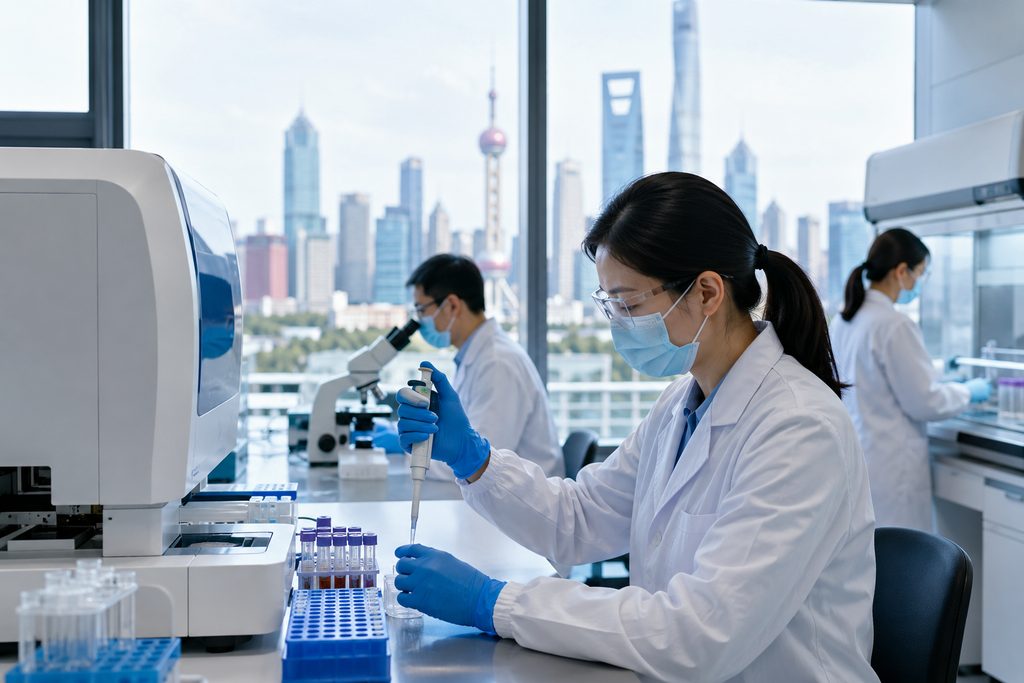
You might think that cutting-edge cancer diagnostics are only available in a handful of Western academic medical centers. That was true a decade ago. It is not true now. The question we hear from patients around the world has shifted from “does China have this?” to “how do I actually access it?” And the answer involves navigating a system that is both remarkably advanced and structurally different from what you know.
Key Takeaways
- Liquid biopsy in China costs approximately $800–$2,500, compared to $3,000–$6,000 in the United States, with comparable clinical sensitivity for major mutations.
- Several Chinese hospitals now run their own in-house next-generation sequencing (NGS) labs, cutting turnaround time to 5–10 business days for comprehensive genomic profiling.
- International patients cannot simply mail a blood sample to a Chinese lab. Legal compliance, sample chain-of-custody, and hospital registration all require on-the-ground coordination.
- Precision oncology in China is not one thing. It spans public hospital molecular tumor boards, private sequencing companies, and clinical trial matching—and you need to know which door to knock on.
The Problem: Cancer Does Not Wait for a Diagnostic Roadmap
A patient with stage IV non-small cell lung cancer sits in a clinic in London or Los Angeles. The tissue biopsy came back inconclusive. Or the tumor is in a location too risky to needle. The oncologist suggests a liquid biopsy—a simple blood draw that captures circulating tumor DNA. But the local lab quotes a three-week turnaround and a price tag north of $4,500. Insurance pre-authorization drags on. The cancer does not pause while paperwork moves.
This scenario plays out thousands of times each year. Approximately 1 in 5 tumor biopsies yields insufficient tissue for comprehensive genomic profiling. That is not a rare edge case. That is a structural gap in modern oncology. And when the standard pathway stalls, patients start searching. They type phrases like “liquid biopsy cost China” or “how to get molecular testing in China for cancer” into a search engine at 2 a.m. They are looking for a door. We help them walk through it.
China’s molecular diagnostics infrastructure has expanded at a pace that surprises even industry insiders. The country now houses multiple CAP-accredited and CLIA-equivalent sequencing facilities. Some are embedded within the nation’s top-ranked oncology hospitals. Others operate as standalone genomics companies that partner directly with hospital molecular tumor boards. The technology is here. The barrier is not the science. It is the logistics.
Who We Are
We are China Medical Services. We are not a hospital, a laboratory, or a medical practice. We do not diagnose disease or prescribe treatment. What we do is connect international patients with China’s most respected medical institutions—the ones that appear on the Fudan University hospital rankings and hold JCI accreditation. Our team handles hospital matching, appointment coordination, bilingual medical companionship, and the visa and travel logistics that make precision oncology accessible across borders. We are the bridge. You bring the clinical question. We map the route to the answer.
Why China’s Precision Oncology Infrastructure Delivers Results
Clinical Volume Drives Diagnostic Speed
Speed in molecular diagnostics is partly a function of throughput. A sequencing lab that runs 10,000 panels a year operates with different economics and workflow efficiency than one running 1,000. China’s top cancer hospitals manage staggering patient volumes. Fudan University Shanghai Cancer Center sees over 1.5 million outpatient visits annually. The sequencing cores attached to these hospitals run continuously. That volume translates into something tangible for a patient waiting on a result: shorter batch queues and faster turnaround.
We have seen comprehensive NGS panel reports returned in 7 business days from major Shanghai labs. The same panel ordered through a US reference lab might take 14–21 days. For a patient with progressing disease, those extra days are not trivial. They are the difference between starting a matched targeted therapy and watching a performance status decline past the point of treatment eligibility.
In-House NGS Labs Cut the Middleman
Many Western hospitals outsource genomic profiling to third-party commercial labs. The sample ships out. The report ships back. Coordination gaps happen. In China, several of the hospitals ranked among the nation’s top 10 for oncology operate their own in-house NGS facilities. The blood draw happens on the third floor. The sequencing happens in the same building. The molecular tumor board reviews the results the same week.
This vertical integration is not universal. It exists at specific institutions. Knowing which hospitals have in-house capability—and which rely on external commercial partners—is part of the matching process we handle for every patient. You can explore oncology department rankings on our specialty pages to understand which institutions lead in cancer care.
The Liquid Biopsy Cost Equation
Let us address the question that brings many international patients to this page. The liquid biopsy cost China advantage is real and structural. It is not about discounting quality. It is about different cost structures for laboratory labor, equipment amortization, and regulatory overhead.
| Test Type | Estimated Cost in China (USD) | Estimated Cost in US (USD) | Typical Turnaround (China) |
|---|---|---|---|
| Single-gene liquid biopsy (e.g., EGFR T790M) | $300–$600 | $800–$1,500 | 3–5 business days |
| Small NGS panel (50–100 genes) | $800–$1,500 | $2,500–$4,000 | 7–10 business days |
| Comprehensive genomic profiling (400+ genes, TMB, MSI) | $1,800–$2,500 | $3,500–$6,000 | 10–14 business days |
| Whole exome sequencing (tumor-normal paired) | $2,500–$3,500 | $5,000–$8,000 | 14–21 business days |
These ranges reflect pricing at major public hospital international departments and accredited private labs in Shanghai, Beijing, and Guangzhou. Final cost varies by hospital and case complexity. The numbers do not include our coordination service fees, which are separate and quoted upfront.
Does lower cost mean lower quality? No. Several Chinese NGS labs participate in the same external quality assessment programs—such as those run by the College of American Pathologists and the European Molecular Genetics Quality Network—as their Western counterparts. The reagents are often sourced from the same global manufacturers. The bioinformatics pipelines are validated to the same standards. The difference is the cost of running the operation, not the rigor of the science.
What Does Precision Oncology Actually Look Like in China?
The term “precision oncology” gets thrown around loosely. Let us be concrete. A patient arrives at a precision oncology hospitals Shanghai search leads them to. What happens next?
The oncologist reviews prior imaging and pathology. If tissue is available and adequate, it may be re-analyzed. If tissue is exhausted or inaccessible, a liquid biopsy is ordered. The blood draw takes 10 minutes. The sample goes to the hospital’s NGS lab or an affiliated accredited facility. The panel screens for actionable mutations across hundreds of genes—EGFR, ALK, ROS1, BRAF, KRAS, MET, RET, NTRK, HER2, and many more. It also assesses tumor mutational burden (TMB) and microsatellite instability (MSI) status, both of which inform immunotherapy eligibility.
When the report returns, the hospital’s molecular tumor board—a multidisciplinary team of oncologists, pathologists, and geneticists—reviews the findings. They match mutations to approved targeted therapies available in China. China’s National Medical Products Administration has approved a growing roster of targeted agents, including next-generation EGFR inhibitors, ALK inhibitors, and PD-1/PD-L1 immune checkpoint inhibitors. Some drugs approved in China are not yet available in certain Western markets. Others are available at significantly lower cost.
The question “is liquid biopsy available in China for international patients” has a straightforward answer. Yes. But the sample must be drawn in China, at a registered medical facility, under a valid hospital registration. You cannot courier a tube of blood across the border. The legal and logistical chain requires physical presence. That is where our team comes in.
How to Book Cancer Genomic Profiling in China: The Real Pathway
Searching “book cancer genomic profiling China” brings up a mix of legitimate hospital pages and misleading intermediaries. Let us walk through what actually works.
You cannot book a liquid biopsy online like a hotel room. The process begins with a clinical consultation. A Chinese oncologist must review your medical records, confirm that molecular testing is indicated, and write the order. This is not bureaucratic friction. It is good medicine. No reputable hospital will run a 500-gene panel on a patient they have never evaluated.
The consultation can happen in person or, in some cases, via video. We coordinate video consultations with specialists at top-ranked oncology departments. The oncologist reviews your history, imaging, and prior pathology reports. If liquid biopsy is appropriate, the order is placed. You then travel to China for the blood draw. The sample runs. You receive results and a treatment recommendation.
For some patients, the trip is purely diagnostic. They get the genomic report and take it back to their home oncologist. For others, the trip becomes therapeutic. If an actionable mutation is found and a matched targeted therapy is available in China, treatment can begin during the same visit. This is what a targeted therapy China medical tourism package looks like in practice—not a pre-packaged product, but a coordinated sequence of consultation, testing, and treatment initiation.
Our oncology department rankings page shows which hospitals lead in specific cancer types. Shanghai and Beijing concentrate many of the top-tier options, but excellent molecular oncology programs also exist in Guangzhou, Hangzhou, and Chengdu.
What You Need to Know Before Going Alone
We are direct about this because patients deserve honesty. Attempting to arrange precision oncology in China independently is difficult in ways that are not obvious from abroad.
- Hospital Registration Systems: Chinese public hospitals do not accept international self-referrals for advanced molecular testing. You need a registered patient ID, which requires in-person registration with a passport and a valid visa. The registration counter operates in Mandarin. The queue starts forming before dawn for popular oncology departments.
- Visa Requirements: Medical treatment in China requires an S2 visa, annotated for medical purposes. This is not a tourist visa. The application requires an invitation letter from the receiving hospital. Obtaining that letter without a local contact is a circular problem—the hospital wants to see you before issuing the letter, but you need the letter to enter the country.
- Sample Integrity and Lab Selection: Not all NGS labs in China are equal. Some are world-class. Others are not. Distinguishing between them requires knowing which accreditations matter, which hospital affiliations signal genuine quality, and which commercial labs have a track record of clinical-grade reporting. A bad genomic report is worse than no report. It can lead to ineffective and expensive treatment decisions.
- Report Interpretation Across Borders: A genomic report generated in China will follow Chinese reporting standards and drug annotation databases. Your home oncologist may not be familiar with the format, the gene coverage, or the clinical trial references. Bridging that gap requires someone who understands both systems.
How We Help You Navigate This
These barriers are not insurmountable. They exist for structural reasons—language, regulation, hospital policy—and they yield to experienced coordination. Here is what our involvement looks like in practice.
Before you travel, we collect your medical records, have them translated into clinical Chinese by medical translators, and present them to the appropriate oncology department for pre-review. We confirm that the hospital is willing to evaluate your case and that liquid biopsy is an appropriate next step. We secure the invitation letter needed for your S2 visa application.
When you arrive, a bilingual medical companion meets you at the hospital. They handle registration, queueing, payment, and navigation. You sit in the consultation room with the oncologist, not in a hallway wondering which window to approach. The blood draw happens. The companion ensures the sample is routed to the correct lab and that the ordering physician’s instructions are followed.
When results return, we arrange the follow-up consultation where the oncologist explains the findings and recommends next steps. If a targeted therapy is indicated and you wish to pursue treatment in China, we coordinate the treatment schedule. If you prefer to return home with the report, we ensure you have a complete and properly formatted record set to share with your local oncologist.
Our video consultation fees start from $100–$300 for standard international department consultations and $500–$800 for top-specialist video consultations. If you later upgrade to an in-person treatment coordination service within 90 days, those consultation fees are credited in full toward the coordination service fee. This is a one-time credit applied to our coordination fee only, never to hospital treatment charges. It means your diagnostic investment is protected if you decide to proceed with treatment.
Frequently Asked Questions
No. This is not legally or logistically feasible. Blood samples for clinical genomic testing must be drawn at a registered Chinese medical facility, under a valid patient registration, with proper chain-of-custody documentation. International shipping of blood products for clinical diagnostic purposes faces customs, biosafety, and regulatory barriers that make it impractical. You need to be physically present in China for the blood draw.
Hospital selection depends on your cancer type, prior treatment history, and the specific molecular question you need answered. For lung cancer, certain Shanghai and Beijing hospitals have particular depth in EGFR and ALK resistance mutation profiling. For gastrointestinal cancers, other centers lead. We match based on the Fudan University specialty rankings and the specific molecular testing capabilities of each hospital’s in-house lab. Our top hospitals directory is a starting point, but the final recommendation requires reviewing your individual case.
This happens in a meaningful percentage of cases. Comprehensive genomic profiling returns an actionable alteration in roughly 40–60% of patients with advanced solid tumors, depending on tumor type. If no targetable mutation is found, the oncologist will discuss standard-of-care options, which may include chemotherapy, immunotherapy based on TMB or MSI status, or clinical trial enrollment. A negative result is not a failure of the test. It is information that narrows the treatment path and spares you from ineffective targeted therapy.
Most oncologists care about the quality of the data, not the country of origin. If the report comes from an accredited lab, uses validated sequencing chemistry, follows standard variant interpretation guidelines, and cites publicly available drug annotation databases, it is clinically actionable anywhere. We recommend requesting the raw sequencing data files alongside the interpretive report. This allows your home oncologist’s team to re-analyze the data if they prefer their own bioinformatics pipeline.
Plan on 3–5 weeks from initial contact to holding a genomic report in your hands. This includes: medical record collection and translation (3–5 days), hospital pre-review and invitation letter issuance (5–10 days), visa processing (5–10 business days, country-dependent), travel to China (1–2 days), consultation and blood draw (1 day), and sequencing turnaround (7–14 business days). Expedited pathways exist for patients with rapidly progressing disease, but they require case-by-case coordination with the receiving hospital.
Your Next Step
Precision oncology is not a luxury. It is the standard of care for a growing list of advanced cancers. When local pathways stall—when tissue is insufficient, turnaround times stretch, or costs are prohibitive—China’s molecular diagnostics infrastructure offers a real alternative. The technology is here. The expertise is here. The path to access it requires an experienced guide who speaks both the language and the system.
If you are considering liquid biopsy or comprehensive genomic profiling in China, start with a conversation. We review your case, explain your options, and give you a clear picture of what is possible before you commit to anything. Visit our patient coordination page to request a free initial consultation. No pressure. No hard sell. Just a clear answer about whether this path makes sense for you.
For more medical information and treatment options in China, visit chinamedservices.com (China Medical Services).
