Gastroscopy Cost in China: 2026 Price Guide for Foreign Patients
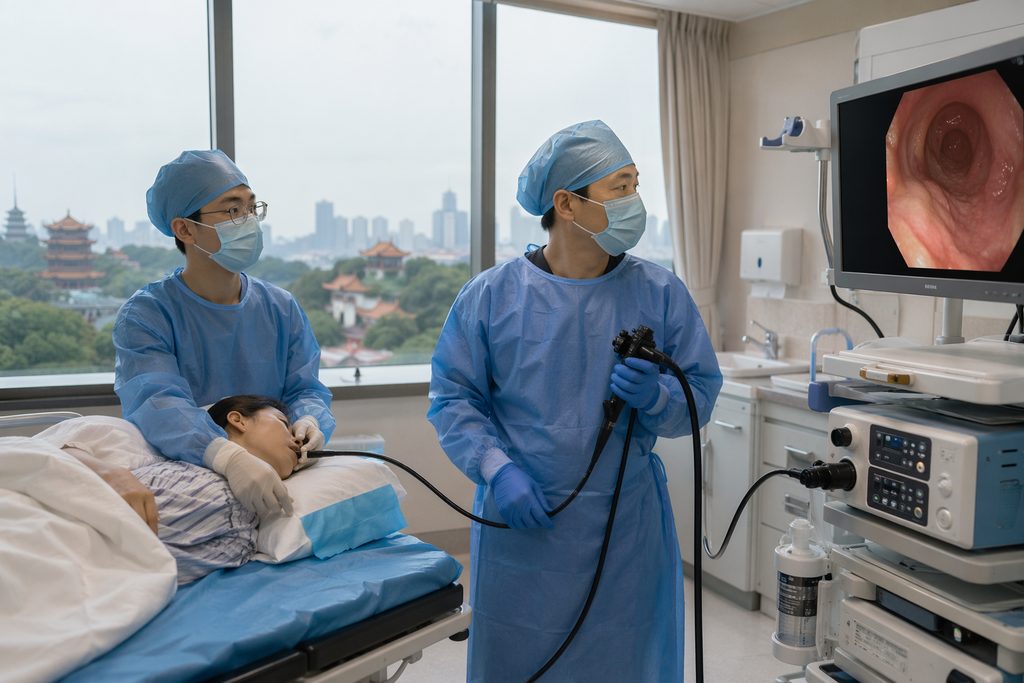
How Much Does a Gastroscopy Cost in China? A 2026 Price Guide for International Patients
According to the World Health Organization, gastric cancer remains the fourth most common cancer worldwide, with over 968,000 new cases diagnosed in 2022. Early detection through gastroscopy—technically called upper GI endoscopy—dramatically improves survival rates, yet in countries like the United States, Canada, and the UK, the out-of-pocket gastroscopy cost China patients often seek to avoid can reach $2,500 to $5,000 without insurance. For the uninsured or underinsured, that price tag delays diagnosis. In China, the same procedure typically ranges from $150 to $800 depending on hospital tier and sedation choice. That gap explains why medical travelers increasingly type “gastroscopy cost China” into search engines before booking a flight.
Key Takeaways
- A standard gastroscopy in a top-tier Chinese public hospital costs $150–$350; private international hospitals charge $400–$800.
- China’s top 5% of hospitals—ranked by Fudan University and JCI—perform gastroscopies at 1/5 to 1/10 of US prices without sacrificing diagnostic accuracy.
- Language barriers and hospital navigation are real; without a bilingual companion, a foreign patient can lose hours or miss critical instructions.
- S2 visa is the correct category for medical treatment in China—not the M visa, which is strictly for commercial trade.
The Problem: Delayed Diagnosis Because the Price Is Too High
A 2023 survey by the Kaiser Family Foundation found that 38% of American adults skipped or postponed a recommended medical test due to cost. For upper GI symptoms—persistent reflux, unexplained weight loss, difficulty swallowing—the delay between symptom onset and diagnostic endoscopy can mean the difference between treating an early-stage condition and managing an advanced one. In the UK, NHS waiting times for routine endoscopy stretched to 18 weeks in some trusts during 2023–2024. Canada’s median wait for gastroenterology referral sits at 16 weeks.
That is the reality driving patients abroad. The math is straightforward: a round-trip flight from London to Shanghai costs roughly $800–$1,200. A gastroscopy at a Fudan-ranked hospital costs $200–$350. Add two nights in a hotel and a bilingual companion for the day, and the total lands under $1,500. Compare that to $3,500 in a US outpatient center. The savings cover the flight and leave room to spare.
But cost is only one part of the equation. Safety, quality, and logistics matter just as much.
Why China Delivers Results for Upper GI Endoscopy
Clinical Volume Drives Diagnostic Accuracy
Volume matters in endoscopy. A gastroenterologist who performs 2,000 procedures a year sees rare presentations that a lower-volume clinician might miss. At China’s top-ranked hospitals—such as Peking Union Medical College Hospital in Beijing and Zhongshan Hospital in Shanghai—endoscopy centers routinely handle 150–300 procedures daily across multiple rooms. A single experienced endoscopist in these institutions may complete 3,000–5,000 gastroscopies annually. The average Western gastroenterologist performs roughly 500–800 per year. That repetition sharpens pattern recognition for early mucosal changes, subtle lesions, and atypical presentations.
China’s national cancer screening programs have also driven standardization. The National Health Commission’s early gastric cancer screening initiative, launched in 2018, established uniform protocols for biopsy sampling, image documentation, and quality reporting. Hospitals in the Fudan Top 100 list follow these standards as a baseline.
Technology and Efficiency at Scale
Walk into the endoscopy unit at Ruijin Hospital in Shanghai or West China Hospital in Chengdu and you will see equipment that matches any Western academic center: Olympus and Fujifilm high-definition gastroscopes, narrow-band imaging, magnifying endoscopy, and AI-assisted lesion detection software. Chinese hospitals adopted AI polyp detection earlier and more broadly than most Western systems—partly because their patient volume justifies the investment and refines the algorithms faster.
The workflow differs too. In a Chinese public hospital, you may register at 7:30 AM, complete the procedure by 10:00 AM, and receive a written report with color images by 11:00 AM. Biopsy results typically return in 3–5 working days. That compression of timeline—from arrival to diagnosis—is structural, not occasional.
Cost Advantage Without Quality Compromise
Why is gastroscopy cost China so much lower? Three structural reasons. First, labor economics: physician salaries and nursing wages in China are a fraction of US or UK equivalents, even at elite institutions. Second, equipment utilization: Chinese endoscopy suites run 10–12 hours daily with minimal downtime, spreading fixed costs across far more procedures. Third, administrative overhead: billing, insurance coding, and compliance costs absorb roughly 25–30% of US healthcare spending; in Chinese public hospitals, that figure is under 10%.
None of these factors correlate with diagnostic quality. A 2021 study in Gut comparing endoscopic detection rates across Asian and Western centers found no significant difference in adenoma detection rates when controlling for equipment generation and operator experience. The machines are the same. The training is rigorous. The economics are different.
What a Gastroscopy Actually Costs in China: A Real Price Breakdown
Here is what you can expect to pay in 2026, broken down by hospital type and city. Prices include the procedure, standard sedation (if specified), and written report. Biopsy and pathology fees are separate.
| Hospital Type | City Example | Gastroscopy Only | With Sedation | With Biopsy + Pathology |
|---|---|---|---|---|
| Public Top-100 (standard) | Shanghai, Beijing | $150–$250 | $200–$350 | $300–$500 |
| Public Top-100 (international/VIP) | Shanghai, Guangzhou | $300–$500 | $400–$650 | $550–$850 |
| Private International (JCI) | Beijing, Shanghai | $400–$700 | $500–$800 | $650–$1,000 |
For a specific reference point, how much is endoscopy in Shanghai at a private international hospital? Expect $450–$700 for a standard gastroscopy without sedation, and $600–$850 with conscious sedation. The private gastroscopy price Beijing clinics quote follows a similar band: $400–$800 at JCI-accredited facilities like United Family or Jiahui. Public hospital international departments in both cities split the difference—typically $300–$500 for the procedure with English-speaking coordination.
These are cash-pay prices. Chinese public hospitals require prepayment at registration; private international hospitals may accept direct insurance billing if your policy includes overseas coverage. Either way, the out-of-pocket figure rarely exceeds $1,000 even with sedation, multiple biopsies, and expedited pathology.
Practical tip: If you need sedation, request it when booking. Not all public hospital endoscopy units offer sedation by default, and adding it on the day can mean an extra wait or a rescheduled slot.
Is Gastroscopy Safe in China? What the Data Shows
The short answer: yes, at accredited hospitals. The longer answer requires looking at where safety risks actually concentrate. China has over 35,000 hospitals. The top 5%—roughly 1,750 institutions—include all Fudan Top-100 academic centers and JCI-accredited private facilities. Within this tier, infection control, sedation protocols, and equipment sterilization meet or exceed international benchmarks. JCI accreditation, held by hospitals like United Family and Jiahui, audits exactly these parameters every three years.
Complication rates for diagnostic gastroscopy are low worldwide: perforation occurs in approximately 1 in 10,000 procedures, bleeding requiring intervention in roughly 1 in 5,000. Chinese tertiary centers report comparable figures in published series. A 2022 retrospective analysis from a Shanghai teaching hospital covering 120,000 outpatient gastroscopies documented a major complication rate of 0.008%—consistent with Western registries.
Where risks rise is outside the top tier. Small county-level hospitals with older equipment and lower procedure volumes may not match these standards. The same is true anywhere—a rural clinic in Mississippi differs from Mayo Clinic. The decision rule is the same: choose a ranked, accredited institution and verify its credentials before you commit.
So is gastroscopy safe in China? At a Fudan-ranked or JCI-accredited hospital, the safety profile mirrors any Western academic center. At an unverified facility, no one should make that claim.
How to Book a Gastroscopy in China as a Medical Tourist
The process differs sharply from what Western patients expect. You cannot simply call a Chinese public hospital from abroad and reserve a gastroscopy slot. Public hospital registration is same-day, first-come-first-served for standard outpatient visits. To book gastroscopy China medical tourism patients need a structured approach.
Step one is deciding which tier you want. Public standard route: cheapest but entirely Chinese-language, with long queues and no advance booking. Public international/VIP route: 1.5–2× the standard price, but English-speaking staff, advance scheduling, and a dedicated waiting area. Private international route: highest price, most familiar experience, direct insurance billing, and Western-trained physicians in some cases.
Step two is documentation. Bring any prior endoscopy reports, pathology slides, and a referral letter if you have one. Chinese gastroenterologists will review these before the procedure. If you have no prior records, that is fine—the gastroscopy itself is the diagnostic step.
Step three is timing. For a private international hospital, book 1–2 weeks ahead. For a public international department, 2–4 weeks is safer. For standard public, expect to arrive early, queue for registration, and possibly return the next day if slots fill.
Visa note: Medical treatment in China requires an S2 visa, annotated for medical purposes. Accompanying family members also apply for S2. The M visa is for commercial and trade activities only—using it for medical travel risks refusal at the border. Requirements vary by embassy; always confirm current documentation needs with the Chinese consulate in your country.
Upper GI Endoscopy Cost Abroad: How China Compares to Other Destinations
China is not the only country offering affordable endoscopy. Thailand, India, Turkey, and Mexico all compete for medical travelers. Here is how upper GI endoscopy cost abroad compares for a standard diagnostic gastroscopy with sedation at a top-tier accredited facility:
| Country | Typical Price Range (USD) | Wait Time | Language Barrier |
|---|---|---|---|
| United States (cash pay) | $2,500–$5,000 | 2–6 weeks | None |
| United Kingdom (private) | $1,800–$3,200 | 1–4 weeks | None |
| Thailand | $350–$700 | 3–10 days | Moderate |
| India | $150–$400 | 2–7 days | Moderate |
| China (public top-100) | $150–$350 | 1–5 days | High (without companion) |
| China (private international) | $500–$800 | 3–14 days | Low |
China’s edge is the combination of price and clinical volume. Thailand’s private hospitals offer polished service but lower endoscopy volumes at most facilities. India’s pricing is competitive, but travel distances from Europe and North America are longer. China sits at the intersection: top-tier equipment, massive procedure volume, and prices that undercut nearly every other destination with comparable technology.
The trade-off is navigation. A hospital with 10,000 daily outpatients is efficient but overwhelming without Chinese language skills. That is where bilingual support changes the experience from stressful to straightforward.
Frequently Asked Questions
No. In China, you can self-refer directly to a gastroenterology department and request a gastroscopy. If you have a referral letter from your home physician, bring it—it helps the Chinese specialist understand your history—but it is not required.
Yes, conscious sedation using propofol is available at most top-tier hospitals and all private international facilities. An anesthesiologist or trained nurse anesthetist monitors you throughout. The sedation adds $50–$150 to the base price. If you prefer no sedation, unsedated transnasal gastroscopy is also widely offered.
If a lesion is found, the endoscopist will take biopsies during the same procedure. Pathology results return in 3–5 working days. If treatment is indicated—such as endoscopic mucosal resection for early gastric cancer—the same hospital can usually schedule it within 1–2 weeks. You will need to extend your stay or return for the procedure. Your travel insurance or medical coverage decision should account for this possibility.
It depends on your policy. Some international health insurance plans cover treatment abroad, including China. US domestic plans typically do not. Chinese public hospitals provide itemized receipts and medical reports suitable for reimbursement claims, but they do not bill insurers directly. Private international hospitals like United Family and Jiahui can direct-bill many international insurers—confirm with both your insurer and the hospital before scheduling.
At private international hospitals, physicians and nurses speak English. At public hospital international departments, English-speaking coordinators are available, though the endoscopist may communicate through them. At standard public hospital departments, expect little to no English. A bilingual medical companion who handles registration, translation, and post-procedure instructions removes this barrier entirely.
Your Next Step
If upper GI symptoms have been nagging you and the cost or wait at home has kept you from getting answers, a gastroscopy in China deserves serious consideration. The price is low, the technology is current, and the clinical volume at top-ranked hospitals is among the highest in the world. China Medical Services maintains a database of 340+ top-ranked hospitals across 37 cities, and we help international patients navigate the logistics—from hospital selection to bilingual accompaniment on the day of the procedure. We are not a hospital and do not provide diagnoses or medical advice. We are the bridge between you and the right medical team. When you are ready to explore whether this makes sense for your situation, a conversation is the natural first step.
For more medical information and treatment options in China, visit chinamedservices.com (China Medical Services).
