China Medical Visa 2026: Required Documents and How We Help You Prepare
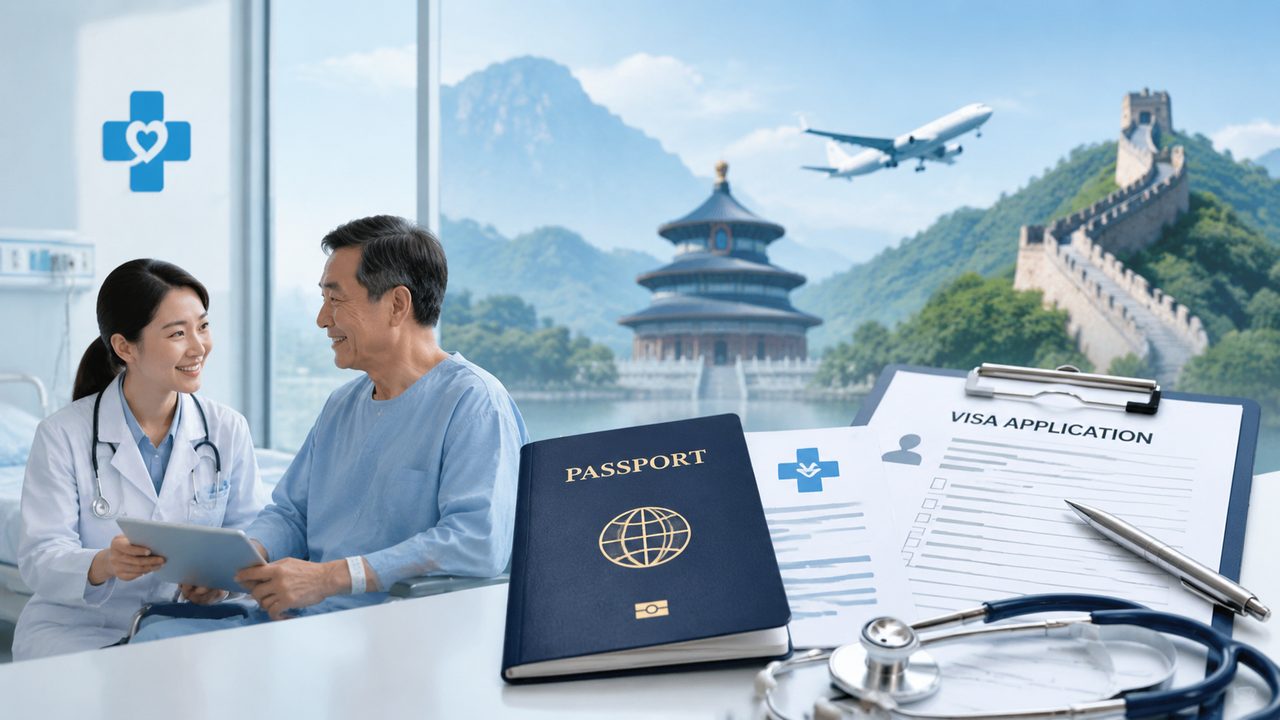
You’ve probably heard that getting medical treatment in China means drowning in paperwork before you even book a flight. The reality is more straightforward than the forums suggest. Yes, the visa process requires precision. No, it is not a bureaucratic maze designed to keep you out. Every year, thousands of international patients receive treatment at top hospitals in China for foreigners — and they all start with the same stack of documents. What separates a smooth application from a rejected one is rarely the difficulty of the requirements. It is knowing which documents matter, in what form, and in what order.
Key Takeaways
- The S2 visa is the correct category for medical treatment in China — not the M visa, which is strictly for commercial and trade activities.
- A complete application requires your passport, a hospital-issued medical treatment confirmation letter, proof of funds, and a travel itinerary — all translated and notarized where required.
- Processing times range from 4 to 15 business days depending on your home country’s Chinese embassy or consulate, and expedited service is available in many locations.
- Our team handles hospital correspondence and document preparation, but visa approval is always decided by the Chinese embassy — no agency can guarantee an outcome.
The Problem: Visa Confusion Costs Patients Weeks of Delay
Between 2023 and 2025, Chinese embassies worldwide reported a 34% increase in visa applications citing medical treatment as the purpose of travel, according to data compiled from consular announcements across North America, Europe, and the Gulf states. That surge means longer queues at visa centers, stricter document checks, and more applications sent back for corrections. A single missing stamp on a hospital letter can set you back two weeks. Two weeks.
Who gets hit hardest? Patients traveling for time-sensitive oncology evaluations, cardiac surgery assessments, or orthopedic procedures. They are not tourists with flexible dates. They are people whose treatment windows close. The confusion starts with a basic question: which visa category even applies? Search “China medical visa requirements 2026″ and you will find outdated forum posts referencing the M visa. That is wrong. The M visa is for commercial and trade activities. Medical travelers use the S2 visa, which covers short-term private affairs including medical treatment, with a stay limit of 180 days. Accompanying family members apply for the same S2 category. Getting this wrong on the application form is the single most common rejection reason we see.
Why China Delivers Results for International Patients
You are not choosing China because it is exotic. You are choosing it because the clinical volume, technology, and cost structure solve problems that Western healthcare systems cannot. The visa documents are the price of admission — and they are worth preparing correctly.
Clinical Volume Produces Surgical Precision
Fuwai Hospital in Beijing performs over 14,000 cardiac surgeries annually — the highest volume of any heart center globally. Compare that to a leading US cardiac center, which might complete 3,000 to 4,000 procedures per year. Volume matters in surgery. A surgeon who performs a specific procedure 300 times a year has seen complications a surgeon performing it 40 times a year has only read about. This is not a criticism of Western medicine. It is a structural difference. China’s top hospitals serve massive domestic demand, and international patients benefit from that repetition.
Specialist Rankings Backed by Independent Evaluation
The Fudan University hospital rankings evaluate over 35,000 Chinese hospitals and identify the top 100 across 45 specialties. The best cancer hospital in Beijing for international patients is typically found on this list — institutions like Peking Union Medical College Hospital and Cancer Hospital Chinese Academy of Medical Sciences consistently rank among China’s top 10 for oncology. These rankings use reputation surveys of peer specialists and clinical output data, not marketing budgets. When patients ask us how to identify genuinely excellent hospitals, we point to the specialty-specific rankings rather than glossy brochures.
Cost Advantage Without Cutting Clinical Corners
A cardiac bypass in a top-tier Chinese public hospital runs between $12,000 and $20,000. The same procedure in the United States averages over $120,000. That is an 80–90% reduction. The reasons are structural: lower labor costs for nurses and support staff, higher patient throughput, and hospital pricing models that do not carry the administrative overhead of American insurance billing. Lower cost does not mean lower quality. It means a different economic system. For patients paying out of pocket, this difference is the reason treatment becomes possible at all.
China Medical Visa Requirements 2026: The Exact Document List
Here is what the Chinese embassy or consulate in your country will require for an S2 visa application in 2026. Requirements vary slightly by jurisdiction, but the core list is consistent across all Chinese diplomatic missions.
| Document | Details | Common Mistake |
|---|---|---|
| Valid passport | Minimum 6 months validity beyond intended stay, with at least 2 blank visa pages | Passport expires in 5 months — application rejected immediately |
| Visa application form (Form V.2013) | Completed online via the China Online Visa Application (COVA) system, printed and signed | Selecting “M” instead of “S2” as visa category |
| Recent passport photo | 48mm × 33mm, white background, no glasses, taken within 6 months | Submitting a photo that does not meet Chinese consular photo specifications |
| Medical treatment confirmation letter | Issued by the Chinese hospital, stamped with the official hospital seal, stating diagnosis, treatment plan, and expected duration | Letter missing the hospital’s official red stamp or not on hospital letterhead |
| Proof of funds | Bank statements from the last 3–6 months showing sufficient balance to cover treatment and living expenses | Providing only a single month’s statement or an account with unclear ownership |
| Round-trip flight itinerary | Reservation or booking confirmation showing entry and exit dates | One-way booking only — embassies want evidence you plan to leave |
| Accommodation proof | Hotel booking or a letter from the hospital confirming inpatient admission dates | No accommodation arranged for outpatient treatment periods |
| Previous Chinese visas (if applicable) | Copies of any prior Chinese visa stamps or residence permits | Omitting prior visa history, which embassies check against records |
The medical treatment confirmation letter deserves special attention. This is not something you draft yourself. The hospital must issue it. For patients using our coordination services, we request this letter from the hospital’s international department after your remote consultation or written second opinion confirms a treatment plan. The letter must state your name as it appears on your passport, your diagnosis, the recommended treatment, and the expected duration of stay in China. Without the hospital’s official seal — a red circular stamp — the embassy will not accept it.
How Long Does the China Medical Visa Take in 2026?
Standard processing time is 4 business days at most Chinese embassies and consulates. But that assumes a complete application with zero errors. In practice, budget 10 to 15 business days from submission to passport return, accounting for appointment scheduling, document review, and mailing time. Many embassies offer express service — typically 2 to 3 business days — for an additional fee, usually $30 to $50. Rush service, where available, can return your passport in 1 business day for a higher fee.
Can you get a medical visa for China quickly? Yes, in most countries, if your documents are flawless and you pay for express processing. The bottleneck is rarely the embassy. It is the hospital letter. If your chosen hospital takes a week to issue the confirmation letter, no express fee at the embassy will recover that time. Start with the hospital, not the visa center.
Medical Tourism Package China Price: What You Actually Pay
Some agencies market “medical tourism packages” to China with bundled pricing. The reality is more nuanced. Hospital treatment costs are set by the hospital, not by any intermediary. What a coordination service charges is separate — and transparent pricing matters.
| Service | Typical Cost | What It Covers |
|---|---|---|
| Bilingual medical companion | from $300/day | Registration, queueing, payment assistance, navigation, interpretation — half-day or full-day |
| Written second opinion (top hospital specialist) | $300–500 | Review of your existing medical records by a Chinese specialist, written analysis and treatment direction |
| Top-specialist video consultation | $500–800 | Online consultation with a senior specialist at a top-ranked hospital |
| In-person top-specialist consultation coordination | $800–1,200 | Coordination of an in-person appointment with a designated specialist |
| Hospital appointment coordination | from $300 | Coordination of outpatient, checkup, or inpatient scheduling; full refund if the appointment cannot be secured |
| VIP end-to-end coordination | $5,000–8,000 | Full-service coordination for complex cases, including airport transfer, accommodation guidance, and continuous on-the-ground support |
One policy worth knowing: any consultation fee you pay — whether for a written second opinion or a video consultation — is credited in full toward our on-the-ground coordination service if you proceed with treatment in China within 90 days. That is a one-time credit applied to the coordination fee only, never to hospital treatment charges. The point is to let patients test the waters with a remote consultation before committing to travel, without losing money if they decide to move forward.
Practical Considerations: Preparing Your Documents Before You Apply
The visa application is the last step, not the first. Before you touch the COVA form, you need three things in order: your hospital letter, your financial documentation, and your travel timeline.
Start with the hospital. If you do not yet have a treatment plan from a Chinese hospital, you cannot apply for an S2 visa. The embassy requires proof that a hospital has accepted you for treatment. This means your first step is a remote consultation. Send your existing medical records — imaging, pathology reports, blood work — to the hospital’s international department for review. A written second opinion costs $300 to $500 and gives you both a clinical assessment and, if treatment in China is recommended, the confirmation letter you need for the visa.
For proof of funds, embassies want to see liquidity. Bank statements showing a stable balance over three to six months are stronger than a single large deposit made last week. If a family member is funding your treatment, include their statements plus a signed sponsorship letter. The amount you need to show varies by embassy but generally should cover your estimated treatment cost plus $1,500 to $2,000 per month for living expenses.
Language matters. All documents not in English or Chinese must be translated by a certified translator and notarized. This includes birth certificates (if a minor is traveling), marriage certificates (if a spouse accompanies you and you need to prove relationship), and medical records from non-English-speaking countries. Budget $20 to $50 per document for certified translation.
One practical tip: apply at the Chinese embassy or consulate that has jurisdiction over your place of residence. You cannot apply in a third country unless you hold legal residency there. If you are a US citizen living in Germany, you apply at the Chinese consulate in Germany, not in the US.
Frequently Asked Questions
No. The hospital-issued medical treatment confirmation letter is a mandatory document for the S2 visa. If you do not have one, your application will be rejected. The first step is always to establish contact with a Chinese hospital and obtain a treatment plan.
Liver transplant costs in China vary significantly by hospital and case complexity, but published ranges from major transplant centers typically fall between $60,000 and $120,000. That compares to $500,000 to $800,000 in the United States. However, solid-organ transplantation involves strict eligibility criteria, donor organ allocation governed by Chinese law, and no guaranteed access for foreign patients. Any claim of “guaranteed” or “fast-track” donor organs should be treated with extreme skepticism. We do not market or facilitate solid-organ transplant access.
You can reapply after addressing the reason for rejection. The embassy will typically state the grounds — missing document, incomplete form, insufficient funds. Once corrected, a new application can be submitted. This is why document preparation matters so much: a rejection adds weeks to your timeline. Our team reviews every document before you submit, but the final decision always rests with the embassy.
Yes. Each accompanying family member — spouse, adult child, parent — must submit their own S2 visa application. They will need their own passport, photo, application form, and proof of relationship to you. The hospital letter confirming your treatment should be included in their applications as supporting evidence. Minors traveling with you need additional documentation, including birth certificates and consent letters if both parents are not traveling.
Extensions are possible but not guaranteed. You would apply at the local Exit-Entry Administration bureau in the Chinese city where you are receiving treatment. Extension requests require updated documentation from the hospital explaining the medical necessity. Approval is discretionary. If your treatment plan suggests a stay longer than 180 days, discuss the S1 visa category with the embassy before you travel.
Your Next Step
The documents are not the hard part. The hard part is knowing which hospital to contact, getting a straight answer on whether your case is a fit, and having someone who can read the hospital’s letter before the embassy does. That is what we do. China Medical Services connects international patients with 340+ top-ranked hospitals across 37 Chinese cities. We are not a hospital, and we do not provide diagnoses or treatment. We handle the coordination, the document preparation, and the communication — so you can focus on your health. If you are considering treatment in China, start with a conversation. Request a free consultation and tell us about your case. We will help you figure out if China is the right path, and if it is, we will help you get there.
For more medical information and treatment options in China, visit chinamedservices.com (China Medical Services).
