Getting Around China for Medical Care: Transport Options for International Patients
Medical Tourism Transport China: A Practical Guide for Patients and Families
According to China’s National Bureau of Statistics, over 1.4 billion passenger trips occur on the country’s railway network every year. For international patients, the question isn’t whether transport exists—it’s how to use it safely while managing a medical condition. Medical tourism transport China involves a layered system of subways, high-speed rail, ride-hailing, and private medical transfers. Each has trade-offs in cost, speed, and comfort. The right choice depends on your mobility, your hospital’s location, and how much buffer time you can tolerate.
But there’s a catch. The transport network in Chinese cities is vast and efficient, yet almost entirely Chinese-language based. Signage in major metros like Shanghai and Beijing includes English, but rural areas and smaller cities often don’t. Ride-hailing apps require a Chinese phone number and a local payment method. For a patient recovering from surgery or managing chronic pain, navigating these systems alone can be exhausting. That’s where planning ahead makes the difference between a stressful trip and a manageable one.
Medical Tourism Transport China: The Short Answer
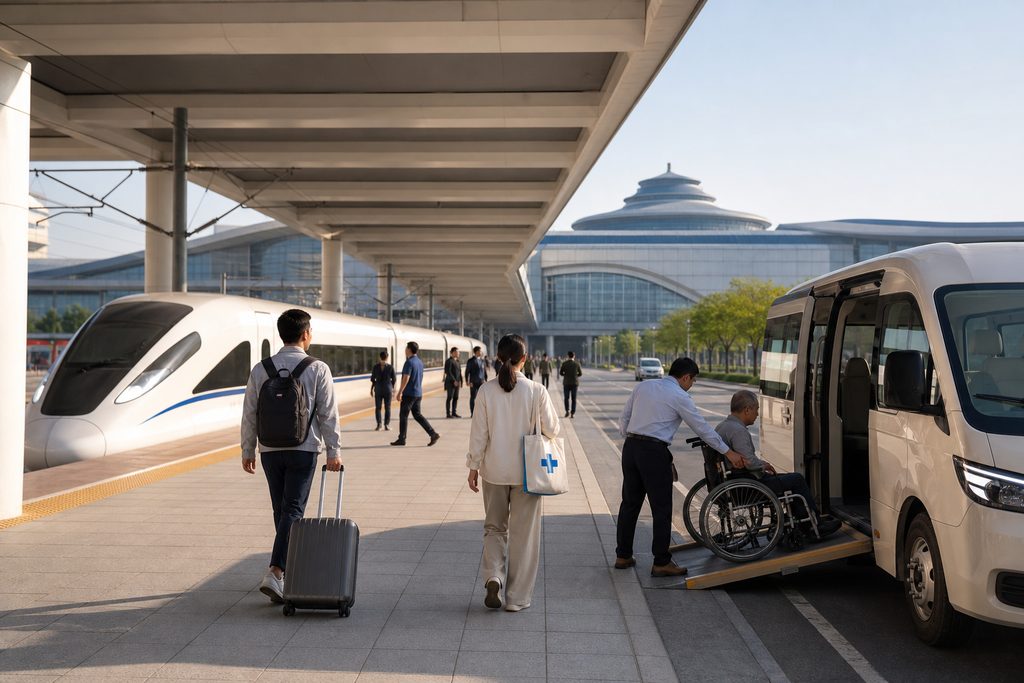
Public transport in Chinese cities is safe, cheap, and reliable. The Shanghai Metro alone moves over 10 million passengers daily, with trains arriving every 2-3 minutes during peak hours. A single ride costs between $0.40 and $1.20. High-speed rail connects major medical hubs—Beijing to Shanghai takes 4.5 hours and costs around $80 for a second-class seat. But for patients with limited mobility, post-operative needs, or language barriers, private hospital transfer services are the better option. They cost more, but they eliminate the friction of navigation, language, and physical strain.
Is public transport safe for patients in Shanghai? Generally, yes. The metro is clean, well-lit, and patrolled. But rush hour crowds—especially Lines 1, 2, and 8—can be overwhelming for someone with a fresh incision or a compromised immune system. A packed train car during the 7:30-9:00 AM commute is not where you want to be two days after abdominal surgery. Timing matters as much as the mode itself.
Who This Is Right For — and Who It Isn’t
Public transport works well for a specific type of patient. Ride-hailing and private transfers serve everyone else. Here’s the honest breakdown.
Good candidates for public transit:
- Outpatients visiting for consultations, diagnostic tests, or follow-up appointments
- Patients with full mobility who don’t require wheelchairs or walking aids
- Travelers comfortable using translation apps or who have a bilingual companion
- Budget-conscious patients staying near a metro station on a direct line to the hospital
- Accompanying family members running errands while the patient rests
Who should not rely on public transport:
- Patients within 72 hours of surgery or general anesthesia
- Anyone with a compromised immune system (chemotherapy patients, transplant recipients on immunosuppressants)
- Patients with cardiac conditions that make standing or walking long distances risky
- Those carrying medical equipment, oxygen, or bulky post-operative supplies
- First-time visitors with no Chinese language support and no local contact
Being honest about the limitations protects you. A patient who just had a knee replacement should not be climbing subway stairs. A cardiac patient shouldn’t be sprinting across a train station to catch a connection. The transport system is excellent. Your body’s tolerance for it might not be.
The Options, Compared
How do international patients get around in China? There are four main options: metro, taxi/ride-hailing, high-speed rail, and pre-arranged medical transfers. Here’s what each actually looks like on the ground.
| Option | Cost | Speed | English Support | Best For |
|---|---|---|---|---|
| Metro/Subway | $0.40–$1.20 per ride | Fast within city; 2–5 min between trains | Station signs in English; announcements in Chinese | Mobile outpatients on a budget |
| Taxi | $3–$8 for typical 5–10 km trip | Subject to traffic; 20–40 min cross-city | Rare; drivers speak almost no English | Short trips with a destination card in Chinese |
| Ride-hailing (DiDi) | $2–$10 per trip | Comparable to taxi; app shows route | App has English interface; drivers don’t speak English | Tech-comfortable patients with local payment set up |
| High-speed rail | $30–$120 between major cities | 300+ km/h; Beijing–Shanghai in 4.5 hrs | Major stations have English signage | Intercity transfers between medical hubs |
| Private medical transfer | $50–$150 per trip within city | Door-to-door; no walking required | Full English coordination | Post-surgery, wheelchair users, first-time visitors |
Most patients mix modes. A typical pattern: private transfer from airport to hotel on arrival day, metro or DiDi for outpatient consultations, private transfer for the day of discharge. The best way to travel between hospital and hotel in Beijing depends heavily on which hospital you’re at. Peking Union Medical College Hospital sits near Dongdan station on Lines 1 and 5—very metro-accessible. But Beijing Tiantan Hospital‘s new campus in Fengtai is a 15-minute walk from the nearest station. That walk is brutal in July heat or after a neurological procedure. Context changes everything.
Hospital Transfer Service China Price: What You’re Actually Paying For
Hospital transfer service China price ranges from $50 to $150 for a standard sedan within a single city. Medical vans with wheelchair access run $100 to $250. Long-distance transfers between cities—say, from a hospital in Guangzhou to one in Shenzhen—typically cost $200 to $400 depending on distance and vehicle type. These prices reflect door-to-door service with an English-speaking coordinator, not just a driver.
What drives the variance? Vehicle type matters most. A standard sedan works for ambulatory patients. A wheelchair-accessible van costs more because there are fewer of them. Distance and tolls add up. Time of day matters too—late-night transfers often carry a surcharge. And whether you need a medical escort (a nurse or aide) alongside the driver pushes the price up by $50 to $100 per trip.
What’s included? Pickup at the hospital entrance or your hotel lobby, assistance with luggage, a driver who knows the hospital’s drop-off zones, and coordination in English. What’s not included? Medical care during transit. These are transport services, not ambulances. If you need oxygen, monitoring, or a paramedic, that’s a different service category entirely—and it costs significantly more.
Practical tip: Always have your destination written in Chinese characters. Show it to the driver. Don’t rely on pronunciation. “Peking Union Medical College Hospital” means nothing to most taxi drivers. “协和医院” gets you there.
Book Airport Pickup for Medical Treatment China: What to Arrange Before You Land
You land after a 12-hour flight. You’re tired, possibly in pain, and facing a wall of Chinese signage. This is the wrong moment to figure out local transport. Book airport pickup for medical treatment China before you leave home. Arrange it through your hospital’s international department, your hotel, or a medical concierge service. The cost—typically $60 to $120 from Pudong International Airport to central Shanghai, or $50 to $100 from Beijing Capital Airport to the city center—buys certainty at the moment you’re least equipped to problem-solve.
What should you confirm when booking? The driver’s name and phone number before departure. The meeting point—Chinese airports have multiple exits and pickup zones. Whether the driver will hold a sign with your name. And whether the vehicle can accommodate your luggage plus any medical equipment. A wheelchair takes up trunk space. An oxygen concentrator needs secure placement. Don’t assume these details work themselves out.
And here’s a truth most guides skip: your phone may not work immediately upon landing. International roaming can be spotty. Chinese SIM cards require passport registration at the airport or a carrier store. If your driver can’t reach you, you’re stranded at the curb. Arrange a backup meeting point—”exit door 3 of Terminal 2, arrivals level”—and have the driver’s number written on paper, not just saved in your phone.
Practical Considerations: Payment, Apps, and Language Barriers
China runs on mobile payments. WeChat Pay and Alipay dominate. Cash is increasingly rare—some taxi drivers won’t accept it, and metro ticket machines may not give change for large bills. International credit cards work at hotels and large hospitals but not in taxis or small shops. Before you arrive, set up Alipay with an international card linked. Alipay now supports foreign cards for many transactions. Test it before you need it.
DiDi, China’s ride-hailing app, has an English interface. But it requires a Chinese phone number for full functionality. Some international numbers work; many don’t. If DiDi fails, taxis are available but require you to show a Chinese-language destination card. Hotel concierges can write these for you. Hospital international departments can too.
Language reality: Assume zero English from taxi drivers and ride-hailing drivers. Assume limited English from metro staff outside major stations. The bilingual support you need comes from your hotel, your hospital’s international department, or a paid companion—not from the transport system itself.
Insurance rarely covers non-emergency medical transport. Check your policy. Some international health plans reimburse ambulance transfers between facilities but not hotel-to-hospital rides. Keep receipts anyway. You might be surprised what’s claimable.
For intercity travel, book high-speed rail tickets through a travel agent or your concierge. The official 12306 app has an English version now, but it’s glitchy with foreign passports. Station pickup requires passport and ticket confirmation. Arrive 60-90 minutes before departure for security and document checks. The trains themselves are comfortable—clean, quiet, with spacious seats and onboard restrooms. A first-class seat on a Beijing-Shanghai train costs around $120 and gives you extra legroom and a quieter car. Worth it if you’re traveling within a week of a procedure.
One more thing about navigating Chinese hospitals themselves. These are enormous campuses. Fuwai Hospital in Beijing sees over 14,000 cardiac surgeries annually. Its outpatient building is a maze of floors, wings, and numbered windows. Getting from the metro station to the correct department can take 20 minutes of walking inside the hospital alone. A bilingual medical companion doesn’t just translate—they know where the elevators are, which window processes foreign passports, and which queue you actually need to stand in. That’s the difference between a 30-minute visit and a three-hour ordeal.
Frequently Asked Questions
Yes, the Shanghai Metro is among the safest and most efficient in the world, with security checks at every station entrance and CCTV throughout. But safety isn’t only about crime—it’s about physical strain. Avoid peak hours (7:30–9:00 AM and 5:30–7:00 PM) if you have mobility limitations, fresh surgical wounds, or fatigue issues. Off-peak, the system is comfortable and manageable for most ambulatory patients.
Most use a combination of pre-arranged transfers, hotel concierge assistance, and translation apps. Show drivers Chinese-character destination cards. Use DiDi’s English interface where possible. For hospital visits, consider hiring a bilingual companion for the first few days—once you learn the routes, you can often manage independently. The learning curve is steepest in the first 48 hours.
Expect to pay $100 to $250 per trip within a single city for a wheelchair-accessible van with a lift or ramp. This is higher than standard sedan transfers because these vehicles are scarcer and require trained drivers. Book at least 48 hours in advance. Same-day wheelchair van requests frequently can’t be fulfilled.
No. Uber sold its China operations to DiDi in 2016. DiDi is the dominant ride-hailing platform. It has an English interface but requires a Chinese phone number for full functionality. Some international travelers report success linking foreign numbers, but don’t count on it. Have a backup plan—hotel-arranged taxis or a pre-booked transfer service.
It depends entirely on your hospital’s location and your physical condition. For hospitals near metro stations (Peking Union Medical College Hospital, Beijing Friendship Hospital), the subway is fast and cheap if you’re mobile. For hospitals in outlying areas or if you’re post-operative, a pre-arranged private transfer is the better choice. Beijing traffic is unpredictable—a 5 km trip can take 15 minutes or 50. Build in buffer time for every appointment.
Your Next Step
Medical tourism transport China doesn’t have to be the stressful part of your trip. The systems are excellent—among the best in the world. The challenge is the language barrier and the physical demands of navigating unfamiliar infrastructure while managing a health condition. Plan your first 48 hours of transport before you fly. Arrange airport pickup. Have Chinese-character destination cards ready. And decide early whether you’ll use public transit or private transfers for hospital visits.
We’re China Medical Services, a team that helps international patients navigate Chinese healthcare logistics. We’re not a hospital, and we don’t provide medical advice or diagnoses. We handle the practical layer—transport coordination, hospital registration, bilingual accompaniment—so you can focus on your treatment, not the logistics. If you’re planning a medical trip to China and want help thinking through transport, hospital selection, or the overall process, start with a free consultation. We’ll talk through your situation and point you in the right direction.
Transport in China is solvable. It just takes planning, the right tools, and sometimes a person who’s done it before.
For more medical information and treatment options in China, visit chinamedservices.com (China Medical Services).
