Sleep Apnea Treatment in China: Costs, Top Hospitals, and How to Book Care
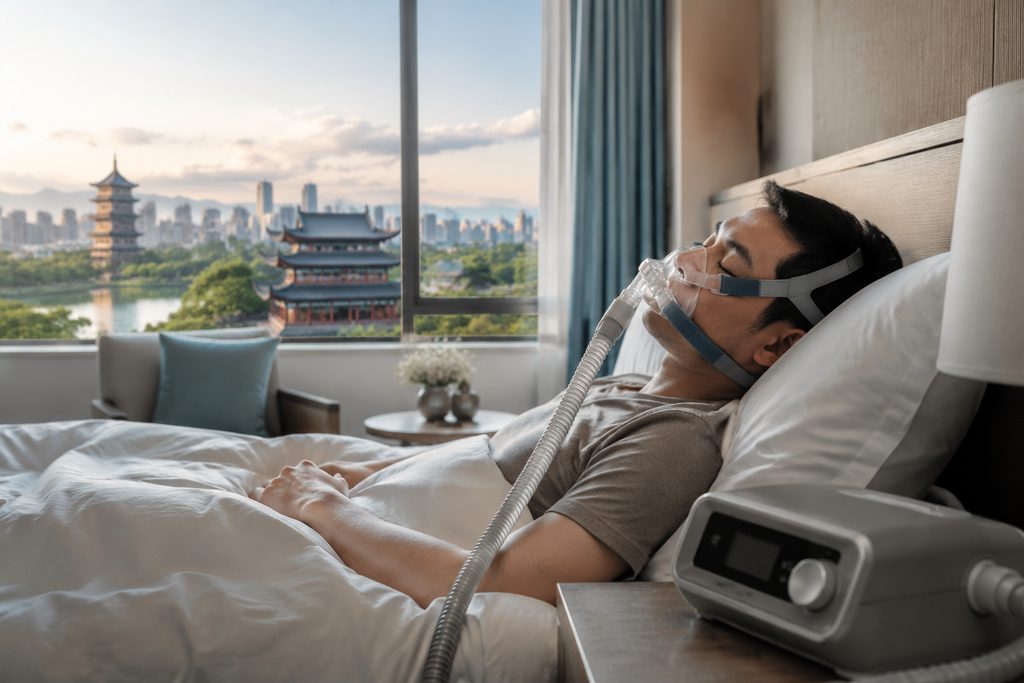
You have probably heard that getting medical care in China means long waits, language chaos, and uncertain quality. For sleep apnea specifically, the assumption is often that you would need to bring your own machine, manage everything alone, and pray nothing goes wrong. The reality is more structured than that. Public and private hospitals in major Chinese cities run dedicated sleep centers with overnight polysomnography, CPAP titration, and surgical programs, and the sleep apnea treatment cost China runs a fraction of Western pricing. The challenge is not whether care exists. It is knowing which door to walk through, what documents to prepare, and what the actual sequence looks like from first contact to a working treatment plan.
How This Actually Works, Step by Step
You do not just fly to Shanghai and walk into a sleep clinic expecting same-day titration. The process starts remotely, with records. Here is the sequence we walk our patients through.
First, you send what you already have: any prior sleep study, a list of symptoms, current medications, and your height and weight. If you have used a CPAP before, include your pressure settings and mask type. A Chinese sleep specialist reviews these before anything is booked. That review determines whether you need a fresh in-lab study or can proceed directly to a consultation.
Second, the hospital confirms a date. Top sleep centers in Beijing and Shanghai typically schedule new international patients within one to three weeks, depending on the department and whether you are going through the standard public route or the hospital’s international VIP channel. The public route means you register and queue on the day. The international channel lets you lock a specific date and specialist in advance. The price difference is real, and we will get into that.
Third, you arrive for the study. A full polysomnography night in a Chinese sleep lab costs between $150 and $400 at a top public hospital, compared with $2,000 to $5,000 in the United States. You sleep in a private or semi-private room wired with EEG, respiratory belts, oximetry, and video. A technician monitors you all night. Results are usually available the next morning.
Fourth, the treatment decision. If CPAP is indicated, you do a titration study — either the same night or a second night — and leave with a prescription for a machine and mask. If surgery is on the table, the ENT or oral-maxillofacial team reviews your airway imaging and anatomy before scheduling anything. No hospital in China will operate on sleep apnea without objective study data and a face-to-face consultation.
How Is Sleep Apnea Treated in China: The Clinical Reality
Treatment in China follows the same international ladder you would find at a sleep center in Germany or the US. The difference is cost, speed, and the volume of surgical experience at certain centers.
CPAP remains the first-line treatment for moderate to severe obstructive sleep apnea. Chinese hospitals dispense and titrate ResMed, Philips, and domestic brands like BMC and Yuwell. A ResMed AirSense 10 or 11 costs roughly $800 to $1,200 out of pocket in China, similar to Western pricing, though domestic machines run $300 to $600. The titration study itself is inexpensive, and many international patients use the Chinese titration data to buy a machine back home through insurance.
Oral appliances are available through dental sleep medicine departments at major stomatology hospitals. Custom mandibular advancement devices cost between $500 and $1,500 depending on the hospital and materials. This is often the right choice for mild to moderate cases or for patients who cannot tolerate CPAP.
Surgery is where Chinese volume becomes relevant. Uvulopalatopharyngoplasty, or UPPP, and newer techniques like expansion sphincter pharyngoplasty and hypoglossal nerve stimulation are performed at high-volume ENT centers. A UPPP in China costs between $3,000 and $8,000 at a top public hospital, compared with $15,000 to $40,000 in the US. The surgeons at major centers do hundreds of these procedures annually, which matters for outcomes. But surgery is never the first conversation. Any responsible Chinese sleep surgeon will ask why CPAP failed before discussing the scalpel.
A Realistic Timeline
People underestimate the administrative lead time. Here is what a typical journey looks like for an international patient pursuing sleep apnea care in China.
| Stage | What Happens | Realistic Duration |
|---|---|---|
| Remote records review | You send prior studies and history; a specialist reviews | 3–7 days |
| Appointment confirmation | Hospital confirms sleep study date; international channel may lock a specialist | 1–3 weeks |
| Visa processing | S2 visa application with hospital invitation letter | 1–4 weeks, varies by consulate |
| Travel and arrival | Fly in, settle, attend first consultation | 1–2 days |
| Sleep study night | Overnight polysomnography; results next morning | 1–2 days |
| CPAP titration | If indicated, second night or split-night study | 1–2 days |
| Treatment plan finalization | Prescription issued; machine fitting or surgery scheduling | 1–3 days |
| Surgery (if applicable) | Pre-op workup, procedure, hospital stay | 3–10 days total |
Total time from first email to walking out with a working CPAP prescription: two to six weeks. Add surgery and you are looking at a month on the ground, including recovery before flying home. Nobody should plan a sleep apnea trip to China on a one-week itinerary unless they are only doing a consultation.
What Can Go Wrong — and What Happens Then
Let us be blunt about the failure modes, because they exist and you should plan for them.
Your prior sleep study is not accepted. Some Chinese hospitals will not rely on a home sleep test from another country and will require an in-lab study before treating. The recourse is simple: do the in-lab study. It costs a few hundred dollars and gives the local team clean data.
The specialist you wanted is not available. Top names in Chinese sleep medicine have packed schedules. If you insist on one particular doctor through the public route, you may wait months. The international channel solves this by booking a specific specialist in advance, but at 1.5 to 2 times the standard consultation fee. If the doctor is still unavailable, the hospital will propose a peer with equivalent seniority. You decide whether to accept or reschedule.
The titration does not go smoothly. Some patients cannot sleep in a lab, or their apnea is positional and the first night is not representative. Hospitals handle this by repeating the study or doing a split-night protocol. You pay for the extra night, but the cost is modest compared with Western labs.
Insurance refuses to reimburse. Chinese public hospitals require prepayment, and you submit claims afterward. Not all international insurers reimburse care in China. Check your policy before booking. Private international hospitals like United Family and Jiahui offer direct billing with many insurers, which removes the cash-flow problem but raises the sticker price.
Where to Go: Best Sleep Apnea Hospital Shanghai and Beyond
A full diagnostic pathway — consultation, overnight polysomnography, and CPAP titration — runs $400 to $1,200 at top public hospitals. Surgery ranges from $3,000 to $8,000 depending on the procedure. Private international hospitals charge more, often $1,500 to $3,000 for the diagnostic workup alone. All figures vary by hospital and case complexity.
No reputable hospital will let you book surgery without an in-person consultation and an on-site sleep study. What you can book in advance is the consultation and the sleep study, through the hospital’s international department or a coordination service. Surgery gets scheduled after the local team reviews your data.
Some private international hospitals and medical tourism agencies market packaged sleep apnea workups that bundle the study, consultation, and hotel. These are convenient but often cost more than arranging the same care directly through a public hospital’s international department. Read the fine print on what is included before paying for a package.
Most will, provided the report is in English and includes raw data. Ask the Chinese hospital to issue an English-language report with the full polysomnography summary. If your home physician wants a specific format, request it before the study is finalized.
Your Next Step
Sleep apnea care in China is real, structured, and dramatically less expensive than in the US or Europe. The hard part is not the medicine. It is the coordination: knowing which hospital fits your case, getting the right appointment, and having someone in the room who speaks both languages. That is what we do at China Medical Services. We do not diagnose or treat. We connect you with the right specialists, arrange your appointments, and stand beside you through the process. If you are weighing a sleep study or surgery in China, start with a conversation. Send us your records and questions, and we will tell you honestly whether this path makes sense for your case.
Bring your sleep data. Ask hard questions. Plan for the waiting steps. And if you decide China is right for your care, do not go alone.
Frequently Asked Questions
Yes. The hospitals used for international patients are JCI-accredited and follow the same international safety standards as top hospitals in the US and Europe. Surgical teams perform high volumes of procedures — often more than their Western counterparts — which studies show leads to better outcomes.
Costs vary by procedure and hospital, but international patients typically save 40-80% compared to US prices — even when factoring in travel and accommodation. A consultation with our team will give you an exact, all-inclusive quote with no hidden fees.
Send us your existing medical reports to get started. We handle everything from hospital selection and appointment scheduling to visa assistance and post-operative recovery planning. Your medical records are reviewed by the specialist before you even book a flight.
For more medical information and treatment options in China, visit chinamedservices.com (China Medical Services).
