Colonoscopy in China: Costs, Top Hospitals, and How to Book
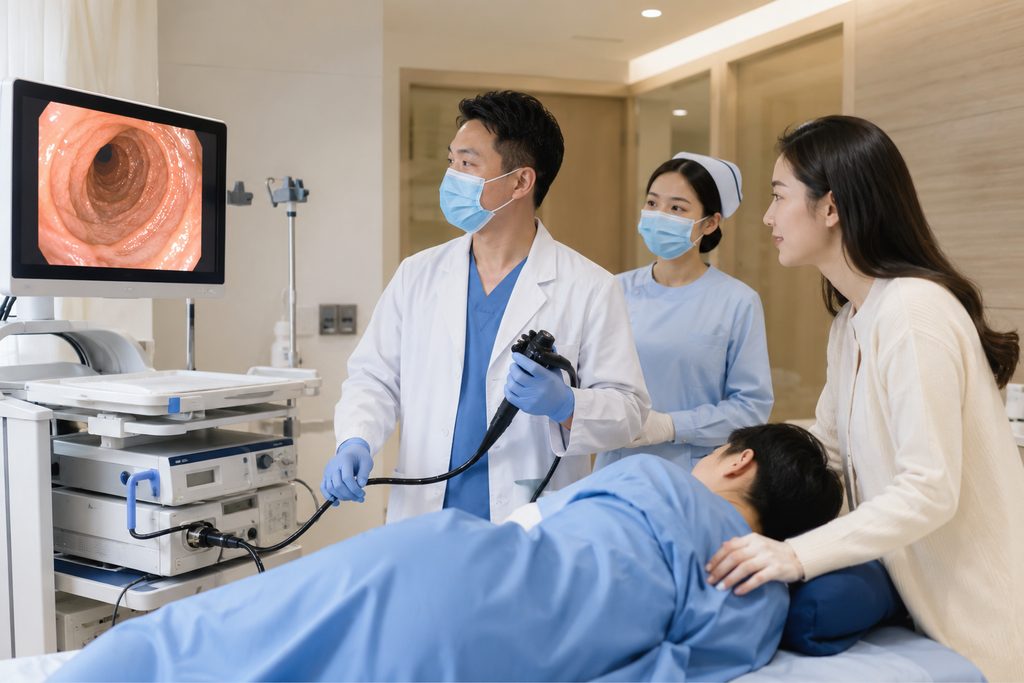
You’ve probably heard that getting medical care in China means long lines, language chaos, and questionable quality. For routine procedures like a colonoscopy, that assumption collapses fast. The reality is that China’s top-tier hospitals run some of the highest-volume endoscopy centers on the planet — and the colonoscopy cost China patients pay often lands between $150 and $600 at a public hospital’s international department, compared to $2,000 to $5,000 out-of-pocket in the United States. The question isn’t whether you can get one. It’s how to get it done without burning a week on logistics.
But there’s a catch. You can’t just email a hospital and book a slot. Chinese public hospitals rarely accept overseas reservations for routine outpatient procedures. You need either a local proxy, a hospital international department, or a service that coordinates the process. We’ll break down exactly how that works below.
Can Foreigners Get a Colonoscopy in China? The Short Answer
Yes. Foreigners can absolutely get a colonoscopy in China. The procedure itself is identical to what you’d receive in the US, UK, or Australia — same Olympus and Fujifilm endoscopes, same sedation protocols, same polypectomy techniques. The difference is the pathway to booking it.
Public hospitals operate on a walk-in registration system. You show up, queue for a number, see a gastroenterologist, get a colonoscopy order, schedule the prep and procedure, and return days later. That’s fine if you live in Shanghai. It’s a nightmare if you’re flying in from London or Dubai. The workaround is the hospital’s international medical department — known in many facilities as the VIP or special-needs clinic. These departments handle foreign patients, offer English-speaking staff, and can often coordinate a colonoscopy within 3 to 7 days of your consultation. The price runs roughly 1.5 to 2 times the standard outpatient rate, which still leaves you far below Western costs.
Who This Is Right For — and Who It Isn’t
A colonoscopy in China makes strong sense for several groups of people. It’s not for everyone.
Good candidates:
- People who need a screening colonoscopy and are paying out-of-pocket in their home country
- Expats already living in China who want a faster appointment than their home country’s public system offers
- Medical tourists combining a screening with other health checks or treatment in China
- Patients who want a second look at a previous finding — polyps, bleeding, family history of colorectal cancer
- Travelers who are comfortable with a 3-to-5-day stay in a major Chinese city
Who should think twice:
- People with unstable heart or lung disease who need a higher level of anesthetic monitoring than a standard endoscopy suite provides
- Patients on blood thinners who cannot safely pause medication without close specialist supervision
- Anyone with a known complex polyp that requires advanced endoscopic mucosal resection — you’d want a dedicated therapeutic endoscopy center, not a standard screening unit
- People who need results interpreted by a doctor in their home country and cannot arrange that handoff
If you’re in the second group, staying home is genuinely better. No savings justify a risky procedure in an unfamiliar system.
The Options, Compared
| Option | Typical Cost (USD) | Wait Time | Language Support | Best For |
|---|---|---|---|---|
| US outpatient center (uninsured) | $2,000–$5,000 | 1–4 weeks | Native | Complex cases, insurance coverage |
| China public hospital, standard clinic | $80–$250 | 3–14 days | Minimal | Mandarin speakers, local residents |
| China public hospital, international dept | $150–$600 | 3–7 days | English available | Foreigners wanting low cost + support |
| China private international hospital | $400–$1,200 | 1–5 days | Full English | Insurance direct billing, Western-style care |
The international department route hits the sweet spot for most foreign patients. You get English-speaking coordination, faster scheduling, and a price that’s still 80–90% below US rates. Private international hospitals like United Family or Jiahui cost more but handle insurance paperwork directly and feel closest to a Western clinic. The standard public clinic is cheapest but realistically requires a Mandarin-speaking companion.
What a Colonoscopy in China Actually Involves
Here’s the part most articles skip. A colonoscopy is not a walk-in, get-scoped, walk-out procedure. It demands prep, and prep takes a full day.
The standard protocol in Chinese hospitals mirrors international guidelines. You’ll get a split-dose polyethylene glycol solution — usually 2 to 3 liters. The day before the procedure, you stop solid food. You drink the first half of the prep in the evening, the second half the next morning. Expect multiple bathroom trips. The hospital will want you at the endoscopy unit 1 to 2 hours before your slot for paperwork, IV placement, and sedation consent.
Sedation in China is typically propofol-based, administered by an anesthesiologist. You’ll be asleep for the 15 to 30 minutes the scope takes. If a polyp is found, the gastroenterologist usually removes it on the spot — that’s standard practice and included in the base procedure fee at most hospitals. Biopsy results take 3 to 7 working days, and many international departments will email you the pathology report in English.
One thing to know: you cannot fly immediately after sedation. Most hospitals advise waiting 24 hours before air travel. Plan for a minimum 3-day stay — day one for consultation and prep, day two for the procedure, day three as a buffer before departure.
Colonoscopy Cost China: What You’ll Actually Pay
The headline numbers sound almost too good to be true. Let’s look at what drives them.
At a top public hospital’s international department in Beijing or Shanghai, a standard screening colonoscopy without polypectomy runs from $150 to $400. Adding polyp removal pushes it to $250 to $600. Sedation and anesthesia fees are usually bundled, but confirm this — some hospitals bill anesthesia separately at $50 to $100. A pre-procedure consultation with the gastroenterologist costs $30 to $80. Pathology on any removed tissue adds $50 to $150 per specimen.
Private international hospitals in Shanghai charge $500 to $1,200 for the same procedure. That’s the price of English-native staff, JCI accreditation, direct insurance billing, and a more hotel-like environment. Still far below US rates.
What’s not included: your flight, hotel, visa, and any companion or coordination service. A bilingual medical companion typically starts at $300 per day. A full appointment coordination package starts from $300. Even with those added, a foreign patient flying to Shanghai for a colonoscopy often spends less than the US out-of-pocket price for the procedure alone.
Prices vary by hospital and case complexity. Always get a written quote before committing.
Best Gastroenterology Hospitals in Beijing and Shanghai
If you’re asking “how much is a colonoscopy in Shanghai” or searching for the best gastroenterology hospital Beijing has, you’re already thinking in the right direction. Both cities host multiple hospitals ranked among China’s top 10 for gastroenterology in the Fudan specialty reputation rankings.
In Beijing, Peking Union Medical College Hospital (PUMCH) runs one of the country’s most respected gastroenterology departments. Its international medical services department handles foreign patients daily. Also strong: Peking University Third Hospital and Beijing Friendship Hospital — the latter is a national center for digestive diseases and performs an enormous volume of endoscopies annually.
In Shanghai, Zhongshan Hospital affiliated with Fudan University and Ruijin Hospital both rank among China’s best for digestive diseases. Both have international departments with English-speaking coordinators. Renji Hospital, also in Shanghai, is another high-volume gastroenterology powerhouse.
For a deeper look at specialty rankings, see our department-specific hospital rankings and our guide to China’s top-ranked hospitals by city.
Private options in both cities — United Family, Jiahui, Parkway — offer JCI-accredited gastroenterology services with native English staff. You’ll pay more, but the process feels familiar if you’re coming from a Western healthcare system.
Practical Considerations: Booking, Records, and Follow-Up
Let’s talk logistics. This is where most foreign patients hit friction.
Medical records. Bring any previous colonoscopy reports, pathology slides, or imaging. If you’ve had polyps before, the gastroenterologist needs to know the histology. Have documents translated into Chinese if possible — though international departments can usually work from English originals.
Visa. Medical treatment in China falls under the S2 visa category — short-stay, for private affairs including medical care. It’s not the M visa, which is strictly for commercial and trade activities. You’ll need supporting documents from the hospital, typically an invitation letter or treatment confirmation. Requirements shift, so check with the Chinese embassy or consulate in your country before booking flights. We can help you understand what documents the hospital needs to issue.
Payment. Public hospital international departments generally require prepayment — cash, UnionPay, or major credit cards. Private international hospitals often bill your insurer directly. If you have international health insurance, confirm coverage before traveling. Many policies exclude routine screening, which means you’d pay out-of-pocket and seek reimbursement.
Language. International departments have English-speaking staff. But the moment you step outside that department — to the pharmacy, the lab, the cashier — English disappears. A bilingual companion who knows the hospital layout saves hours of confusion.
Follow-up. If a polyp is removed, you’ll get a pathology report. Your home doctor can interpret it. If the finding is significant, the Chinese hospital will recommend a follow-up interval — typically 1, 3, or 5 years depending on histology. You can do that follow-up anywhere.
Frequently Asked Questions
Yes, but only through the right channel. A public hospital’s standard outpatient clinic will be nearly impossible without Mandarin. The international department or a private international hospital solves this — English-speaking staff handle registration, consent, and discharge instructions. A bilingual companion helps for anything outside that department.
Prices are similar. Expect $150 to $600 at a public hospital international department in either city, with Shanghai’s private international hospitals trending slightly higher than Beijing’s due to a larger expat market. The bigger variable is which hospital you choose and whether polyp removal is needed. Always request a written quote.
At top-ranked hospitals, yes. The gastroenterology departments at PUMCH, Zhongshan, Ruijin, and similar institutions perform thousands of colonoscopies annually using the same equipment and sedation protocols as Western centers. The risk profile is comparable. What differs is the coordination burden — which is why choosing the right hospital and support matters more than the procedure itself.
Polyps are removed during the procedure and sent to pathology. If a malignancy is found, the hospital will recommend next steps — often additional imaging, then surgery or endoscopic resection. You are not obligated to continue treatment in China. You can take the pathology report and images home and consult your own specialist. The report belongs to you.
You’ll typically apply for an S2 visa, which covers short-term private affairs including medical treatment. The hospital provides supporting documentation. The M visa is not appropriate — it’s for commercial activity. Requirements change, so verify with the Chinese embassy or consulate handling your application.
Your Next Step
A colonoscopy in China is not a complicated procedure to arrange once you know the pathway — international department, S2 visa, 3 to 5 days, $150 to $600 plus travel. What’s harder is knowing which hospital to trust and how to navigate the paperwork. That’s where we come in.
China Medical Services maintains a database of 340+ top-ranked hospitals across 37 cities, including the gastroenterology leaders in Beijing and Shanghai. We are not a hospital and we do not diagnose or treat. We help you identify the right facility, coordinate the appointment, and arrange a bilingual companion if you want one. Start with a free consultation — tell us your situation, and we’ll map out what a screening trip would look like, including realistic costs and timing.
Getting a colonoscopy in China is not a compromise. It’s a smart financial decision for the right patient — provided you plan it properly. That planning is exactly what we do.
For more medical information and treatment options in China, visit chinamedservices.com (China Medical Services).
