Is STD Testing Confidential? Privacy Rules, Costs, and Where to Get Discreet Screening in Shanghai
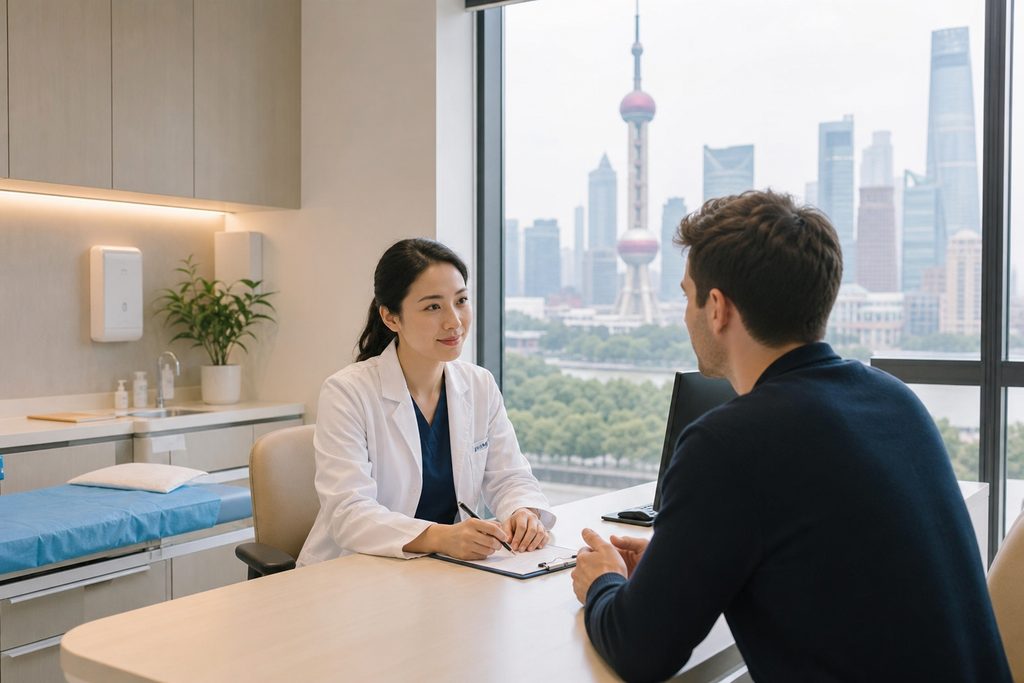
Confidential STD testing means exactly what it sounds like: your name, your results, and the fact you got tested stay private. No employer notification. No insurance letter home. No record shared with anyone you haven’t authorized. For expats in China, this privacy concern runs deep — many worry that testing at a local hospital might somehow surface in a work permit renewal or a shared health record. That fear keeps people from getting tested at all. And untreated infections don’t wait.
Here’s the reality: confidential std testing Shanghai is available through multiple channels — private international clinics, public hospital VIP departments, and self-pay laboratory testing. Each has different privacy mechanics, price points, and speed of results. This guide breaks down exactly how confidentiality works in the Chinese healthcare system, what you’ll pay, and how to book screening without your employer, insurer, or family finding out.
Key Takeaways
- China has no centralized national STD registry accessible to employers or immigration authorities — your hospital record stays within the hospital system unless you authorize release.
- Private international clinics in Shanghai offer the highest privacy tier: anonymous or pseudonymous registration, cash or card self-pay, and results delivered only to you.
- Self-pay testing bypasses insurance entirely, meaning no explanation of benefits (EOB) letter gets mailed to your home or employer.
- Standard STD panels in Shanghai cost $80–$250 at private clinics, with results in 1–3 days; rapid HIV tests return in 20–30 minutes.
The Problem: Fear of Exposure Keeps People From Getting Tested
A 2023 survey by the Shanghai Municipal Center for Disease Control and Prevention found that among expatriates who suspected they might have an STI, 41% delayed testing for more than three months. The top reason cited? Worry that test results would somehow reach an employer, a spouse, or a government database. That’s a dangerous delay. Chlamydia and gonorrhea can cause pelvic inflammatory disease and infertility when left untreated. Syphilis progresses through stages that eventually damage the heart and brain. HIV, caught early, is manageable; caught late, it’s life-threatening.
The fear isn’t entirely irrational. In some countries — including the US — insurance claims generate EOB documents that list lab tests by name. A family member opening the mail sees “STD panel” in black and white. In China, the system works differently. But if you don’t know that, you assume the worst. And assumption becomes inaction.
Here’s what actually happens when you get tested in Shanghai: the hospital or clinic creates a medical record under your name. That record is governed by China’s Law on the Prevention and Treatment of Infectious Diseases and the Civil Code’s privacy provisions, both of which impose confidentiality obligations on healthcare providers. Your employer has no access to it. Your insurer only sees a claim if you file one. And if you self-pay, no claim exists at all.
Why Shanghai’s Private Medical Sector Delivers Real Privacy
Shanghai hosts the densest concentration of private international clinics in mainland China. Jiahui Health, United Family Healthcare, Parkway Health, and Raffles Medical all operate multiple locations across the city, staffed by bilingual physicians and licensed by the Shanghai Health Commission. These aren’t back-alley labs. They’re JCI-accredited facilities that treat diplomats, executives, and families. And they treat STD testing as a routine, non-judgmental service.
Registration Without a National ID
At a Chinese public hospital, you typically register with a national ID card or passport, and the hospital issues a medical card linked to that identity. That’s fine for most care. But it means your name is attached to every test order. Private clinics in Shanghai handle this differently. Many allow registration under a pseudonym or an abbreviated name for STD testing specifically. You present your passport for identity verification at the front desk — required by law — but the lab requisition and test results can be issued under a code or initials. The front desk knows who you are. The lab sees a number. Your results are released only to the phone number or email you provide.
Self-Pay Means No Paper Trail to Your Insurer
This is the single biggest confidentiality lever you control. When you use international health insurance, the clinic submits a claim on your behalf. That claim includes diagnostic codes. Your insurer’s portal then shows “STD screening” in your claims history — visible to anyone with access to the policy, including the policyholder if it’s your employer or spouse. Self-pay eliminates that entirely. You pay by card or cash. The clinic issues a receipt that says “laboratory services” or “consultation.” No claim. No EOB. No portal record.
Cost is the trade-off. A comprehensive STD panel at a private Shanghai clinic runs $150–$250 self-pay. The same panel at a public hospital costs $40–$80 — but you’ll navigate Chinese-language registration, wait in shared queues, and have your name on every form. For most expats, the privacy premium is worth it.
Results Delivered Only to You
Shanghai private clinics default to a “no news is good news” model for some tests, but for STD screening, you want active notification. The standard practice: you provide a personal email and a phone number. Results arrive via encrypted email or a patient portal login. Some clinics still call — but only to the number you gave, and only with your consent to leave a voicemail. No letters. No faxes. No calls to your office. If you test positive, the clinic’s physician calls you directly to discuss treatment. That conversation is covered by the same confidentiality obligations as the test itself.
What STD Testing Actually Costs in Shanghai — and What You’re Paying For
Price transparency in Chinese healthcare is inconsistent. Public hospitals post official price lists, but they’re in Chinese and assume you understand the itemized billing system. Private clinics quote package prices upfront. Here’s what you can expect to pay for common STD screening options in Shanghai, based on 2025 pricing from major international clinics:
| Test or Panel | Public Hospital (Self-Pay) | Private International Clinic | Turnaround Time |
|---|---|---|---|
| HIV rapid test (fingerstick) | $8–$15 | $40–$60 | 20–30 minutes |
| Syphilis (RPR/TPPA) | $10–$20 | $35–$55 | Same day to 24 hours |
| Chlamydia + Gonorrhea (urine PCR) | $25–$40 | $80–$120 | 1–2 days |
| Hepatitis B + C screening | $15–$30 | $50–$80 | 1 day |
| Full STD panel (HIV, syphilis, chlamydia, gonorrhea, hep B/C, herpes) | $70–$120 | $180–$280 | 2–3 days |
Prices vary by hospital and case complexity, and these are self-pay rates — no insurance involvement. The std check price China expat forums often quote ($100–$150) usually refers to a mid-range private clinic panel covering the core four: HIV, syphilis, chlamydia, gonorrhea. If you add herpes simplex virus (HSV) IgG/IgM, hepatitis screening, and trichomoniasis, expect the higher end of the range.
One structural reason costs stay lower than Western benchmarks: Chinese laboratories process enormous volumes. A single Shanghai lab may run 2,000–3,000 PCR tests per day, spreading fixed equipment costs across far more samples than a typical Western clinic lab. That efficiency doesn’t compromise accuracy — the major Shanghai labs participate in external quality assessment programs and use the same testing platforms (Roche Cobas, Abbott Architect) found in US and European facilities.
Where to Get a Discreet STD Test in Shanghai: Your Real Options
You’re weighing three practical routes. Each has a different privacy profile, cost structure, and user experience. Here’s the honest comparison.
Option 1: Private International Clinics — Highest Privacy, Highest Cost
Jiahui, United Family, Parkway, and Raffles all offer walk-in or appointment-based STD testing. Registration takes 10 minutes. The consultation is with an English-speaking physician who asks about symptoms, exposure history, and what you want tested. You can decline any test. The blood draw and urine sample happen on-site. Results come through the clinic’s patient portal or encrypted email. Total time in the clinic: 45–60 minutes. Total cost: $150–$280 depending on panel breadth.
These clinics also offer anonymous HIV testing through partnerships with Shanghai CDC programs. If you ask for anonymous testing, the clinic uses a code instead of your name on the lab form, and results are given verbally or via a code-matched printout. Not every clinic offers this for every STD, but for HIV specifically, anonymous testing is widely available.
Option 2: Public Hospital VIP / International Departments — Middle Ground
Top-tier public hospitals in Shanghai — Huashan Hospital, Ruijin Hospital, Zhongshan Hospital — operate international or VIP departments where English-speaking staff handle your registration and escort you through the process. Your name is on the record, but the record stays within that hospital’s system. No employer access. No insurer access if you self-pay. The testing itself costs public-hospital rates ($70–$120 for a full panel), but the VIP department adds a service fee, bringing the total to roughly $120–$180. Privacy is strong, but not anonymous — the staff know who you are.
Wait times vary. VIP departments offer same-day appointments, but you may still wait 30–60 minutes during peak hours. Results typically arrive in 1–3 days, same as the main hospital lab.
Option 3: Direct-to-Lab Services — Emerging Option, Use Caution
Several lab chains in Shanghai (Dian Diagnostics, ADICON) now offer direct-to-consumer testing through WeChat mini-programs or partner pharmacies. You order online, collect a kit or visit a collection point, and receive results via app. Prices are low — $50–$90 for a full panel. But the user interface is entirely in Chinese, and the privacy model is less clear. These services are designed for the domestic market, not expats. If you can’t read Chinese fluently, you’ll struggle with registration, sample collection instructions, and result interpretation. For most international patients, this route creates more confusion than it solves.
Is STD Testing Anonymous in Beijing? What Expats Should Know
Beijing’s privacy landscape mirrors Shanghai’s, with one notable difference: the city’s CDC district offices run free, anonymous HIV and syphilis testing centers that have served the expat community for years. These government-run sites use code-based registration — no name, no passport, no fee. The trade-off is limited test menu (HIV, syphilis, sometimes hepatitis) and a clinical, utilitarian environment. For comprehensive STD panels, Beijing’s private international clinics (United Family, OASIS, Beijing Puhua) operate on the same model as their Shanghai counterparts: pseudonymous registration, self-pay, results to your personal email or phone.
So yes — is std testing anonymous in Beijing? For HIV and syphilis at CDC sites, fully anonymous. For broader panels at private clinics, confidential but tied to your identity for billing purposes. If you need complete anonymity for a non-HIV test, your options narrow. Some private clinics will accommodate anonymous testing for gonorrhea and chlamydia if you ask and pay cash, but this is at the physician’s discretion, not a guaranteed policy.
Practical Considerations: Documentation, Payment, and Follow-Up
Getting tested in China as a foreigner requires a passport or other government-issued photo ID. This is non-negotiable — clinics must verify identity under Chinese medical regulations. The ID verification happens at registration. What happens after that depends on the clinic’s privacy policy. Ask these questions before you book:
How are results delivered? Insist on email or patient portal. Decline any offer to send results by post. Decline any offer to call a landline number associated with your employer or housing compound.
What appears on the receipt? If you’re paying by card, ask what the charge descriptor will show. Most Shanghai private clinics bill under a generic name like “Jiahui Health Services” or “Parkway Medical” — not “STD Testing Department.” Cash eliminates even that trace.
Who has portal access? If you’re on an employer-sponsored insurance plan, your employer may have administrative access to the insurer’s portal. Self-pay avoids this entirely. If you must use insurance, ask the clinic to code the visit as “general consultation” rather than “STD screening” — most will accommodate this within legal limits.
Treatment is a separate consideration. If you test positive, the clinic will prescribe treatment on-site. Antibiotics for chlamydia, gonorrhea, and syphilis cost $20–$60 at Shanghai pharmacies. HIV treatment requires referral to a designated hospital — Shanghai Public Health Clinical Center is the main treatment site — and that referral is confidential but not anonymous. You’ll need to register under your real name for antiretroviral therapy. This is a legal requirement, not a clinic policy.
Frequently Asked Questions
No. If you self-pay, no insurance claim is filed, and no document leaves the clinic. Even if you use employer-sponsored insurance, Chinese clinics do not report test results to employers. The only risk is if your employer has access to the insurance portal and you file a claim — so self-pay is the safest route when privacy is paramount.
Rapid HIV and syphilis tests return in 20–30 minutes at most private clinics. Urine PCR for chlamydia and gonorrhea takes 1–2 days. A full panel including herpes and hepatitis serology takes 2–3 days. Some clinics offer a “rush” option for PCR tests at an additional $50–$80, cutting turnaround to same-day evening results.
Only you. The physician who ordered the test will call you directly to discuss results and treatment. For certain notifiable infections — HIV, syphilis, gonorrhea — the clinic must report the case to the Shanghai CDC for epidemiological tracking. This reporting is code-based for HIV at anonymous testing sites and name-based at clinical sites, but the CDC does not contact employers, insurers, or family members. The data is used for public health surveillance, not individual notification.
No. Chinese medical regulations require government-issued photo identification for all clinical encounters, including STD testing. If you’re concerned about your passport being photocopied, ask the clinic what they do with the copy — reputable private clinics store it in your confidential medical record and do not share it with third parties.
A core four-panel test (HIV, syphilis, chlamydia, gonorrhea) at a private international clinic costs $150–$200. A comprehensive panel adding hepatitis B/C and herpes runs $200–$280. Public hospital VIP departments cost 30–40% less but offer slightly lower privacy. All prices are self-pay and vary by hospital and case complexity.
Your Next Step
Confidentiality in Chinese healthcare is real, but it works differently than in Western systems. The key is understanding the mechanics: self-pay eliminates the insurance paper trail, private clinics offer pseudonymous registration, and results are delivered only to you. For most expats, the right choice is a private international clinic in Shanghai — higher cost, but the privacy is engineered into the process, not bolted on as an afterthought.
If you’re navigating this for the first time and want help identifying which Shanghai clinic fits your privacy needs and budget, our team at China Medical Services can point you toward vetted options. We’re not a medical provider and we don’t diagnose anything — we simply help international patients understand their choices and connect with appropriate facilities. Start with a free consultation and we’ll walk you through the landscape, no pressure and no judgment.
For more medical information and treatment options in China, visit chinamedservices.com (China Medical Services).
