Full Mouth Restoration in China: Costs, Clinics & Safety in 2026
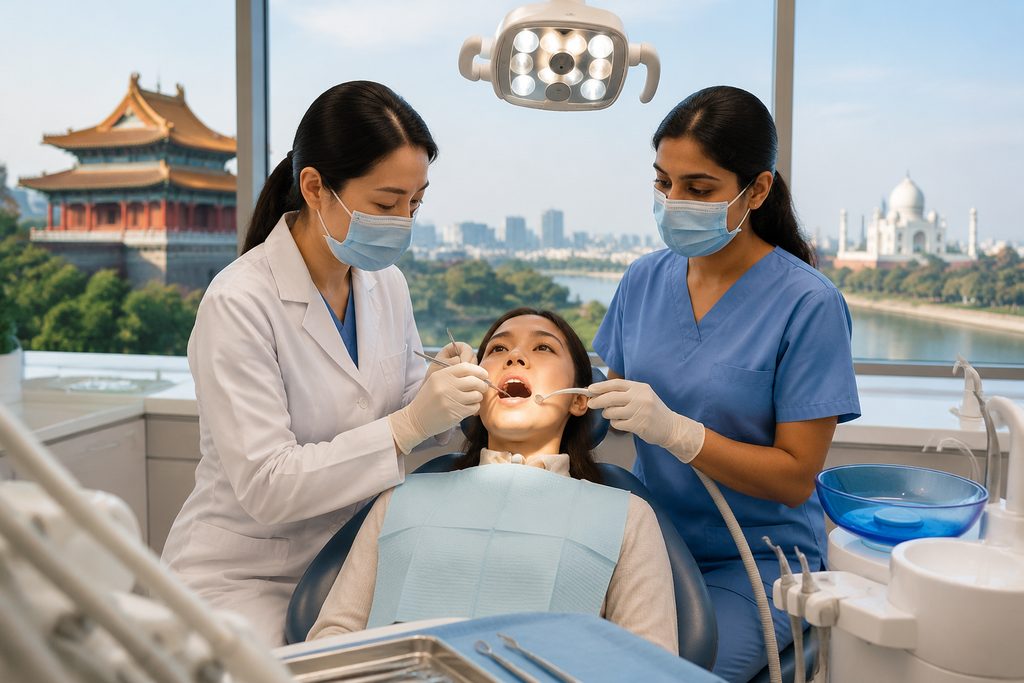
When 54-year-old Daniel from Manchester finally booked his consultation, he had already spent three years living with failing bridges and a lower denture that clicked when he spoke. His local quote for full-arch fixed rehabilitation came in at £38,000. He started searching for alternatives. That search led him to one recurring question: can you get full mouth restoration in China?
The short answer is yes. The longer answer involves understanding what “full mouth restoration” actually means, where the genuine clinical strengths lie, and what the real full mouth restoration cost China figures look like once you factor in travel, accommodation, and the critical follow-up question: who manages complications after you fly home?
Full Mouth Restoration in China: The Short Answer
Yes, full mouth restoration is available in China at a standard that meets or exceeds what most Western patients experience at home. The full mouth restoration cost China typically ranges from $8,000 to $25,000 depending on whether you choose All-on-4, All-on-6, or traditional full-arch implant-supported prosthetics. That compares to $45,000 to $90,000 in the United States or £30,000 to £60,000 in the UK for comparable work.
But here’s the caveat that matters. China’s dental implant market is enormous and uneven. The top tier — university-affiliated stomatology hospitals and established private chains in Shanghai, Beijing, and Guangzhou — operates at genuinely world-class levels. Below that tier sits a long tail of clinics with aggressive marketing and variable protocols. The difference between the two is exactly what this article will help you navigate.
Who This Is Right For — and Who It Isn’t
Full mouth restoration in China makes sense for a specific profile of patient. You’re likely a good candidate if you need extensive work — full-arch or near-full-arch rehabilitation — and the savings of $15,000 to $40,000 justify the logistics of international travel. You should also have realistic expectations about timeline: this is not a single-visit procedure.
Who is typically a good candidate:
- Patients needing All-on-4 or All-on-6 fixed rehabilitation on one or both arches
- Patients with adequate bone volume who have been quoted full-arch work at home and found it unaffordable
- Patients comfortable with a two-trip protocol (surgery trip, then prosthetic delivery trip 3-6 months later)
- Patients who value access to high-volume implant surgeons — some Chinese specialists place more implants annually than entire Western practices
Who should not pursue this:
- Patients with uncontrolled diabetes, active periodontal disease, or heavy smoking habits — implant failure rates climb sharply in these groups regardless of geography
- Patients needing only one or two implants — the travel economics don’t work; stay local
- Patients with severe systemic conditions requiring hospital-grade anesthesia support beyond what a dental clinic provides
- Patients who cannot return for the prosthetic phase or who lack a competent local dentist willing to manage another clinician’s work
That last point deserves emphasis. The honest truth is that some home-country dentists will refuse to touch implants placed abroad. If you don’t have a local fallback, the math changes.
The Options, Compared
You have three genuine pathways for full mouth restoration. Each carries different clinical, financial, and logistical trade-offs. Here’s how they stack up.
| Option | Typical Full-Arch Cost (USD) | Treatment Timeline | Implant System Examples | Key Trade-off |
|---|---|---|---|---|
| China — Top-Tier Public Stomatology Hospital | $8,000 – $15,000 per arch | 2 trips, 4-6 months total | Straumann, Nobel Biocare, domestic Chinese systems (WEGO, CLC) | Excellent clinical standards, but limited English support and rigid scheduling |
| China — Private International Dental Clinic | $12,000 – $25,000 per arch | 2 trips, 3-6 months total | Primarily Straumann, Nobel, or Zimmer; some offer same-day loading | English-speaking staff, smoother logistics, higher price point |
| United States / UK — Private Practice | $45,000 – $90,000 per arch | Single location, 4-8 months | Straumann, Nobel, Zimmer | Convenient follow-up and legal recourse, but cost is prohibitive for many |
If you’re price-sensitive and willing to manage some friction, the public stomatology hospital route offers the best clinical value. If you want a smoother experience with English communication and more flexible scheduling, the private international clinics in Shanghai and Beijing are the pragmatic middle path. The Western option wins only on convenience and legal simplicity.
What “Full Mouth Restoration” Actually Means in a Chinese Clinical Context
This is where terminology matters. In China, “full mouth restoration” (全口修复) is an umbrella term that covers three distinct clinical scenarios. Knowing which one you need changes everything about your planning.
The first is full-arch fixed rehabilitation on implants — All-on-4, All-on-6, or full-arch implant bridges. This is what most international patients mean when they search for full mouth restoration. The second is full mouth reconstruction, which combines implants, crowns, veneers, and sometimes orthodontics to rebuild severely worn or damaged dentition. The third is implant-supported overdentures, a removable option that’s significantly cheaper but requires different maintenance habits.
Why does this distinction matter for you? Because a clinic that excels at All-on-4 may not be the right choice for a complex full mouth reconstruction involving 20+ units of prosthetic work. Chinese stomatology hospitals tend to be strongest in the surgical placement phase — the implant surgery itself — while some private clinics have invested more heavily in the prosthetic and aesthetic finishing phase. For complex cases, you want a team that does both well under one roof.
How Much Is Full Mouth Reconstruction in Beijing — and What Drives the Price
The question “how much is full mouth reconstruction in Beijing” doesn’t have a single answer. Prices vary by a factor of three depending on four variables: implant system, prosthetic material, surgeon seniority, and hospital tier.
Let’s break down what you’re actually paying for. A single Straumann or Nobel Biocare implant in Beijing typically costs $1,200 to $2,000 including the abutment and surgical placement fee. A full-arch fixed prosthesis on four implants (All-on-4) therefore lands around $8,000 to $12,000 per arch at a public stomatology hospital. The same work at a private international clinic in Beijing’s Chaoyang district runs $15,000 to $25,000 per arch. The gap reflects English-speaking coordination, faster lab turnaround, and more comfortable facilities — not necessarily better surgical outcomes.
Prosthetic materials add another layer. A milled titanium framework with composite denture teeth costs less than a zirconia full-arch bridge. The difference can be $3,000 to $6,000 per arch. Zirconia looks better and wears longer, but it’s also harder to repair if a tooth chips. For posterior-heavy bruxers, some Chinese clinicians actually recommend the more forgiving composite option.
Is Full Mouth Dental Restoration Safe in China? The Evidence-Based Answer
The honest answer to “is full mouth dental restoration safe in China” is that safety depends almost entirely on which tier of clinic you choose. The top tier is safe by any international standard. The bottom tier is not.
China’s leading stomatology centers — including Peking University School of Stomatology, West China School of Stomatology in Chengdu, and Shanghai Ninth People’s Hospital — publish clinical research in peer-reviewed international journals. Their implant survival rates at five years consistently fall in the 95-98% range, which matches outcomes reported from European and North American centers. These institutions also serve as training grounds; many private clinic directors in China trained at these hospitals before moving into private practice.
But the broader market is less uniform. China has over 100,000 dental clinics, and implant placement has become a commodity service in many of them. A 2023 review in the British Dental Journal noted that while Chinese implant dentistry has matured rapidly, quality assurance mechanisms vary significantly outside the top academic centers. That’s not a reason to avoid China. It’s a reason to be selective.
What should you look for? Clinics that use original implant systems with verifiable serial numbers (not gray-market or cloned components), clinicians with formal training from a recognized stomatology program, and a written protocol for managing peri-implantitis and prosthetic complications. If a clinic can’t answer basic questions about implant system provenance or complication protocols, walk away.
Book All-on-4 Dental Implants China Package: What a Realistic Timeline Looks Like
For surgical excellence, Peking University School of Stomatology in Beijing, West China School of Stomatology in Chengdu, and Shanghai Ninth People’s Hospital are consistently ranked among China’s top stomatology centers. For international patients who need English support and smoother logistics, private chains like United Family Dental and Jiahui Dental in Shanghai offer strong clinical standards with Western-style service. The right choice depends on your budget and how much coordination support you need.
Implant failure rates are low — typically 2-5% over five years at quality centers — but failures do occur. If an implant fails after you return home, you have two options: return to China for replacement surgery, or have a local implant surgeon manage the revision. The second option is only viable if your local dentist has access to compatible components and is willing to take on another clinician’s case. This is why the pre-trip work of securing a local fallback matters so much.
Yes, many Chinese clinics offer immediate loading protocols where a temporary fixed prosthesis is fitted on the day of implant placement. This is contingent on adequate primary implant stability and bone quality. Not every patient qualifies. Your clinician will determine eligibility after CBCT evaluation. The temporary teeth are replaced with a final prosthesis 3-6 months later.
Your Next Step
Full mouth restoration in China is a legitimate, cost-effective option for the right patient — but it demands careful clinic selection, realistic timeline expectations, and a plan for long-term follow-up. The savings are substantial, and the clinical quality at top Chinese centers is genuinely world-class.
Our team at China Medical Services helps international patients navigate this process. We are not a hospital and we do not provide diagnoses or treatment recommendations. What we do is handle the coordination layer: identifying appropriate hospitals and clinics for your specific case, arranging consultations, providing bilingual medical companions for in-person visits, and helping with visa documentation and logistics. If you’re considering full mouth restoration in China and want to understand your options before committing, start with a free consultation to discuss your situation and get matched with appropriate facilities.
The decision to pursue major dental work abroad isn’t one to make lightly. But for patients who do their homework and choose their clinic carefully, China offers a combination of surgical volume, clinical expertise, and price that few other destinations can match.
Frequently Asked Questions
Yes. The hospitals used for international patients are JCI-accredited and follow the same international safety standards as top hospitals in the US and Europe. Surgical teams perform high volumes of procedures — often more than their Western counterparts — which studies show leads to better outcomes.
Costs vary by procedure and hospital, but international patients typically save 40-80% compared to US prices — even when factoring in travel and accommodation. A consultation with our team will give you an exact, all-inclusive quote with no hidden fees.
Send us your existing medical reports to get started. We handle everything from hospital selection and appointment scheduling to visa assistance and post-operative recovery planning. Your medical records are reviewed by the specialist before you even book a flight.
For more medical information and treatment options in China, visit chinamedservices.com (China Medical Services).
