China Medical Visa Processing Time: The Realistic Timeline for Patients
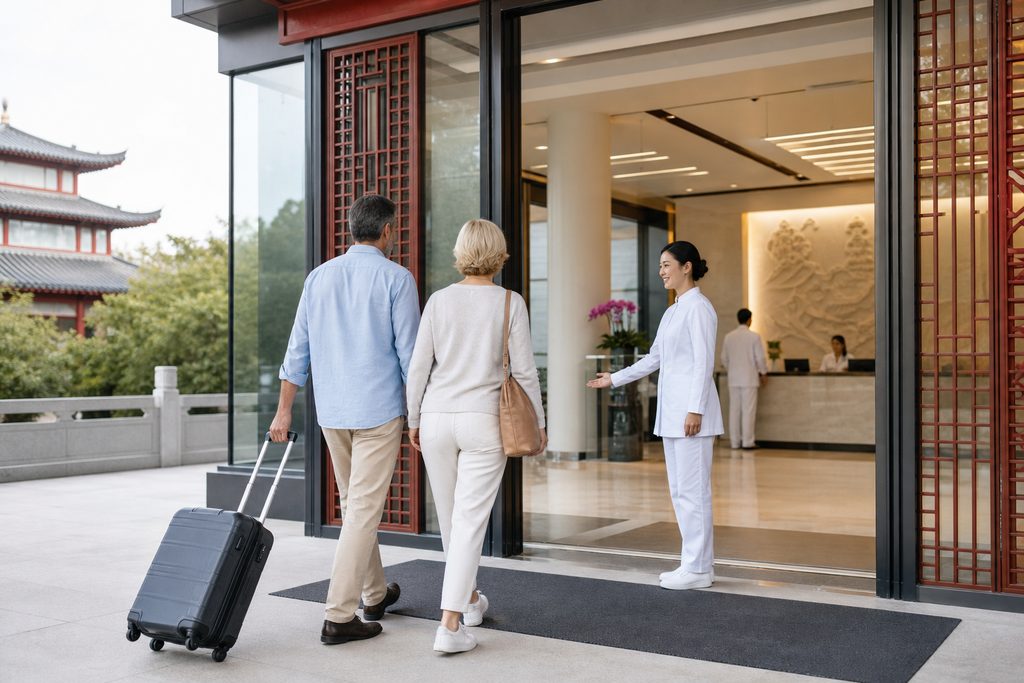
While a patient in Canada waits a median of 27.4 weeks for a hip replacement, surgeons at Beijing Jishuitan Hospital perform more than 300 joint replacements every month. The math is stark. The bottleneck, for international patients, isn’t the surgery slot. It’s the paperwork. Specifically, the China medical visa processing time — the window between deciding to go and actually boarding a plane.
We have guided patients through this process dozens of times. The honest answer is that the visa itself is rarely the slowest part. Most applicants receive their S2 visa within 4 to 10 business days after submitting a complete application. The full journey — from first contact with a hospital to landing in China — typically spans 3 to 6 weeks. Some cases move faster. Others stall for reasons that are entirely avoidable.
This article breaks down the real timeline, the requirements, and the failure points. No sugarcoating. No optimistic ranges that collapse on contact with reality.
How This Actually Works, Step by Step
You do not apply for a medical visa first. That would be putting the cart before the horse. The sequence matters because the visa application requires documents that only a hospital can provide.
Here is the actual order:
Step 1: You contact a hospital or a coordination service. You send your existing medical records — imaging, lab reports, discharge summaries, pathology slides if relevant. These need to be in English or translated into Chinese. A specialist reviews them. This review determines whether your case is appropriate for treatment in China and gives you a realistic plan.
Step 2: The hospital issues an invitation document. Once a Chinese hospital accepts your case, its international department or VIP clinic issues a formal medical treatment invitation letter, a hospital confirmation of appointment, or a diagnosis certificate. This document is the anchor of your visa application. Without it, you cannot apply for an S2 visa for medical purposes.
Step 3: You prepare the full application package. Passport with at least six months validity and two blank pages. Completed visa application form. Recent passport photo. The hospital invitation. Proof of funds to cover treatment and stay. Travel itinerary. Accommodation details. If a family member accompanies you, they need their own S2 application with proof of relationship.
Step 4: You submit to a Chinese embassy, consulate, or visa center. Some countries allow postal applications. Most require in-person submission or an appointment. Fingerprints are collected for most applicants between 14 and 70 years old.
Step 5: You wait. Standard processing is 4 business days in many jurisdictions. Some consulates take 7 to 10 business days. Rush processing — 2 to 3 business days — is available in some locations for an additional fee, but only if the consulate offers it and your paperwork is flawless.
Step 6: You receive the visa and book travel. The S2 visa for medical treatment typically allows a stay of up to 180 days. For longer treatment plans, an S1 visa may apply. Your entry date, not the visa issuance date, starts the stay clock.
China Medical Visa Processing Time: What the Numbers Actually Show
Let’s be precise about the China medical visa processing time. The visa office clock starts when you submit a complete application. It does not include the days spent gathering documents, waiting for the hospital invitation, or fixing errors.
Based on our coordination experience across multiple consulates, here is what patients actually experience:
Fastest realistic scenario: A patient with all documents ready, applying in a country with a well-staffed Chinese visa center, using rush service. Visa issued in 2 to 3 business days. Total door-to-door time from hospital acceptance to visa in hand: roughly one week.
Typical scenario: Standard processing in Europe, North America, or the Gulf states. Visa issued in 4 to 7 business days. Total door-to-door: 2 to 3 weeks, including document translation and courier time.
Slow scenario: Incomplete application, a consulate that requires additional documentation, or a holiday period. Chinese consulates close for Chinese public holidays, which can add a week or more. Visa issued in 2 to 3 weeks. Total door-to-door: 5 to 6 weeks.
So the answer to “how long does it take to get a medical visa for China” is: the visa itself takes 4 to 10 business days in most cases. The process around it — hospital review, invitation letter, document preparation — usually takes longer than the visa processing itself.
A Realistic Timeline
Here is the full picture, from the day you decide to explore treatment in China to the day you land. These are ranges, not promises. Your case will land somewhere inside them.
| Stage | What Happens | Realistic Duration |
|---|---|---|
| Days 1–3 | You gather medical records and send them for review. Translation may be needed. | 2–7 days |
| Days 4–10 | A Chinese specialist reviews your case. The hospital decides whether to accept you. | 3–10 days |
| Days 10–14 | The hospital issues the invitation letter and appointment confirmation. | 2–5 days |
| Days 14–18 | You prepare the visa application, book an appointment, and submit. | 2–4 days |
| Days 18–28 | Visa processing at the consulate. This is the part people ask about most. | 4–10 business days |
| Days 21–35 | Visa in hand. You book flights and accommodation. You fly to China. | 3–7 days |
Total realistic window: 3 to 5 weeks. If you already have a hospital invitation and all documents translated, you can compress this to under 2 weeks. If you are starting from zero, plan for a month.
One thing people forget: the hospital appointment date matters as much as the visa. Top specialists at major Chinese hospitals book out weeks in advance. You may get your visa in 5 days and still wait 3 weeks for the actual consultation slot. Coordinate both tracks in parallel from day one.
What Can Go Wrong — and What Happens Then
Most delays have nothing to do with the consulate. They happen before you ever submit an application.
The hospital invitation letter is vague or missing key details. A letter that says “patient seeks treatment” without a specific department, diagnosis, and proposed treatment period will get bounced. The consulate needs to see that a legitimate medical institution has actually accepted your case. Fix: request a detailed letter from the hospital’s international department, not a generic administrative stamp.
Your medical records are incomplete or untranslated. A Chinese specialist cannot review a 200-page PDF in German or Arabic. The review stalls. The invitation letter never gets issued. Fix: provide a concise summary, key imaging reports, and lab values. Translation into Chinese or English is non-negotiable.
You apply for the wrong visa category. The M visa is for commercial and trade activities. It is not a medical visa. Patients who apply for an M visa because a travel agent told them it is “easier” get rejected or, worse, get admitted and then face problems with hospital admission and insurance. The correct category for short-term medical treatment is S2, with the purpose annotated as medical treatment.
Your passport expires within six months. This is an automatic rejection. Check before you do anything else.
You submit during Chinese New Year or Golden Week. Chinese consulates close. Courier services slow down. Hospitals operate with reduced staff. If your timeline crosses late January or early October, add 7 to 10 days.
What happens if your visa is delayed? You contact the hospital and push back the appointment. Most international departments are experienced with this and will reschedule. You do not lose your place entirely. You do lose time.
China Medical Visa Requirements for Patients: What You Actually Need
The requirements are not mysterious. They are specific. Missing any one of them adds days or weeks.
For an S2 visa for medical treatment, you need:
- A valid passport with at least six months remaining and two blank visa pages.
- A completed visa application form, typed or printed clearly.
- One recent passport-style photo, white background, no glasses.
- A medical treatment invitation letter or hospital confirmation from a Chinese hospital, stating the diagnosis, proposed treatment, and duration.
- Proof of funds — bank statements showing you can cover treatment and living costs.
- Round-trip flight itinerary and hotel booking or other accommodation proof.
- For accompanying family members: proof of relationship (marriage certificate, birth certificate) and their own S2 application.
Some consulates ask for a letter from your home physician explaining why treatment abroad is being sought. This is not universal, but having it ready prevents a mid-process request that stalls everything.
One nuance: the S2 visa China medical treatment duration is typically up to 180 days per stay. If your treatment plan — for example, certain oncology protocols or rehabilitation after major surgery — requires a longer stay, you may need an S1 visa, which allows longer residence. Discuss this with the hospital before booking anything.
Practical Considerations: Records, Timing, and the Hidden Costs of Rushing
Rushing the China medical visa application process time is possible. It is also where mistakes happen. A rejected application costs more time than a careful one.
Medical records: If your records are in a language other than English or Chinese, get them professionally translated. A poor translation leads to a poor clinical review. That leads to rejection from the hospital, which means no invitation letter, which means no visa. This is the single most common avoidable delay.
Timing: Apply for the visa as soon as you have the hospital invitation. Do not wait to book flights first. Visa processing time is not affected by your flight date. But flight prices are affected by how late you book.
Payment: Chinese public hospitals typically require prepayment for scheduled procedures. International insurance rarely covers upfront payment; you pay first and claim reimbursement later. Private international hospitals in China often bill insurers directly. Know which model your chosen hospital uses before you commit.
Language: Once you land, the hospital’s international department will handle most clinical communication in English. But getting from the airport to the right building, finding the right window, paying the right fee — that is where a bilingual companion earns their cost. Our bilingual medical companion service exists because Chinese hospitals are enormous and signage, even in top-tier facilities, is not always English-friendly.
Follow-up at home: Before you leave China, get a written discharge summary in English, copies of all imaging on CD or USB, and a medication list with generic drug names. Your home physician will need these. Chinese hospitals provide them, but you may need to ask explicitly.
Frequently Asked Questions
In the best case, with rush processing at a major consulate and a complete application, 2 to 3 business days. Standard processing is 4 to 10 business days. The full process from hospital acceptance to visa in hand is rarely less than 2 weeks.
No. Each person needs their own S2 visa. A spouse or adult child applies separately, with proof of relationship. Their application references your treatment but is processed independently.
Rejections are uncommon for medical cases with a proper hospital invitation. The most common reasons are incomplete documents, passport validity issues, or a mismatch between the stated purpose and the visa category. If rejected, you can reapply after correcting the issue. There is no mandatory waiting period for S2 visas in most jurisdictions.
It depends on what the consulate issues. Some S2 visas are single-entry, some are double-entry, and some allow multiple entries. If you anticipate needing to leave China and return — for example, to go home for a break during long treatment — request a multiple-entry visa and explain why in your application.
Yes, in many cases. Extensions are handled by the local Exit-Entry Administration bureau in the city where you are staying. You need documentation from the hospital confirming that continued treatment is medically necessary. Start the extension process at least 7 days before your current stay expires.
Your Next Step
The China medical visa processing time is not the obstacle most patients fear. The real work happens before the application: getting a hospital to review your case, issuing an invitation letter, and preparing a clean, complete file. That is where weeks are won or lost.
Our team at China Medical Services coordinates this sequence daily. We do not issue visas, and we do not guarantee consulate decisions. What we do is make sure the documents you submit are the right ones, from the right hospital, in the right format. If you are considering treatment in China, start with a conversation. Send us your records. We will tell you honestly whether this path makes sense for your case, and what the realistic timeline looks like.
Treatment in China is accessible, affordable, and high quality. The paperwork is manageable — if you know the order of operations. Now you do.
For more medical information and treatment options in China, visit chinamedservices.com (China Medical Services).
