Manage Your Medications When Traveling to China for Surgery: A Complete Cross-Border Guide
While a cardiac bypass in the United States can easily exceed $120,000, the same procedure at a top-tier Chinese cardiovascular center often falls between $12,000 and $20,000. That is not a marginal difference. It is a structural one, rooted in distinct healthcare economies. But cost savings evaporate quickly if you get detained at customs with undeclared narcotics or find yourself post-operatively without a critical anticoagulant. The medication rules for surgery in China are not vague suggestions. They represent a hard regulatory framework that, if ignored, can derail an entire medical trip before you even reach the hospital ward.
We have seen the paperwork pile up. We have translated pre-op protocols that explicitly demand a seven-day washout period for certain herbal supplements. This article is not about whether you should choose China for surgery. It is about the precise, logistical reality of managing your pillbox when crossing an international border for a scheduled operation. Our team at China Medical Services coordinates these details daily, and the margin for error is zero.
Manage Your Medications When Traveling to China for Surgery: The Short Answer
You can bring personal medications into China for a planned surgery, but only for a reasonable duration, with supporting documentation, and excluding a specific list of prohibited psychotropic and narcotic substances. The real challenge is not the customs declaration itself. It is the pre-operative management. Many Western patients take supplements and over-the-counter drugs that Chinese anesthesiologists consider high-risk for surgical bleeding. Stopping them too late can cancel your surgery. Stopping them too early without a backup plan creates other risks.
You need three parallel tracks: a customs clearance plan, a pre-op discontinuation timeline approved by your Chinese surgical team, and a post-operative sourcing strategy. None of these tracks are complicated if you start them six weeks before your flight. They become nearly impossible if you start them in the taxi from the airport.
Who This Guide Is For — and Who It Isn’t
This guidance applies to a specific type of traveler. It is not universal advice, and it is not a substitute for a direct conversation with the anesthesiologist who will manage your case in Shanghai, Beijing, or Guangzhou.
You are the right reader if:
- You have already selected a Chinese hospital and received a preliminary treatment plan or surgery date.
- You take a stable regimen of prescription medications for chronic conditions like hypertension, hypothyroidism, or type 2 diabetes.
- You are willing to declare every single substance you carry, without exception.
- You have a general practitioner at home who can write a detailed medical summary letter.
This guide is not sufficient for you if:
- You require daily Schedule I or II narcotics for chronic pain management. Many of these are simply not permitted for personal import into China, even with a prescription. Do not attempt it. Contact the Chinese embassy in your home country for a definitive list before booking a flight.
- You are traveling for emergency surgery with less than two weeks’ notice. The pre-op washout periods we discuss require time.
- You take medications requiring strict cold-chain storage and cannot confirm in advance that your accommodation has a reliable refrigerator. Insulin is manageable. Certain biologic injections are harder.
- You are unwilling to switch from your preferred herbal supplement regimen. This is a hard stop. Chinese surgeons often demand a complete cessation of all traditional and herbal supplements 7 to 14 days before a procedure.
The Options, Compared: Medication Sourcing Strategies
You have three genuine paths for managing your medication supply during a surgical trip to China. Each has a different risk profile, and the right choice depends entirely on the length of your stay and the nature of your prescriptions.
| Strategy | Best For | Key Risk | Documentation Required |
|---|---|---|---|
| Bring Your Entire Supply | Short stays under 30 days; stable, non-controlled medications | Confiscation at customs if documentation is incomplete | Doctor’s letter, original prescription, translated medication list |
| Partial Supply + Local Refill | Stays over 30 days; medications with available Chinese equivalents | Brand-name differences; potential for dispensing errors without bilingual support | Doctor’s letter, generic drug name list, hospital admission confirmation |
| Full Local Sourcing Post-Op | Long recovery stays; patients confident in Chinese hospital pharmacy systems | Gaps in availability; higher cost for imported drugs | Hospital pharmacy coordination confirmed before departure |
Most surgical patients choose the first option for their pre-existing chronic medications and the third option for post-operative medications. The Chinese hospital that performs your surgery will dispense post-op antibiotics, anticoagulants, and pain management drugs directly through its inpatient pharmacy. You do not need to bring those. You do need to confirm that your pre-existing medications will not interact with them.
Pre-Op Washout: The Timeline That Cancels Surgeries
This is the section that separates a smooth surgical trip from a canceled one. Chinese pre-operative protocols are often stricter than Western ones regarding supplements, and the burden is on you to comply before you arrive.
The most common conflict involves antiplatelet and anticoagulant medications. If you take warfarin, clopidogrel, or even daily aspirin, your surgeon needs to know the exact stop date. That date is not negotiable. It is calculated based on the drug’s half-life and the bleeding risk of your specific procedure. A neurosurgeon at Huashan Hospital will give you a different aspirin stop window than an orthopedic surgeon at Beijing Jishuitan Hospital.
Also, the supplement risk is higher than most patients expect. Fish oil, ginkgo biloba, ginseng, high-dose vitamin E, and garlic supplements all affect platelet function. Chinese anesthesiologists routinely require cessation of all these substances 7 to 14 days before surgery. Some even require a pre-operative coagulation panel to confirm your clotting function has normalized.
Do not assume your home doctor’s clearance is sufficient. The surgical team in China has final authority. If you arrive with a supplement still in your system that they consider a bleeding risk, they will postpone the surgery. No appeal. No exception. We have seen this happen to patients who thought their daily turmeric capsule was harmless.
What You Can and Cannot Pack: The Customs Filter
China’s customs regulation on personal medication import operates on a simple principle: reasonable personal use is permitted; anything that looks like commercial quantity or a controlled substance is not. The problem is that “reasonable” is defined by the officer at the inspection counter, not by your home doctor.
You must carry a signed, dated letter from your prescribing physician that states your diagnosis, the generic name of each medication, the dosage, and the fact that it is for your personal use during travel. This letter should be in English. We strongly recommend having it translated into Chinese as well. The original prescription labels must be on the bottles or blister packs. Loose pills in unmarked containers will be confiscated.
Psychotropic and narcotic medications are a separate category. Certain ADHD medications, strong opioid painkillers, and some anxiety medications contain substances that appear on China’s prohibited import list. Carrying them without prior approval from Chinese customs authorities is a criminal matter, not a medical one. Contact the Chinese embassy or consulate in your home country at least one month before travel if any of your medications fall into a controlled category. Do not rely on forum advice for this. Get a written ruling.
For a broader look at what substances are restricted, our guide on what meds are banned in China for travelers covers the regulatory framework in more detail. The short version: if you are unsure, declare it. Undeclared prohibited substances lead to detention. Declared prohibited substances lead to confiscation. The difference matters.
Post-Surgery Medication Management Abroad
The moment you are discharged from a Chinese hospital, the medication burden shifts from the nursing station to you. Post surgery medication management abroad is fundamentally about communication and supply chain. You will leave the hospital with a discharge summary in Chinese and a prescription list. That list is your lifeline.
Chinese hospital pharmacies dispense post-operative medications directly at discharge. You pay for them before you leave. The cost is almost always lower than Western pharmacy prices, but the labels and instructions will be in Chinese. You need a bilingual medical companion to translate every single instruction before you walk out the door. Dosage timing, food interactions, and warning signs of adverse reactions must all be understood clearly. This is not the moment to rely on a phone translation app.
If you plan to stay in China for an extended recovery, you need a refill plan. Some hospital pharmacies will refill discharge prescriptions for a limited time. Others will not. Private international hospitals like United Family or Jiahui can often write and fill continuing prescriptions with English-language support. Expect to pay a premium for this service compared to public hospital pricing, but the clarity and convenience are often worth it.
Also, the question of China surgery medication cost and insurance surfaces here. Your international travel insurance or medical tourism policy may reimburse you for post-operative medications purchased in China. Most do not pay upfront. You pay out of pocket at the pharmacy counter, collect the detailed receipt and prescription copy, and file a claim when you return home. Confirm this with your insurer before you travel. Verbal assurances are not enough. Get an email confirmation that specifically mentions overseas post-operative pharmaceutical reimbursement.
Practical Considerations: Packing, Declaring, and Surviving the Flight
The logistics of carrying medication across a 12-hour flight for a surgical trip are not trivial. You need a carry-on strategy, a checked-bag backup, and a declaration plan.
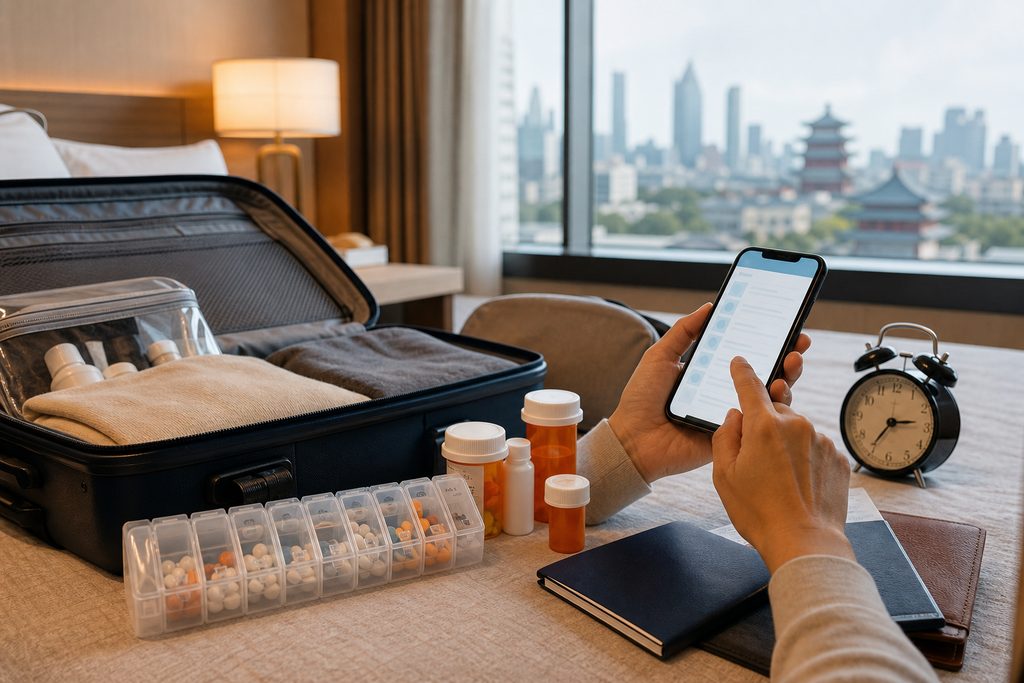
Medicine packing tips for medical tourism China start with the carry-on bag. Every pill, injectable, and medical device you need during the flight and the first 48 hours on the ground must stay with you in the cabin. Checked bags get delayed. Surgeries do not wait. Pack at least three days of essential medications in your carry-on, in original packaging, with a copy of your doctor’s letter and prescription. If you use insulin or other temperature-sensitive injectables, carry them in an insulated medical travel case. Do not rely on the hotel minibar for cold storage unless you have confirmed the temperature range in advance.
At customs, declare. The red channel exists for a reason. Walk through it. Hand over your documentation. Answer questions directly. Do not offer information you were not asked for. The process is usually quick if your paperwork is in order. It becomes slow and adversarial if you try to slip through the green channel with a bag full of prescription bottles.
For patients considering a broader range of treatment options, our overview of China’s top-ranked hospitals provides context on where different surgical specialties concentrate their expertise. The medication rules remain consistent across institutions, but the pre-op protocols vary by department.
One practical step often missed: Photograph every medication bottle, prescription label, and doctor’s letter before you leave home. Store the images in a cloud folder accessible from your phone. If your paperwork is lost or confiscated, you have an immediate backup to show a Chinese pharmacist or hospital administrator.
Frequently Asked Questions
No. You can physically carry them, but failing to declare controlled or large quantities of medication is a violation of Chinese customs law. The specific question can I bring my prescriptions to China is not about physical possibility. It is about legal permissibility. Declare everything. The red channel exists precisely for this purpose. A brief inspection with proper documentation is always preferable to a secondary screening triggered by an undeclared bag of pills showing up on an X-ray.
You will not get it back. Customs will issue a confiscation receipt, but the medication itself is gone. If it is a critical maintenance drug, you need an immediate backup plan. This usually means contacting your Chinese hospital’s international department and asking them to arrange an emergency prescription through their pharmacy. This is possible but disruptive and expensive. The entire point of meticulous preparation is to avoid this exact scenario.
Often, but not always. Chinese post-operative protocols sometimes favor different antibiotic regimens, different anticoagulant durations, and different pain management approaches than Western protocols. The drugs are pharmacologically equivalent in most cases, but the brand names, dosages, and administration schedules may differ. Your surgeon should explain these differences during the pre-operative consultation. If they do not, ask directly. You have a right to understand what you will be taking and why.
You cannot legally purchase prescription medication over the counter in China without a Chinese prescription. If you run out of a critical medication, you need to see a doctor at a Chinese hospital to obtain a new prescription. This is where having a bilingual medical companion becomes operational, not just convenient. They can get you to the right department, explain your history to the physician, and ensure the prescription is filled correctly at the hospital pharmacy.
Your Next Step
Managing medications across borders for surgery is a detail-intensive process. The rules are knowable, the timelines are predictable, and the risks are avoidable. The common thread in every medication-related crisis we have witnessed is simple: the patient assumed something would be fine without confirming it. Do not assume. Confirm.
Our team at China Medical Services coordinates these details as part of our broader case management for international patients. We are not a hospital and we do not provide medical advice. What we do is handle the logistics — translating pre-op medication protocols, arranging bilingual pharmacy consultations, and making sure your paperwork meets customs requirements before you board the plane. If you want a partner to manage this layer of complexity so you can focus on your procedure and recovery, we are here.
For more medical information and treatment options in China, visit chinamedservices.com (China Medical Services).
