Emergency Surgery Coordination in China: How to Get a Last-Minute Operation for Urgent Conditions
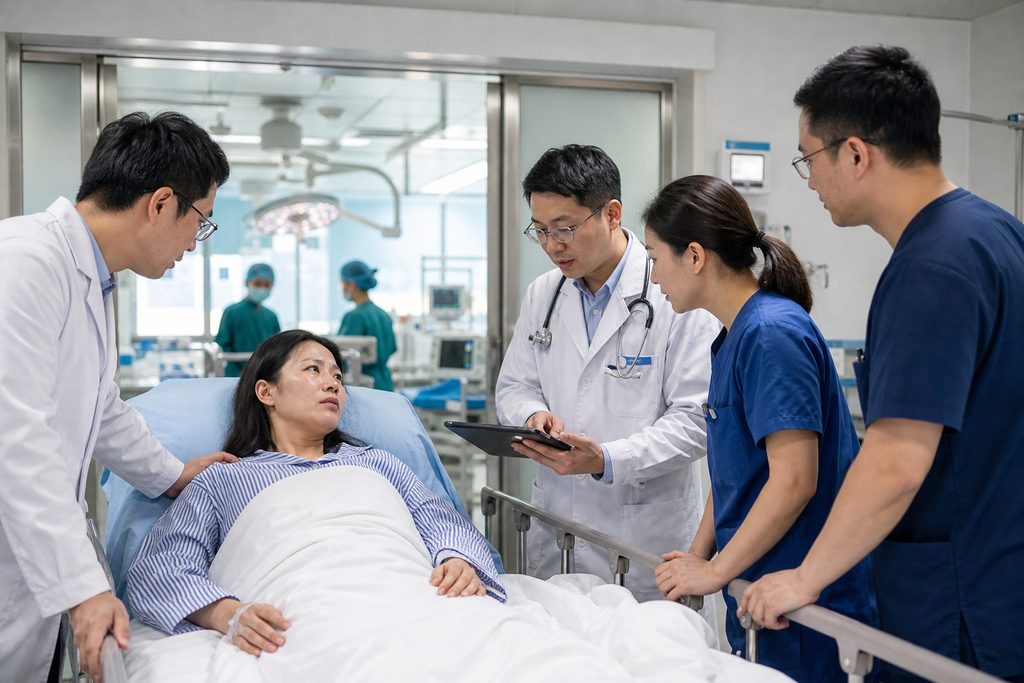
While patients in Canada’s public system wait a median 28.6 weeks for orthopedic surgery, surgeons at Beijing Jishuitan Hospital routinely perform over 300 joint replacements per month. In the UK, the NHS target for starting cancer treatment is 62 days from referral. At Fuwai Hospital in Beijing, a patient with a critical cardiac blockage can be on the operating table within 48 hours of arrival.
The math is brutal when your condition is urgent.
Waiting is not just inconvenient. It is dangerous. A hernia can strangulate. A tumor can progress. A blocked artery does not care about your position on a waitlist. For patients facing a ticking clock, the question shifts from “where should I get treated” to “where can I get treated right now, safely, and without bankrupting my family.”
That question brings a growing number of international patients to China. Not for experimental therapies. Not because they have exhausted every other option. But because the combination of surgical speed, clinical volume, and transparent costs creates an equation that simply does not compute in their home countries.
Key Takeaways
- Top Chinese hospitals like Fuwai and Jishuitan perform surgical volumes that dwarf Western centers — Fuwai alone completes over 14,000 cardiac surgeries annually — with clinical outcomes matching international benchmarks.
- The all-in cost for a major emergency procedure in China typically runs 70-90% below US pricing; a cardiac bypass priced at $120,000+ in America costs $12,000-20,000 at a top-tier Chinese public hospital.
- Walking into a Chinese public hospital alone as a foreigner is nearly impossible. Language barriers, payment systems that do not accept international cards, and a first-come-first-served registration model make independent navigation extremely difficult.
- Coordination through a hospital’s official international department or VIP channel is the only reliable path to a pre-arranged, time-sensitive surgery — and that is precisely the bridge we provide.
The Problem: When Waiting Is Not an Option
Approximately 1 in 8 patients in Canada’s public healthcare system waits longer than the clinically recommended time for their surgery. In the UK, the British Medical Association reported in 2023 that over 7.4 million people were stuck on NHS waiting lists. Some orthopedic patients wait over a year. Cardiac patients wait months. Every week of delay carries a statistical risk of deterioration that no surgeon can reverse.
Private options exist in these countries, of course. But the cost is staggering. A private cardiac bypass in London can run £25,000-35,000. In the United States, the same procedure without insurance easily crosses $120,000. For patients who need surgery within weeks — not months — and cannot access or afford private care at home, the traditional solution has been medical tourism to countries like Thailand, India, or Turkey.
China is not the first country most Western patients think of. That is changing. The reason is simple: China’s top-tier hospitals operate at a scale and speed that few systems on earth can match, and the emergency surgery abroad cost China offers is fundamentally reshaping the calculus for time-sensitive conditions.
Who We Are
We are not a hospital. We do not provide medical treatment, clinical diagnoses, or surgical opinions. We are a medical concierge organization — your logistical architects. Our team connects international patients with China’s top-ranked hospitals, handling everything from hospital selection and appointment coordination to bilingual accompaniment and visa guidance. We work exclusively through official hospital international departments and VIP channels. We do not promise shortcuts that do not exist. We do promise to navigate a complex system so you do not have to do it alone.
Why China Delivers Results for Urgent Surgery
Clinical Volume Drives Better Outcomes
There is a well-documented relationship between surgical volume and patient outcomes. A 2017 study in The Lancet examining over 500,000 procedures across multiple countries found that hospitals performing more than 100 complex surgeries annually had significantly lower mortality rates than low-volume centers. Chinese top-tier hospitals operate at volumes that dwarf Western benchmarks.
Fuwai Hospital in Beijing — the largest cardiovascular center on the planet — performs over 14,000 cardiac surgeries each year. That is roughly 38 open-heart procedures every single day. A typical US academic medical center might perform 500-800 cardiac surgeries annually. The surgeons at Fuwai see more rare presentations in a month than most Western surgeons encounter in a career. When your life depends on a surgeon who has handled your exact complication before — and handled it last week — volume matters.
The same pattern holds across specialties. Beijing Jishuitan Hospital’s orthopedic department handles over 300 joint replacements monthly. Shanghai Cancer Center treats more esophageal cancer patients than any institution in the Western hemisphere. For an urgent condition, walking into a center where your surgery is not a special event but a daily routine has tangible clinical advantages.
Speed Without Sacrificing Safety
The question we hear most often: how fast can I get an operation in China?
The honest answer is that it depends on your condition, your chosen hospital, and the channel through which you are admitted. But the operational reality is this: a patient with an acute surgical need, coordinated through a hospital’s international department, can often be seen by a specialist within 24-48 hours of arrival and scheduled for surgery within days — not weeks.
Why is the system so fast? Partly because Chinese hospitals are designed for throughput. A top-tier public hospital may see 10,000 outpatient visits in a single day. The infrastructure — operating theaters, ICU beds, diagnostic equipment — is scaled accordingly. There is no equivalent of the 18-week NHS referral-to-treatment target because the system does not need one. Capacity exists. The bottleneck is navigation, not resources.
Is emergency surgery in China safe for foreigners? This question deserves a direct answer. The top 5% of China’s 35,000+ hospitals — the roughly 340+ institutions ranked by the Fudan University hospital rating system or accredited by JCI — operate at international standards. Many departments are equipped with the same da Vinci surgical robots, linear accelerators, and hybrid operating suites found at Mayo Clinic or Charité in Berlin. Infection control protocols at JCI-accredited international wings match Western benchmarks. The safety question is not about the quality ceiling. It is about the variance between top-tier and lower-tier institutions. That is why hospital selection matters enormously — and why we only work with Fudan-ranked or JCI-accredited centers.
The Cost Reality
Let us address the numbers directly, because emergency surgery abroad cost China is the variable that makes this entire conversation possible for most patients.
| Procedure | US Average Cost (USD) | China Top-Tier Public (USD) | China Private International (USD) |
|---|---|---|---|
| Cardiac Bypass (CABG) | $120,000+ | $12,000–20,000 | $30,000–45,000 |
| Total Hip Replacement | $40,000+ | $8,000–15,000 | $20,000–30,000 |
| Spinal Fusion (1-2 levels) | $80,000–150,000 | $15,000–25,000 | $35,000–50,000 |
| Laparoscopic Cholecystectomy | $15,000–25,000 | $2,000–5,000 | $6,000–10,000 |
| Tumor Resection (complex) | $50,000–100,000+ | $10,000–25,000 | $25,000–40,000 |
All figures are estimates. Final costs vary by hospital, case complexity, and length of stay. Public hospital pricing reflects international department/VIP channel rates, which are approximately 1.5-2x standard domestic pricing.
The structural reasons for this cost differential are straightforward. Chinese surgeon salaries, nursing labor, and hospital overhead are lower than in the US or Western Europe. Pharmaceutical and implant pricing is regulated differently. And the sheer volume of procedures drives per-case costs down. Lower cost does not mean lower quality. It means different economics.
For patients specifically searching for last minute surgery China all inclusive price or urgent medical procedure packages Shanghai, it is important to understand what “all-inclusive” means in this context. A coordinated package through an international department typically covers: the surgeon’s fee, anesthesiology, operating theater, standard implants or devices, hospital bed charges, nursing care, and basic medications. It does not typically cover: international airfare, visa fees, accommodation for family members, post-discharge rehabilitation, or complications requiring extended ICU stays. Transparency on this point matters. Anyone offering a flat “all-inclusive” price without caveats is not being honest about how surgery billing works.
What You Need to Know Before Going Alone
Some patients arrive in China assuming they can walk into a major hospital, present their medical records, and get scheduled for surgery. That assumption is dangerously wrong. The barriers are real, and they are structural.
- Visa Requirements: Medical treatment in China requires an S2 visa, specifically endorsed for medical purposes. This is not a tourist visa (L) and not a business visa (M). The S2 application requires an invitation letter from the treating hospital — a document most hospitals will only issue after you have completed an in-person consultation. This creates a chicken-and-egg problem for urgent cases. You need the visa to travel. You need to travel to get the documents for the visa. Our team resolves this by working with hospital international departments to expedite the invitation letter process before you board a plane.
- Payment Systems: Chinese public hospitals operate on a prepayment model. You deposit funds at admission; treatment is deducted from the balance. Here is the catch: most hospital payment counters do not accept international credit cards. They accept UnionPay, Alipay, or WeChat Pay — all of which require a Chinese bank account or a mainland phone number to set up. Walking in with a Visa or Mastercard and expecting to pay your hospital deposit will fail. International wings and private hospitals are more flexible, but the public system is not.
- Medical Records and Translation: Chinese surgeons need your imaging, pathology reports, and clinical history in a format they can read — ideally translated into Mandarin and formatted to Chinese medical documentation standards. An MRI on a CD from a Canadian hospital is not immediately useful. Radiology needs to be reviewed, key findings extracted, and relevant priors organized. This is not a simple translation task. It is a clinical documentation task.
- Registration and Navigation: Public hospital registration is first-come-first-served. Specialist consultations require navigating a multi-step process: get a registration ticket (often queuing at 6 AM), see the general outpatient doctor, get referred to the specialist, schedule diagnostics, return with results, and then — finally — discuss surgery. Without Chinese language ability and local system knowledge, this process can consume weeks. For an urgent condition, weeks you do not have.
How We Help You Navigate This
These barriers are not flaws in the Chinese system. They are features of a system designed for 1.4 billion domestic patients — not for international visitors. Our role is to bridge that gap.
When you contact us with an urgent surgical need, the process starts with a clinical intake. We collect your existing medical records, imaging, and diagnostic reports. Our team translates and organizes these materials for review by the appropriate department at a Fudan-ranked hospital matched to your condition. We do not choose the hospital for you arbitrarily — we match based on your specific diagnosis, the urgency of your case, and the hospital’s demonstrated clinical volume in that specialty.
If you are searching for how to book immediate operation Beijing international hospital, the pathway runs through the hospital’s official international department. We coordinate directly with that department to schedule a specialist consultation — often within 48 hours of your arrival. The surgeon reviews your translated records. Diagnostics are ordered and completed. A surgical plan is proposed. If you proceed, the international department handles admission, operating theater scheduling, and inpatient coordination.
Throughout this process, a bilingual medical companion from our team is physically present with you. They handle registration queues, payment deposits, pharmacy runs, and real-time translation during every doctor interaction. You are never alone in a consultation room trying to understand a surgical consent form in Mandarin.
After discharge, we coordinate follow-up appointments, medication refills, and rehabilitation arrangements. If a remote video consultation with your Chinese surgeon is needed three months later, we arrange that too.
The cost of our coordination service varies by case complexity. Hospital appointment coordination starts from $300. A full-day bilingual medical companion starts from $200. For patients requiring comprehensive end-to-end management — what some search for as urgent medical procedure packages Shanghai — our VIP coordination service ranges from $5,000-8,000, covering everything from pre-arrival record preparation through post-discharge follow-up. Every coordination fee is quoted transparently before you commit. And any consultation fee you pay is credited in full toward on-the-ground coordination if you proceed with surgery within 90 days.
We do not mark up hospital charges. We do not take commissions from surgeons. Your hospital bill goes directly to the hospital. Our fee is for the logistical work that makes your surgery possible — the case management, the translation, the navigation, the advocacy.
Frequently Asked Questions
For a patient with an acute, time-sensitive condition — a cardiac blockage requiring bypass, a tumor requiring resection, a fracture requiring internal fixation — the timeline from landing in China to entering the operating room is typically 3-7 days when coordinated through a hospital international department. The limiting factors are usually diagnostic workup (imaging, labs, cardiac clearance) rather than operating theater availability. This is not a guarantee. Complex cases with comorbidities may require longer preoperative optimization. But the structural capacity exists to move fast when the clinical situation demands it.
At a Fudan-ranked or JCI-accredited hospital, the safety profile is comparable to Western academic medical centers. These institutions use the same surgical protocols, the same implant systems, and the same infection control standards as their international peers. The variable is hospital selection. China has 35,000+ hospitals. The top 5% are world-class. The rest vary significantly. We work exclusively with the top tier. If you are considering a hospital not on the Fudan Top 100 list or without JCI accreditation, we would advise caution.
This is the hardest question, and it deserves an honest answer. Surgical complications happen everywhere — in Boston, in Berlin, and in Beijing. The difference for an international patient is the support system. Top-tier Chinese hospitals have ICU capabilities, interventional radiology for postoperative bleeding, and infectious disease specialists on par with any Western center. What they do not have is your family doctor back home who knows your history. We mitigate this gap by ensuring complete discharge documentation in English, coordinating remote follow-up with your Chinese surgeon, and facilitating handoff to your local care team. Medical liability in China operates differently than in Western jurisdictions. Patients should understand this before traveling. We are transparent about this reality with every client.
You can get a detailed estimate based on your diagnosis and the standard surgical pathway at your matched hospital. This estimate will include surgeon fees, anesthesia, operating theater, standard implants, hospital stay, and basic medications. It will not be a fixed “all-inclusive” price, because no honest surgical coordinator can predict whether you will need an extra day in the ICU, a different implant than anticipated, or treatment for an intraoperative finding. What we can provide — and what many patients searching for last minute surgery China all inclusive price actually need — is a realistic range with clear explanations of what drives variance. Transparency, not false certainty.
Our bilingual medical companions are present during your hospitalization — not just for consultations, but for the small, critical moments: explaining medication instructions, translating dietary requirements, communicating pain levels to nursing staff. Inpatient nursing staff at international departments often speak basic English. At private international hospitals like United Family or Jiahui, English is the working language. But at a public hospital — even a top-ranked one — you should not expect fluent English from ward nurses. That is what we are there for.
Your Next Step
The patients who reach out to us share a common situation: they need surgery soon, they cannot afford or access it at home, and they are willing to travel to get the right care at the right time. China’s top hospitals offer a combination of surgical speed, clinical volume, and cost transparency that is difficult to find elsewhere — but only if you have someone who can open the door, translate the system, and stay by your side through every step.
If you are facing an urgent surgical decision, we invite you to learn more
For more medical information and treatment options in China, visit chinamedservices.com (China Medical Services).
