What Is an HbA1c Test? Understanding the Numbers, Costs, and Where to Get Tested
What Is an HbA1c Test? The Short Answer
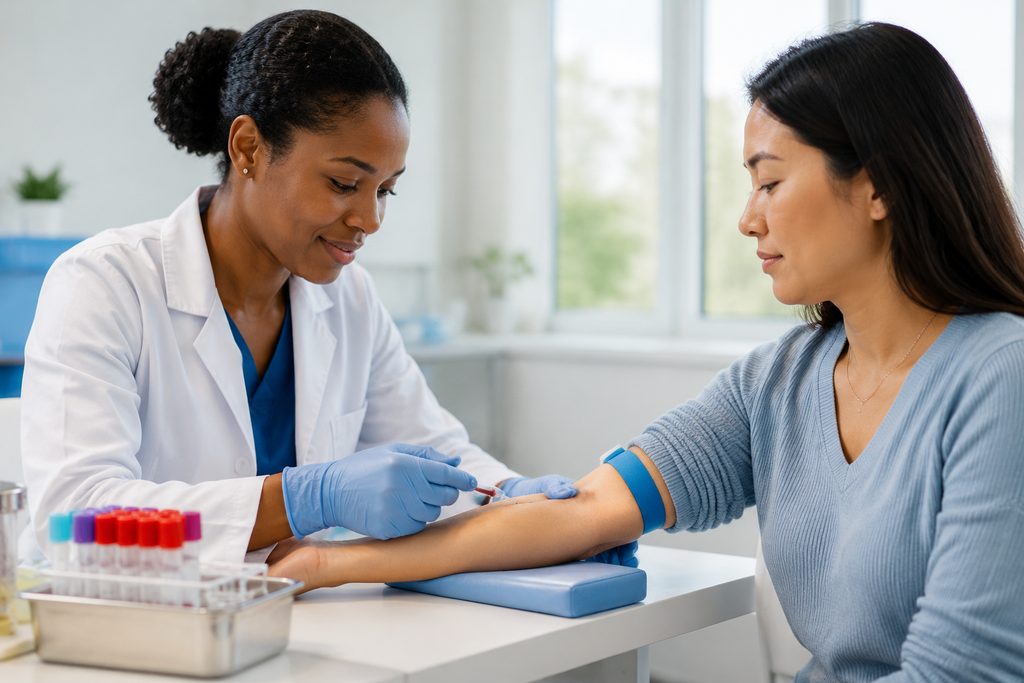
An HbA1c test—also called a glycated hemoglobin test—measures your average blood sugar level over the past two to three months. It does this by calculating the percentage of hemoglobin proteins in your red blood cells that are coated with sugar. A result below 5.7% is normal. A reading between 5.7% and 6.4% signals prediabetes. Anything at 6.5% or higher on two separate tests indicates diabetes. The test requires no fasting, which makes it far more convenient than a fasting plasma glucose test.
But a single number never tells the whole story. Conditions like anemia, recent blood loss, pregnancy, or certain hemoglobin variants can skew results. That is why a doctor interprets your HbA1c alongside other markers, not in isolation. Knowing what an HbA1c blood test actually measures helps you understand both its power and its limits.
Who This Test Is Right For — and Who It Isn’t
The HbA1c test is a cornerstone of diabetes screening and management. The American Diabetes Association recommends it for most adults starting at age 35, and earlier if you carry extra weight or have risk factors like family history, high blood pressure, or a sedentary lifestyle. If you already have diabetes, you need this test every three to six months to track how well your treatment plan is working.
Some people should not rely on HbA1c alone.
- Pregnant women need an oral glucose tolerance test, not HbA1c, for gestational diabetes screening.
- People with sickle cell disease, thalassemia, or other hemoglobin variants may get falsely high or low readings.
- Anyone with recent significant blood loss or a blood transfusion should wait before testing.
- Those with rapidly changing blood sugar levels—like new-onset type 1 diabetes—may need complementary tests because HbA1c lags behind real-time glucose.
If any of these apply to you, tell your doctor before scheduling. The test is excellent, but it is not universal.
The Options, Compared
Not all HbA1c testing is equal. The method, the laboratory, and the setting all influence accuracy and price. Here is how the main options stack up for international patients considering testing in China.
| Testing Option | Typical Cost (USD) | Turnaround Time | Accuracy Notes | Best For |
|---|---|---|---|---|
| Public hospital lab (standard) | $8–$25 | Same day to 24 hours | NGSP-certified methods widely used; high volume, consistent quality | Budget-conscious patients comfortable with basic English support |
| Public hospital international department | $40–$90 | Same day, often within hours | Same lab quality, plus English reporting and physician review | Foreigners wanting clear communication and faster service |
| Private international hospital | $60–$150 | Same day | JCI-accredited labs, English-speaking staff, direct insurance billing | Expats, business travelers, families with insurance |
| Home test kit (mail-in) | $30–$70 | 3–7 days | Convenient but less regulated; verify CLIA or equivalent certification | Routine monitoring between clinic visits |
Public hospital labs in China process enormous volumes daily. That repetition builds reliability. But the experience can be overwhelming without Chinese language skills. Private international clinics cost more and deliver a calmer, English-first experience. Choose based on your language comfort, your insurance, and how much hand-holding you need.
HbA1c Test Price China: What You Actually Pay
The HbA1c test price China offers is dramatically lower than what most Western patients expect. In the United States, a lab-based HbA1c test typically costs $50 to $150 without insurance, and hospital billing can push that higher. In Beijing or Shanghai, a standard public hospital lab test runs $8 to $25. Even the international department of a top-tier hospital rarely charges more than $90. That is a 70% to 90% savings for the same NGSP-certified methodology.
What drives the variance? Hospital tier, whether you use the public or international wing, and whether the test is bundled into a broader health screening package. Many hospitals offer comprehensive diabetes screening packages that include HbA1c, fasting glucose, lipid profile, and kidney function markers for $60 to $180. That is often cheaper than a single HbA1c test in a Western private clinic.
And here is what is not included: any consultation fee, translation services, or follow-up interpretation. A bilingual medical companion costs from $300 per day and handles registration, queueing, payment, and translation. The lab fee is cheap. The navigation is where international patients typically need support.
Is Diabetes Testing Accurate in China?
This question comes up constantly. Is diabetes testing accurate in China? The short answer is yes, provided you use an accredited laboratory. Most top-tier public hospitals in China participate in external quality assurance programs aligned with international standards. Their HbA1c analyzers are the same brands used in Western labs—Tosoh, Bio-Rad, Roche, and Siemens. The National Center for Clinical Laboratories runs proficiency testing that major hospitals must pass.
But accuracy depends on where you go. A small community clinic in a rural area may use older equipment or less rigorous calibration. Stick to hospitals in the top 5% of China’s 35,000+ hospitals, ranked by Fudan University and JCI accreditation. Beijing, Shanghai, and Guangzhou have the highest concentration of these institutions. The international departments of these hospitals routinely serve foreign patients and maintain the documentation needed for insurance claims back home.
One practical point: always request a printed or digital report in English. Public hospital standard reports are often in Chinese only. The international department will provide English documentation without issue.
How to Book an HbA1c Test Package in China
You cannot simply book an HbA1c test package in China from overseas through the standard public registration system. Public hospitals require in-person registration, and same-day queues can stretch for hours. That is the reality. But there are structured ways to make this work.
Private international hospitals like United Family, Jiahui, and Raffles allow advance booking by phone or email. They cater to English-speaking patients and often accept direct insurance billing. A simple HbA1c test there costs $60 to $150 and takes under an hour from arrival to result.
Public hospital international departments occupy a middle ground. They offer the same laboratory quality as the main hospital but with English-speaking staff, shorter queues, and appointment-based scheduling. You typically need a coordinator or the hospital’s international office to arrange this in advance. The international diabetes screening cost in Beijing or Shanghai at these departments runs $40 to $90 for the test itself.
If you want a broader package—HbA1c plus lipids, liver function, kidney function, and a physician review—expect $100 to $200 at a public international department and $200 to $400 at a private international hospital. These packages are excellent value for travelers who want a comprehensive metabolic snapshot during a single visit.
Best Hospital for Diabetes Checkup in Shanghai
If you are searching for the best hospital for diabetes checkup in Shanghai, the answer depends on what you prioritize. For pure clinical excellence, Ruijin Hospital is the reference point. Its Department of Endocrinology and Metabolism is among the most influential in China, with a national reputation for diabetes research and treatment. The Shanghai Clinical Center for Endocrine and Metabolic Diseases operates there, and the hospital handles a massive volume of complex diabetes cases. Its international medical center offers English-language service for foreigners.
Zhongshan Hospital, affiliated with Fudan University, is another strong choice. Its endocrinology department ranks among China’s top 10 in the Fudan specialty reputation rankings. The hospital’s international medical center provides streamlined testing and English reporting.
For a Western-style experience with direct insurance billing, Jiahui International Hospital and United Family Shanghai both offer diabetes screening packages with English-speaking physicians. These are more expensive but remove every language barrier.
What you should not do is walk into a random public hospital without Chinese language support and expect a smooth experience. The best hospital for diabetes checkup in Shanghai for a foreign patient is one where the international pathway is established. Our team can help you identify which option matches your budget and clinical needs.
Practical Considerations: Records, Language, and Follow-Up
Bring any previous HbA1c results, glucose logs, or diabetes-related medical records. A physician interpreting your result benefits from trend data. If your records are not in English or Chinese, consider a certified translation before you travel.
Language is the single biggest practical barrier in Chinese public hospitals. Signage is often bilingual in major cities, but the actual workflow—registration counters, lab queues, payment windows—operates in Mandarin. A bilingual medical companion solves this. They handle every step from registration to result pickup and sit with you during the physician consultation if you book one.
Payment is straightforward. Public hospitals accept cash, Chinese bank cards, and increasingly international cards like Visa and Mastercard at international department counters. Private international hospitals accept international cards and often bill your insurer directly. Confirm with your insurer before you arrive whether a Chinese hospital’s invoice meets their reimbursement requirements.
After you return home, share your results with your primary care physician. An HbA1c value is universally interpretable. No special conversion is needed. If you are diagnosed with diabetes or prediabetes in China, you will leave with a treatment plan, but you need local follow-up care. Do not let a Chinese diagnosis become an orphan—connect it to a doctor at home.
Frequently Asked Questions
It measures the percentage of your hemoglobin that has glucose attached to it. Red blood cells live about 120 days, so the test reflects your average blood sugar over roughly three months. It is not affected by what you ate the night before, which is why fasting is unnecessary.
The HbA1c test price China clinics charge international patients ranges from $8 at a standard public hospital lab to $150 at a private international hospital. The international department of a top public hospital typically charges $40 to $90. Comprehensive diabetes screening packages run $60 to $400 depending on the hospital tier and what is included.
Yes, if the lab belongs to a top-tier hospital. Major Chinese hospitals use the same NGSC-certified analyzers found in Western labs and participate in national proficiency testing. Ask whether the laboratory holds ISO 15189 accreditation. If it does, the result is reliable. If you are unsure, the international department of a Fudan-ranked hospital is the safest choice.
No. You can request the test directly at a hospital lab or through a health screening package. However, interpreting the result without a physician is risky. If your reading is abnormal, book a consultation. The international departments can arrange a same-day endocrinology review in most cases.
Do not panic. A single elevated reading warrants follow-up, not immediate alarm. Book a consultation with an endocrinologist at the same hospital. They can order confirmatory tests, rule out interfering conditions like anemia, and provide a management plan. Take that plan home and schedule a follow-up with your regular doctor within a month.
Your Next Step
An HbA1c test is a simple, powerful window into your metabolic health. Getting it done in China can be fast, accurate, and far less expensive than in most Western countries—if you choose the right facility and have the right support. That is where we come in.
China Medical Services is not a hospital and we do not diagnose or treat. We are a coordination team based around China’s top-ranked hospitals. We help international patients identify the right facility, arrange appointments, and navigate the language and logistics. If you are considering an HbA1c test or a broader diabetes screening during your time in China, tell us what you need and we will lay out your options clearly. No pressure, no obligation—just a practical path forward.
For more medical information and treatment options in China, visit chinamedservices.com (China Medical Services).
