Can You Get Rhinoplasty in China? Costs, Safety, and Top Surgeons Explained
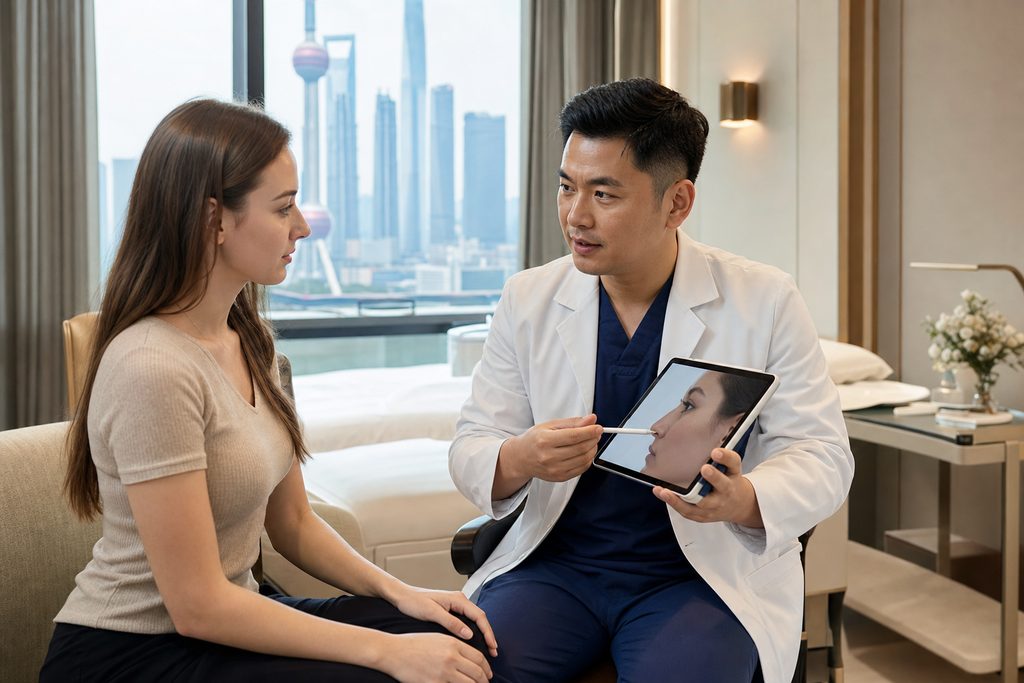
Can You Get Rhinoplasty in China? The Short Answer
Yes. International patients can absolutely get rhinoplasty in China, and the rhinoplasty cost China hospitals quote typically ranges from $3,000 to $12,000 depending on technique, implant material, and hospital tier. That is roughly one-third to one-fifth of what the same procedure costs in the United States or Western Europe. But the real question is not whether you can get it. It is whether you should, and how to do it without walking blind into a system you do not understand.
You have probably heard that surgery in China means compromising on quality. The reality is closer to the opposite in the top-tier hospitals. China’s leading plastic surgery departments handle case volumes that most Western surgeons will never see in a lifetime. A single senior rhinoplasty specialist at a major Shanghai or Beijing teaching hospital may perform 300 to 500 nose procedures per year. That repetition breeds a specific kind of technical fluency. But volume is not the same as aesthetic judgment, and that is where your homework matters.
Who This Is Right For — and Who It Is Not
Rhinoplasty in China makes sense for a specific profile of patient. You are a reasonable candidate if you have realistic expectations, a clear understanding of what you want changed, and the patience to go through a remote consultation before booking a flight. You are also a strong candidate if you are combining surgery with an extended stay in China for work, study, or family reasons. And you are a good fit if you want a technically demanding revision procedure and are willing to pay for a senior specialist’s time.
You should not pursue this if you have uncontrolled hypertension, a bleeding disorder, or an active nasal infection. You should also pause if you are pregnant or breastfeeding. Smokers face significantly higher complication rates and most surgeons will require you to stop at least four weeks before and after surgery. And if you are looking for a bargain first and a surgeon second, stay home. The cheapest option in any country is usually the most expensive mistake.
One more honest note: if you want a very specific ethnic-preservation approach, such as Black rhinoplasty or Middle Eastern rhinoplasty techniques, you need to verify that your chosen surgeon has genuine experience with your nasal anatomy. Not every Chinese surgeon does. The best ones will tell you that directly.
The Options, Compared
Rhinoplasty is not one operation. It is a family of procedures, and the price tag swings wildly depending on which one you actually need. Here is how the main approaches compare in the Chinese market, with reference points for what you would pay elsewhere.
| Procedure Type | What It Involves | Typical Cost in China (USD) | US/EU Reference Cost (USD) | Recovery Before Travel |
|---|---|---|---|---|
| Closed rhinoplasty (primary, no implant) | Incisions inside nostrils; tip refinement, hump reduction | $3,000–$6,000 | $8,000–$15,000 | 10–14 days in-country |
| Open rhinoplasty (primary, with implant) | External incision across columella; silicone or Gore-Tex implant, tip work | $4,500–$8,500 | $10,000–$20,000 | 14–21 days in-country |
| Rib cartilage rhinoplasty (revision or complex primary) | Autologous rib cartilage harvest; full structural rebuild | $6,000–$12,000 | $15,000–$35,000 | 21–28 days in-country |
| Revision rhinoplasty (any technique) | Correcting prior surgical issues; scar tissue, asymmetry, breathing problems | $5,000–$12,000 | $12,000–$30,000 | 21–30 days in-country |
If you want a subtle tip refinement and have good nasal structure, the closed approach is often enough and the recovery is faster. If you need significant dorsal augmentation — common among patients with a low or flat bridge — an implant is usually required. If a previous rhinoplasty failed, rib cartilage is frequently the only material strong enough to rebuild the framework. The right column for you depends less on your budget and more on your anatomy and surgical history.
How Rhinoplasty in China Differs From the West — Aesthetic Logic and Surgical Culture
Here is the part most international patients do not anticipate. The aesthetic standard in Chinese rhinoplasty has historically centered on augmentation — building up a higher, more defined dorsal bridge. That is the opposite of the Western reduction-focused tradition, where surgeons mostly take down humps and refine tips. If you are a Western patient seeking a smaller, more delicate nose, you need to be extremely explicit about that goal. Show reference photos. Ask the surgeon to describe back to you what they heard. Do not assume shared aesthetic defaults.
And that leads to the second difference: implant culture. Silicone and Gore-Tex implants are used far more routinely in China than in the United States or much of Europe. For augmentation, they work well and avoid the extra scar from rib harvest. But implants carry long-term risks — infection, extrusion, capsular contracture — that autologous tissue does not. A good surgeon will discuss both paths honestly. If a surgeon only offers implants and never mentions rib or ear cartilage as an option, that is a signal to get a second opinion.
The third difference is operational. China’s top plastic surgery departments are inside massive public hospitals. Peking Union Medical College Hospital in Beijing, Shanghai Ninth People’s Hospital, and West China Hospital in Chengdu run enormous craniofacial and plastic surgery units. Shanghai Ninth alone performs over 40,000 plastic surgery procedures annually across all subspecialties. That is not marketing language. It is a documented institutional scale. For complex revision work, few places on earth see that volume.
Rhinoplasty Cost China: What the Price Actually Includes
The rhinoplasty cost China clinics advertise is rarely the full number. You need to know what sits inside the quote and what does not. A typical surgical package at a top-tier public hospital international department includes the surgeon’s fee, operating room time, anesthesia, basic implant material if used, and one to two nights of inpatient observation. That package usually starts around $4,000 and climbs with complexity.
Here is what is not included: pre-operative lab work and imaging, which run $150 to $400. Post-operative medications, typically $50 to $150. Compression garments or nasal splints, usually under $100. And the big one — your accommodation, meals, and local transport during a two-to-four-week stay, which can add $1,500 to $4,000 depending on your standards. If you book a package that includes hotel and airport transfers, expect the total to rise accordingly.
How much is a nose job in Beijing specifically? The range at public hospital international departments in Beijing runs roughly $4,000 to $10,000. Shanghai prices are comparable, sometimes slightly higher at the very top end because of demand for a handful of famous revision specialists. Private international hospitals like United Family or Jiahui charge more — often $8,000 to $15,000 — but offer fully English-speaking environments and direct insurance billing.
Recovery Timeline: What “Rhinoplasty Recovery Time Abroad” Actually Looks Like
Rhinoplasty recovery time abroad is not just about healing. It is about when you can safely board a plane, when you can remove your own splint, and when you can walk into a meeting without looking like you just had surgery. Here is the realistic week-by-week picture.
Days 1–3: You will have nasal packing or internal splints, swelling, bruising around the eyes, and significant congestion. You will be breathing through your mouth. Sleep upright. Ice your cheeks, not your nose. You should be within 30 minutes of your surgical team.
Days 4–7: Packing and external splint usually come off around day 5 to 7. Bruising starts fading from purple to yellow. Swelling is still obvious. You can walk around, eat normally, and work remotely if you feel up to it.
Days 8–14: This is the earliest window most surgeons will clear you for a short-haul flight. For long-haul international flights, most want you to wait until day 10 to 14. The cabin pressure change is generally safe after the first week, but you want the surgeon’s sign-off first.
Weeks 3–6: Most visible swelling resolves. The tip stays swollen longest — expect it to look slightly upturned or bulbous for up to three months. No contact sports, no glasses resting directly on the bridge, no blowing your nose hard.
Months 3–12: The final shape settles gradually. Tip refinement can take a full year to show. This is why revision decisions should never be made before month six.
If you are asking whether you can “book nose job China package” that includes surgery plus a two-week recovery stay, the answer is yes — many international patient coordinators structure exactly that. But do not book a 10-day package for an open rhinoplasty with rib harvest. You will be flying home with fresh sutures and no local follow-up. Give yourself buffer.
Is Rhinoplasty Safe in China? The Data, the Risks, and the Red Flags
Is rhinoplasty safe in China? In accredited top-tier hospitals, the safety profile is comparable to any developed country. Infection rates for primary rhinoplasty at major teaching hospitals run in the low single digits. Serious complications — septal perforation, skin necrosis, implant extrusion — are uncommon in experienced hands. But “in experienced hands” is doing a lot of work in that sentence.
China’s medical system is bifurcated. At the top are the Fudan-ranked teaching hospitals and JCI-accredited international facilities we work with. At the bottom are unregulated aesthetic clinics operating in commercial districts, staffed by practitioners with questionable credentials, offering rhinoplasty at $800 to $1,500. Those places are where the horror stories come from. Not from Shanghai Ninth. Not from Peking Union. Not from the institutions that publish peer-reviewed surgical research.
Red flags to watch for: a clinic that will not tell you the surgeon’s name and credentials before you pay. A surgeon who refuses to discuss risks. A price that seems dramatically below market. A coordinator who promises a specific result. No ethical surgeon promises a specific result. And if you are told you do not need a pre-operative consultation because “the surgeon can just see you the day before” — leave.
Practical Considerations: Records, Visa, Payment, and Follow-Up
You will need a S2 visa for medical treatment in China, not an M visa. The M visa is for commercial and trade activities. For short-term medical care, S2 is the applicable category, and you will need supporting documents from the hospital — typically an invitation letter or treatment confirmation. Your accompanying family member applies for the same S2 category. Processing times vary by embassy, so start at least six to eight weeks before your planned surgery date.
Bring every relevant medical record: previous surgical notes if this is a revision, allergy history, current medication list, recent blood work, and any imaging. If your records are not in English or Chinese, get them translated before you travel. Hospitals will also run their own pre-operative labs, so do not skip that step.
Payment in public hospitals is almost always required upfront. International credit cards work at international departments and private hospitals, but public hospital cashier systems sometimes only accept Chinese bank cards or WeChat Pay. Your coordinator should clarify payment methods before you arrive. If you have international health insurance, check whether it covers elective cosmetic surgery abroad — most do not. Some private international hospitals in China offer direct billing for the insurers they work with, but cosmetic procedures are typically excluded from coverage anyway.
Follow-up after you return home is the weakest link in any cross-border surgery plan. You will need someone local to remove sutures if they are not dissolvable, assess healing, and manage any late complications. Identify that person before you leave China. Ask your Chinese surgeon for a written post-operative protocol you can hand to a local provider. And schedule a video follow-up with your surgical team at one month and three months.
Frequently Asked Questions
Start with the plastic surgery departments of Shanghai Ninth People’s Hospital and Zhongshan Hospital Fudan University. Both are Fudan-ranked top-tier institutions with high-volume rhinoplasty programs. The “best” surgeon is not a single name — it is the one whose documented experience matches your specific anatomy and goal. Ask for before-and-after photos of patients with noses similar to yours, not just the surgeon’s best three results. A surgeon who has done 2,000 augmentations may not be the right choice for a reduction-focused Western patient.
Yes, and many international patients do. Common combinations include rhinoplasty with blepharoplasty, chin augmentation, or facial fat grafting. Combining procedures reduces total anesthesia exposure and recovery overlap, but it also increases surgical time and swelling. Some surgeons will not combine a complex revision rhinoplasty with anything else. Ask during your remote consultation whether your surgeon is comfortable combining your specific procedures, and do not push for a combination they advise against.
This is the hard truth about any surgery abroad. If a revision is needed, you will likely need to return to China. Your original surgeon knows exactly what was done and is usually the best person to fix it. Some international patient programs include one video follow-up in the surgical package, but a physical revision requires a new trip, new visa, and new surgical fee — often at a reduced rate from the original surgeon. Factor this possibility into your decision. It is rare in experienced hands, but it is not zero.
Yes. There is no restriction on foreigners receiving elective cosmetic surgery in China, provided the hospital is properly licensed and you enter on the correct visa. The S2 visa is the standard category for short-term medical treatment. Bring your passport, hospital invitation documents, and proof of sufficient funds for your stay.
Your Next Step
Rhinoplasty in China is not a shortcut. It is a legitimate option for patients who do their homework, choose a top-tier institution, and plan for a proper in-country recovery. The cost advantage is real, but it only matters if the surgical result is right.
We are China Medical Services, a patient coordination team that connects international patients with top-ranked Chinese hospitals. We are not a hospital, we do not perform surgery, and we do not give medical advice or diagnoses. What we do is handle the logistics — hospital matching, appointment coordination, bilingual medical companions, and visa documentation support — so you can make decisions with clear information. If you are considering rhinoplasty in China, start with a free consultation. Tell us your goals and your medical history, and we will tell you honestly whether this path makes sense for you.
The right surgeon for your nose is out there. The question is whether you will do the work to find them.
For more medical information and treatment options in China, visit chinamedservices.com (China Medical Services).
