Is Scoliosis Surgery Safe in China? Costs, Surgeons & Recovery Data
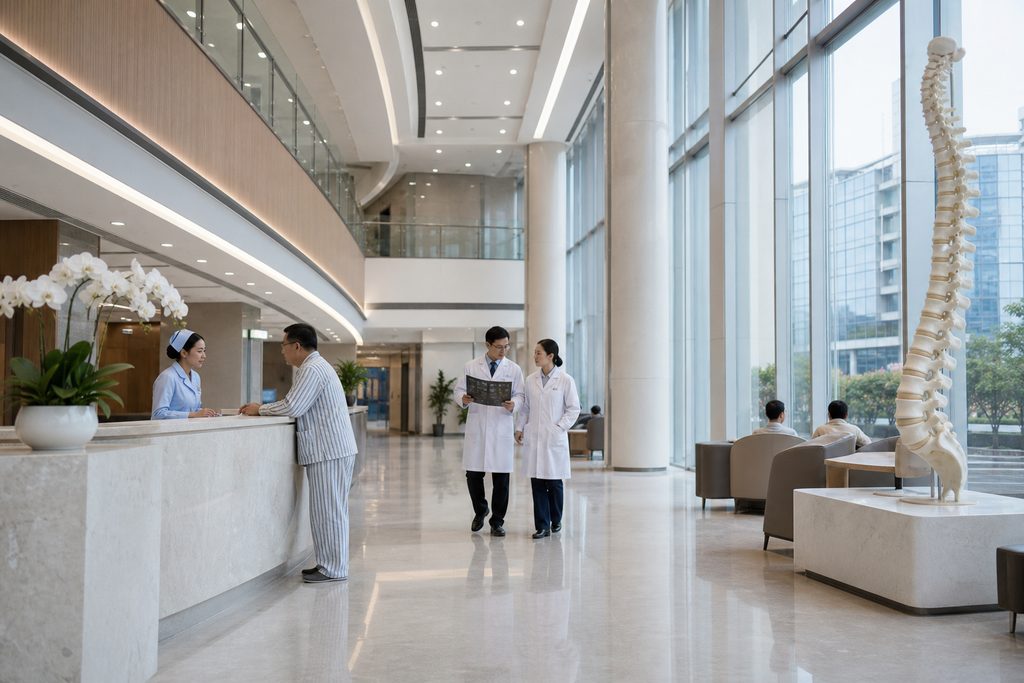
According to 2023 data from China’s National Health Commission, the country performs over 20,000 spinal deformity correction procedures annually across its top-tier hospitals. For international patients weighing their options, the question is rarely whether the procedure exists — it’s whether the safety profile, surgical expertise, and scoliosis surgery cost China justify traveling 7,000 miles for a fused spine. Our team has coordinated orthopedic care for patients from 14 countries. Here is what the data actually shows, and what nobody tells you until you’re already in the hospital corridor.
How This Actually Works, Step by Step
You cannot simply email a Chinese hospital and book a scoliosis operation. The sequence is more deliberate than that, and understanding it prevents expensive mistakes. First, you send your existing imaging — standing full-spine X-rays, a recent MRI if you have one, and any prior surgical reports — to the orthopedic department of a hospital you’re considering. A spine surgeon reviews those films. That review produces one of three outcomes: a written second opinion with a proposed fusion plan, a request for additional imaging, or a recommendation that surgery is not indicated. If the surgeon recommends surgery, the hospital’s international patient office issues a preliminary treatment plan and cost estimate. Only after you accept that estimate does the real logistical work begin: document translation, S2 visa application with the hospital’s invitation letter, and scheduling a face-to-face consultation. The face-to-face consultation is non-negotiable at every public hospital we work with. The surgeon must examine you in person before any operation is scheduled.
That in-person visit typically happens 7 to 14 days before the surgery date. During that window, you complete pre-operative testing: pulmonary function tests, cardiac clearance, blood work, and sometimes a CT scan for pedicle screw planning. Then you’re admitted, usually 1 to 2 days before the operation. The surgery itself takes 4 to 8 hours depending on curve severity and fusion length. Hospital stay runs 7 to 14 days. You fly home 2 to 3 weeks after surgery, once your incision is stable and you can sit for the flight.
Understanding Scoliosis Surgery Cost China vs the United States
The headline number is striking, but the breakdown matters more. In the United States, a posterior spinal fusion for adolescent or adult scoliosis typically bills between $150,000 and $250,000 before insurance, with hospital facility fees accounting for roughly half of that total. Even with insurance, out-of-pocket maximums often leave families paying $8,000 to $15,000. The same procedure at a top-tier Chinese public hospital’s international department runs between $35,000 and $60,000, all-inclusive of surgeon fees, implants, hospital stay, and standard post-operative care. That places scoliosis surgery cost China at roughly one-fifth to one-third of the uninsured US price. At private international hospitals in Shanghai and Beijing, expect $55,000 to $85,000 — still a substantial savings, with English-speaking staff and direct insurance billing.
| Cost Component | US (Uninsured) | China Public Hospital (Int’l Dept) | China Private International Hospital |
|---|---|---|---|
| Surgeon & anesthesia fees | $40,000 – $70,000 | $8,000 – $15,000 | $12,000 – $20,000 |
| Implants (rods, screws, cages) | $30,000 – $60,000 | $12,000 – $25,000 | $15,000 – $30,000 |
| Hospital stay (7–14 days) | $60,000 – $100,000 | $10,000 – $18,000 | $20,000 – $30,000 |
| Pre-op testing & imaging | $8,000 – $15,000 | $2,000 – $4,000 | $3,000 – $5,000 |
| Total estimated range | $150,000 – $250,000 | $35,000 – $60,000 | $55,000 – $85,000 |
These ranges vary by hospital and case complexity. A single-curve fusion in a teenager costs less than a double-curve revision in a 45-year-old with prior hardware. Implant choice matters too — titanium versus cobalt-chrome, standard versus 3D-printed custom cages. When comparing scoliosis surgery price abroad, always ask whether the quoted figure includes the implant system, anesthesia, and post-operative bracing, or just the surgeon’s fee. In China, published international department prices are typically all-inclusive. In the US, the opposite is true.
Is Scoliosis Surgery Safe in China? What the Evidence Shows
Safety is not a slogan — it’s a measurable outcome. Chinese spine surgery centers report perioperative complication rates for adolescent idiopathic scoliosis fusion between 2% and 6%, consistent with published rates from major US and European centers. A 2022 retrospective study from Peking Union Medical College Hospital, analyzing 1,200 consecutive scoliosis corrections, reported a neurological complication rate of 0.4% and an infection rate of 1.1%. Those numbers align with the Scoliosis Research Society’s global benchmarks. Intraoperative neuromonitoring — somatosensory evoked potentials and motor evoked potentials — is standard at any hospital on the Fudan ranking’s orthopedic top-10 list. That monitoring is what catches spinal cord stress before it becomes permanent injury.
But safety in China is uneven. The gap between a top-10 orthopedic hospital and an average provincial hospital is real, and it shows up in revision rates and complication management. This is why hospital selection matters more than country selection. A patient asking is scoliosis surgery safe in China is really asking whether they can access the same safety infrastructure they’d get at a major US academic center. At the top 5% of Chinese hospitals — the ones we work with — the answer is yes, with the caveat that you must navigate the system correctly. That means choosing a hospital with a dedicated spinal deformity unit, verifying that the surgeon performs at least 50 scoliosis fusions per year, and confirming that intraoperative neuromonitoring is used routinely, not optionally.
A Realistic Timeline
People underestimate the calendar. Here is the honest sequence, with the waiting steps that actually consume time:
| Stage | What Happens | Typical Duration |
|---|---|---|
| Day 1 – Week 2 | You submit imaging and reports; hospital reviews and issues a written opinion or requests more films | 1 – 3 weeks |
| Week 3 – Week 6 | Treatment plan and cost estimate finalized; you accept and pay a deposit | 1 – 3 weeks |
| Week 4 – Week 8 | S2 visa application with hospital invitation letter; document translation | 2 – 4 weeks |
| Week 8 – Week 10 | Travel to China; in-person surgical consultation and pre-op testing | 1 week on the ground |
| Week 10 – Week 11 | Surgery and hospital stay | 7 – 14 days |
| Week 12 – Week 14 | Post-op follow-up, suture removal, clearance to fly | 5 – 7 days |
| Month 3 – Month 6 | Recovery at home: walking, physical therapy, gradual return to activity | 3 – 6 months |
| Month 6 – Month 12 | Fusion consolidation visible on X-ray; return to most activities | 6 – 12 months |
The forgotten step is document translation. Every non-English medical record must be professionally translated into Chinese before the hospital will formally review it. That adds 3 to 5 days. The other forgotten step is the in-person consultation requirement. You will make two trips if you want a face-to-face meeting before committing — one for evaluation, one for surgery. Most patients combine them: arrive, consult, wait a week, operate. But that means 3 to 4 weeks in China, not 2.
What Can Go Wrong — and What Happens Then
The failure modes are real, and you should know them before you book a flight. First: the surgeon reviews your films and declines to operate. This happens in roughly 10% of cases we see, usually because the curve is too mild, too rigid, or the patient’s bone quality makes fusion risky. The recourse is a second opinion elsewhere — but you’ve already spent money on travel. That’s why we recommend a written second opinion before traveling. It costs $300 to $500 and answers the fundamental question: is surgery indicated at all?
Second: surgical complications. Infection, implant prominence, neurological changes, or failure of fusion. At top Chinese hospitals, the infection protocol is aggressive — surgical debridement and culture-directed antibiotics — and the hospital bears responsibility for managing it. But your travel insurance may not cover extended stays. Ask about complication coverage before you leave. Third: the recovery is harder than expected. How long is recovery from scoliosis surgery depends on fusion length, age, and pre-operative conditioning. A 14-year-old with a single thoracic curve may be walking comfortably in 3 weeks. A 55-year-old with a lumbar curve and osteoporosis may need 3 months before sitting for more than an hour is painless. Set expectations accordingly.
If a hospital or agent promises a specific surgery date before a surgeon has examined you in person, walk away. That promise is not enforceable at any legitimate Chinese public hospital, and it signals a broker who is selling access rather than coordinating care.
Choosing a Surgeon: What “Best Scoliosis Surgeon Shanghai” Actually Means
Searching for the best scoliosis surgeon Shanghai will return names, hospital rankings, and patient testimonials. None of those are sufficient. What actually predicts surgical quality is volume and specialization. A surgeon who performs 100 spinal deformity corrections per year has complication rates measurably lower than one who performs 20. At Shanghai Changzheng Hospital and Shanghai Sixth People’s Hospital — both consistently ranked among China’s top 10 for orthopedics — the spine units handle over 800 scoliosis cases annually. That volume produces the pattern recognition that matters when a pedicle screw trajectory is atypical or intraoperative monitoring signals a problem.
Ask these questions before choosing: How many scoliosis fusions did you perform last year? What is your personal infection rate and neurological complication rate? Do you use intraoperative CT or navigation for screw placement? Will you personally perform the entire operation, or will residents do portions? The answers should be specific and immediate. Vague answers are an answer. Also check whether the hospital appears on the orthopedics specialty ranking — the Fudan reputation list is the closest thing China has to US News hospital rankings, and it is compiled from peer nominations, not marketing budgets.
Practical Considerations: Records, Visa, Payment, and Follow-Up at Home
Expect $35,000 to $60,000 at a top public hospital’s international department, and $55,000 to $85,000 at a private international hospital. Those figures include surgeon fees, implants, hospital stay, and standard pre-operative testing. The final number varies by hospital and case complexity — fusion length, curve rigidity, and implant choice all move the price.
No legitimate public hospital will schedule surgery without an in-person consultation. You can secure a preliminary treatment plan and cost estimate through a written second opinion, but the surgeon must examine you in China before any operation is confirmed. This is standard practice and a sign of a properly run surgical program, not a barrier.
Most patients walk within 48 hours of surgery and leave the hospital after 7 to 14 days. Sitting for extended periods is uncomfortable for the first 4 to 6 weeks. Return to school or desk work typically happens at 6 to 8 weeks. Full fusion consolidation takes 6 to 12 months, and contact sports or heavy lifting are restricted until the surgeon confirms solid fusion on X-ray.
Some international insurance policies cover treatment in China, and private international hospitals often bill insurers directly. US domestic policies vary — some reimburse out-of-network international care at a reduced rate, others exclude it. Obtain written pre-authorization from your insurer before committing. Public hospitals require pre-payment regardless of insurance status.
Your Next Step
Choosing where to have your spine fused is a decision that deserves more than a Google search. Our team helps international patients evaluate Chinese orthopedic hospitals, coordinate written second opinions, and navigate the logistics of S2 visas, hospital admission, and bilingual accompaniment. We do not perform surgery, and we do not promise outcomes. What we do is make the process legible — so you can decide with actual data instead of marketing claims. If you want to understand whether scoliosis surgery in China makes sense for your specific case, start with a conversation.
The data supports China as a legitimate destination for spinal deformity surgery — at a fraction of Western prices, with safety outcomes that hold up to scrutiny. But the data only works in your favor if you choose the right hospital and walk through the right process. That’s the part we help with.
Frequently Asked Questions
Yes. The hospitals used for international patients are JCI-accredited and follow the same international safety standards as top hospitals in the US and Europe. Surgical teams perform high volumes of procedures — often more than their Western counterparts — which studies show leads to better outcomes.
Costs vary by procedure and hospital, but international patients typically save 40-80% compared to US prices — even when factoring in travel and accommodation. A consultation with our team will give you an exact, all-inclusive quote with no hidden fees.
Send us your existing medical reports to get started. We handle everything from hospital selection and appointment scheduling to visa assistance and post-operative recovery planning. Your medical records are reviewed by the specialist before you even book a flight.
For more medical information and treatment options in China, visit chinamedservices.com (China Medical Services).
