Varicose Vein Treatment in China: Costs, Top Hospitals, and How It Works
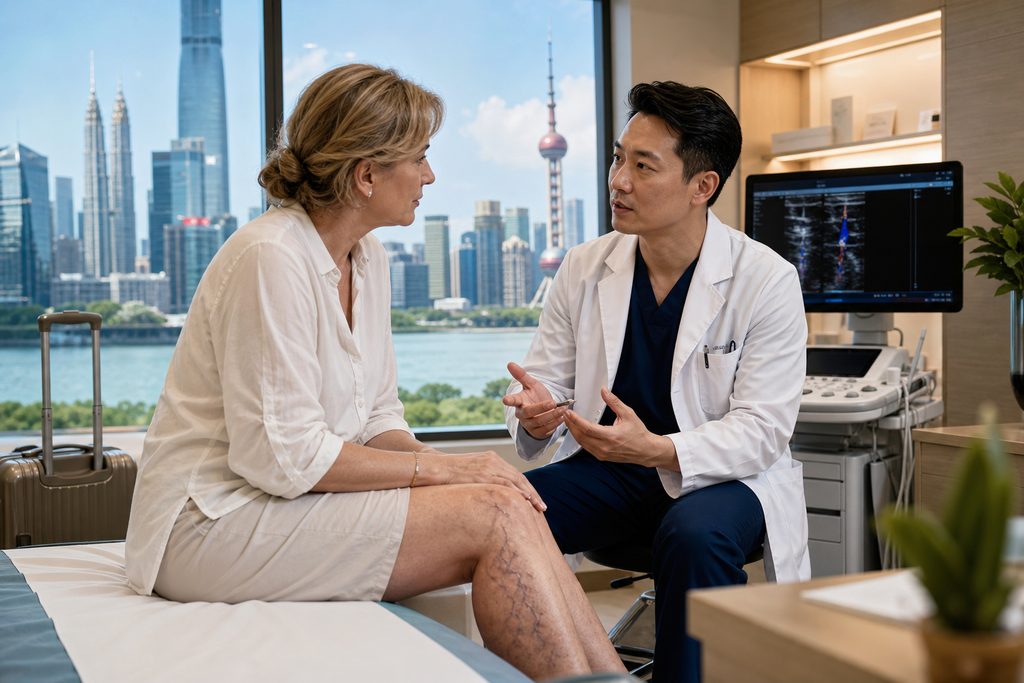
According to a 2024 report from the International Society for Vascular Surgery, chronic venous disease affects approximately 1 in 3 adults over age 45 in Western countries. For many, the progression from spider veins to painful, bulging varicose veins means facing a surgical bill that can exceed $15,000 in the United States. That same procedure — often with newer laser technology — is available at a fraction of the price in China. The varicose vein treatment cost China hospitals quote for international patients typically runs between $1,500 and $4,500 depending on the method and hospital tier. We have coordinated care for patients from the US, UK, and Australia who made this exact calculation. The savings are real. The logistics are manageable if you know the system.
Key Takeaways
- Laser ablation for varicose veins in top Chinese hospitals costs $1,500–$3,500 per leg, versus $6,000–$15,000 in the US.
- Shanghai and Beijing vascular surgery departments perform thousands of endovenous procedures annually — volume that drives technical proficiency.
- Foreign patients cannot simply walk into a public hospital and book surgery the same week. The system requires either an in-person consultation first or coordination through an international medical department.
- You will need an S2 visa for medical treatment, comprehensive medical records translated into English or Chinese, and a plan for follow-up imaging after you return home.
The Problem: Varicose Veins Don’t Wait, But Your Insurance Might
Varicose veins are not just a cosmetic nuisance. Untreated venous reflux can progress to chronic venous insufficiency, leg ulcers, and deep vein thrombosis. The Journal of Vascular Surgery reported in 2023 that patients who delay treatment beyond five years of symptom onset face a 2.4x higher risk of developing venous leg ulcers. Yet in the US, UK, and Canada, patients routinely wait 6 to 18 months for a vascular surgery consultation through public systems. Private options exist — but the price tag stops many people cold.
An American patient with no insurance or a high-deductible plan might pay $8,000 for radiofrequency ablation on one leg. Add the second leg, anesthesia fees, and facility charges, and the total can hit $18,000. In the UK, NHS waiting lists for varicose vein treatment have stretched past 12 months in many trusts. Meanwhile, the condition worsens. Legs ache. Swelling increases. Skin changes begin. The gap between needing care and being able to access it is where medical travel becomes a rational decision, not a luxury.
Why China Delivers Results for Vascular Patients
The Chinese healthcare system has structural advantages that translate directly into better value for varicose vein patients. We see three reasons consistently in our work with international patients.
Clinical Volume Creates Technical Confidence
Top-tier Chinese vascular surgery departments are high-throughput environments. A single vascular unit at Zhongshan Hospital in Shanghai performs over 2,000 endovenous procedures annually. Compare that to a typical US community hospital, where a vascular surgeon might complete 150 to 300 vein procedures per year. Volume matters for any procedure — but especially for endovenous laser ablation and radiofrequency ablation, where precision in catheter placement and energy delivery determines both short-term results and long-term recurrence rates. The 2022 European Journal of Vascular and Endovascular Surgery meta-analysis found that surgeons performing more than 100 endovenous ablations per year had significantly lower complication rates than lower-volume operators. Chinese top-tier vascular teams clear that threshold many times over.
Technology Adoption Without Legacy Costs
Chinese hospitals adopted endovenous laser ablation, radiofrequency ablation, and ultrasound-guided foam sclerotherapy later than Western centers — but they adopted the current-generation equipment directly. No legacy infrastructure to amortize. No decade-old laser consoles still in service. The result is that patients at hospitals like Peking Union Medical College Hospital or Ruijin Hospital receive treatment with equipment comparable to what you would find at Mayo Clinic or Cleveland Clinic. The 1470nm laser systems used in Shanghai and Beijing are the same models deployed in leading European vein centers. That hardware parity matters when you are evaluating whether lower cost means lower quality. It does not — not in this context.
Cost Structure: Why the Same Procedure Costs 70–80% Less
Labor costs in Chinese healthcare are dramatically lower than in the US or Western Europe. A vascular surgeon in Shanghai earns a fraction of what an American vascular surgeon earns — even accounting for purchasing power differences. Hospital facility fees are lower. Malpractice insurance costs are lower. Administrative overhead is lower. None of those savings come out of the clinical budget. The laser fibers, the ultrasound machines, the operating room standards — those are all comparable to international benchmarks. What you are not paying for is the inflated billing structure of the American healthcare system. That is the honest explanation for why laser varicose vein removal China price quotes from top hospitals land between $1,800 and $3,200 per leg, while the same procedure in the US runs $6,000 to $12,000.
Varicose Vein Treatment Options in China: What Actually Happens
You will encounter four main treatment approaches in Chinese vascular departments. Understanding the differences helps you evaluate what a hospital is actually recommending — and whether the quoted price matches the method.
| Treatment Method | What It Involves | Typical Cost in China (per leg) | US Comparison (per leg) | Recovery Time |
|---|---|---|---|---|
| Endovenous Laser Ablation (EVLA) | Laser fiber inserted via catheter; heat closes the diseased vein | $1,800–$3,200 | $6,000–$12,000 | 1–2 days to normal activity |
| Radiofrequency Ablation (RFA) | Similar to EVLA but uses radiofrequency energy | $2,000–$3,500 | $7,000–$13,000 | 1–2 days |
| Ultrasound-Guided Foam Sclerotherapy | Foam sclerosant injected into vein under ultrasound guidance | $300–$800 per session | $500–$1,500 per session | Same day |
| Vein Stripping (Traditional Surgery) | Vein removed through small incisions; now rarely recommended | $1,200–$2,500 | $4,000–$9,000 | 1–2 weeks |
Prices vary by hospital and case complexity. International departments at top-tier public hospitals typically charge 1.5 to 2 times the standard rate — which is still far below Western prices. Private international hospitals like United Family or Jiahui charge more, typically $4,000 to $6,000 per leg for EVLA, but offer fully English-speaking staff and direct insurance billing. If you are asking how much does vein stripping cost in Beijing, the honest answer is that most top vascular surgeons will try to talk you out of vein stripping entirely. Endovenous methods have replaced it as first-line treatment. But if stripping is clinically indicated for your anatomy, the $1,200–$2,500 range at a public hospital international department is realistic.
Finding the Best Hospital for Varicose Veins in Shanghai and Beyond
Shanghai is the most common entry point for international patients seeking vascular care. The city hosts several hospitals with dedicated vascular surgery departments that rank among China’s best. When patients ask us about the best hospital for varicose veins Shanghai has to offer, we point to the Fudan University hospital rankings — China’s most authoritative hospital evaluation system.
Zhongshan Hospital affiliated with Fudan University operates one of the largest vascular surgery departments in Asia. Its venous disease program handles complex cases referred from across China. Ruijin Hospital, also in Shanghai, has a strong vascular surgery reputation and a well-established international medical department. In Beijing, Peking Union Medical College Hospital and Fuwai Hospital both maintain vascular programs, though Fuwai focuses primarily on cardiac and arterial disease. For a full breakdown of top-ranked vascular surgery departments across China, our specialty rankings page lists Fudan-ranked departments by field. And if you want to understand the hospital tiers before you commit, the top hospitals directory explains how the Fudan ranking system works and which hospitals carry the highest designations.
One thing to understand clearly: you cannot simply email a top Shanghai hospital and book a varicose vein procedure for next month. Public hospitals require an in-person consultation before any surgical scheduling. That means either two trips — one for consultation, one for treatment — or coordination through the hospital’s international department, which can sometimes streamline the process. Private international hospitals in Shanghai are more flexible, but their prices are higher. The tradeoff is real, and we lay it out honestly to every patient who contacts us.
Is Varicose Vein Surgery Safe in China? What the Evidence Shows
The question comes up in nearly every consultation: is varicose vein surgery safe in China? The short answer is yes — at accredited, top-tier hospitals. The longer answer requires understanding where the safety comes from and where the risks lie.
Endovenous laser ablation has a well-documented safety profile globally. The Cochrane Database of Systematic Reviews published a 2021 review of endovenous treatments showing major complication rates below 1% across thousands of patients. Chinese vascular surgery departments publish outcomes data in peer-reviewed journals that align with international benchmarks. Complication rates for thermal ablation at top Chinese centers — including deep vein thrombosis, nerve injury, and skin burns — are comparable to those reported in US and European registries.
But safety depends heavily on where you go. China has more than 35,000 hospitals. The top 5% — roughly 1,700 institutions — meet international standards for complex care. The bottom tier is not where you want to be. This is why we only coordinate care at Fudan-ranked or JCI-accredited facilities. The hospital matters more than the country. A patient who chooses a top-tier Shanghai vascular department is receiving care at an institution with outcomes data comparable to any Western academic medical center. A patient who chooses an unvetted clinic based on a low price is taking a risk that has nothing to do with China and everything to do with provider selection.
Practical Considerations: Visas, Records, and Payment for Vein Treatment in China
If you are seriously considering traveling to China for varicose vein treatment, here is what the logistics actually look like.
Visa Requirements
Medical treatment in China falls under the S2 visa category. This is a short-stay visa for private affairs, including medical treatment. You will need supporting documents from the Chinese hospital — typically an invitation letter or treatment confirmation. Your accompanying family members also apply for S2 visas. The M visa, which some patients mistakenly ask about, is for commercial and trade activities only. It is not appropriate for medical travel. Processing time is typically 4–10 business days depending on your home country’s Chinese embassy or consulate. We always recommend applying at least 4–6 weeks before your intended travel date.
Medical Records You Will Need
Bring everything. A venous duplex ultrasound report from within the last 6 months is essential — Chinese vascular surgeons will want to see the reflux pattern and vein diameters before recommending a treatment approach. Bring your full medical history, list of current medications, any previous vein treatments, and allergy information. If your records are not in English, have them translated. If they are in English, most top Chinese vascular surgeons can read them directly. This is one area where preparation pays off: patients who arrive with complete records typically get a treatment plan confirmed in one consultation.
Payment and Insurance
Public hospitals in China require prepayment for procedures. International departments accept major credit cards and sometimes international bank transfers. Private international hospitals like United Family and Jiahui have direct billing arrangements with many international insurers — if you have expat health insurance or a plan with international coverage, check whether your insurer has a direct billing agreement. Most US domestic insurance plans will not cover treatment in China, but some PPO plans reimburse out-of-network international care. Get pre-authorization in writing before you travel. The financial risk if you skip this step is entirely yours.
Follow-Up After You Return Home
Varicose vein treatment requires follow-up ultrasound at 1–2 weeks and again at 3–6 months to confirm the treated vein has closed and no deep vein thrombosis has developed. Chinese hospitals will provide a discharge summary and follow-up recommendations in English if you request it. You can then arrange follow-up imaging with a local vascular specialist back home. This is a standard protocol — but it requires you to have a local provider willing to do the follow-up. Arrange that before you travel. A patient who arrives home with no plan for follow-up imaging has created a gap in their own care.
Frequently Asked Questions
Expect to pay $1,500–$4,500 per leg depending on the method and hospital. Endovenous laser ablation at a top-tier public hospital international department typically runs $1,800–$3,200 per leg. Private international hospitals charge $4,000–$6,000. Foam sclerotherapy is cheaper at $300–$800 per session. All prices vary by hospital and case complexity.
Not through standard public hospital channels. Public hospitals require an in-person consultation before scheduling any procedure. Some international departments can arrange a video consultation first, which may allow you to confirm a treatment plan and provisional procedure date before you fly. Private international hospitals are more flexible and may accept bookings based on your medical records alone. If your goal is to book varicose vein treatment China medical tourism packages in advance, private hospitals or international department coordination are your realistic options.
Major complications from modern endovenous procedures are rare — below 1% in published registries. Top Chinese hospitals have standard protocols for managing complications, including access to vascular surgery backup and interventional radiology. You should confirm before treatment that the hospital has an English-speaking point of contact for post-procedure concerns. You should also have a plan for follow-up care in your home country. No hospital, in China or elsewhere, can guarantee zero complications. What you can verify is that the institution has the infrastructure to handle them if they occur.
At international departments of top public hospitals, no. These departments employ English-speaking coordinators and often have bilingual nursing staff. At private international hospitals, English is the working language. At standard public hospital departments, yes — you will need Chinese or an interpreter. This is exactly where a bilingual medical companion becomes valuable: handling registration, payment, queue navigation, and translation during consultations. It is not mandatory, but it removes the single biggest source of stress for foreign patients.
Your Next Step
Varicose vein treatment in China is a legitimate option for patients facing high costs or long waits at home. The hospitals are real, the technology is current, and the price difference is substantial. What is not simple is navigating the system from abroad — which is where we come in. China Medical Services helps international patients connect with top-ranked Chinese hospitals, from initial video consultations to on-the-ground coordination. We are not a hospital and we do not provide medical advice. We are the bridge between you and the right vascular team. If you want to understand your options without committing to anything, request a free consultation and tell us about your situation. We will give you an honest assessment of whether China makes sense for your case.
For more medical information and treatment options in China, visit chinamedservices.com (China Medical Services).
