Colorectal Cancer Treatment Service China: From Diagnosis to Surgery We Manage Every Step
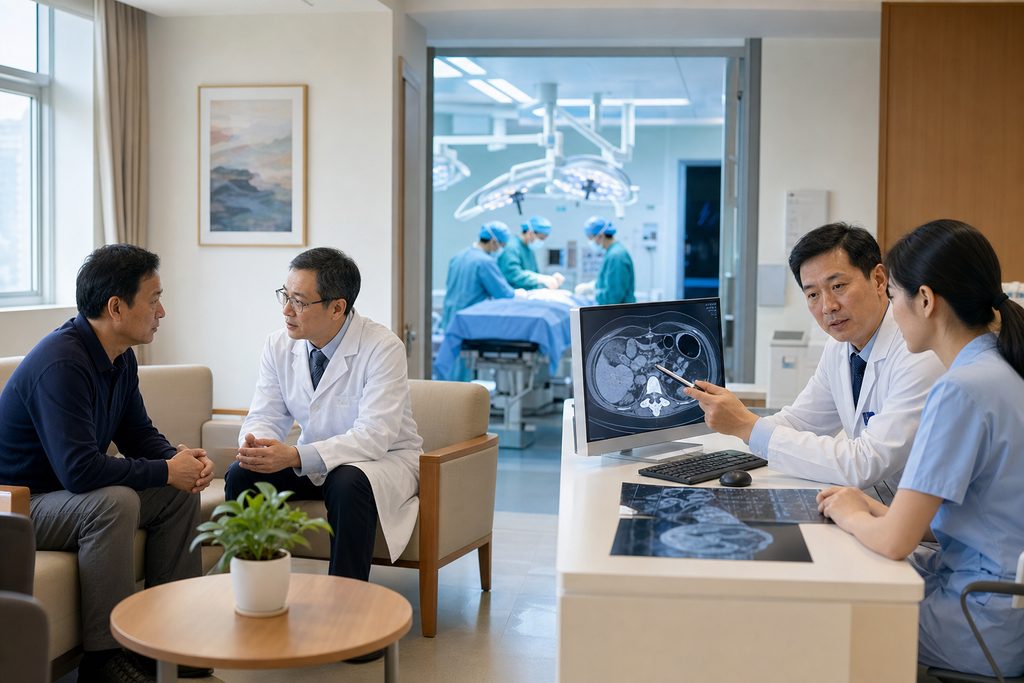
While a patient in the United States faces an average bill exceeding $65,000 for a colorectal resection, the same procedure at a top-tier Chinese cancer center typically ranges from $12,000 to $20,000. This stark difference is not a compromise on clinical quality. It reflects structural economic factors and the sheer procedural volume of China’s leading hospitals, where oncology departments routinely manage case volumes that dwarf Western institutions. Our team handles the logistics so that this clinical expertise becomes accessible — without the administrative chaos.
Key Takeaways
- The colorectal cancer surgery cost in China at a top-ranked public hospital averages $12,000–$20,000, roughly one-fifth of the US price for comparable JCI-accredited care.
- China’s top oncology centers, such as those ranked in the Fudan University Hospital Rankings, perform thousands of colorectal resections annually, driving surgical precision through high-volume experience.
- Navigating a Chinese public hospital independently is extremely difficult without Mandarin fluency; internal VIP and international department channels are the only reliable pathway for overseas patients to secure a surgical slot.
- You cannot simply “book a package” online. Legitimate treatment requires an in-person consultation first, followed by a tailored surgical plan — we coordinate this entire sequence.
The Problem: A Diagnosis Should Not Mean Financial Ruin or Endless Waiting
A colorectal cancer diagnosis triggers two immediate fears: the biological threat and the financial one. In the United States, the total cost for surgical intervention and the first year of follow-up care can easily surpass $100,000, depending on staging and whether a stoma is required. Even with insurance, high deductibles and out-of-network surprises leave patients with crushing debt. The Commonwealth Fund reports that medical bills are the single largest cause of personal bankruptcy in America.
In systems like the UK’s NHS or Canada’s provincial health plans, the financial burden is removed — but time becomes the enemy. A 2023 report from the Canadian Institute for Health Information showed that only 59% of patients received their first surgery within the benchmark timeframe. When you are dealing with a malignancy that can progress from stage II to stage III, a four-month delay is not an inconvenience. It is a clinical risk. That is the brutal trade-off many patients face: financial toxicity or temporal uncertainty.
Who We Are
We are not a hospital. We do not provide medical advice, perform surgeries, or prescribe treatment protocols. China Medical Services operates as a dedicated medical concierge for international patients seeking care in China. Think of us as your logistical architects. We maintain a curated database of over 340 top-ranked hospitals across 37 cities, and we use that network to match your specific diagnosis with the surgical team best equipped to handle it. Our role is to dismantle every non-clinical barrier — language, visa paperwork, hospital registration, payment systems, and post-operative accommodation — so you can focus entirely on recovery. We bridge the gap between you and China’s concentrated surgical expertise.
Why China Delivers Measurable Advantages for Colorectal Cancer Surgery
High Procedural Volume Drives Refined Surgical Outcomes
There is a well-documented relationship in surgical oncology between the number of times a team performs a procedure and the quality of the patient’s result. A landmark study in the New England Journal of Medicine demonstrated that hospitals with very high volumes for complex cancer resections had significantly lower operative mortality rates. This is where China’s top-tier hospitals operate in a different league. At a major cancer center like Fudan University Shanghai Cancer Center, colorectal surgeons might perform over 1,000 radical resections annually. A busy Western surgical oncologist might perform 50 to 100. That repetition matters. It refines the ability to achieve clear margins — a critical factor in preventing local recurrence. It sharpens the team’s response to intraoperative complications. The question “what is the success rate of colon cancer surgery in China” is best answered by looking at these volume-driven outcomes. For localized disease, five-year survival rates at these top centers align with the best international benchmarks, often exceeding 90% for stage I disease.
Technology Integration Without the Legacy Lag
Many of China’s leading hospitals have built their surgical infrastructure in the last decade. That means integrated laparoscopic and robotic systems are not retrofitted into aging operating theaters — they are the default. The da Vinci Xi surgical system is widely deployed. More importantly, the adoption of 3D laparoscopic and indocyanine green (ICG) fluorescence imaging for anastomotic perfusion assessment is routine in top centers. This technology directly addresses one of the most feared complications of colorectal surgery: anastomotic leakage. By visualizing blood flow to the surgical join in real time, surgeons can reduce leak rates significantly. This is not experimental technology here. It is standard of care at institutions we connect you with.
A Structural Cost Advantage Without Quality Compromise
The colorectal cancer surgery cost China patients pay is not lower because of inferior supplies or rushed care. The cost structure is fundamentally different. Physician salaries, while rising, are not the dominant cost driver they are in the US fee-for-service model. Hospital construction costs are amortized differently. The pharmaceutical supply chain for generic chemotherapeutic agents is extremely efficient. What you get is a financial reality where a complex laparoscopic low anterior resection with a five-day hospital stay costs between $15,000 and $20,000 at a JCI accredited cancer hospital China price point. A comparable US hospitalization would bill $60,000 to $80,000. The implants, the staplers, the anesthesia monitoring — they are the same global brands. The difference is the system around them. If you are looking to book colorectal cancer treatment package China through the right channels, you access this cost structure while maintaining clinical standards that are audited by international bodies.
What You Need to Know Before Going Alone
The clinical capacity exists. But accessing it independently is where plans collapse. We have seen patients arrive hoping to walk into a public hospital and register. It does not work that way. Here is the reality:
- Visa Requirements Are Specific and Unforgiving: You cannot enter China for medical treatment on a tourist (L) visa or a business (M) visa. You need an S2 visa, specifically endorsed for medical purposes. The application requires a formal invitation letter and treatment confirmation from a Chinese hospital. Obtaining that letter without a local contact inside the hospital’s international department is a circular problem — you need the letter to get the visa, but you need a confirmed medical relationship to get the letter. We break that cycle.
- The Registration and Payment Wall: Top-tier public hospitals in China process over 10,000 outpatient visits daily. Registration counters are Mandarin-only. Payment before service is standard. International credit cards are often not accepted for large hospital deposits. You need a local payment method or a wire transfer arranged in advance. Without a bilingual companion physically present, the simple act of paying your deposit and collecting your admission slip can take an entire day of failed attempts.
- The “Package” Myth: You might search for a way to “book colorectal cancer treatment package China” online. Legitimate, top-tier public hospitals do not sell fixed-price surgical packages to unknown overseas patients sight unseen. A surgeon must review your full medical records, imaging, and pathology slides. You must have an in-person consultation. The surgical plan is then custom-built. Any service offering a one-click purchase for a complex cancer resection is either a low-quality private clinic or a scam. The real pathway is a coordinated consultation sequence — which we manage.
How We Help You Navigate This
These barriers are structural, not malicious. The Chinese public hospital system is designed to serve a domestic population of 1.4 billion people. It was never optimized for an English-speaking patient arriving from overseas. That is where our team operates.
Before you travel, we handle the diagnostic translation. Your existing colonoscopy reports, biopsy results, CT and MRI images — we have them professionally translated into clinical Chinese and submitted to the appropriate department head. We do not just send records into a void. We present them through the hospital’s official international patient channel, securing a preliminary review. If the surgeon confirms you are a surgical candidate, we obtain the formal treatment confirmation letter required for your S2 visa application. You arrive with a scheduled appointment, not a hope.
On the ground, a bilingual medical companion meets you at the hospital entrance. They manage every physical interaction: queueing for registration, collecting your hospital card, guiding you to the consultation room, and translating the surgeon’s assessment in real time. When the surgeon explains the planned margins, the lymph node dissection strategy, and the likelihood of a temporary ileostomy, you hear it in clear English — not a garbled translation app. We coordinate admission deposits, inpatient registration, and the pre-operative checklist. After surgery, we remain involved through discharge, ensuring you have translated discharge summaries, a clear medication schedule, and follow-up instructions before you fly home.
Frequently Asked Questions
For stage I and II colon cancer, five-year survival rates at Fudan University Shanghai Cancer Center and Peking University Cancer Hospital are consistently above 90%, matching international benchmarks. The key variable is not the country but the hospital tier. The institutions we work with are ranked in the top 5% of China’s 35,000+ hospitals. Success is driven by high surgical volume, standardized lymph node dissection, and strict adherence to NCCN guidelines. We connect you with those specific centers, not a random local hospital.
For a standard laparoscopic colectomy without major complications, the initial hospital stay is typically 5 to 7 days. You should not board a long-haul flight immediately after discharge. Most surgeons require you to remain locally for at least 10 to 14 days post-operation for monitoring, removal of sutures or staples, and confirmation of bowel function. We help arrange extended-stay accommodation near the hospital for this exact recovery window. A full return to normal activity takes 6 to 8 weeks, but the critical in-country observation period is that first fortnight.
You can express a preference, and we will explain your options clearly. Shanghai has several world-class centers, including Fudan University Shanghai Cancer Center and Zhongshan Hospital. But the final match depends on your specific clinical situation. A rectal cancer requiring a complex sphincter-preserving procedure may be better suited to one surgical team, while a right hemicolectomy with extensive liver metastases might require a hospital with a stronger hepatobiliary collaboration. We present your case to the department that fits your pathology, not the one with the most famous name. That clinical matching is the core of what we do.
No. The top-tier hospitals we work with use the same internationally certified surgical consumables — Ethicon, Medtronic, Covidien — that you would find in a US or European operating theater. The cost difference is in the system overhead, not the sterile supplies. You are not getting a cheaper anastomosis. You are getting a more economically structured hospitalization. You can verify this during your consultation when the surgeon discusses the operative plan.
Your Next Step
A colorectal cancer diagnosis demands decisive action, but it does not demand that you accept financial devastation or dangerous waiting periods as inevitable. There is a pathway to exceptional surgical care at a fraction of the cost you fear, provided you navigate the system correctly. The clinical resources in Shanghai, Beijing, and Guangzhou are world-class. The administrative labyrinth is real. We handle the labyrinth. You focus on your health. If you want to understand which hospital and surgical team fits your specific diagnosis, reach out for a preliminary consultation.
For more medical information and treatment options in China, visit chinamedservices.com (China Medical Services).
