Aortic Aneurysm Surgery in China: Emergency & Elective Repair Coordination
When 42-year-old Michael first heard the diagnosis, he had no idea where to start looking for treatment. A routine check-up in Manchester had uncovered a thoracic aortic aneurysm measuring 5.2 centimeters. His cardiologist told him surgery was inevitable. Then came the second shock: the wait time for an elective repair on the NHS stretched past four months. Privately, the quote hit £45,000. He lay awake at night doing the math. The fear of rupture competed with the fear of financial ruin. He started typing desperate searches into Google. One of them was some variation of “aortic aneurysm surgery cost China.”
Our team receives calls like Michael’s every week. The numbers look different—dollars, euros, riyals—but the math is always the same. A life-threatening condition meets a healthcare system that is too slow, too expensive, or both. Patients feel trapped. They are not trapped. There are other paths.
Key Takeaways
- China’s top cardiac centers perform over 14,000 heart surgeries annually at a single hospital, driving outcomes that rival or exceed Western benchmarks.
- Elective aortic repair in China typically costs 70-90% less than in the US or UK, without sacrificing the quality of the implant or the surgeon’s technical skill.
- Navigating a Chinese public hospital independently is extremely difficult without Mandarin fluency; the international VIP pathway is the only realistic route for foreign patients.
- Emergency coordination is possible, but it requires pre-established hospital relationships and rapid visa processing—you cannot simply walk in.
The Problem: A Ticking Clock and a Six-Figure Bill
Aortic aneurysms do not advertise themselves. They grow silently. When they reach a critical threshold—usually 5.5 centimeters for the ascending aorta—the annual risk of rupture spikes to over 10%. Emergency repair of a ruptured aneurysm carries a mortality rate above 50%, even in world-class centers. This is the brutal math that keeps vascular surgeons awake. You need the surgery before it ruptures. But getting it quickly and affordably is a structural challenge in many Western healthcare systems.
In the United States, the cash price for an elective thoracic aortic aneurysm repair lands somewhere between $70,000 and $150,000. Even with insurance, out-of-pocket maximums can crush a family’s finances. In Canada and the UK, the problem is not the price tag—it is the queue. Public systems triage based on aneurysm size and growth rate. A 5.2-centimeter aneurysm might be classified as “urgent elective,” which still means months of waiting. Every month of waiting is a month of low-grade terror. Patients describe checking their pulse obsessively. They avoid lifting anything heavy. They stop traveling. The aneurysm becomes the center of gravity around which their entire life orbits.
That is no way to live. And for some, it is no way to stay alive.
Who We Are
We are not a hospital. We do not provide medical treatment, surgical opinions, or clinical diagnoses. We are your logistical architects. China Medical Services bridges the gap between you and China’s top-tier medical expertise. Our team handles the invisible infrastructure that makes treatment abroad possible: hospital matching based on your specific aneurysm morphology and surgical needs, appointment coordination through official international departments, bilingual medical companions who translate every conversation with your surgeon, visa guidance for S2 medical visas, and post-operative recovery logistics. We exist because the distance between a patient in London or Los Angeles and a world-class operating theater in Beijing is not just measured in miles—it is measured in paperwork, language barriers, and institutional opacity. We clear that path.
Why China Delivers Results for Aortic Surgery
Volume That Creates Unmatched Surgical Fluency
There is a blunt truth in surgery: you want a surgeon who does the same operation hundreds of times a year, not dozens. Fuwai Hospital in Beijing performs over 14,000 cardiac surgeries annually. It is the highest-volume heart center on the planet. Within those numbers, complex aortic root replacements, valve-sparing David procedures, and total arch replacements with elephant trunk implantation are routine weekly cases. A surgeon at a major Chinese cardiovascular center might perform 80 to 120 thoracic aortic repairs per year. Compare that to the average US cardiac surgeon, who performs roughly 25 to 40. Volume is not a vanity metric. Study after study in the Journal of Thoracic and Cardiovascular Surgery has demonstrated an inverse relationship between institutional volume and operative mortality for complex aortic procedures. High-volume centers simply have lower death rates. The teams have seen every anatomical variant, every intraoperative surprise. Nothing surprises them anymore.
For patients considering elective aneurysm surgery abroad price comparisons, this volume advantage translates into something tangible: confidence. You are not hoping the surgeon remembers the steps. You are betting on muscle memory built over thousands of cases.
Technology Deployed at Scale
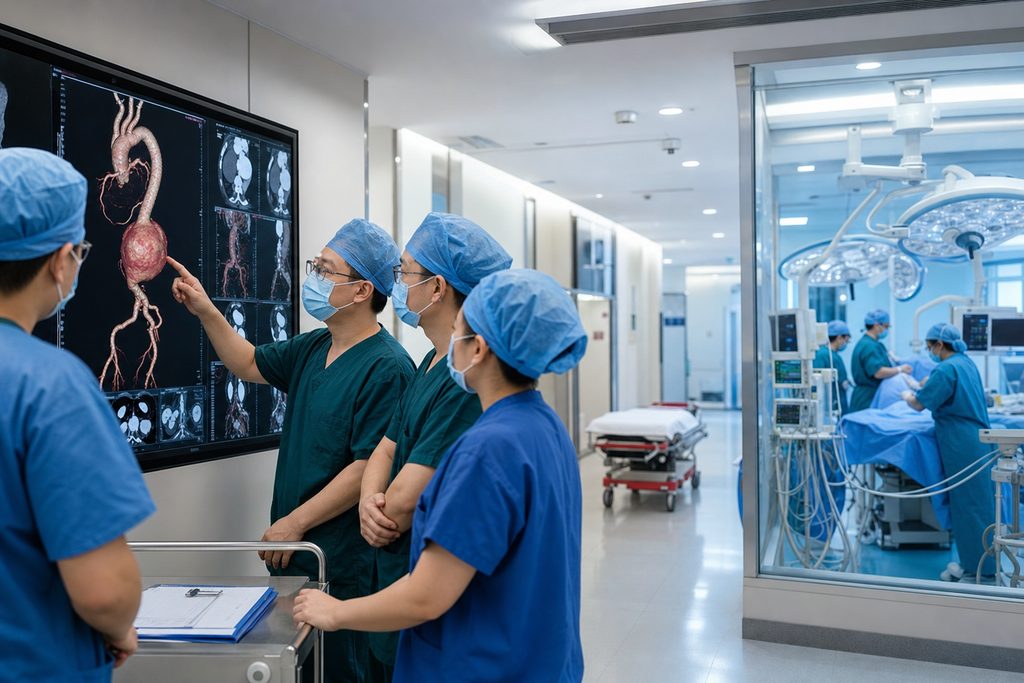
China’s top cardiac hospitals have invested heavily in hybrid operating suites that allow open surgery and endovascular intervention in the same room, during the same procedure. This matters enormously for aortic disease. A patient with a complex thoracoabdominal aneurysm might need a frozen elephant trunk procedure—a hybrid technique that combines open arch replacement with endovascular stent deployment in the descending aorta. Doing this in two stages, in two different rooms, increases risk. Doing it in one hybrid OR with real-time CT imaging cuts contrast dye exposure, reduces operative time, and improves accuracy.
These are not experimental techniques. They are standard of care at hospitals like Zhongshan Hospital Fudan University in Shanghai and West China Hospital in Chengdu. The equipment is the same Siemens and GE machinery you would find at the Cleveland Clinic or Charité in Berlin. The difference is utilization. Chinese hospitals run these suites from early morning until late evening. They do not sit idle. The teams are drilled. The workflows are optimized. Efficiency is not a buzzword—it is a survival mechanism in a system that serves enormous patient volumes.
What Emergency Aortic Repair in China Actually Looks Like
Let us talk about the scenario that scares everyone. A patient with a known aneurysm develops sudden chest or back pain. A CT scan in their home country confirms an acute aortic syndrome—a dissection, an intramural hematoma, or a contained rupture. They need surgery now. Not next week. Now.
Emergency aortic repair China coordination is not something you figure out from a Google search at 2 AM. It requires pre-existing relationships with hospital international departments, a clear understanding of which surgeons are on call, and the ability to transmit CT DICOM files instantly to a team that can read them and say “yes, we can take this case.” Our team has facilitated emergency transfers for acute Type A dissections. The sequence is brutal and fast: stabilize the patient, get them on a medical evacuation flight with a critical care team, transmit all imaging ahead, have the Chinese surgical team briefed and the hybrid OR prepped before the plane lands. This is not theoretical. It has been done. The survival rates for Type A dissection repair at China’s top centers are comparable to the best Western centers—operative mortality in the 5-10% range for patients who reach the OR alive, which is remarkable for a condition that kills 1-2% of patients per hour in the first 48 hours.
The cost for emergency repair runs higher than elective surgery. More blood products. Longer ICU stays. More uncertainty. But even an emergency total arch replacement in China will typically cost between $35,000 and $55,000—a fraction of the $200,000-plus bill that the same emergency would generate in a US hospital for an uninsured or underinsured patient.
What You Need to Know Before Going Alone
We need to be blunt here. Walking into a Chinese public hospital as a foreigner with no Mandarin skills and no local guide is a recipe for failure. Here is what awaits you:
- Visa Complexity: Medical treatment in China requires an S2 visa with a specific annotation for medical purposes. This is not a tourist visa. The supporting documentation must include an invitation letter from the hospital, proof of appointment, and medical records. Consulates scrutinize these applications. Errors mean delays. Delays mean a growing aneurysm. Accompanying family members also need S2 visas. This is not a process you want to navigate by trial and error.
- Registration and Payment Systems: Chinese public hospitals operate on a prepaid card system. You load money onto a hospital account, and every test, every consultation, every medication is deducted in real time. The kiosks are in Chinese. The queues are long. The payment windows close at specific times. International credit cards are often not accepted at public hospital counters. You need a Chinese bank card or a local payment app like WeChat Pay or Alipay, which require a Chinese bank account to set up as a foreigner. This is a solvable problem, but it is a problem.
- Informed Consent and Communication: You will be asked to sign consent forms in Chinese. Your surgeon will explain the procedure, the risks, the alternatives. If you do not speak Mandarin, you are relying on whatever ad-hoc translation the hospital can scrounge up—often a junior doctor with passable English who is already overworked. Nuance disappears. “There is a 3% risk of paraplegia” becomes “small chance of leg problem.” That is not acceptable for a decision this consequential.
How We Help You Navigate This
These barriers are real. They are also structural, not personal. They exist because the Chinese healthcare system was built to serve 1.4 billion Chinese citizens, not international patients. The international medical tourism infrastructure is layered on top, and it runs through specific channels—the hospital’s international department, the VIP wing, the designated coordinators who handle foreign cases.
Our process starts with your imaging and your clinical history. We translate your records into medical Chinese—not just language translation, but format translation, ensuring the documentation matches what Chinese surgeons expect to see. We then match your case to the right hospital. This is not a one-size-fits-all decision. A patient with a bicuspid aortic valve and an ascending aneurysm needs a surgeon who specializes in valve-sparing root replacement. A patient with Marfan syndrome and a thoracoabdominal aneurysm needs a center with deep experience in connective tissue disorders. We have a database of over 340 top-ranked hospitals across 37 cities. We know which teams excel at which procedures.
Once the hospital accepts your case, we handle the invitation letter for your S2 visa, coordinate your appointment schedule, and provide a bilingual medical companion who stays with you through every consultation, every pre-operative test, and the admission process. Your companion translates the surgeon’s explanation in real time, ensures you understand the consent form before you sign it, and handles all the payment logistics. After surgery, we coordinate your follow-up imaging and your surgeon’s clearance for travel. You return home with a translated discharge summary, operative report, and a clear plan for ongoing surveillance.
For patients exploring medical tourism aortic repair package China options, the financial structure is straightforward. We charge a coordination fee, and the hospital charges its standard international department rates. There are no hidden referral commissions inflating your surgical bill. The hospital’s invoice goes directly to you. Our fee is separate and transparent.
How Is Aortic Aneurysm Treated in China: The Surgical Approaches
How is aortic aneurysm treated in China? The answer depends entirely on location, morphology, and the patient’s underlying condition. Chinese surgeons deploy the full spectrum of modern aortic surgery, and the decision-making mirrors international guidelines from the American Heart Association and the European Society of Cardiology.
For ascending aortic aneurysms, open surgery remains the gold standard. The approach is through a median sternotomy. The aneurysm is resected and replaced with a Dacron graft. If the aortic valve is involved, the surgeon may perform a composite graft replacement (the Bentall procedure) or, if the valve leaflets are healthy, a valve-sparing root replacement (the David or Yacoub procedure). Chinese surgeons at major centers perform all of these. The David procedure, in particular, requires significant technical skill—reimplanting the native aortic valve inside a Dacron tube graft while maintaining perfect leaflet coaptation. High-volume Chinese centers report excellent long-term durability with this approach.
For descending thoracic aortic aneurysms, thoracic endovascular aortic repair (TEVAR) has largely replaced open surgery. A stent-graft is delivered through the femoral artery and deployed inside the aneurysm, excluding it from circulation. The procedure is minimally invasive. Recovery is measured in days, not weeks. Chinese hospitals were early adopters of TEVAR and have accumulated enormous experience. The cost for a TEVAR procedure in China, including the stent-graft device, typically ranges from $25,000 to $40,000—again, a fraction of Western prices for the same device from the same manufacturers.
For thoracoabdominal aneurysms involving both the chest and abdominal segments, the options are open repair, hybrid repair, or fenestrated/branched endovascular repair. These are the most complex aortic cases. They require a team that includes cardiac surgery, vascular surgery, perfusion, and interventional radiology. Only a handful of centers in any country truly excel at these. In China, Fuwai Hospital, Zhongshan Hospital, and West China Hospital are the reference centers. Our team can help you understand which approach is recommended for your specific anatomy and which center has the deepest experience with that technique.
Best Hospital for Aortic Aneurysm Surgery Beijing and Beyond
Patients often ask us to name the single best hospital for aortic aneurysm surgery Beijing or elsewhere. The honest answer is that there is no single best hospital—there is the best hospital for your specific aneurysm. That said, several centers stand out for their aortic programs.
Fuwai Hospital in Beijing is the giant. Its cardiovascular surgical volume is unmatched globally. The aortic surgery team handles everything from straightforward ascending replacements to complex redo arch surgeries. If you need a total arch replacement with frozen elephant trunk, Fuwai does hundreds per year. The hospital’s international department is experienced with foreign patients, and we work with them regularly.
Zhongshan Hospital Fudan University in Shanghai is another powerhouse. Its cardiovascular surgery department, led by some of China’s most respected surgeons, has particular expertise in valve-sparing root replacement and minimally invasive approaches. Shanghai is also a more accessible city for many international patients—better flight connections, more English-friendly infrastructure, and a large expatriate community.
For patients from the Middle East or South Asia, West China Hospital in Chengdu is an excellent option. It is one of China’s largest hospitals by bed count and has a strong cardiac surgery program. Chengdu’s cost of living is lower than Beijing or Shanghai, which reduces the overall financial burden of a prolonged recovery stay.
We have detailed profiles of all these hospitals on our site. You can explore our top-ranked hospital database to compare programs, or visit our specialty department rankings to see which hospitals rank highest for cardiac surgery and vascular surgery according to China’s Fudan Hospital Rankings.
Frequently Asked Questions
For an elective ascending aortic replacement with a Dacron graft, expect to pay between $18,000 and $30,000 at a top Chinese public hospital’s international department. The same procedure in the US typically costs $70,000 to $150,000. A TEVAR procedure in China runs $25,000 to $40,000, including the device. In the US, $50,000 to $80,000. These are cash prices. They vary by hospital, surgeon, implant type, and case complexity. They do not include our coordination fee, travel, or accommodation. But the savings are structural and real—driven by lower labor costs, higher surgical volumes, and a hospital payment system that does not inflate charges to negotiate with insurance companies.
It is possible, but it is significantly harder and slower than a planned elective admission. Emergency transfer requires rapid transmission of CT imaging, acceptance by a surgical team, and emergency visa processing. Without a coordinator who has existing relationships with hospital international departments, you will lose precious hours—or days—trying to get someone on the phone who can authorize an admission. If you have a known aneurysm that is approaching surgical thresholds, the safest strategy is to establish a relationship with a Chinese center before you need emergency surgery. We can facilitate a remote consultation and get your records into the system so that if an emergency arises, the team already knows your case.
What happens if there is a surgical complication?
Chinese hospitals do not outsource complications. The surgical team that operates on you manages your post-operative care, including any complications. Top cardiac centers have dedicated cardiovascular intensive care units staffed 24/7 by intensivists who manage bleeding, stroke, renal failure, and other major complications. The standard of ICU care at Fuwai or Zhongshan is
For more medical information and treatment options in China, visit chinamedservices.com (China Medical Services).
