Tattoo Removal in China: Laser Costs, Safety, and What to Expect
Can I Remove My Tattoo in China? A Practical Guide to Laser Tattoo Removal
According to a 2023 market analysis by Grand View Research, the global tattoo removal market surpassed $4.2 billion, driven largely by professional regret and career shifts. If you are among the millions reconsidering permanent ink, China offers a compelling option. The laser tattoo removal cost China clinics charge typically runs 60% to 80% below comparable treatments in the United States or Western Europe. But cost is only one part of the equation. Safety standards, technology, and the number of sessions required vary significantly depending on where you go.
Our team at China Medical Services regularly fields questions from international visitors curious about elective procedures like tattoo removal. The short answer is yes—you can absolutely remove a tattoo in China, and in many cases, you can access the same Q-switched and picosecond laser platforms used in top Western dermatology clinics. What differs is the regulatory landscape, the pricing structure, and the need for careful provider selection. Let’s walk through exactly how the process works, what you should budget, and where things can go wrong if you are not prepared.
How This Actually Works, Step by Step
The sequence from initial inquiry to completed tattoo removal in China is more straightforward than most people assume, but it is not instant. Here is the realistic path.
You begin by identifying a clinic. This can be a dermatology department within a major public hospital, a specialized aesthetic medicine center, or a private international clinic. Once you have selected a provider, you send photographs of the tattoo along with basic information: age of the ink, colors used, location on the body, and any prior removal attempts. A clinician reviews these materials and provides an initial assessment of how many sessions you might need and an estimated per-session price range.
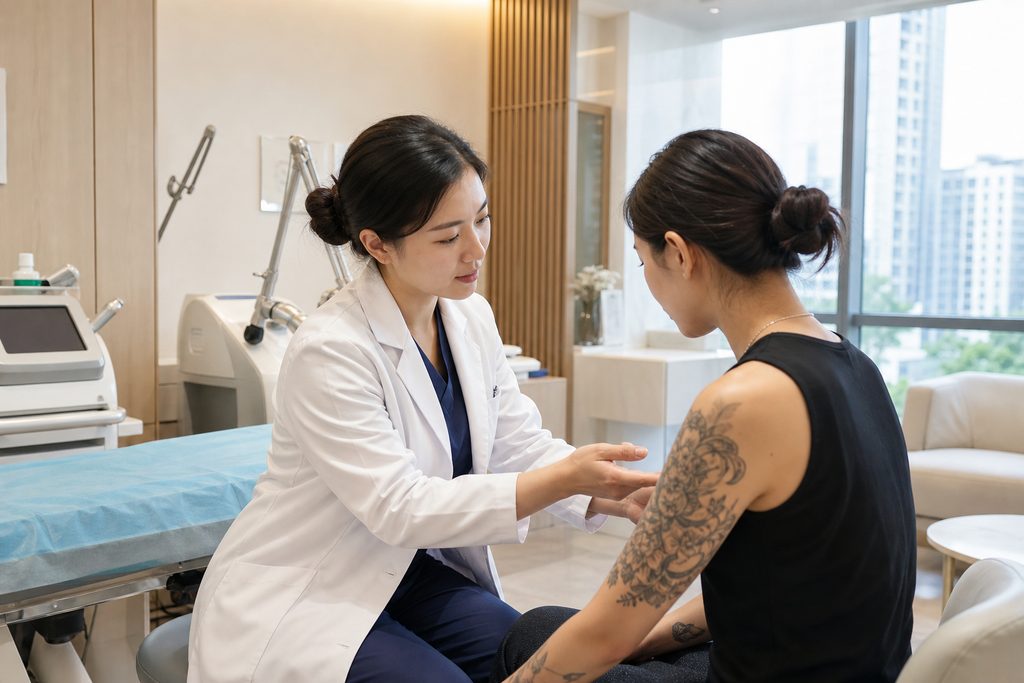
Then comes the in-person consultation. You cannot book a laser session remotely. Chinese regulations require a face-to-face evaluation before any laser procedure. The dermatologist examines the tattoo under magnification, assesses your skin type using the Fitzpatrick scale, and confirms the laser wavelength appropriate for your ink colors. This consultation typically costs between $30 and $80, and some clinics deduct it from your first session if you proceed.
After the consultation, you schedule your first laser session. Most clinics require a patch test on a small area of the tattoo at least 48 hours before the full treatment. This checks for adverse reactions and gives you a preview of how your skin responds. Assuming the patch test goes well, the full session follows. Each session lasts 15 to 45 minutes depending on tattoo size. You leave with aftercare instructions, and the next session is scheduled 6 to 8 weeks later.
Payment happens per session in almost all cases. You prepay at the clinic’s cashier or through a hospital payment app. Insurance does not cover tattoo removal, so you will pay out of pocket. The clinic gives you a receipt, which you can use for your own records.
What Laser Tattoo Removal Actually Costs in China
Let’s address the headline number directly. The laser tattoo removal cost China providers quote typically falls between $50 and $300 per session for a tattoo the size of a credit card. That range reflects differences in technology, clinic tier, and city. In Shanghai, a city with intense competition among aesthetic clinics, you will find prices at the lower end of that spectrum. The tattoo removal price Shanghai clinics advertise often starts around $40 to $80 per session for small, single-color tattoos using Q-switched lasers. Picosecond lasers—which remove ink faster and with fewer sessions—cost more, generally $150 to $300 per session.
For comparison, the same picosecond treatment in the United States averages $400 to $600 per session. In London, expect £200 to £350. Over a full course of six to ten sessions, the savings in China can easily reach $2,000 to $4,000, even after factoring in travel costs for some patients.
| Treatment Type | China (USD/session) | United States (USD/session) | United Kingdom (USD/session) |
|---|---|---|---|
| Q-switched laser, small tattoo | $40–$100 | $150–$300 | $120–$250 |
| Q-switched laser, medium tattoo | $80–$180 | $250–$450 | $200–$400 |
| Picosecond laser, small tattoo | $150–$250 | $400–$600 | $300–$500 |
| Picosecond laser, medium tattoo | $200–$300 | $500–$800 | $400–$650 |
These figures vary by hospital and case complexity. A large, multi-color back piece will cost substantially more per session than a small black ankle tattoo. Some clinics offer package pricing for a set number of sessions, which can reduce the per-session cost by 10% to 20%. Always ask whether the quoted price includes numbing cream, aftercare products, and follow-up visits.
Is Tattoo Removal Safe in China? What the Evidence Says
Is tattoo removal safe in China is a fair question, and the honest answer depends entirely on where you go. China’s top-tier dermatology departments—those ranked among the top 10 nationally in the Fudan University hospital rankings—operate at international standards. Many of these departments use the same laser platforms you would find at a dermatology clinic in Seoul, Singapore, or New York: PicoSure, PicoWay, Q-switched Nd:YAG, and alexandrite lasers.
The risk lies in unregulated aesthetic studios. China has thousands of small beauty salons that offer laser tattoo removal at extremely low prices—sometimes $10 to $20 per session. These establishments frequently operate without proper medical licensing. Their staff may lack formal dermatology training. The lasers they use are often older, poorly maintained devices that deliver inconsistent energy output. That inconsistency leads to two problems: ineffective treatment that requires more sessions overall, and a higher risk of scarring, hypopigmentation, or hyperpigmentation.
A 2022 review published in the Journal of Cosmetic Dermatology found that adverse events from laser tattoo removal were strongly correlated with operator training and device quality, not with geography. In other words, a properly trained dermatologist using a well-maintained picosecond laser in Beijing is no less safe than one in Boston. The key is verifying credentials before you book.
How Many Sessions Will You Need? The Reality of Tattoo Removal in China
The question how many sessions to remove tattoo in China search engines surface constantly has no universal answer. The number depends on five factors: ink color, ink density, tattoo age, tattoo location, and your immune response. Black ink responds fastest. Dark blue and dark green follow. Lighter colors like yellow, white, and pastel shades are the hardest to remove and sometimes require alternative approaches like surgical excision or dermabrasion.
As a general guide, a professional black-ink tattoo on the upper arm will typically require 6 to 10 sessions with a picosecond laser, spaced 6 to 8 weeks apart. That means a total timeline of 9 to 15 months from first session to final result. Older, faded tattoos sometimes clear in 4 to 6 sessions. Dense, multi-color tattoos can require 10 to 15 sessions or more. Anyone promising complete removal in fewer than 4 sessions is either using an aggressive energy setting that risks scarring, or they are not being honest with you.
Chinese clinics tend to be more conservative with energy settings than some Western providers. This is partly cultural—Chinese patients place a high value on avoiding post-inflammatory hyperpigmentation, which is more visible on Asian skin tones. The practical effect for you is that your sessions may feel less aggressive, and you may need one or two more sessions than you would in the United States. The trade-off is a lower risk of permanent skin texture changes.
Choosing a Provider: What to Look For in Beijing and Shanghai
If you are searching for the best tattoo removal clinic Beijing has to offer, you will find two distinct tiers. The first tier is hospital-affiliated dermatology and laser medicine departments. Hospitals like Peking Union Medical College Hospital and Beijing Friendship Hospital operate dedicated laser centers with board-certified dermatologists. These departments prioritize medical safety over marketing. You will get a thorough pre-treatment evaluation, standardized aftercare protocols, and honest assessments of what laser can and cannot do. The downside is that English-speaking staff may be limited, and appointment wait times for top dermatologists can stretch to several weeks.
The second tier is private international clinics. United Family Healthcare, Raffles Medical, and ParkwayHealth all operate facilities in Beijing and Shanghai with English-speaking staff and JCI accreditation. These clinics cater specifically to international patients. You will pay more—often 30% to 50% above public hospital prices—but you get seamless communication, direct insurance billing for any related medical services, and a more familiar Western clinical experience.
Shanghai offers a third option: specialized aesthetic medicine centers. The city has become a hub for cosmetic dermatology in Asia, and clinics like Shanghai Ninth People’s Hospital’s laser center are internationally recognized for their volume and expertise. The tattoo removal price Shanghai clinics charge at these specialized centers is often lower than in Beijing, reflecting the competitive density of providers in the city.
When evaluating any provider, ask three questions. First, what laser platform do they use, and when was it last serviced? Second, who performs the procedure—a board-certified dermatologist or a technician? Third, what is their protocol for adverse reactions, and do they have a physician on call if something goes wrong? A clinic that answers these questions clearly and without hesitation is one you can trust.
A Realistic Timeline
Most people underestimate the total time commitment for tattoo removal. Here is what a typical timeline looks like from initial research to final result.
| Stage | Duration | What Happens |
|---|---|---|
| Research and clinic selection | 1–3 weeks | You compare providers, send photos, receive initial assessments and price quotes. |
| Visa processing (if traveling specifically for treatment) | 2–4 weeks | You apply for an S2 visa with supporting documents from the clinic confirming your appointment. |
| In-person consultation and patch test | 1–2 days | Dermatologist evaluates your tattoo, confirms treatment plan, performs patch test. |
| First laser session | Day 3–5 of visit | Full treatment session, typically 15–45 minutes. |
| Healing period | 2–4 weeks | Skin heals, ink particles are cleared by your immune system. |
| Subsequent sessions | Every 6–8 weeks | Repeat treatments until desired clearance is achieved. |
| Total timeline for full removal | 9–18 months | Varies by tattoo characteristics and number of sessions required. |
If you are traveling from overseas specifically for tattoo removal, you face a practical constraint. You cannot complete a full removal course in a single trip. The 6-to-8-week healing interval between sessions means you will need multiple visits over a year or more. Some patients choose to have their first session in China, then continue treatment with a local provider at home. Others plan their sessions around business trips or holidays. Our team helps patients coordinate this logistics puzzle, but the medical reality of spaced sessions is non-negotiable.
What Can Go Wrong—and What Happens Then
Laser tattoo removal is generally safe, but complications do occur. The most common is hyperpigmentation—darkening of the treated skin. This happens more frequently on darker skin tones and with aggressive energy settings. In most cases, hyperpigmentation fades over 3 to 6 months with topical treatment. Hypopigmentation, or lightening of the skin, is less common but more persistent. It occurs when the laser damages melanocytes, the cells that produce skin pigment. Full repigmentation is not always possible.
Scarring is the complication patients fear most. It happens when the laser energy is too high, when the skin is not properly cooled during treatment, or when the patient picks at scabs during healing. Atrophic scars—depressions in the skin—are the most difficult to treat. Hypertrophic scars, which are raised, can sometimes be improved with steroid injections or silicone gel.
What happens if you experience a complication at a Chinese clinic? Reputable hospital-affiliated departments have protocols in place. They will document the adverse event, provide treatment at no additional cost, and follow up until the issue resolves. Private international clinics typically offer the most robust aftercare, including English-speaking follow-up consultations. If you are treated at a low-cost aesthetic studio and something goes wrong, your recourse is limited. These establishments often lack the medical infrastructure to manage complications, and pursuing legal action as a foreign visitor is difficult.
Common Mistakes International Patients Make
The biggest mistake is prioritizing price over provider quality. Yes, China is cheap. But a $15 laser session at an unlicensed salon that leaves you with a scar is not a bargain—it is a permanent problem you will pay far more to fix. The second mistake is underestimating the time commitment. Tattoo removal is a marathon, not a sprint. Patients who expect a quick fix often abandon treatment halfway through, leaving them with a partially faded tattoo that looks worse than the original.
A third mistake involves aftercare. Sun exposure is the enemy of healing skin. If you are visiting China and plan to sightsee after your session, you must keep the treated area covered and apply high-SPF sunscreen. Many patients forget this and end up with hyperpigmentation that could have been avoided. Finally, some patients assume that all lasers are the same. They are not. A Q-switched laser works well for black ink but struggles with certain colors. A picosecond laser is faster and more effective for multi-color tattoos but costs more. The right choice depends on your specific tattoo, and that decision should come from a dermatologist, not a price list.
Practical Considerations: Visas, Payment, and Language
If you are traveling to China specifically for tattoo removal, you will need a visa. The correct category is the S2 visa, which covers short-term private affairs including medical treatment. You will need supporting documents from the clinic confirming your appointment. Our team can guide you through this process, but approval is always at the discretion of the Chinese embassy or consulate. Plan for 2 to 4 weeks of visa processing time.
Payment is straightforward. Clinics accept cash, Chinese mobile payment platforms like WeChat Pay and Alipay, and major international credit cards at private facilities. Public hospitals may not accept foreign credit cards, so bring cash or set up a Chinese payment app. Insurance does not cover elective cosmetic procedures, so expect to pay everything out of pocket.
Language is the most significant barrier at public hospitals. Top dermatology departments may have some English-speaking staff, but you cannot count on it. At private international clinics, English is standard. If you choose a public hospital for cost savings, a bilingual medical companion can bridge the gap—handling registration, translating during consultations, and ensuring you understand aftercare instructions. This is one of the core services we provide through our patient coordination program.
For those considering combining tattoo removal with other medical care, China’s top hospitals offer comprehensive dermatology services. You can explore ranked departments through our specialty hospital directory, which covers 45 specialties including dermatology and laser medicine. Many international patients also explore private international hospitals for their English-speaking convenience and JCI accreditation.
Can You Book Tattoo Removal as Part of Medical Tourism in China?
The phrase book tattoo removal China medical tourism reflects a growing trend. China has become a destination for elective medical procedures, driven by cost advantages and the concentration of high-volume clinical expertise. Tattoo removal fits naturally into a broader medical tourism itinerary. You might combine laser sessions with a comprehensive health screening, dental work, or traditional Chinese medicine consultations.
But there is a structural difference between tattoo removal and other medical tourism procedures. A surgical procedure like orthopedic surgery happens once, and you recover. Tattoo removal requires repeat visits over many months. This
Frequently Asked Questions
Yes. The hospitals used for international patients are JCI-accredited and follow the same international safety standards as top hospitals in the US and Europe. Surgical teams perform high volumes of procedures — often more than their Western counterparts — which studies show leads to better outcomes.
Costs vary by procedure and hospital, but international patients typically save 40-80% compared to US prices — even when factoring in travel and accommodation. A consultation with our team will give you an exact, all-inclusive quote with no hidden fees.
Send us your existing medical reports to get started. We handle everything from hospital selection and appointment scheduling to visa assistance and post-operative recovery planning. Your medical records are reviewed by the specialist before you even book a flight.
For more medical information and treatment options in China, visit chinamedservices.com (China Medical Services).
