Tattoo Removal: How Many Laser Sessions Do You Really Need?
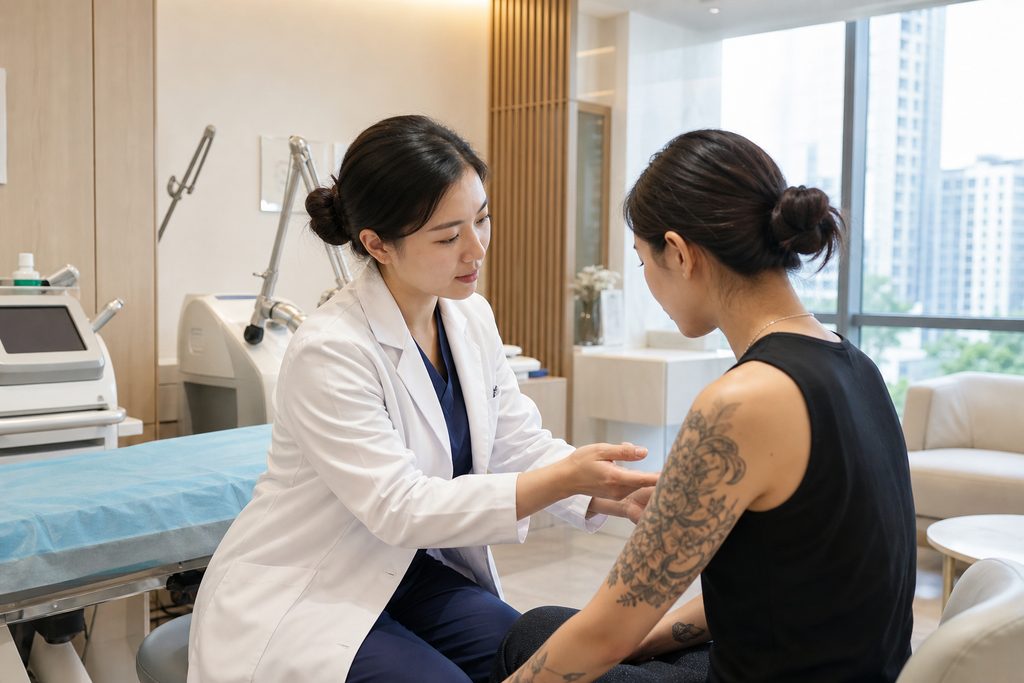
Tattoo Removal: How Many Laser Sessions Do You Really Need?
Most tattoos require 6 to 12 laser sessions for significant fading, spaced 6 to 8 weeks apart. That means a realistic timeline runs 12 to 18 months. The honest answer depends on ink color, depth, age, and your immune system. Tattoo removal cost China often comes in 60–80% below Western pricing, which changes the math on whether full clearance is worth pursuing.
While patients in the United States commonly pay $200–$500 per session at dermatology clinics, equivalent treatments at public hospital laser departments in Shanghai or Beijing typically run $50–$150 per session. That price gap reshapes the entire decision. But session count stays stubbornly biological — no clinic can change how your skin clears fragmented ink particles.
China Medical Services works with international patients who want to combine tattoo removal with other medical care or who simply want access to high-volume hospital laser departments at local prices. We are not a clinic. We coordinate access and translation. This article gives you the real numbers.
How Many Laser Sessions to Remove a Tattoo on Average: The Short Answer
The clinical consensus lands at 8 to 10 sessions on average for professionally applied black ink. Older amateur tattoos sometimes clear in 4 to 6. Dense, colorful, professionally saturated work can demand 12 or more. A 2021 review in Lasers in Surgery and Medicine found that complete clearance rates after 10 sessions ranged from 47% to 75% depending on tattoo characteristics. Complete removal is not guaranteed for every tattoo.
Here is the complication nobody mentions in the first consultation: your body does the actual removal. The laser only shatters ink into particles small enough for your lymphatic system to carry away. That process takes weeks. Rushing sessions does not speed clearance — it increases scarring risk. The 6-to-8-week spacing is a biological constraint, not a clinic scheduling preference.
Black ink responds fastest because it absorbs all laser wavelengths. Green and blue are stubborn. Yellow and white are the hardest — sometimes they never fully clear and may paradoxically darken with certain wavelengths. Red and orange fall in the middle. A tattoo on your ankle or wrist will always need more sessions than the same design on your upper arm, because circulation drives particle clearance.
Who This Is Right For — and Who It Isn’t
Laser tattoo removal works well for a specific profile. You should have realistic expectations and healthy skin. Here is who typically gets good results:
- People with black or dark blue ink on the upper body or torso
- Older tattoos (5+ years) where the immune system has already started clearing some pigment
- Non-smokers with normal immune function and no keloid scarring history
- Patients willing to wait 12–18 months for full clearance
But some people should not pursue laser removal, or should at least pause before booking:
- Anyone with a history of keloid or hypertrophic scarring
- People on isotretinoin (Accutane) — you need to be off it for 6 months minimum
- Those with active skin infections, psoriasis, or vitiligo in the tattoo area
- Anyone expecting a guarantee of 100% removal — no ethical provider will promise that
- People who cannot commit to the full course of sessions and aftercare
If you fall into the second list, staying home with your tattoo is genuinely the better choice. A half-finished removal job often looks worse than the original design. Faded, patchy ink reads as a mistake. Full removal or nothing, in most cases.
The Options, Compared
You have more choices than just “laser or keep it.” The table below compares what actually exists in 2026, including the option of traveling to China for treatment.
| Option | Cost per Session | Typical Sessions | Total Range | Key Limitation |
|---|---|---|---|---|
| Q-switched laser (US/EU clinic) | $200–$500 | 8–12 | $1,600–$6,000 | High cost, long wait times in some regions |
| Pico laser (US/EU clinic) | $300–$600 | 6–10 | $1,800–$6,000 | Premium pricing, variable results vs. Q-switched |
| Q-switched laser (China, public hospital) | $50–$150 | 8–12 | $400–$1,800 | Language barrier, need for coordination |
| Pico laser (China, private international clinic) | $150–$300 | 6–10 | $900–$3,000 | Higher than public hospital, still below Western rates |
| Surgical excision | $500–$2,000 total | 1 | $500–$2,000 | Only for small tattoos, leaves a scar |
| Dermabrasion / chemical peel | $100–$300 | 3–5 | $300–$1,500 | Higher scarring risk, less predictable |
Which column fits you? If you live in a major Western city and have one small black tattoo, paying local rates is fine — the travel cost to China erases the savings. But if you have a large, multi-color piece requiring 10+ sessions, the math shifts hard. Ten sessions at $400 each in New York is $4,000. The same protocol at a Shanghai public hospital runs $600–$1,200 total. Even with a flight and two weeks of accommodation, you can come out ahead if you bundle treatment into a longer stay.
For patients already planning medical travel to China — for orthopedics, cardiology, or preventive screening — adding tattoo removal sessions to the same trip makes the economics even stronger. Our database of 340+ top-ranked hospitals includes public institutions with high-volume dermatology and laser departments that handle thousands of cosmetic cases monthly.
Can a Tattoo Be Fully Removed? The Biology Behind the Answer
Can a tattoo be fully removed? Sometimes. The honest answer is that complete clearance is achievable for roughly 60–75% of tattoos, partial clearance for another 20–25%, and minimal improvement for 5–10%. The variables are mostly fixed before you ever book a session.
Ink composition matters more than anything else. Older inks had heavy metals and large pigment particles — ironically, those often respond well to Q-switched lasers because the particles shatter predictably. Modern organic inks use smaller, brighter particles that can be more resistant. White ink contains titanium dioxide, which can oxidize and darken permanently under laser exposure. That is why any honest clinician will test a small spot before treating a white-heavy tattoo.
Depth matters too. A tattoo applied by a professional goes into the dermis at a consistent 1–2mm depth. An amateur tattoo often sits shallower, which makes it easier to treat. But a heavy-handed professional may have deposited ink at 3mm or deeper, below the reach of standard laser settings. Deeper ink means more sessions or, in some cases, incomplete clearance no matter how many sessions you do.
Location drives clearance speed. Tattoos on the chest, upper back, and upper arms clear faster because blood flow is high. Ankles, wrists, and fingers are slow. The same black tattoo that clears in 6 sessions on your shoulder might need 12 on your ankle. That is not a clinic deficiency — it is circulation physiology.
Your immune system is the final variable. The laser does not remove ink. It breaks it into fragments your macrophages can engulf and drain through lymphatics. A healthy, active person clears particles faster than someone with chronic inflammation or a sedentary lifestyle. Smoking slows clearance measurably. So does poor sleep. These are factors no laser can override.
Laser Tattoo Removal Price Shanghai and Other China Cost Realities
Laser tattoo removal price Shanghai runs $50–$120 per session at public hospital dermatology departments for a palm-sized area. Private international clinics in Shanghai charge $150–$300 for the same area with English-speaking staff and Western-style service. Beijing pricing is nearly identical. Chengdu, Hangzhou, and Wuhan run 10–20% lower.
What drives the variance? Three things. First, the laser platform — pico lasers (Picoway, Picosure) cost clinics more to buy and maintain, so they charge more. Second, the clinic tier — public hospital departments are subsidized and high-volume; private clinics offer comfort and English support at a premium. Third, tattoo size — most clinics price by square centimeter or by “palm-sized area” increments. A 3×3cm tattoo might cost $40 per session in Chengdu. A full sleeve might run $250–$400 per session even at public rates.
Here is what the price typically includes: the laser session itself, post-treatment cooling, and basic antibiotic ointment. What it does not include: numbing cream (often $10–$20 extra per session), any follow-up visits for complications, and travel costs if you are coming from abroad. Some clinics bundle packages — 5 sessions paid upfront at a 10–15% discount. Others charge per session only. We generally advise against large upfront packages unless you have already tested your skin’s response to one session.
For international patients, the real cost is not the laser. It is the logistics. Flights, accommodation, and time away from work. A single 15-minute laser session does not justify a trip to China. But a 2-week stay that includes 1–2 laser sessions, a full health screening, dental work, and a few days of recovery can deliver savings that dwarf the airfare. That is where we see patients get the most value.
Practical Considerations: Documentation, Visas, and Follow-Up After Returning Home
If you are considering tattoo removal cost China as an international patient, the logistics are manageable but specific. You need to plan them before you book a flight.
Medical records. Bring clear photos of the tattoo from multiple angles, its age, and any previous laser treatments. Chinese dermatologists will want to know what laser was used before, because switching platforms mid-course can affect results. If you have had a bad reaction to a previous session, document it.
Visa category. For medical treatment in China, the applicable short-stay visa is the S2 visa, endorsed for medical treatment or private affairs. It is not the M visa — that is for commercial and trade activities only. Supporting documents from the hospital or clinic you plan to visit help your application. Requirements vary by embassy, so check the latest rules before applying. We provide document guidance but never guarantee approval.
Payment. Public hospitals in China require prepayment, usually via cash, Chinese debit card, or Alipay/WeChat Pay. International credit cards are often not accepted at public hospital counters. Private international clinics accept Visa and Mastercard. Bring multiple payment options. Insurance rarely covers cosmetic tattoo removal — expect to pay out of pocket.
Language. Public hospital dermatology departments in Shanghai and Beijing see thousands of patients daily. Front desk staff may not speak English. That is not a criticism — it is a fact of high-volume public healthcare. A bilingual medical companion does the translation, registration, queue management, and payment handling. Our service runs from $300 per day for an 8-hour day, including a companion who handles all hospital navigation.
Follow-up after returning home. You will need sessions every 6–8 weeks. If you do one session in China and then return home, you can continue with a local provider — but the laser platform should be the same type. Q-switched to pico mid-course is not ideal. Some patients plan two China trips per year and do 2–3 sessions per trip, spaced 6 weeks apart. That works if you can stay 2–3 weeks. Others do one session in China to test the clinic, then decide whether to return for the full course.
Frequently Asked Questions
Eight to ten sessions for a typical black ink tattoo on the upper body. Colorful, dense, or poorly located tattoos can require 12 or more. Some amateur tattoos clear in 4–6 sessions. No clinic can guarantee a specific number before seeing your skin respond to the first treatment.
Public hospital laser departments in China charge $50–$150 per session for a palm-sized area, versus $200–$500 in the US. A full 10-session course might cost $600–$1,500 in China versus $2,000–$5,000 in the US. Travel costs narrow the gap for small tattoos. Large, multi-session work is where the savings become substantial.
Full clearance without scarring depends on the ink, your skin type, and the laser operator. With proper settings and adequate spacing between sessions, most patients achieve significant fading with minimal textural change. But some tattoos leave ghosting — a faint shadow of the original design — even after 12 sessions. White and yellow inks can darken permanently. Scarring risk rises with aggressive settings or sessions spaced too closely.
The best clinic depends on your priorities. Public hospital dermatology departments in Shanghai and Beijing offer the lowest prices and high clinical volume, but limited English support. Private international clinics like United Family or Jiahui offer English-speaking staff and Western-style care at 2–3 times the public rate. If you want the best tattoo removal clinic Beijing has to offer, we typically recommend starting with a public hospital dermatology department and using a bilingual companion to bridge the language gap. The clinical quality is excellent; the savings are real.
You can coordinate a treatment plan before you arrive, but ethical clinics will not sell you a full package sight unseen. The standard approach is a remote consultation with photos, then one test session in person, then a decision on the remaining sessions. Our team can coordinate the initial consultation and first session, but we never promise specific clinical outcomes or guarantee that a particular specialist will be available on a particular date. We coordinate; the hospital decides.
Your Next Step
The session count question has a real answer: 6 to 12 sessions, 6 to 8 weeks apart, with no guarantee of 100% clearance. The cost question has a real answer too: tattoo removal cost China runs 60–80% below Western pricing, which can make the difference between pursuing removal and living with the ink. If you are considering treatment in China, China Medical Services coordinates hospital access, bilingual companions, and logistics for international patients. We are not a clinic and we do not provide medical advice. We connect you with qualified dermatology departments and make the process navigable. When you are ready to explore options, request a free consultation and tell us about your tattoo — size, colors, age, and where you are traveling from. We will map out realistic options and costs. No pressure, no obligation.
For more medical information and treatment options in China, visit chinamedservices.com (China Medical Services).
