CT vs MRI: What Is the Difference Between CT and MRI Scans?
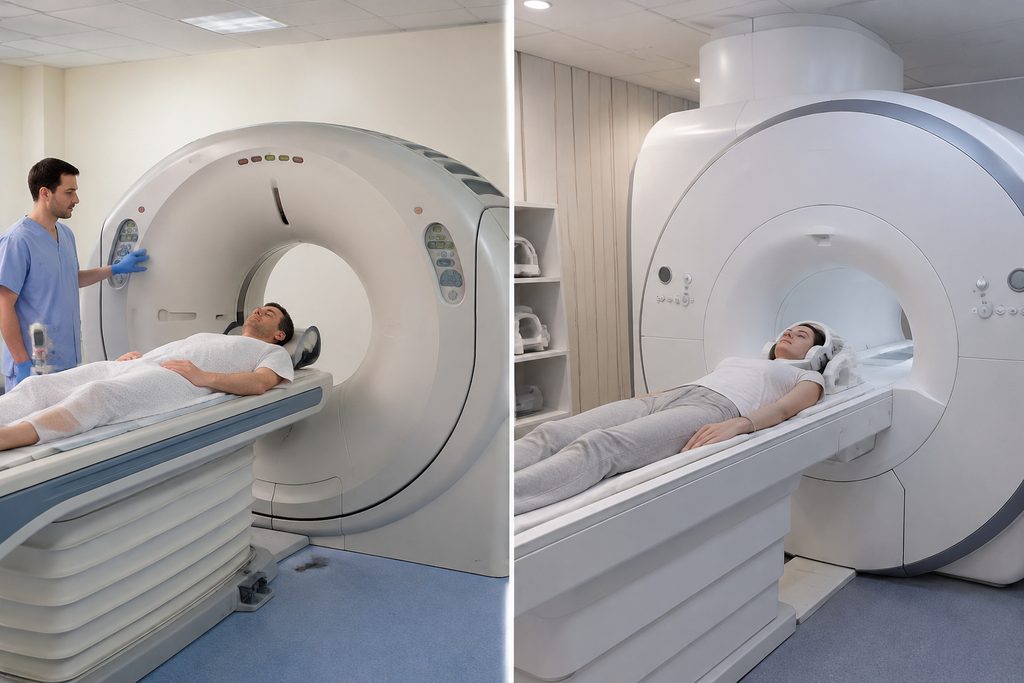
Have you ever stared at a referral form and wondered whether your doctor ordered the right scan? The words “CT” and “MRI” get tossed around constantly, yet few patients understand what separates them. If you are weighing a ct scan vs mri cost China decision, or simply need to know which machine does what, this guide clears up the confusion without the jargon.
CT and MRI are not competing versions of the same test. They are fundamentally different tools that answer different questions. A CT scan uses X-rays to build cross-sectional images in seconds. An MRI uses magnetic fields and radio waves to map soft tissue in extraordinary detail over 20 to 60 minutes. Choosing the wrong one wastes money and delays diagnosis. Choosing the right one gets you answers faster.
Key Takeaways
- CT scans cost roughly $80 to $250 in Chinese public hospitals; MRI scans run $150 to $600 depending on body part and hospital tier.
- MRI is generally superior for brain, spinal cord, ligament, and soft tissue imaging; CT excels at bone, acute bleeding, lung, and trauma assessment.
- Private MRI prices in Beijing and Shanghai range from $300 to $800, often with same-week appointments and English reports.
- Neither scan is universally “better” — the right choice depends entirely on what your doctor suspects, not on which machine is newer.
The Problem: Imaging Confusion Costs Patients Time and Money
Around 80 million CT scans are performed annually in the United States alone, according to data from the Organization for Economic Cooperation and Development. MRI volumes in OECD countries exceed 90 million per year. Yet a 2023 survey published in the Journal of the American College of Radiology found that nearly 40% of patients could not correctly explain the difference between the two modalities. That confusion has real financial consequences.
Patients in the US, UK, and Australia routinely wait 4 to 8 weeks for a non-urgent MRI. Some pay $1,200 to $3,000 out of pocket for a single scan. Others get a CT when an MRI was clinically indicated, or vice versa, because the ordering physician defaulted to whatever was fastest. The result: repeat imaging, delayed treatment, and bills that could have been avoided.
China operates a different model. Top-tier public hospitals in Beijing, Shanghai, and Guangzhou run imaging departments at extraordinary volume. A single large hospital may complete over 1,000 CT and MRI studies per day. That throughput translates into shorter queues and dramatically lower prices — without sacrificing image quality on modern equipment.
Why Understanding CT vs MRI Matters Before You Book Anything
Here is the core distinction in plain terms. CT is about structure and speed. MRI is about tissue characterization and detail. If you arrive at an emergency room with a suspected stroke or internal bleeding, a CT scan happens within minutes because it rules out hemorrhage fast. If you have chronic back pain and your doctor needs to see whether a disc is pressing on a nerve root, an MRI is the standard because X-ray-based CT cannot resolve soft tissue that well.
How CT Actually Works — And Where It Excels
A CT scanner rotates an X-ray tube around your body. Detectors measure how much radiation passes through different tissues. A computer reconstructs hundreds of thin slices into a 3D volume. The entire scan takes 30 seconds to 5 minutes. Radiation dose for a head CT is roughly 2 millisieverts — about what you would absorb from 8 months of natural background radiation. A chest CT delivers closer to 7 millisieverts. These numbers matter if you need repeated scans.
CT is the first-line tool for acute trauma, suspected fractures, lung nodules, kidney stones, and calcified lesions. It is also the default for cancer staging when you need to check the chest, abdomen, and pelvis quickly. Modern dual-source CT scanners in Chinese hospitals complete a full-body scan in under 10 seconds.
How MRI Actually Works — And Where It Wins
MRI does not use radiation at all. A powerful magnet — typically 1.5 or 3 Tesla in modern Chinese hospitals — aligns hydrogen atoms in your body. Radiofrequency pulses knock those atoms out of alignment. When they realign, they emit signals that a computer translates into images. Different tissues emit different signals, which is why MRI can distinguish gray matter from white matter, tumor from healthy tissue, and a torn meniscus from an intact one.
MRI is the gold standard for brain tumors, multiple sclerosis, spinal cord compression, ligament tears, rotator cuff injuries, and liver lesion characterization. The trade-off is time and claustrophobia. A brain MRI with contrast takes 30 to 45 minutes. Some patients need sedation. If you have a pacemaker, certain aneurysm clips, or metal fragments in your eye, MRI may be contraindicated entirely.
Is MRI Better Than CT Scan for Brain Imaging?
The short answer: usually, yes — but not always. The longer answer depends on the clinical question. For evaluating a suspected brain tumor, demyelinating disease, or subtle structural abnormality, MRI provides dramatically more information. A 2021 meta-analysis in The Lancet Neurology reported that MRI detects roughly 30% more clinically relevant findings than CT in non-acute neurological presentations.
But in the first hours after a stroke or head trauma, CT remains the standard. It is faster, widely available, and excellent at ruling out acute hemorrhage. Many Chinese emergency departments complete a head CT within 15 minutes of patient arrival. If the CT is negative but symptoms persist, an MRI typically follows within 24 to 48 hours. So the question is mri better than ct scan for brain imaging depends on urgency: acute bleed detection favors CT, everything else favors MRI.
What Is the Difference Between CT and MRI for Back Pain?
Back pain imaging is where patients most often get the wrong test. CT is excellent for bony anatomy — vertebral fractures, spinal stenosis caused by bone spurs, and post-surgical hardware evaluation. But the most common causes of radiating back pain involve soft tissue: herniated discs, nerve root compression, and ligament hypertrophy. MRI sees all of that clearly. CT does not.
If your doctor suspects a compression fracture after a fall, a CT may be the right first step. If you have had sciatica for 6 weeks and conservative treatment has failed, an MRI is the standard before any surgical decision. Asking what is the difference between ct and mri for back pain before you book a scan can save you from an unnecessary repeat study. Many patients in China get both — a CT for bone detail and an MRI for disc and nerve assessment — when the clinical picture is complex.
CT Scan vs MRI Cost China: Real Numbers for 2025
Cost is where the comparison gets concrete. The ct scan vs mri cost China gap is narrower than in Western countries, but it still exists. Public hospital imaging fees in China are regulated by provincial pricing bureaus, which keeps base prices low. Private international hospitals charge more but offer English reports, shorter waits, and direct insurance billing.
| Scan Type | Public Hospital (Beijing/Shanghai) | Private International Hospital | Typical US Cash Price |
|---|---|---|---|
| Head CT (no contrast) | $80 – $150 | $250 – $400 | $500 – $1,200 |
| Chest CT (no contrast) | $100 – $200 | $300 – $500 | $600 – $1,500 |
| Brain MRI (no contrast) | $150 – $350 | $400 – $800 | $1,200 – $3,000 |
| Lumbar Spine MRI | $180 – $400 | $450 – $800 | $1,500 – $3,500 |
| Full-Body MRI (screening) | Rarely offered | $1,500 – $2,500 | $2,500 – $6,000 |
Prices vary by hospital tier, contrast agent use, and whether you go through the public outpatient system or a hospital’s international department. The international department at a top public hospital typically charges 1.5 to 2 times the standard public rate — still far below US cash prices. If you want to know how much does an mri cost in Shanghai, the answer for a standard brain MRI at a public hospital is roughly $200 to $350, while a private mri scan price Beijing at a JCI-accredited facility runs $400 to $800.
Private MRI Scan Price Beijing: What You Actually Get
Private imaging centers in Beijing — including United Family, Raffles, and Parkway-affiliated facilities — market convenience as much as clinical quality. A private mri scan price Beijing of $500 typically includes same-week scheduling, an English-speaking radiographer, a same-day written English report, and a CD or cloud link with your DICOM images. That package matters if you plan to share results with a specialist back home.
Public hospitals deliver the same image quality on the same 3T Siemens or GE scanners. But you will need a Chinese-speaking companion to navigate registration, payment, and report pickup. That is where services like ours become relevant — a bilingual medical companion handles the logistics while you focus on the scan itself. For more on how to access top-tier Chinese hospitals as a foreigner, see our guide to Fudan-ranked hospitals across 37 cities.
Book MRI Scan China Medical Tourism: A Practical Timeline
If you are considering book mri scan China medical tourism as part of a broader health evaluation, the process is more straightforward than most patients expect. Here is what a realistic timeline looks like.
Day 1–3: Remote Evaluation and Scan Selection
You send your existing medical records — referral notes, prior imaging reports, blood work — to a Chinese hospital’s international department or to a coordination team like ours. A radiologist or relevant specialist reviews the materials and confirms which scan is clinically appropriate. This step prevents you from flying to China for the wrong test. A written second opinion on your imaging needs costs from $300 to $500.
Day 4–7: Appointment Confirmation and Travel Planning
Once the scan type is confirmed, the hospital schedules your appointment. Public hospital imaging slots often open within 3 to 5 days. Private facilities can usually accommodate you within 24 to 48 hours. You apply for an S2 visa with supporting documents from the hospital. Flight and hotel booking happen in parallel.
Day 8–10: Scan Day and Report Delivery
The scan itself takes 30 to 60 minutes for MRI, under 10 minutes for CT. You receive the written report within 24 hours at most public hospitals, often the same day at private centers. Your images are provided digitally. If you need a follow-up consultation with a specialist, that can be arranged for the same week.
Who Should NOT Fly to China for Imaging Alone
China is not the right choice for every imaging scenario. If you need an emergency scan — acute stroke symptoms, severe trauma, suspected internal bleeding — go to the nearest emergency department wherever you are. Do not get on a plane. Imaging tourism makes sense for non-urgent diagnostics, second-opinion imaging, screening programs, and pre-surgical planning.
Patients with unstable cardiovascular conditions, advanced pregnancy, or severe claustrophobia should discuss travel risks with their home physician before booking anything. MRI contrast agents containing gadolinium require normal kidney function — you will need a recent creatinine test. If you have any implanted device, confirm MRI compatibility with the manufacturer before scheduling.
Practical Considerations: Documentation, Payment, and Follow-Up
Bring every prior imaging study you have — not just the reports, but the actual image files on CD or cloud storage. Chinese radiologists routinely compare new scans against old ones, and having the originals improves diagnostic accuracy. Bring a list of all medications, allergies, and prior surgeries translated into English. If you have a known contrast allergy, state it clearly before the scan.
Payment at public hospitals is typically required in advance via cash, UnionPay, WeChat Pay, or Alipay. International credit cards are not always accepted at public hospital counters, though international departments usually process Visa and Mastercard. Private international hospitals accept major credit cards and often bill insurers directly. For an overview of JCI-accredited private options, see our private international hospital directory.
After you return home, your Chinese imaging report should be reviewed by a physician licensed in your home country. Chinese radiologists are highly trained, but treatment decisions should always involve a doctor who knows your full history. The report is a data point, not a prescription.
If you are planning multiple scans — for example, a brain MRI plus a chest CT — schedule them at the same hospital on the same day. You will pay a single registration fee and receive one consolidated report. This is standard practice at Chinese public hospitals and saves both time and money.
Frequently Asked Questions
Public hospitals in China generally require a physician’s order before scheduling an MRI or CT. Private international hospitals are more flexible — many offer self-referred screening scans, including full-body MRI, without a prior consultation. If you do not have a referral, a video consultation with a Chinese specialist can generate the appropriate order remotely. That consultation typically costs $100 to $300.
The two cities are nearly identical in public hospital pricing. A brain MRI without contrast runs $150 to $350 in both Shanghai and Beijing public facilities. Private international hospital pricing is also comparable, ranging from $400 to $800 in either city. Shanghai has a slightly higher concentration of JCI-accredited private centers, which can mean more same-week appointment availability.
If your imaging reveals a significant finding, the hospital’s international department will typically arrange an urgent follow-up consultation with the relevant specialist — often the same day or next day. You then have options: continue treatment in China, return home with a complete diagnostic package, or pursue a remote second opinion. No one is obligated to treat in China. The imaging report and DICOM files belong to you and travel with you.
A single CT scan carries a very small incremental cancer risk — on the order of 1 in 2,000 for a typical adult chest CT, according to the US National Cancer Institute. That risk is far outweighed by the diagnostic benefit when the scan is clinically indicated. The key is avoiding unnecessary repeat scans. MRI involves no ionizing radiation at all, which is why it is preferred for children, pregnant patients, and anyone needing frequent follow-up imaging.
At a private international hospital in Beijing or Shanghai, you can often schedule an MRI within 48 hours of first contact. Public hospital international departments typically book within 3 to 7 days. Compare that to the 4 to 8 week wait common in the UK’s NHS or Canadian provincial systems. The bottleneck is usually your travel logistics, not the hospital’s schedule.
Your Next Step
CT and MRI answer different questions. Knowing which one your case requires — before you spend money or board a plane — is the single most valuable step. We help international patients navigate Chinese imaging centers: identifying the right scan, coordinating appointments, and providing bilingual support on the ground. We are not a hospital and we do not diagnose conditions. If you are weighing a ct scan vs mri cost China decision and want clarity on pricing and process, request a free consultation and we will help you map out the practical path forward.
Imaging should give you answers, not more questions. Start with the right scan, in the right place, at a price that makes sense.
For more medical information and treatment options in China, visit chinamedservices.com (China Medical Services).
