Bone Density Scan: Who Needs One and What It Costs in China
Key Takeaways
- A DEXA bone density scan takes 10–20 minutes, uses roughly one-tenth the radiation of a chest X-ray, and is the only test that can diagnose osteoporosis before a fracture happens.
- Bone density scan cost China runs from about $40 to $150 at top-tier public and private hospitals — often 70–90% less than the $250–$450 common in the US and Western Europe.
- Osteoporosis affects approximately 1 in 3 women and 1 in 5 men over age 50 worldwide, yet most people only discover it after breaking a bone.
- Not everyone needs a scan at 40. But if you are a postmenopausal woman, a man over 70, or anyone with a fracture after 50, the question is not whether to test — it is where and how soon.
What a Bone Density Scan Actually Measures
A bone density scan — formally called a DEXA or DXA scan (dual-energy X-ray absorptiometry) — measures how much calcium and other minerals are packed into a given segment of bone. The machine sends two low-dose X-ray beams through your hip, spine, or forearm. Dense bone blocks more of the beam. The difference between the two beams lets the scanner calculate bone mineral density with remarkable precision.
The result comes back as a T-score. A T-score of -1.0 or above is normal. Between -1.0 and -2.5 signals osteopenia — bone that is thinner than expected but not yet osteoporotic. A T-score of -2.5 or lower means osteoporosis. Each drop of one full point in T-score roughly doubles fracture risk.
That number matters more than most people realize. Hip fractures carry a one-year mortality rate of 20–30% in older adults. Half of those who survive a hip fracture never regain their previous level of independence. A DEXA scan is the only test that can catch the problem before the fall happens.
The Problem: Osteoporosis Is Silent Until It Is Catastrophic
The International Osteoporosis Foundation estimates that osteoporosis causes more than 8.9 million fractures worldwide every year — one every three seconds. In the United States alone, roughly 10 million people have osteoporosis and another 44 million have low bone mass. The economic burden exceeds $19 billion annually in direct medical costs.
Here is the uncomfortable part: most people with osteoporosis do not know they have it. There are no symptoms. No aching bones, no warning twinges. The first sign is often a wrist fracture from a minor fall, or a vertebral compression fracture that shows up as sudden back pain — or no pain at all, just a gradual loss of height.
By the time a fragility fracture occurs, the disease is advanced. Treatment becomes harder, recovery slower, and the risk of a second fracture rises sharply. Within one year of a first vertebral fracture, the risk of another is up to 20%. A scan before the first break changes the entire trajectory.
Why Getting a Bone Density Scan in China Makes Practical Sense
Bone Density Scan Cost China: A Structural Price Gap
The most immediate reason international patients consider testing in China is price. A DEXA scan at a typical US hospital or imaging center costs between $250 and $450 without insurance. In the UK, private clinics charge £150–£250. In Australia, expect AUD $120–$200.
Bone density scan cost China is different. At top-tier public hospitals in Shanghai, Beijing, and Guangzhou, the scan itself typically runs from $40 to $80. At private international hospitals like United Family or Jiahui, where English-speaking staff and direct insurance billing are standard, prices range from $80 to $150. That is the same machine, the same T-score output, the same clinical utility — at a fraction of Western pricing.
The reason is structural, not a compromise in quality. Chinese hospitals operate at enormous scale. A single large public hospital may run 500–1,000 DEXA scans per month. Labor costs for radiographers and technicians are lower. Equipment is the same GE Lunar or Hologic systems used in Western hospitals. Volume plus lower overhead equals lower per-scan cost.
Equipment and Protocol Parity
DEXA technology is standardized globally. The scanners used in China’s top-ranked hospitals are the same models found in Mayo Clinic or Charité Berlin. Calibration follows the same International Society for Clinical Densitometry (ISCD) guidelines. The T-score reference ranges are identical worldwide, based on young-adult peak bone mass from the NHANES database. A T-score of -2.6 in Shanghai means the same thing as a T-score of -2.6 in San Francisco.
Our database includes 340+ top-ranked hospitals across 37 Chinese cities, each screened against Fudan University’s national hospital rankings and JCI accreditation where applicable. For bone densitometry, that means access to endocrinology and orthopedic departments that routinely interpret DEXA results alongside full metabolic workups — calcium, vitamin D, parathyroid hormone, and bone turnover markers.
Same-Day Results and Integrated Follow-Up
In most Western systems, a DEXA scan requires a separate referral, a separate appointment, and a separate results visit. The process can stretch across weeks. In Chinese hospitals, the scan, the radiologist’s read, and a consultation with an endocrinologist or orthopedic specialist often happen in a single morning. That compressed timeline matters when you are traveling for care and need answers before you fly home.
Who Actually Needs a Bone Density Scan
The short answer: more people than currently get one. The longer answer depends on age, sex, medical history, and medication exposure.
The International Society for Clinical Densitometry and the US Preventive Services Task Force agree on the core criteria. Women aged 65 and older should have routine screening. Men aged 70 and older should too. Postmenopausal women under 65 and men aged 50–69 should be screened if they have any risk factor — a prior fracture after age 50, a parent with hip fracture, low body weight, smoking, heavy alcohol use, rheumatoid arthritis, or long-term corticosteroid use.
One group often missed: people on medications that quietly erode bone. Proton pump inhibitors for acid reflux, SSRIs for depression, aromatase inhibitors for breast cancer, androgen deprivation therapy for prostate cancer, and long-term prednisone all accelerate bone loss. If you have taken any of these for more than a year, a baseline DEXA is reasonable even if you are younger than the standard screening age.
And the question “how often should I get a dexa scan” deserves a direct answer. For someone with normal bone density and no new risk factors, every 2–5 years is adequate. For someone with osteopenia, every 2 years. For someone on osteoporosis treatment, most guidelines recommend a follow-up scan 1–2 years after starting therapy to assess response. More frequent testing adds cost without adding clinical value — bone changes slowly.
What the Procedure Feels Like — and What It Does Not
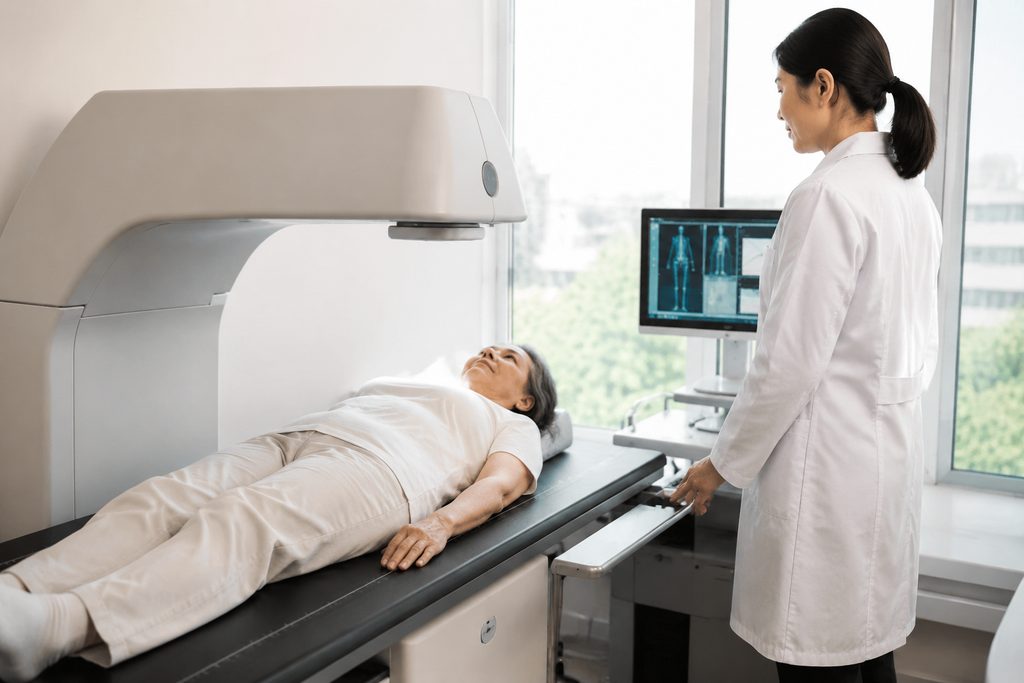
People often ask, “is bone density test painful?” The answer is no. Not mildly uncomfortable. Not briefly unpleasant. Simply no. You lie on a padded table, fully clothed, while a mechanical arm passes over your body. You feel nothing. There is no tunnel, no injection, no contrast dye. The scan of your hip and lower spine takes 10–20 minutes. A forearm scan takes less than 5.
The radiation exposure is minimal. A DEXA scan delivers about 0.001 mSv — roughly one-tenth of a chest X-ray, or the amount of background radiation you absorb during a 3-hour flight. For context, a transatlantic round trip exposes you to about 0.08 mSv. The scan is safe enough that it can be repeated on schedule without cumulative risk concerns.
You should wear loose clothing without metal zippers or buttons. You will be asked to remove jewelry and any clothing with metallic fasteners over the scan area. If you have had a barium study, a CT with contrast, or a nuclear medicine scan in the past week, tell the technologist — those can interfere with results, and the scan may need to be rescheduled.
Bone Density Scan Package for Foreigners in China: What to Expect
Many international patients search for a bone density scan package for foreigners China, and the good news is that the process is more accessible than most assume. The challenge is not the scan itself — it is navigation. Chinese public hospitals are vast. A single hospital campus can see 10,000+ outpatient visits per day. Signage is primarily in Chinese. Registration, payment, and queueing systems assume local knowledge.
That is where a bilingual medical companion changes the experience. From $300 per day, a companion handles registration, escorts you to the correct department, translates your conversation with the radiologist and consulting physician, and ensures your results are explained clearly before you leave. The scan itself might cost $50. The certainty that you understood everything and got the right test — that is what the companion fee buys.
At private international hospitals, the process is simpler from the start. English-speaking staff, Western-style appointment systems, and direct billing to international insurers are standard. A bone density scan package at these facilities often bundles the DEXA with a physician consultation, a basic metabolic panel, and a written summary in English. Expect to pay $120–$250 for that bundle, depending on the hospital and the depth of the consultation.
| Cost Item | China (Top Public Hospital) | China (Private International Hospital) | United States (Typical) |
|---|---|---|---|
| DEXA scan (hip + spine) | $40–$80 | $80–$150 | $250–$450 |
| Specialist consultation | $20–$50 | $100–$250 | $200–$400 |
| Bilingual companion (full day) | From $300/day | N/A (English staff on site) | N/A |
| Total estimated cost | $360–$430 with companion | $180–$400 | $450–$850 |
Prices vary by hospital and case complexity. The figures above reflect 2025–2026 published rates and our own coordination experience, not binding quotes.
Best Hospital for Bone Density Scan Beijing: Where to Start
If you are searching for the best hospital for bone density scan Beijing, the honest answer is that the scan itself is a commodity. The machine is the same. The difference lies in what happens before and after.
Peking Union Medical College Hospital (PUMCH) consistently ranks among China’s top institutions for endocrinology and rheumatology — the two specialties most relevant to bone health. Its international medical services department offers English-speaking coordination and same-day specialist consultations. For a scan plus metabolic interpretation, PUMCH is a strong starting point.
In Shanghai, Ruijin Hospital and Zhongshan Hospital Fudan University both run high-volume endocrinology departments with dedicated osteoporosis clinics. Ruijin’s endocrinology program is among the largest in China, handling complex metabolic bone disease cases daily. For a purely English-language experience, Jiahui and United Family Shanghai offer DEXA with Western-trained physicians and no language barrier at all.
Osteoporosis screening Shanghai price at public hospitals typically runs $40–$70 for the scan alone. At private facilities, expect $100–$180 including consultation. Both are dramatically below US private-pay rates.
For a broader view of options, our department rankings across 45 specialties include endocrinology and orthopedics listings that can help you shortlist hospitals by clinical reputation rather than convenience alone.
Practical Considerations: Documentation, Payment, and Follow-Up
If you decide to get a bone density scan in China, a few logistics deserve attention before you book a flight.
Visa. Medical treatment and short-term private medical visits fall under the S2 visa category, not the M visa. The S2 requires supporting documentation from the hospital — typically an appointment confirmation or a letter from the international medical department. Processing times vary by consulate, so apply at least 4–6 weeks before your intended travel date.
Payment. Chinese public hospitals generally require upfront payment. International credit cards are accepted at major hospital payment counters, but daily transaction limits and foreign-card processing fees can apply. Bring a backup payment method. Private international hospitals are more flexible, with direct billing arrangements for many major insurers including Cigna, Aetna, and Allianz.
Insurance reimbursement. If your home insurance covers preventive screening, request an itemized invoice and a copy of the radiologist’s report in English. Public hospitals may issue reports in Chinese only unless you specifically request an English version through the international department. Private hospitals routinely provide bilingual reports.
Records to bring. Any prior DEXA results, even from years ago, help establish a trend. Bring a list of current medications, especially corticosteroids, anticonvulsants, or cancer therapies. Bring your passport. If you have had recent fractures, bring those imaging reports too.
Interpreting results. The T-score is the headline number, but a good clinician also looks at the Z-score (comparing you to age-matched peers) and the absolute bone mineral density in grams per square centimeter. A Z-score below -2.0 in a younger adult suggests secondary causes of bone loss that need investigation — malabsorption, hyperparathyroidism, vitamin D deficiency, or medication effects. Do not accept a T-score alone as a complete workup.
Frequently Asked Questions
No. The test is completely painless. You lie still on a padded table for 10–20 minutes while the scanner arm moves above you. There is no injection, no tunnel, and no physical sensation during the scan.
If your baseline is normal and you have no new risk factors, every 2–5 years is sufficient. With osteopenia, every 2 years is standard. If you are on osteoporosis medication, most guidelines recommend a follow-up scan 1–2 years after starting treatment to assess whether the medication is working.
At top-tier public hospitals, the scan itself costs $40–$80. At private international hospitals with English-speaking staff, expect $80–$150 for the scan, or $180–$400 when bundled with a physician consultation. A bilingual companion adds from $300 per day if you need navigation support at a public hospital.
Yes. DEXA scans are available on a walk-in basis at many large Chinese hospitals, though a physician order is typically required for the scan to be performed. At private international hospitals, you can book the scan directly, often with same-week availability. No overnight stay is needed.
In almost all cases, yes. DEXA results are standardized worldwide. Request an English-language report and a copy of the raw T-score and Z-score data. Your home physician can interpret those numbers exactly as they would a local result. If any question arises, a written second opinion from the scanning hospital’s endocrinology department can be arranged for $300–$500.
Your Next Step
A bone density scan is one of the simplest, cheapest, and most consequential preventive tests available — and bone density scan cost China makes it accessible to people who might otherwise skip screening due to price. If you are over 50 with any risk factor, or over 65 regardless, the evidence strongly favors getting tested sooner rather than later. We are China Medical Services, a coordination team that connects international patients with top-ranked Chinese hospitals and bilingual support on the ground. We do not diagnose or treat — we help you find the right hospital, book the scan, and understand your results. When you are ready to explore your options, start with a free consultation and we will help you map out the logistics.
For more medical information and treatment options in China, visit chinamedservices.com (China Medical Services).
